Summary
Documentary reconstruction of the Paduan string workshop “Antonio Priuli detto Romanin”, founded in 1613 and active until the early twentieth century. Through notarial deeds, business notifications and contemporary sources the author follows the transfer of the firm across generations and family branches, from the Priuli to the Callegari, up to its sale in 1902 to Giuseppe Drezza of Verona and the definitive closure of the Paduan stringmaking tradition, confirmed by the business notice of 1911. The research bears witness to the European reach of Padua’s string trade and to the long continuity of a highly specialised craft.
Key takeaways
- The “Antonio Priuli detto Romanin” workshop was founded in 1613 by Antonio Romanin and operated continuously until 1902.
- Giovan Battista Priuli’s strings were already sold in the main European capitals during the 18th century, according to Napoleone Pietrucci’s testimony.
- A Paduan proclamation of 1785 granted the firm, together with that of Antonio Bagattella, priority access to gut supplies for fifteen years, with a 5-ducat fine for anyone selling guts outside the Province.
- From 1806 the business was run by the Callegari family, documented by a dense series of notarial deeds between 1849 and 1891.
- In 1902 Antonio Callegari sold the business to Giuseppe Drezza of Verona, undertaking never again to practise or teach the stringmaker’s craft.
- Traces of the old workshop survive in the Paduan place-name “Alla Corderia” and in the local diffusion of the Callegari surname.
City of Padua: chronology of the “Priuli detto Romanin” string workshop (our research, 2002–2004)
Origins and the proclamation of 1785
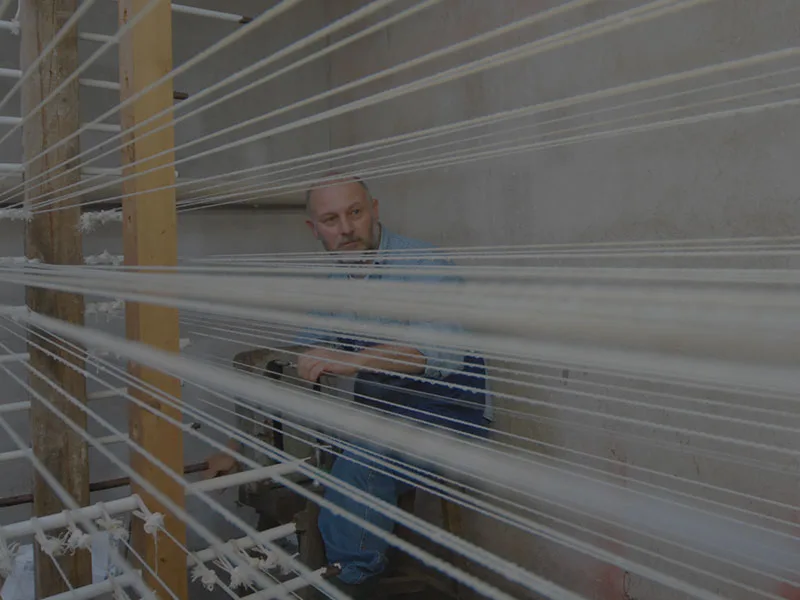
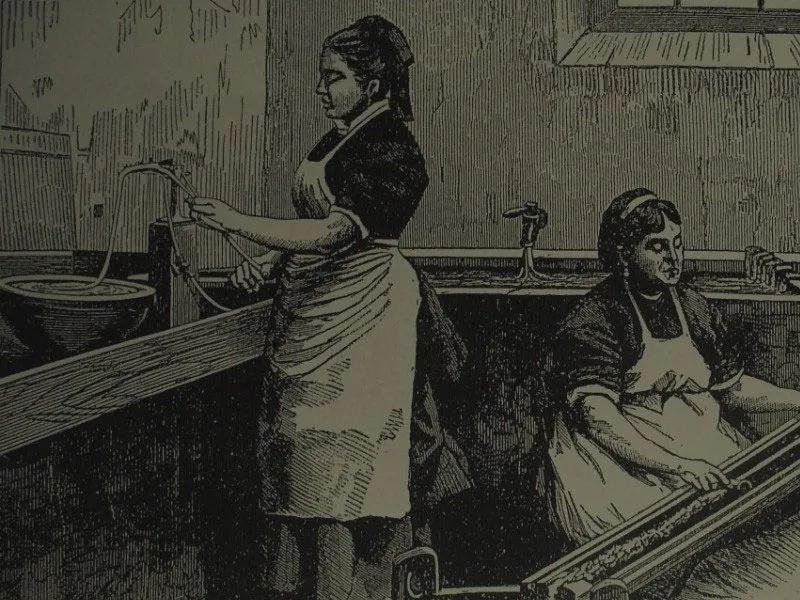
1) The workshop was founded in 1613 by Antonio Romanin and was succeeded by Antonio Priuli. The firm was therefore named “Antonio Priuli detto Romanin” (Antonio Priuli so-called Romanin) and remained so through hereditary transfer until it became property of the Callegari family.
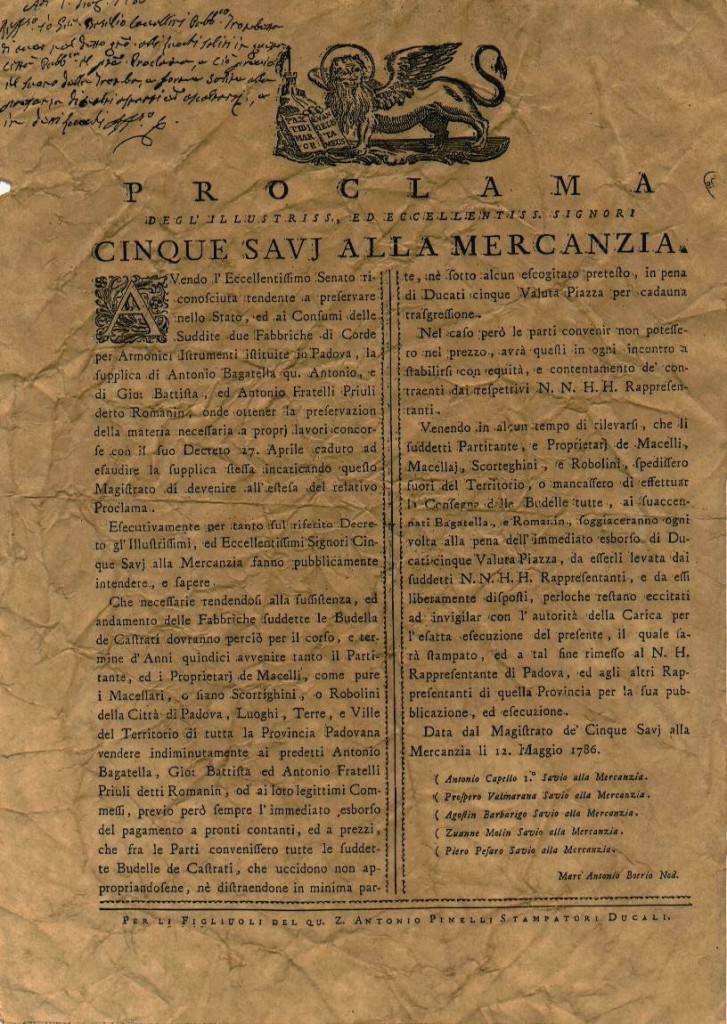
2) The Factory of strings for harmonic instruments of the brothers Giovan Battista and Antonio Priuli so-called Romanin, and that of “Antonio Bagattella, son of the late (quondam) Antonio”, are cited in a Paduan proclamation of 1785: “…in order to obtain the preservation of the material necessary to their work…”. They were granted it for 15 years on the condition of immediate payment. Anyone failing to deliver guts and selling them outside the Province of Padua had to pay a 5-ducat fine.
About Giovan Battista, Napoleone Pietrucci in Biografia degli artisti padovani, printed in Padua in 1858, wrote that: “In Padua he ran a most renowned factory of harmonic strings whose trade was always supported in the leading capitals of Europe”.
Giovan Battista died in 1818 aged 77. It is very interesting to learn that the trade in strings made by the Priuli had reached a European dimension.
The Callegari management (1849–1891)
3) Notification of 10 October 1849. We learn that the firm is run by Antonio Callegari, living at Via San Carlo 3368, that he has been in the business for 43 years (i.e. since 1806) and that two workers are employed.
4) Notice of business of 26 June 1869 to the Padua Chamber of Commerce: the owners of the company are the Callegari sisters Angela, Teresa and Domenica. The petitioner is alone and signs “Angela del fu Antonio” (Angela of the late Antonio). Production was still located in Padua, at Via San Carlo 3368. The header of the form (later crossed out) named “Callegari Girolamo del fu Antonio” as owner of the firm.
5) Notarial deed of 7 July 1877. Angela, Domenica and Teresa Callegari appear on one side, with Maria and Girolamo Callegari as counterparts: it is stated that Maria and Girolamo are siblings of the late Antonio. The deed specifies that the 1869 document had added Girolamo’s name as owner “by a simple error”.
6) Notarial deed of 12 August 1881: Girolamo, Angela and Teresa — “brother and sisters of the late Antonio” — are declared the sole representatives and owners of the firm “Antonio Priuli detto Romanin” and Co. The sisters are stated to be unmarried. Nothing more is known about the sister Domenica.
7) Notarial deed of 6 October 1891. It is specified that Girolamo Callegari, who died in 1883, was a co-owner, and Teresa Callegari notifies that, due to advanced age, she intends to leave the activity in favour of Girolamo’s children, of whom only Antonio is of age. The others — Emilia, Marianna, Angelina and Maria — are still minors in the custody of their mother Anna Santamaria. Nothing is said about Teresa’s sister Angela; she may have died.
8) Notarial deed of 22 October 1891: Teresa Callegari declares her withdrawal from the activity.
9) Activity notification of 31 October 1891: Antonio of the late Girolamo, and then Marianna, Emilia, Angelina and Maria, are declared owners of the firm. The workshop is still at Via San Carlo 3368.
The sale to Giuseppe Drezza and the end of the business (1902–1911)
10) Notarial deed of 30 January 1902: Antonio sells the business to Giuseppe Drezza of Verona, together with the right of gut supply destined to the Romanin firm, and undertakes not to continue the trade of stringmaker nor to teach or advise others on the craft.
11) Notarial deed of 13 March 1902: Antonio’s sisters Emilia, Angelina and Maria, co-owners of the firm, together with the elder sister Teresa, sister of the late Girolamo, request that the Romanin firm be removed from the commercial registers.
12) Notice of Business in his own name, 5 June 1911: Antonio Callegari of the late Girolamo, resident in Via Zabarella, on 30 January 1902 had opened a business of sale of musical instruments in Via Cassa di Risparmio: the glorious Paduan stringmaking tradition comes to a definitive end.
Surviving traces in Padua
In Padua, until a few years ago, there was a café called “Alla Corderia”, located in Via Zabarella near the intersection with Via San Francesco. In the 2002 telephone directory there are, in the city of Padua alone, 5 entries with the surname “Callegari”.