Summary
Essay by Daniela Gaidano devoted to today’s manufacturing of gut strings, published in the Italian magazine «Orfeo» in its Guida all’acquisto (buyer’s guide) column and reproduced here in facsimile across nine pages (pp. 20–28). The author compares the old stringmaker’s cycle — alkaline potash baths, degreasing, cutting, twisting on the frame and bleaching in sulphur dioxide fumes — with the modern one, which starts from gut already degreased and cut into ribbons but follows the string through to its metal winding. The core of the text is twist, the parameter that more than any other determines a string’s type and quality, and its gradual disappearance with industrialisation; then come the mechanical centreless grinding introduced in the late nineteenth century, oiling, varnishes and wound strings. A list of documented historical gauges and a bibliography of sources from the sixteenth century onwards close the article.
Key takeaways
- The modern stringmaker receives gut that is already degreased, cut into ribbons and salted, whereas the old one carried out selection, alkaline baths, bleaching and sulphuring in house: what changed is where the work begins, not only the technology.
- Twist is probably the single most relevant factor in determining a string’s type and quality: low twist at an angle of 30° or less, medium around 45°, high at 60° or above.
- High twist was not abandoned as an aesthetic choice but «by extinction»: it demands manual sensitivity and constant attention, incompatible with the serial production already established in Germany by the late nineteenth century.
- Mechanical grinding, spread from 1885 thanks to Pirazzi, makes the string cylindrical and measurable in hundredths of a millimetre (Pirastro’s PM system) instead of by the count of guts; used to excess, however, it removes the surface fibres and leaves the string brittle and moisture-sensitive.
- Oiling only protects if it is total immersion — at least eight days for thin strings — using first-pressing olive oil, as little viscous as possible and with acidity below 0.3 per cent: merely wetting the surface deadens the string and is strongly discouraged.
- The documented historical gauges from the mid-eighteenth to the late nineteenth century (violin, cello, guitar, bass viol) give the player a concrete basis for checking a stringing scheme instead of relying on the brand name alone.
by Daniela Gaidano
Editorial note: the article is reproduced here in facsimile, as the nine original pages of the magazine «Orfeo» (pp. 20–28); the author’s text is in Italian only, as no English version was ever published. The section introductions, tables and transcribed bibliography below are editorial and are meant to make the document navigable and searchable.
Buyer’s guide: how to choose a gut string and recognise its quality
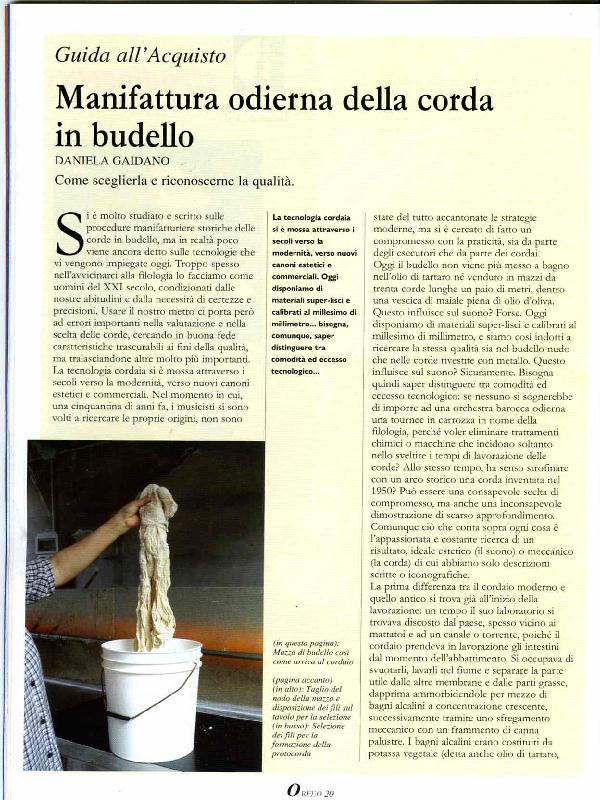
The author starts from an observation: much has been written about historical manufacturing procedures, but little is known about the technologies actually in use today. In approaching historically informed practice, players tend to use gauge as the only yardstick, seeking certainty and precision in good faith while neglecting other equally important parameters. Over the centuries stringmaking moved towards new aesthetic and commercial canons: today materials are super-smooth and calibrated to the thousandth of a millimetre, and one must learn to tell convenience from technological excess.
The old and the modern stringmaker: alkaline baths, degreasing and bleaching (pp. 20–22)
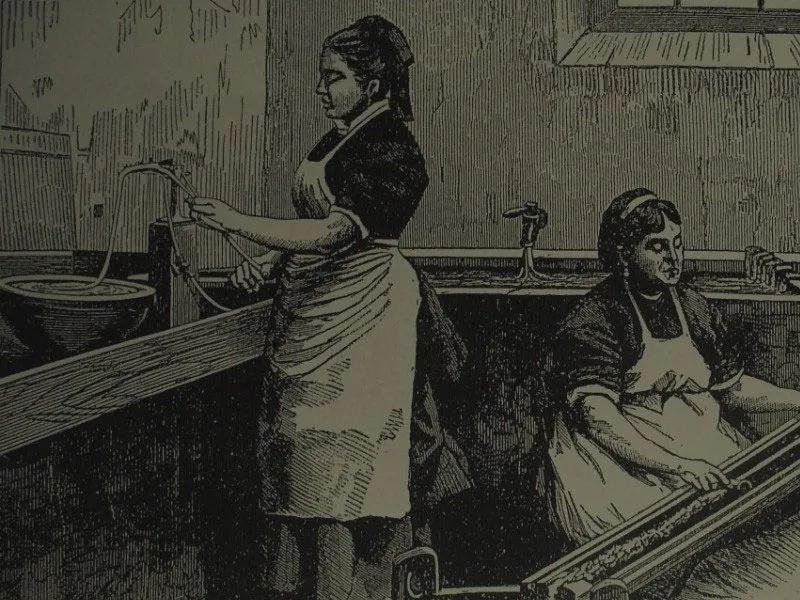
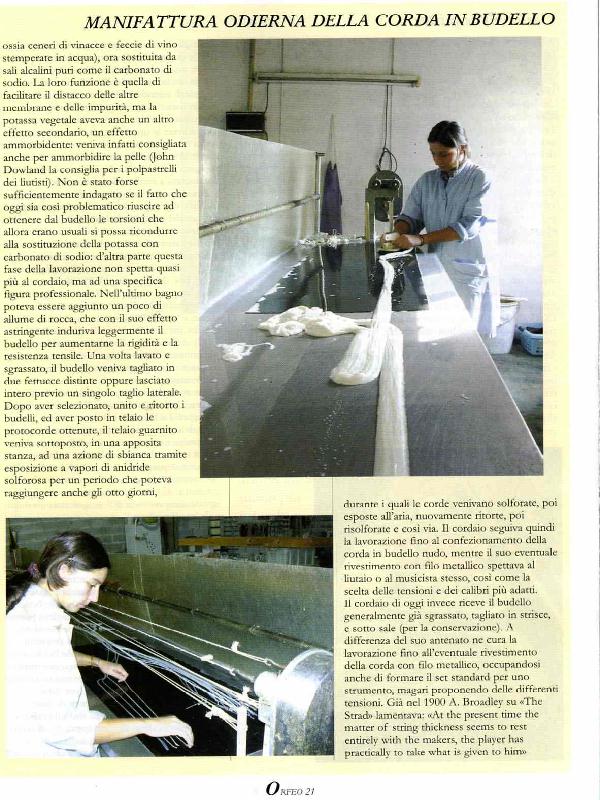
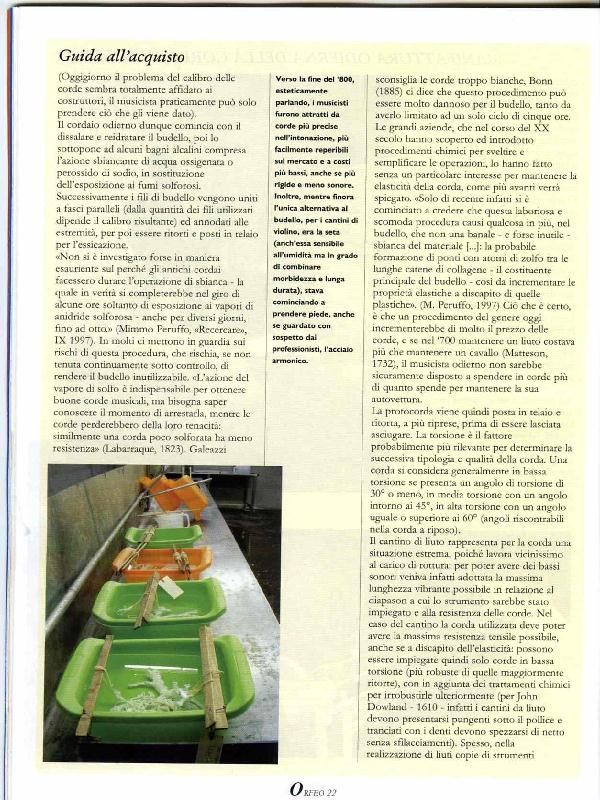
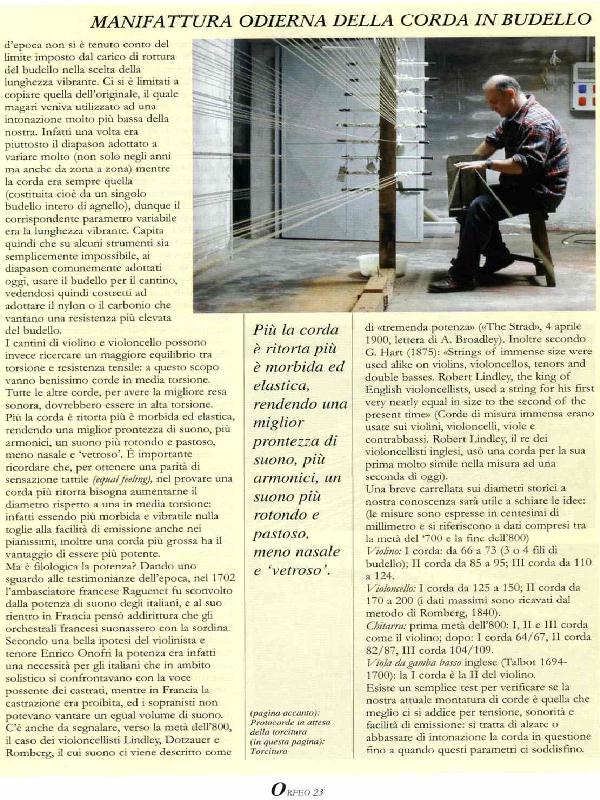
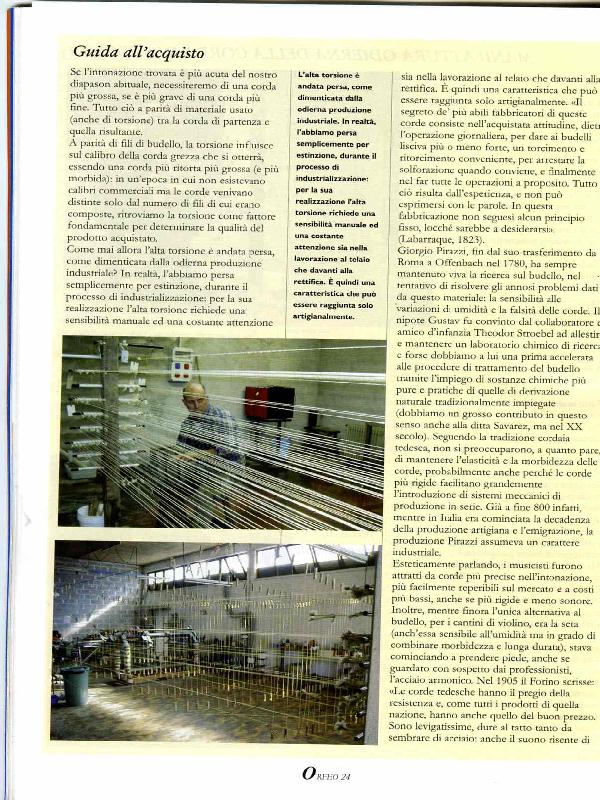
The first difference lies at the very start of the process. The old workshop stood near the slaughterhouse and near a canal or stream: guts were selected, washed in the river, and the usable parts separated from membranes and fat, first by softening them in alkaline baths of increasing concentration and then by mechanical scraping. The baths were based on vegetable potash (grape-marc ash and wine lees steeped in water), later replaced by pure alkaline salts such as sodium carbonate. After washing and degreasing, the gut was cut into two ribbons or left whole with a single lateral cut, then selected, joined and twisted; the frame carrying the resulting rough strings was bleached in sulphur dioxide vapour for periods that could reach eight days. The modern stringmaker instead receives gut already degreased, cut into ribbons and kept under salt, but looks after the work through to the metal winding, and also assembles standard sets and different tensions.
Twist, pitch standard and historical gauges (pp. 23–24)
Twist is probably the most relevant factor in determining the type and quality of a string. The more a string is twisted, the softer and more elastic it becomes, giving a readier attack, more harmonics and a rounder, mellower sound, less nasal and less vetroso (glassy); conversely a lightly twisted string has greater tensile strength and is unavoidable for the violin top string, which works very close to breaking point. To obtain the same tactile sensation (equal feeling) across the set, a more twisted string must be larger in diameter than a medium-twist one. The argument connects with pitch standard and vibrating length: the pitch varied greatly not only over time but from region to region, while the string is always the same, made from a whole lamb gut; hence the corresponding variable parameter is the vibrating length.
| Type | Twist angle |
|---|---|
| Low twist | 30° or less |
| Medium twist | around 45° |
| High twist | 60° or above |
The historical gauges quoted in the essay
| Instrument | 1st string | 2nd string | 3rd string | Notes |
|---|---|---|---|---|
| Violin | 66–73 | 85–95 | 110–124 | the 1st string corresponds to 3 or 4 gut ribbons |
| Cello | 125–150 | 170–200 | — | the maximum figures derive from Romberg’s method (1840) |
| Guitar, first half of the 19th century | 1st, 2nd and 3rd strings as for the violin | — | ||
| Guitar, later period | 64–67 | 82–87 | 104–109 | — |
| English bass viol | the 1st string equals the violin 2nd | Talbot’s data, 1694–1700 | ||
Industrialisation, polishing, mechanical grinding and oiling (pp. 25–26)
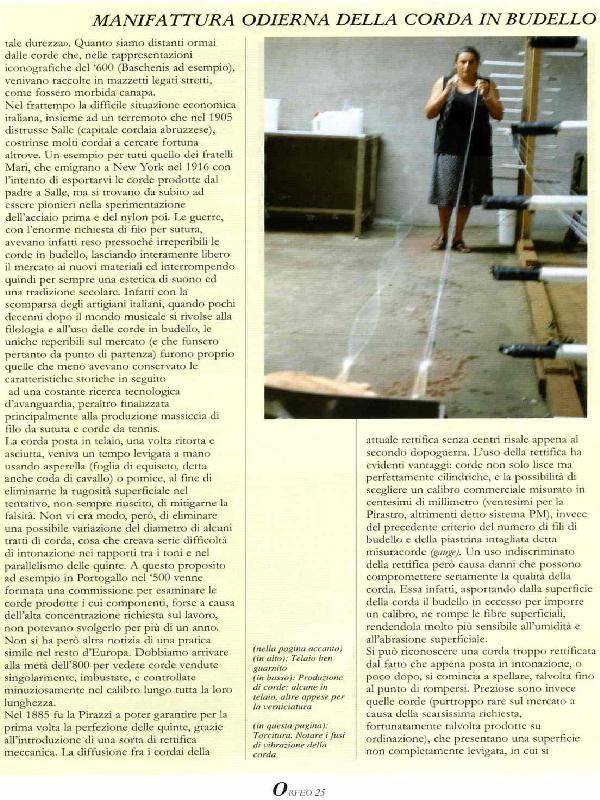
The loss of high twist was compounded by Italian economic events: the 1905 earthquake destroyed Salle, the Abruzzese stringmaking capital, forcing many stringmakers to seek their fortune elsewhere — the Mari brothers emigrated to New York in 1916 — while wartime demand for suture gut made musical gut strings almost unobtainable. Once twisted and dry, the string was polished by hand with horsetail (equisetum) or pumice, to remove surface roughness and mitigate falseness. From 1885 Pirazzi introduced a form of mechanical grinding that made perfect fifths possible and allowed a commercial measurement in hundredths of a millimetre (Pirastro’s PM system) in place of the count of guts; the present centreless grinding dates only from just after the Second World War. The advantage is a perfectly cylindrical, gaugeable string; the risk is abuse: removing gut in excess breaks the surface fibres and leaves the string very sensitive to humidity and abrasion. An over-ground string can be recognised because as soon as it is brought up to pitch it starts to peel and then breaks.
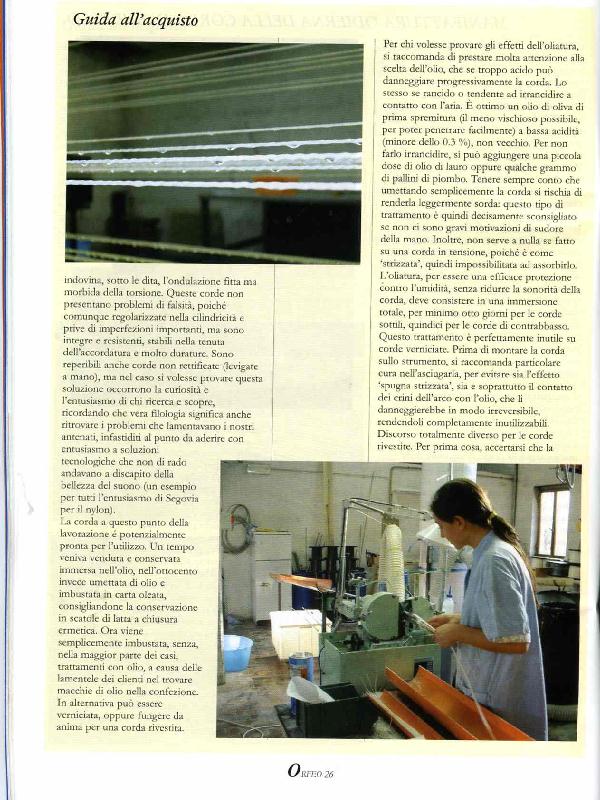
Oiling, varnishes and wound strings (pp. 27–28)
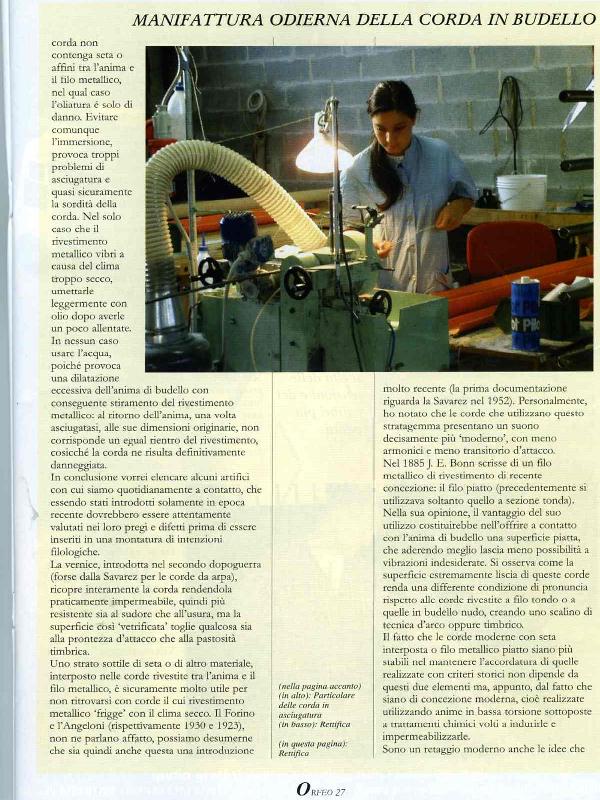
For oiling to protect effectively against humidity without deadening the string it must be a total immersion: at least eight days for thin strings, longer for double bass strings. The oil must be chosen with care — first pressing, as little viscous as possible, with acidity below 0.3 per cent and not old — because it turns rancid on contact with air; to slow this down a small dose of laurel oil or a few grams of lead shot used to be added. For wound strings the case is different: if silk or similar material lies between the gut core and the metal wire, oiling is simply harmful. The author then reviews the devices introduced in recent times that should be weighed critically before being adopted in a historically informed set-up: varnish, which appeared after the Second World War and may be due to Savarez for harp strings, making the string practically impermeable and more resistant to perspiration but altering both the readiness of attack and the mellowness of tone; the thin layer of silk interposed between core and metal wire, useful but recent; and flat-section winding wire, of which J. E. Bonn already wrote in 1885 and whose earliest documented use concerns Savarez in 1952.
Bibliography
List transcribed from the final page of the article («Orfeo», p. 28).
- Livro dos Reggimentos dos officiaes mecanicos da mui excelente e Sempre leal Cidade de Lixbona refromado per ordenança do Illustrissimo Senado della pello Licenciado Duarte nunez do liam, Anno MDLxxij, Lisbon. Historical Archive of the Municipal Chamber of Lisbon, cod. 35, ch. XLII: «Do Reggimento dos que fazem cordas de viola».
- Statuto dell’università dei cordai di Roma, Rome, State Archive, Camerale II arti e mestieri, 1642.
- D. Angeloni, Il liutaio: origine e costruzione del violino e degli strumenti ad arco moderni, Hoepli, Milan 1923.
- J. Edwin Bonn, Technical notes on the choice, keeping, and preparation of violin strings, Brading, Isle of Wight, 1885.
- A. Broadley, String gauges, «The Strad», April 1900.
- R. Dowland, Varietie of lute lessons, London 1610.
- L. Forino, Il violoncello, il violoncellista ed i violoncellisti, Hoepli 1905 (2nd ed. revised by the author, 1930).
- F. Galeazzi, Elementi teorico-pratici di musica…, Rome 1791.
- G. Hart, The violin: its famous makers and their imitators, London 1875.
- Labarraque, Nuovo Dizionario Universale Tecnologico o di arti e mestieri…, Giuseppe Antonelli ed., Venice 1823 (first Italian translation), vol. VIII, entry «Minugiaio».
- D. Larson, Making gut strings, gamutstrings.com/string_making.htm.
- Mimmo Peruffo, Italian violin strings in the eighteenth and nineteenth centuries: typologies, manufacturing techniques and principles of stringing, «Recercare», IX, 1997.
- Mimmo Peruffo, Della virtuosa et ingegnosa pratica costruttiva delli stromenti da musica, «Dialogo», violadagamba.it/dialogo/dialogo.html.
- H. Simson, Gustav Pirazzi & Co.: Since the days of Paganini, Lewis & Son, Chicago, Godwin Library, Oberlin College (the date is unknown, but the advertising booklet goes back to the years when Hermann Pirazzi ran the firm under Gustav’s supervision).
Websites cited by the author
For further information on historical and present-day manufacturing procedures and on historically correct stringing, the author refers the reader to www.aquilacorde.com, www.gamutstrings.com and www.mrinstruments.demon.co.uk (the last no longer active).
The author
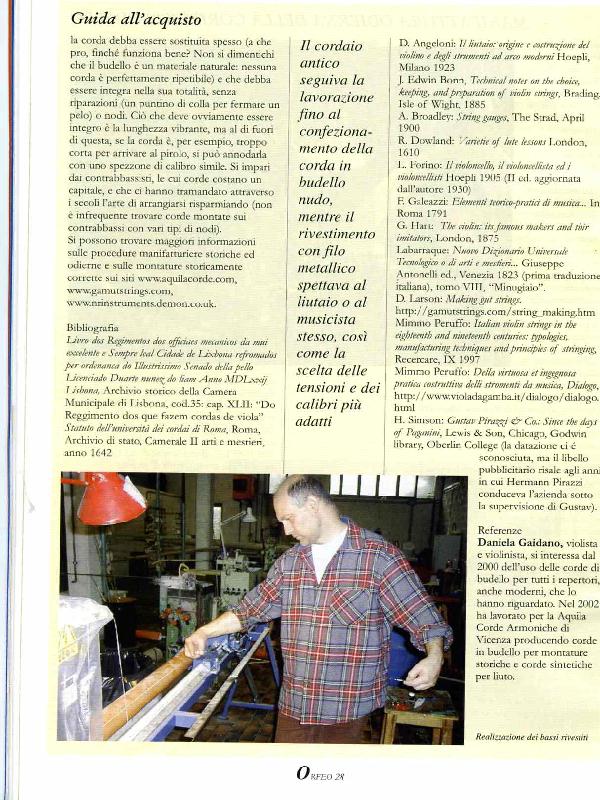
Daniela Gaidano, violist and violinist, has been concerned since 2000 with the use of gut strings across all repertoires, modern ones included. In 2002 she worked for Aquila Corde Armoniche in Vicenza, making gut strings for historical stringing schemes and synthetic lute strings.