Summary
Mimmo Peruffo analyses the only two surviving treatises describing 18th-century mandolin setups — Fouchetti (1771) and Corrette (1772) — to explain the great heterogeneity of the Neapolitan 4-course set, which mixes a gut treble, yellow-brass single wires, twisted brass and wound basses on a gut or silk core. The author introduces the breaking indices of period gut and metals, calculates tensions and gauges, shows that a gut treble was a forced choice (no contemporary metal matched a breaking index of 260–280 Hz · m), rebuilds Corrette’s lacunary information on the 6-course mandolin and proposes a tested experimental setup. He concludes that the 6-course mandolin was likely played with nails as well as with a plectrum, which would explain its relatively high working tensions.
Key takeaways
- Breaking index of gut: 250–280 Hz · m (modern treble); 18th-century iron for harpsichord c. 158–188 Hz · m; brass 101–155 Hz · m.
- The mandolin’s gut treble was not aesthetic but mandatory: no contemporary metal reached 260–280 Hz · m.
- Fouchetti (1771) for 4-course mandolin: Pardessus treble (2 guts, 0.56–0.59 mm); yellow-brass gauge 5 (0.30 mm); two gauge-6 brasses twisted together; wound fourth on gut or silk with brass-gauge-5 octave.
- High-twist twisting of two brass wires yields a string equivalent to 1.54× the starting diameter, reducing pitch distortion while keeping brightness.
- Corrette is lacunary and contradictory: his 6-course setup must be reconstructed by combining his clues with Fouchetti, the 5-course guitar (Stradivari) and historical violin gauges.
- The 6-course mandolin, with working tensions around 4–5 kg per string, was probably played with the nails (not only with a plectrum), as period mandolinists were often theorbo players.
by Mimmo Peruffo
Introduction
When faced with the problem of what kind of strings were used on the 18th century Mandolins of six and four courses, the first thing that stands out is the great heterogeneity of these set ups. What is really hard to understand is particularly on the 4-course Neapolitan Mandolin: here we find together gut strings, single and twisted metal wires, and wound strings on a gut/silk core. To complete the already heterogeneous picture, for the 4th course there are also two choices between unison and octave.
Here is the first question: why was a gut treble used and not a metal wire like the other courses, when metal was later used from the first half of the nineteenth century? This question is logical: the average breaking load stress (breaking point) of gut is “only” 34 kg/mm², much lower than the average of iron and brass of the time, which easily exceeded 100 kg/mm². To understand the reason, we must first start from the mechanical and acoustic behaviour of the string. In this way we will be able to try to figure out what were the guiding criteria used to determine the vibrating lengths of plucked and bowed instruments, including Mandolins.
The strings and their characteristics
Musical strings follow the rules that are summarized in the string equations of Tylor-Mersenne, or even called Hook’s law (although the first to mention it was Vincenzo Galilei around 1580), which relates frequency, vibrating string length, diameter and density of the string. However, when the gauge of a string increases, another thing is not included in this equation: with the increasing string diameters comes also a progressive loss of its acoustic properties, until reaching the point where, over certain gauges, the string has clearly lost most of its performance. This is caused by the progressive increasing of the stiffness of the string. This phenomenon is called inharmonicity: before the appearance of the wound strings (in the second half of the 17th century) it was the main problem with which all the manufacturers of plucked, bowed and keyboard instruments had to deal.
The inharmonicity clearly determines a limit to the total number of bass strings that an instrument can have, i.e. the open range. There is a second problem: a poor elasticity, i.e. a high elastic module, also produces an unwanted sharper frequency when pushed on the frets; this phenomenon is particularly noticeable on short-vibrating-length instruments (pitch distortion). The best solutions, in order to keep the inharmonicity confined and the string sounding still “good”, is to limit the diameter increase by means of some solutions — or, alternatively, keeping a thicker gauge but increasing the elasticity of the string to reduce the stiffness. Our main interest is represented by these relationships: diameter and vibrating length are inversely proportional; diameter and tension are inversely proportional; diameter and density are inversely proportional.
The solutions that, at the same frequency, can contribute to reduce the diameter are the following: 1) reduction of working tension; 2) increasing of the vibrating string length. However, there are other implementable actions: 3) increase the elasticity of the string (does not affect the diameter reduction); 4) increase the density of the string (affects the diameter reduction). Point 1 is an exclusive decision of the player: according to the ancients the right string tension — better to call it the right feel of tension — is when the strings are not too stiff, nor too slack under the finger pressure. There is, however, a lower tension limit, otherwise not only can you lose the finger control on the string but also the acoustic power, its “fire”, along with the increase of what is commonly called pitch distortion, due to the fact that the strings are too slack and so out of control by the performer. Point 2 depends only on the luthier: this solution was adopted from the far past for the harps, but later also for the keyboards, theorboes/archlutes etc., where the vibrating string length increases, step by step, towards the bottom strings, making them, step by step, thinner (proceeding in this way, the inharmonicity is under control). Points 3 and 4 depend only on the strings maker: the appearance of the wound strings in the middle of the seventeenth century can be considered a good example of point 4; a roped gut string, or a very high twist string, an example for point 3.
At the end of the day, the point where a luthier can act is only No. 2, where vibrating length and diameter are inversely proportional (we consider that the performer has already done its job on the choice of the right feel of tension). In the sixteen, seventieth and (maybe) the first half of the eighteenth century, the problem of string inharmonicity was a well-known thing for luthiers: it can be seen, for example, from the still existing bowed and plucked instruments, whose vibrating string lengths are all related to the frequency of the first note and the hypothetic standard pitch: in practice we are speaking of the well-known rule of those times to tune the first string to the most acute possible just before the breakage. In order to optimize the sound performance of a musical instrument it was therefore followed by the luthiers the rule of using the maximum vibrating length possible for that given treble note indicated by the customer (in other words, in which country and its related pitch standard the instrument must be then employed): only in that way could all the strings have the minimum gauge at the right feel of tension, for the benefit of the overall acoustic performance. However, the vibrating length cannot be increased as desired because of the limit imposed by the breaking load of the 1st string: there is a limit that we call the Superior limit. At the same time, it is not possible to increase the amount of bass strings (i.e. increasing of the open range) because there is another boundary called the Inferior limit. In other words, the full open range of a musical instrument is enclosed within these two borders. The so-called Inferior limit, however, using pure gut strings, begins to heavily manifest when the frequency range between the 1st string and the last reaches, more or less, two octaves. Only the six-course Mandolin, of the two models, comes to this range. Generally speaking, the problem was, however, partially solved after the 2nd half of the 16th century by the introduction of a kind of very elastic and/or denser bass gut strings, and then totally solved by the introduction of the bass wound strings in the 2nd half of the 17th century. In the 2nd half of the 18th century, the wound strings were probably totally in use.
The Superior limit
When a string of any material is progressively stretched between two fixed points (i.e., the vibrating string length), it will at some point reach a frequency where it will, instantly, break (breaking point). In the case of a modern gut string, the average value of this frequency for a vibrating length of one meter is 260 Hz (actually, after several tests, we have found that the whole range is 250–280 Hz), which is a slightly low C. The value of such a limit frequency, known as the “breaking frequency”, is completely independent — as strange as it may seem — from the diameter, and this can easily be verified both by mathematics (applying the general formula of the strings) and empirically. By changing the diameters, the only changing parameter is the tension value always corresponding to the breaking point (i.e. the breaking frequency).
The breaking frequency is inversely proportional to the vibrating length at which the string is stretched. So, if the string length is cut down to a half the frequency doubles, and vice versa. This means that the product between the vibrating length (in m) and the breaking frequency (in Hz) is a constant defined as the breaking index, or more simply the FL product (vibrating length × breaking frequency). By introducing the breaking index into the string formula and considering a unit section of 1 mm² (that is equal to 1.18 mm in diameter) at 1.0 m of vibrating string length, at the corresponding breaking frequency value in Hz we obtain, of course, the breaking load stress value of 34 kg/mm². In other terms, a string of 1.18 mm gauge, 1.3 density, 1.0 m scale, at 34 kg of breaking tension will reach the limit of 260 Hz. In short: the breaking point of a modern gut string, according to our practical tests, ranges from 33 to 38 kg/mm², which is equivalent to a breaking index of 250–280 Hz · m (mean value: 260 Hz · m).
Going back to our main topic, a luthier thinks in opposition to what has just been explained: it is the frequency of the 1st string that is the first parameter to be fixed when designing a musical instrument such as the Mandolin, Lute, etc. By dividing the breaking index by the desired 1st string’s frequency, you will obtain the theoretical vibrating length limit where the string will break when reaching the desired note (breaking point). This is a simple proportion: 260 : 1 meter = 1st string’s frequency : X (where X is the vibrating length to be attributed in meters). In the case of a six-courses Mandolin whose first string is a G, 698.5 Hz (18th-century French chorus of 392 Hz), it obtains: 260/698.5 = .37 m. This is therefore the vibrating limit length where we know that the string will break reaching the G (here we are referring to the ancient French pitch standard of 392 Hz). The choice of vibrating “working” length should therefore consider a prudential shortening of this limit length. But how much? The more it is shortened, the more the strings are thicker, with the risk of losing acoustic performance.
Prudential Shortening or Working Index
Examining the vibrating string lengths of the plucked and bowed instruments of the tables of Michael Praetorius (Syntagma Musicum, 1619) made it possible to calculate their Working Index and put them in correlation to the gut breaking index. This allowed us to understand the security margin adopted in those times.
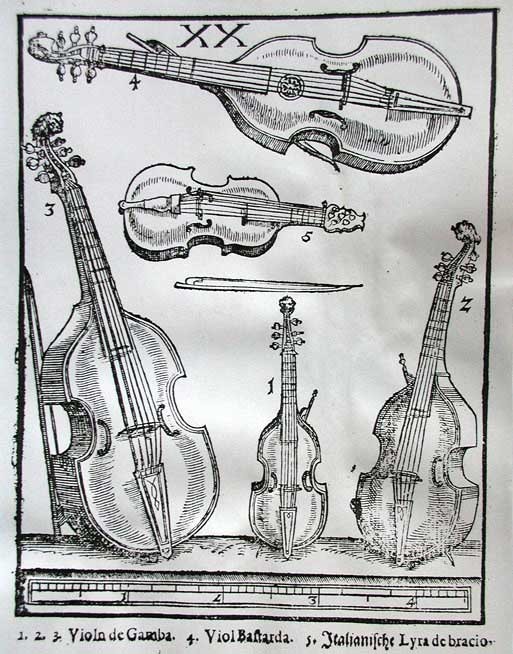
However, in the various calculations, Ephraim Segerman took as reference the average breaking load value — or breaking point — of a modern gut string found in literature: 32 kg/mm² (which is equivalent to a breaking index of 240 Hz · m), which is, actually, too low compared to reality. So, this value can be placed in the “lower quadrant” of the range of breaking loads that we have found in today’s commercial strings during our experiments (we here suggest the average value of a breaking point of 34 kg/mm², equal to 260 Hz · m of breaking index). However, comparing the breaking index of 240 Hz · m with all the other Working Indices, he found that the choice of the vibrating working length of the Lute family and some Gambas (Viola Bastarda for example) was about 2–3 semitones below the breaking index (and hence also below the theoretical vibrating length that we calculated before). Considering our example, therefore, the length shortening of two/three semitones would represent the real vibrating length to be adopted (corresponding to a G of 392 Hz): 32.9/31.1 cm, values that fall within the measures that are actually found in the six-courses Mandolins of the time.
However, there is concrete evidence of what has been said so far: we have subjected a gut string to a progressively increasing tension (stress) and measured the related stretching (strain). Examining the final stress/strain diagram, the initial proportional variation that comes out follows the law of Hook and emerges evidently (also called Tyler/Mersenne).
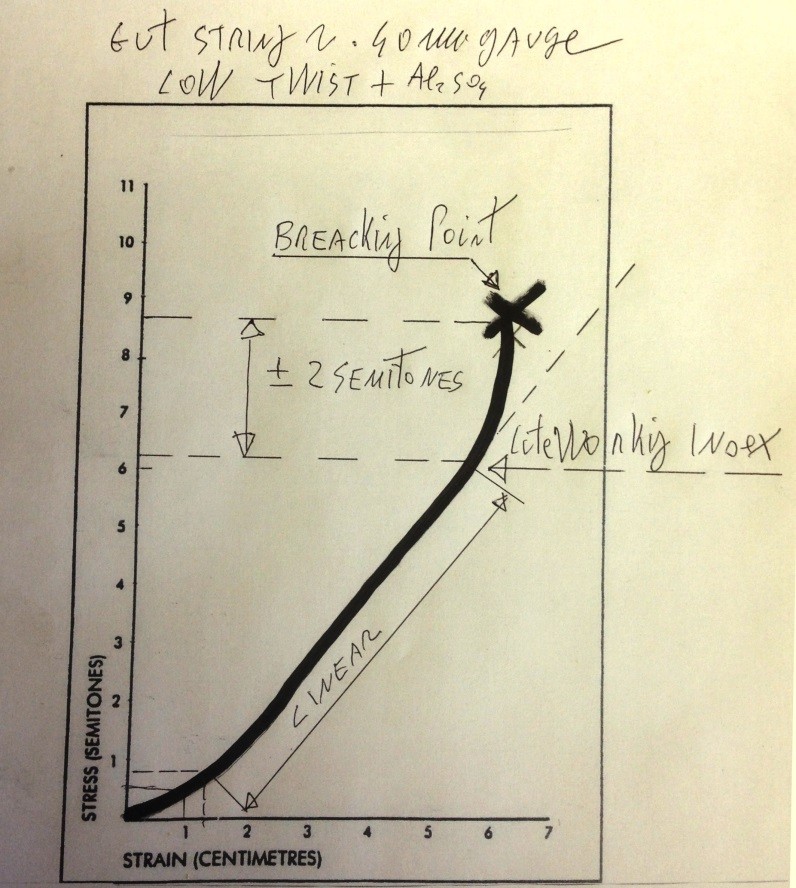
At a certain point, the proportional variation stops and you reach a condition where the stretching (and therefore the corresponding tension) suddenly rises for small peg turns imposed on the string. The string therefore maintains its linearity until about 2–3 semitones from the breaking point; beyond this value, it enters the critical phase. This does not follow the phenomenon of the typical yield of metals and Nylon/Nylgut/Fluorocarbon strings. From this point, gut almost completely loses its ability to stretch, reaching rapidly its breaking point. It is therefore concluded that the use of the maximum vibrating length can only work in the upper point of the linearity, just before the line starts to bend towards the final breakage. The maximum acoustic performance (given by the maximum reduction of the diameter of all strings, i.e. maximum control on the inharmonicity) is determined by the fact that the instrument is working at the upper limit of proportionality, just before it changes — and this is exactly two to three semitones from the final exitus, as shown in the graph.
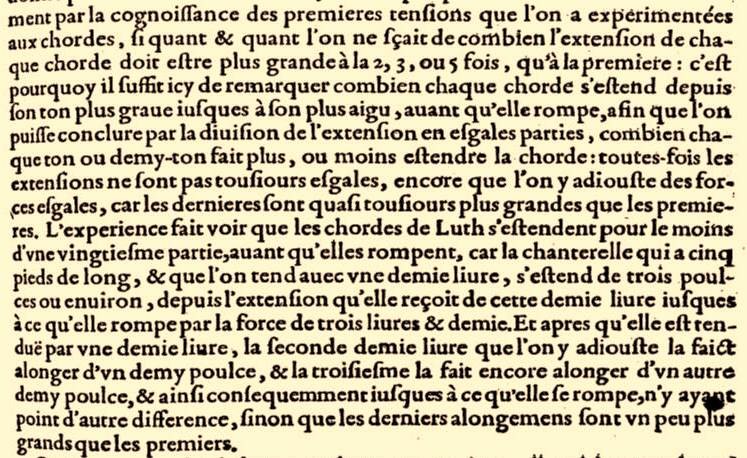
Such behaviour of the gut string was well known even to the ancients and was therefore applied as one of the basic rules in the design/construction of musical instruments. Marin Mersenne, for example, was aware of the right proportions that a musical instrument must have (Harmonie Universelle, 1636, Livre Troisième, Proposition X, p. 129):
Here is what Bartoli wrote by the end of the XVII century: «Una corda strapparsi allora che non può più allungarsi…» — a string breaks when it cannot stretch any further (Daniello Bartoli, Del suono, de’ tremori armonici e dell’udito, 1679).
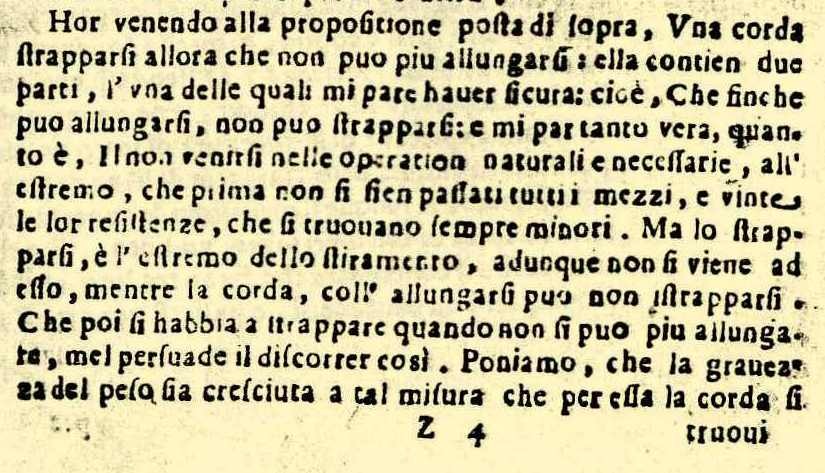
On the other hand, it is well-known to everybody the rule of those times of tuning the lute, and even some bowed instruments, at the highest note and stopping immediately before the breakage of the first string: this is the ultimate proof of what we have already shown graphically.
The Lute example
The vibrating lengths that were chosen for some of the old, surviving Lutes of the past sum up valuable information. The main problem is that in order to make an evaluation you have to use instruments that are not only unmodified, but whose standard pitches can be determined with relative certainty. This is the case of some unmodified renaissance Venetian lutes, German d-minor baroque lutes, and French baroque guitars. Starting from a highly supposed standard pitch (thanks to their origins) and from what emerged in the study of their vibrating string lengths, the research on the various 5-course French guitars (at the 17th-century French pitch standard close to 390 Hz), as well as the German 13-course d-minor Lutes tuned at the Kammerton of 410–420 Hz (see Baron 1727: Kammerton f note for the 1st), and finally including even some surviving renaissance Venetian lutes whose scale is 56–58 cm, probably related to the Venetian standard pitch of mezzo punto = 460 Hz more or less, has allowed us to detect a range of Working Index within 225 and 235 Hz · m, with an average of 230 Hz · m: this can be considered the Lute Working Index of past times (theorboes generally speaking work with a bit more safety; some Magno Graill or Buechenberg large theorbo has vibrating string lengths around 95 cm; at the Roman pitch standard of 390 Hz · m, the related working index range is 210–220 Hz · m). We are very close to what was calculated, for example, by Segerman: 210 Hz · m.
If we consider it true that the Working Index of these examined original instruments presents a safety margin of two or three semitones from the breaking point (as we have seen in our stress/strain graph), it is therefore also possible to estimate the average breaking point — in kg — of the Lute 1st strings of those centuries. This can be obtained by increasing the working index that we have deducted by two or three semitones. From this simple reverse calculation, it is possible to determine that the average breaking load of the gut chanterelles of the 16th, 17th and 18th century would be between 33.7–35.1 kg/mm² (corresponding to a breaking index range of 256–268 Hz · m) in the case of two semitones of safety margin, and 35.7–37.3 kg/mm² (breaking index 273–285 Hz · m) if the safety margin was instead three semitones. As we can see, the range of all these values is perfectly in line with that of current treble Lute gut strings of .36–.46 mm gauge (34–38 kg/mm²).
Going back to the six-courses Mandolin with a 1st string = G, a prudential shortening of two semitones on the average value of the breaking index of 260 Hz · m determines a vibrating length of 32.9 cm; it will be 31.1 cm if we are considering three semitones of safety margin: these are the typical vibrating lengths found in the surviving instruments. The range of Working Index (the product between the frequency of the first string × vibrating length in meters) is as follows: G at standard pitch 392 Hz — 32.9 cm: 230 Hz · m; 31.1 cm: 217 Hz · m. G at standard pitch 415 Hz — 32.9 cm: 244 Hz · m; 31.1 cm: 230 Hz · m. As can be seen, a 6-courses Mandolin exceeds the typical Working Index of the surviving Lutes and 5-course Guitars only if the safety margin is two semitones with a pitch standard of 415 Hz.
In the case of the 4-course Neapolitan Mandolin with a vibrating length of 33 cm (the one typical of the Violin), the following is obtained: E at 392 Hz reference pitch — 33.0 cm: 194 Hz · m; E at 415 Hz reference pitch — 33.0 cm: 205 Hz · m. The conclusion is that both these Working Indexes are included within the breaking index of the gut treble: the 6-courses mandolin in particular works exactly like a Lute, while the 4-courses Neapolitan has a lower tension condition on the first string, just like the Violin. The plausible explanation is as follows: while in the 6-courses mandolin the frequency excursion between the first and the last string is two octaves (24 semitones), in the 4-course it is reduced to 18 semitones. Consequently, in the second case it is not strictly necessary for the strings to work at the highest possible acoustic performance, i.e. close to the breaking point, as happens on instruments with an open range of two full octaves like the Lute, in order to preserve the acoustic performance of the bottom strings.
Why the mandolin treble is gut, not metal
However, the starting point is still unsolved: why was a metal treble not used, whose sound would be much brighter and more readily available, would have had less wear and tear, and even a higher breaking load than gut? The breaking load stress of an XVIII century iron for the harpsichord can reach up to 100 kg/mm². For old brass this value is lower, but always much higher than the average breaking load stress of gut. The explanation is that the highest reachable pitch is certainly directly proportional to the breaking load, but also inversely proportional to the specific weight of the material, which is very high in metals: 7.0 g/cm³ for iron, 8.5 g/cm³ for brass, only 1.3 g/cm³ for gut.
From simple calculations, taking into account both ancient pieces of wire for keyboard instruments and some essays of those times, we can list a series of breaking indices according to Mersenne: silver 155 Hz · m; iron 160 Hz · m; brass 150 Hz · m. The typical high density of metals affects quite strongly the limit of the breaking index: an “ancient” steel string with a breaking load of 100 kg/mm² for example (which is one of the higher values found among old strings for keyboard instruments), however, has a breaking index of just 178 Hz · m. This clearly explains why the battente guitar, fitted with robust metal strings, has a vibrating length limited to only 55–58 cm, while those with the less strong gut strings can reach 68–73 cm (with the same reference pitch).
A lot of breaking load stress values for metal strings of the past have been found. Here are some breaking indices found in old metal strings for spinet or harpsichord: “old” harpsichord iron, 158–188 Hz · m, mean 173 Hz · m; “old” spinet and harpsichord iron, 164–187 Hz · m, mean 175 Hz · m; “old” spinet iron from the second half of the 17th century, 159–195 Hz · m, mean 177 Hz · m. Other metals: “old” copper alloys, 112–138 Hz · m, mean 125 Hz · m; “old” brass, 101–155 Hz · m, mean 128 Hz · m; “old” brass, 148–153 Hz · m, mean 150 Hz · m. It can be easily noticed that the difference between Mersenne’s data and the average of the measured values is not particularly relevant.
The reason why the Mandolins used gut for the highest string is therefore clear: they did not have pure metals and/or metal alloys that could reach a breaking index similar to gut’s (260–280 Hz · m). Considering iron (the metal with the highest breaking index of the time), this would correspond to a breaking load of 145–160 kg/mm². The evidence of the use of gut trebles on the Mandolin is a clear demonstration that strong metal strings were not available in the course of the XVIII century, and even for the first decades of the XIX. A metallic wire with these values would have been employed immediately, as it actually happened between the 16th and 17th centuries and after 1830. The Mandolin was therefore inevitably forced to use gut strings for the 1st course due to a lack of alternatives.
Historical sources: Fouchetti (1771)
There are few historical sources of the XVIII century containing information regarding the string setups of 4- or 6-course Mandolins; these few are, at the end of the day, only Fouchetti and Corrette. Let’s see what they wrote and what can be deducted.
Fouchetti
What Fouchetti wrote about the 4-course Neapolitan mandolin setup, generally speaking, is considered unreliable, if not quite imaginative. A set of strings like those he described appears to be the most bizarre and heterogeneous among those of all the plucked and bowed instruments of his time. In fact we find mixed together, in just four courses, gut strings, brass wires, twisted brass wires, wound gut/silk strings. Indeed, this degree of heterogeneity is absolutely amazing.
By looking more closely and making some calculations, we realize that this set includes in itself almost the utmost perfection possible for that time, both from the mechanical point of view and from the acoustic point of view, with very few other possibilities of choice, if we consider what was available in those times to make strings. Let’s see why, keeping in mind that the most wanted feature for this instrument was brightness and promptness of emission, as it had to imitate the harpsichord:
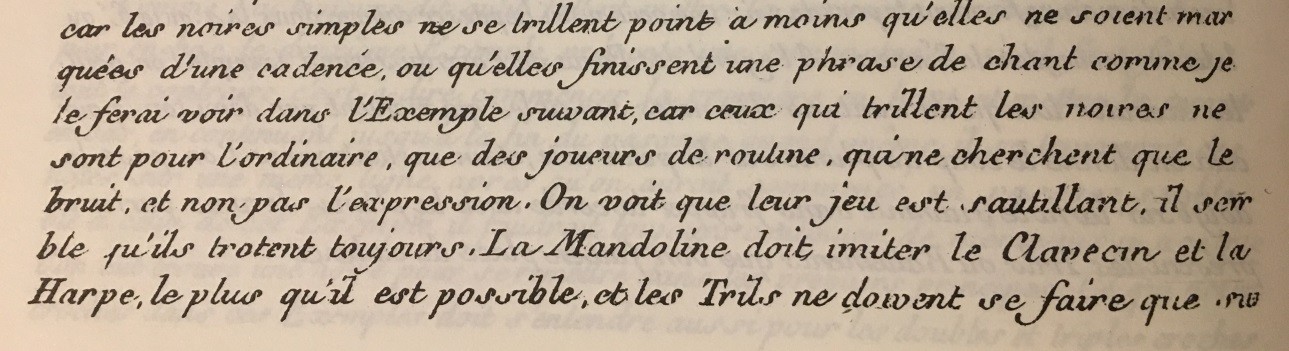
Vibrating lengths: the size used confirms with clear evidence, especially on the 6-course Mandolins, that we are considering an instrument that, like the Lute, had the maximum vibrating length in order to ensure the best acoustic performance. Here is the set for the Neapolitan 4-course Mandolin (Fouchetti says nothing about the 6-course one): 1) use a Pardessus gut treble; 2) a harpsichord gauge-5 yellow brass; 3) two harpsichord gauge-6 yellow brass wires twisted together; 4) a light G Violin wound fourth — the core can also be silk. As octave pair you can use a 5-gauge yellow brass, like those of the second course. Sometimes the fourth course is installed in unison.
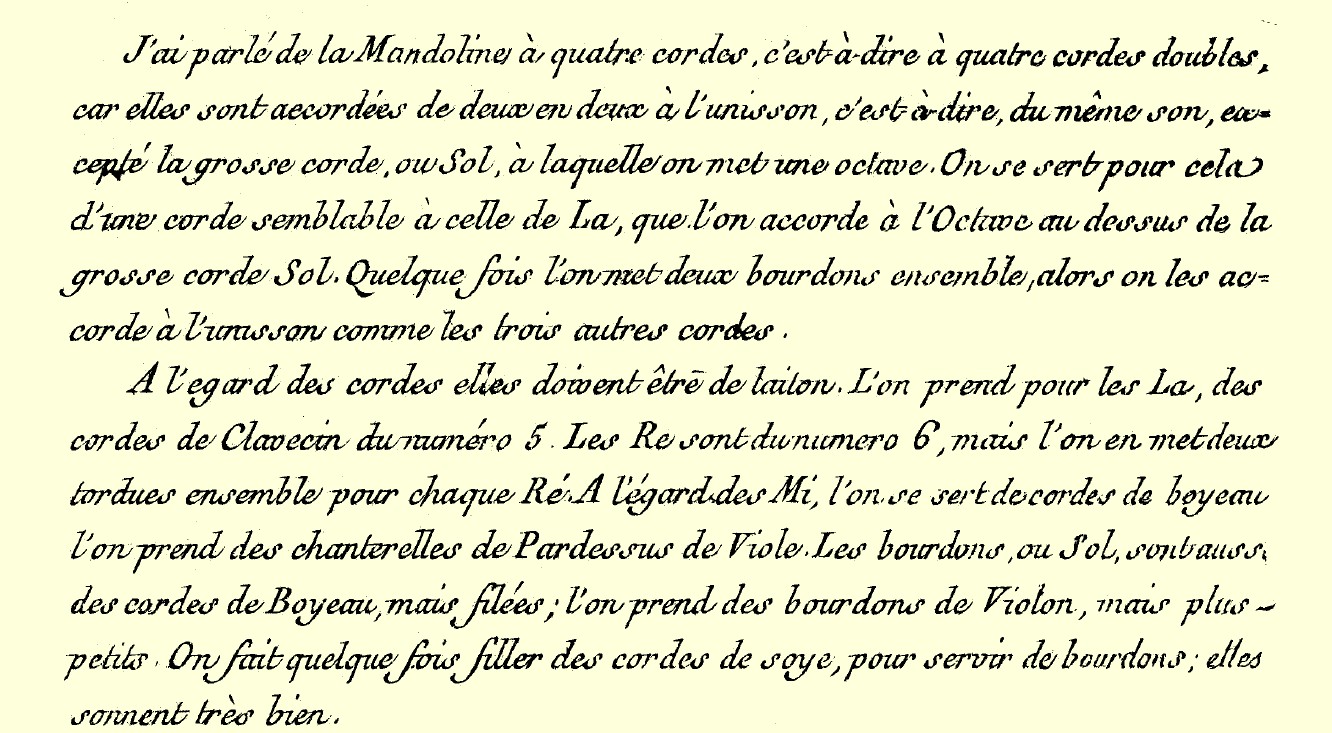
First string: considering the range of the Working Index that we determined, the first string must be of gut due to the lack of possible alternatives: Fouchetti suggests a 1st Pardessus string. According to the data provided by De Lalande and other sources, we know that the treble for Pardessus, and also for Mandolin, was made up of two whole lamb guts, and the Violin 1st of three. There are numerous studies that associate three whole lamb guts with a gauge of .68 to .73 mm. By simple proportion, the Mandolin/Pardessus 1st string had a diameter of .56–.59 mm.
Second string: Fouchetti says you should use a yellow brass wire of gauge 5. The second course’s working index is around 129 Hz · m, so the brass wire available for harpsichord was not breaking. The use of a brass string and not a more robust iron one has only one explanation, of an exclusively acoustic nature: brass, due to its higher specific weight than iron, is brighter — this fits quite well with the criteria of those times, where the Mandolin should imitate the sound of the harpsichord. According to the Cryseul gauge scale, gauge 5 corresponds to a diameter of about 0.30 mm. Yellow brass has a specific weight around 8.5 g/cm³ (red brass: around 8.7 g/cm³).
Third string: Fouchetti says to take two yellow brass harpsichord wires of gauge 6 and twist them together. The purpose is clear: the strings twisted together become more elastic, minimizing the ‘pitch distortion’ effect on the frets, which with a simple single wire would be absolutely evident even for small pressure variations and/or lateral displacements on the string. With a single metal wire, it would also be considerably difficult to keep it in tune over time, because even an imperceptible rotation of the tuning peg would produce significant variations. By twisting two wires together, the problems listed above are solved; the use of brass still guarantees the best acoustic performance in terms of tonal brightness and emission power, even though it is still a little lower and ‘rounder’ than that of a single wire. Gauge 6, always according to the Cryseul scale, corresponds to .29–.30 mm in diameter.
The problem here is to determine the twisting degree of the strings, as Fouchetti says nothing about it. We can find a solution by realizing different types of twisting and checking the mechanical strength, the sound, and especially the resulting working tension, comparing it to the working tensions of the other courses. We thus found that two .30 mm brass strings twisted together with a low twist produced a final string of .39 mm diameter (1.30 times the diameter of the starting wire), or .46 mm (1.54 times the diameter of the starting wire) if the twisting ratio is very high. In this second case, however, we found the sound was far better: the working tension at D note of 262 Hz (Parisian pitch standard of 392 Hz) is around 3.4 kg.
Fourth string: for the fourth string a Violin G wound string was used, but a bit thinner than ordinary — in those times they were made using an average second Violin string as core; we employed a thin second one. Considering a gut-core wound string, it is evident that you lose the characteristic brightness manifested by the three most acute strings. This problem is greatly mitigated by the fact that a yellow brass octave string (and not a gut one) is added, whose obvious purpose was to add brightness so as to obtain an acoustic alignment with the higher strings. In this course, the arrangement in unison was also made, but Fouchetti tells us that it was seldom used. The author suggests, alternatively, the use of silk as the core of the fourth, thus anticipating what would then become the standard for the basses of the six-course guitar of the nineteenth century. Indeed, the use of silk-core basses for the 5-course guitar had already been described by Juan Guerrero in 1760.
But how was a wound Violin G string made in those times? Some sources of those times wrote that a second string of the instrument was taken for the core and then covered with a thin silver wire or silver-copper wire. The equivalent gut of a string like this, in order to ensure the balanced setup (scaled tension) for this instrument, ranged from 1.70 to 1.90 mm. Fouchetti writes, however, that this string has to be a bit thinner than ordinary, but how much? Having as vibrating length 33 cm, the diameters and the density of the materials, it is possible to obtain the working tensions of all the strings at the supposed Parisian pitch standard of 392 Hz: 1st, 5.44 kg (average tension value between .56–.59 mm diameter = .575 mm); 2nd, 5.3 kg (gauge 5 = .34 mm); 3rd, 3.4 kg (two gauge-6 low twist = .30 mm); 4th octave, 4.46 kg (.34 mm); 4th wound bass, the tension should be the same as the paired octave string: 4.46 kg.
At the ‘Parisian’ 392 Hz pitch standard, the working index of the yellow brass wire for the octave of the 4th string is about 115 Hz · m (122 Hz · m at 415 Hz): a yellow brass wire can therefore be safely used. The setting presents a scaled tension profile which probably leads to a situation of equal tactile feel, if it were not for the third course’s abnormal tension, which is quite low. In reality, it is possible to balance the situation if we consider a thinner gauge for the first string, realized however always from two guts. Then, in order to have the same working tension as its paired octave, the equivalent gut of the fourth string should be 1.75–1.80 mm: in fact, we have a fourth Violin string that tends to be in the range of the generally definable light tensions.
The setup described by Fouchetti presents almost perfect coherence in the tension values between the various strings, and on the acoustic side, due to the careful choice of materials and string types, it achieves the highest performance, resulting in powerful emission and brightness. It should be noted, however, that there were not many alternatives: the first string had to be gut, while the fourth had to be a wound gut/silk core string. Most likely, in the second and third courses iron wires for harpsichord could be used, but this would be at the expense of brightness — it is not expected, however, that wires of this material providing the same working tension as gauge 5 and 6 yellow brass would be available — as there was no intermediate gauge between n° 5 and n° 6. The octave of the fourth course could be gut instead of brass, but here too there would have been a loss of brightness, a factor which is emphasized by Fouchetti, who points out, as already said, that the Mandolin must imitate the harpsichord and the harp.

Corrette (1772)
By examining the method of Corrette, the first evident thing is that he does not seem to make any novelty as described by Fouchetti for the 4-course mandolin tuned in fifths. In fact, there are substantial differences and, in our opinion, several errors: course called F must be a 5-course guitar first string; course called G must be a harpsichord gauge 5; course called H and R: R must be a demi-filé, H says nothing; octave course called K and I: I is a full-wound string, nothing is said about K.
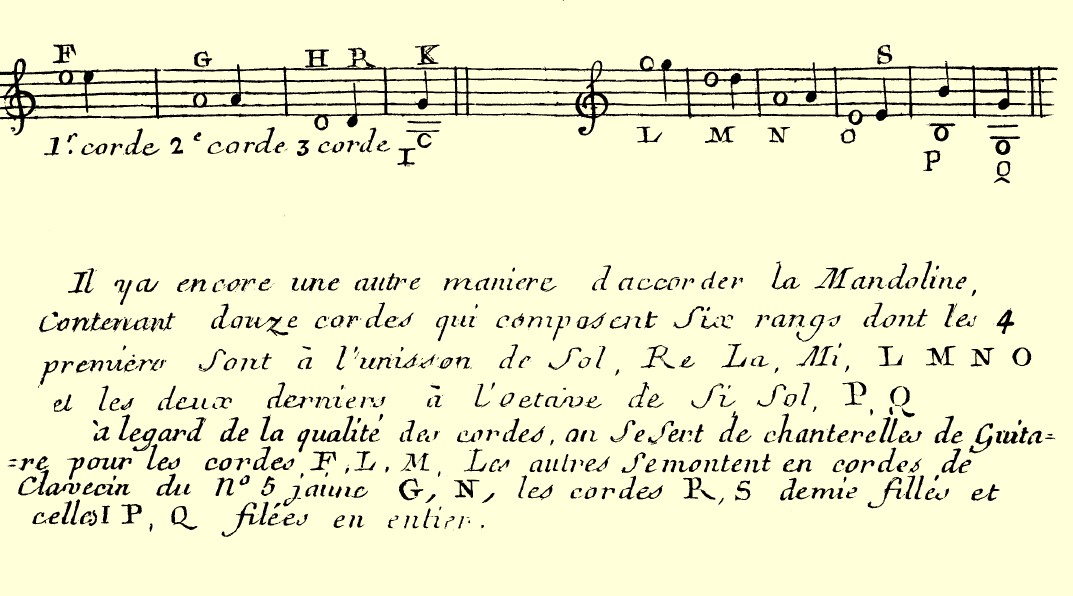
The first gut string is not a treble of Pardessus as for Fouchetti, but a 1st string for the 5-course Guitar: what diameter could it be? So, let’s focus on solving this problem: we need to know if there are direct references to the number of strands and strings of the Guitar, or at least an indirect reference to another musical instrument. It is noted that at the moment we unfortunately have no direct reference; instead, there are several references to a well-studied instrument: the Violin.
In the Stradivarius Museum there is a drawing on cardboard (drawing no. 375) which shows the description of the necessary strings for the five fretted courses of the chitarra attiorbata, which is basically a normal 5-course guitar with five single drones added on an extended neck. First and second string (first course): «Questi deve essere compani due cantini di chitara» — this must be a couple of two guitar 1st strings. Third and fourth strings (second course): «Queste deve essere compane due sotanelle di chitara» — these must be two guitar 2nd strings. Fifth and sixth string (third course): «Queste deve essere compane doi cantini da violino grossi» — these must be a couple of thick violin 1st strings. Etc etc.
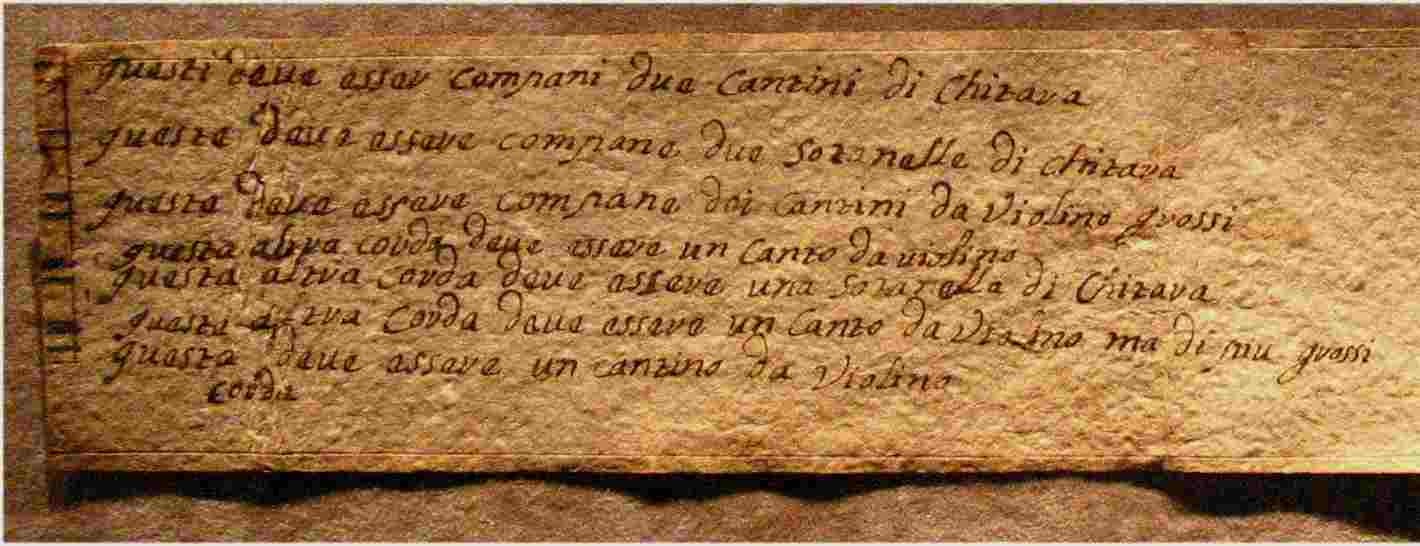
To solve this problem, we need to know what the average Violin diameter of those times was and what could be called a ‘thick’ treble. Count Riccati — who was, in addition to a great physicist, a decent amateur violinist and friend of Tartini — around 1740/50 made some interesting measurements on the strings of his Violin: from his calculations we get the size of the treble installed on his Violin, about .70 mm. This estimation is indirectly confirmed by the data provided by the French traveler and astronomer De Lalande, around 1760, about the pieces of gut used to make mandolin, violin and double bass strings by the famous Abruzzi string maker — operating in Naples — Domenico Antonio Angelucci, and that these proportions remained strictly constant until the end of the following century, in Italy and in France.
As for the ‘thick’ trebles, let’s consider as reference the thicker Mi and La gauges made from the same number of guts, as George Hart suggests. Considering the standardization in the manufacturing process of Violin strings, it is then possible to assume that a ‘thick’ three-strand gut could be around .73–.74 mm. Since the third course of this guitar used a violin gut (at the time realized with three guts called ‘wires’), using simple proportions — maintaining a constant tension — the second course had to consist of two wires (such as the treble of the Mandolin and Pardessus, according to De Lalande), and the first of a single gut only, just like the treble of the Lute. In theoretical calculations, the ratio between the diameters is equal to the square root of the ratio of the number of wires used; but then we have to deal with the tactile feel of tension, which must be homogeneous: two gut wires therefore produce a diameter between .57 and .59 mm.
Since with three gut wires an average diameter around 0.70 mm was obtained (here we refer expressly to a ‘big’ treble, for example .73 mm, which is considered ‘thick’ by George Hart), and considering a setup with the same feel as the Guitar (which, however, leads to a tension in kg of a scaled profile, conditioning the choice of its gauges), this is what we obtained: 1st course, ~.44–.46 mm, made from a single whole gut; 2nd course, ~.57–.59 mm, made from two pieces of gut; 3rd course, ~.73 mm, thick violin treble, made from three guts. Etc etc. Corrette: «La guitarre se mont en cinq rangs de cordes, le 1er n’en a qu’un qui se nomme chantarelle, et les quatre autres rangs en ont chacum deux… Il faut observer que les deux cordes du 3me rang et la petite corde a l’octave du 5me rang soient égales en grosseur pas si forte que la chantarelle de violon…».
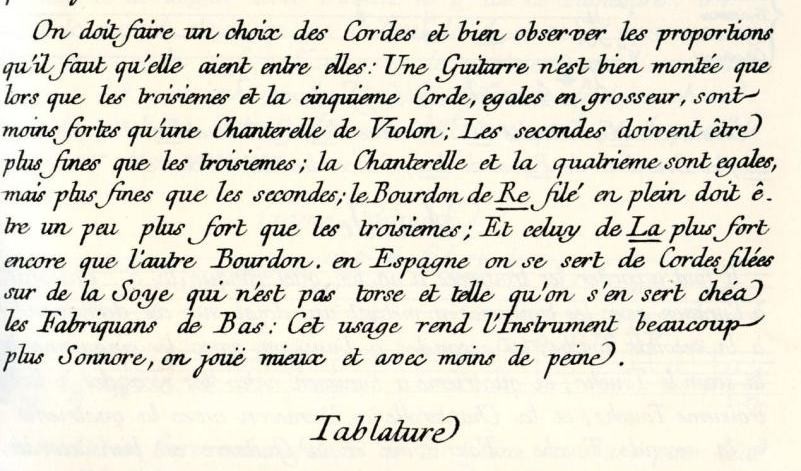
Corrette himself thus confirms what was written in the Stradivarian document. Now that we have a more precise idea of the 5-course guitar gauges, we can go back to the 4-course Mandolin described by Corrette and try to provide the diameters.
First string: Corrette talks about the guitar 1st string. As we have seen, the reference starting point to find out the Guitar gut gauges is its third course, which has a gauge equal to a thick Violin treble: in order to preserve an even feel of tension between the strings, the 1st, according to what the author wrote, has to be about .44 to .46 mm gauge.
Second string: the harpsichord’s gauge 5 is used. Corrette, though, does not specify the type of metal; however, the analogy with Fouchetti is consistent, which is why we think he’s talking about yellow brass.
Third string: Corrette oddly seems to consider each as a single string, despite the fact that on the pentagram you can see that they are in unison. Of one, called H, nothing is said; of the other, called R, it is written that it is a demifilé, without adding any extra detail: unfortunately, from this statement it is not possible to get anything concrete; we do not know if the strings were both demifilé, and there are no indications of how to make it.
Fourth string: Corrette says nothing about the octave named K. The bass string, called C, is described only as being a wound string. However, we do not know which core to use, silk or gut — anyway, thanks to Fouchetti we know that both materials were suitable, so we might guess that, again, it’s a Violin G.
The indications given by Corrette about the 4-course Mandolin are, according to the writer, totally unreliable. The first course (.44–.46 mm approximately) would have a working tension of only 3.0–3.2 kg per string; the second course (presumably yellow brass gauge 5, but nothing is specified) rises to at least 5.3 kg per string. The gap with the first course is remarkable. To have a working tension comparable to the second course, the first should use the second-string guitar strings (2 guts = first Mandolin = first Pardessus, according to De Lalande), aligning with Fouchetti. For the third and fourth courses, nothing useful can be obtained: if it were not for Fouchetti, which gives a useful comparison, the data provided by Corrette would be completely meaningless.
Six courses Mandolin
With the problems already encountered on the 4-string mandolin tuned in fifths, we still inevitably expect issues. In fact, different indications are unfortunately incorrect: some reasoning is needed. Only at the end of this review work does the mandolin’s six-course setup become really workable.
First and second course: Corrette writes that the courses called L and M must be Guitar trebles: what does it mean? That he used the guitar treble also for the second course of the Mandolin? Corrette here is very inaccurate. Certainly, they cannot be trebles installed on the second course too: there would be a total misalignment in the working tension. We therefore feel that Corrette refers instead to the first and second course of the Guitar. The third course, called N: Corrette says to use harpsichord gauge 5, but omits to specify the type of metal; however, we think it is the usual yellow brass for harpsichord. Fourth course, called S: Corrette says that this is a demi-filé string, but does not add anything else (silk or gut core? Corrette says nothing on the matter). Fifth course, called P: this is a full wound string, but we have no other information: the string in the octave is not mentioned at all. Sixth course, called Q: this is a full wound string, but we have no other information: the string in the octave is not mentioned at all.
Based on the data provided by Corrette, no one today — but also not in his time! — is able to draw the entire string setup; however, it is possible to introduce some reasoning that might eventually solve the enigma. Let’s start from the only certain data available: the third course, at the note A, which corresponds to the harpsichord gauge 5. We believe it is yellow brass (.34 mm). Using a typical six-courses Mandolin average vibrating length, .315 m, and a presumed Parisian/Roman pitch of 392 Hz, we obtain a working tension of 4.8 kg. The first and second courses of the instrument must therefore somehow relate to this value: by installing in these two courses the first and second string of the Guitar (of which we have a more accurate idea thanks to Stradivari’s Violin), the following working tensions are obtained: 3.9–4.3 kg for the first course and 3.8–3.9 kg for the second. Compared to the tension value of the third course, there is certainly a non-balanced tension trend, yet still functional.
Things are much simpler with the sixth course: as it is a G, we can think that it can be a fourth violin string, as in the Fouchetti model, whose octave is equal to the gut second string (third of the guitar): considering this hypothesis as valid, the tension of the bass and its paired octave is about 3.9 kg. The paired octave may be the same yellow brass gauge 5 already used for the 3rd course: a gut string would be about .90 mm. Having obtained the working tension of the first, second, third and sixth courses, it is logical to think that the working tension of the fourth and fifth must necessarily be between 4.8 kg (third course) and 3.9 kg (sixth course): how can this condition be achieved while fitting in the technologically and acoustically correct range?
Fourth course: as we have seen, based on Corrette’s indications, you should use a demi-filé string. It is necessary here to consider a working tension range slightly lower than that of the third course, but in any case higher than the range theoretically associated with the fourth course; the range has to be like this in order to preserve the linearity of the values calculated so far. If we assume that the range is 4.4–4.7 kg, the following diameters are obtained: 1.10–1.14 mm. These diameters correspond exactly to a third Violin string that was, at that time, in France, usually made as demi. Its paired octave should have a diameter between .55 and .57 mm: the first string for the 4-course Mandolin, i.e. the 2nd Guitar course.
Fifth course: Corrette states that this is a unison and a full wound string. From simple calculations, considering a tension range slightly above that of the fourth course, in order to preserve the linearity of the values calculated so far (assuming that the range is 4.1–4.3 kg), for note B we obtain an equivalent gut of 1.42–1.47 mm in diameter. The data should be reliable: its octave, at the same tension, varies between .71 and .73 mm in diameter — in practice the third guitar string, i.e. a 1st Violin string.
The problem is its realization, especially if a gut core is used. During those times, according to our research, metal wires with a diameter of less than about .13–.15 mm were not produced, because the suitable technology to draw thinner metal wires was not available. In other words, the half-wound string was not at all a transition string between a gut string and a fully wound string, but a technological way out, used to avoid the problem of the shortage of thinner metallic wires: in fact, you can find proof in the Metallic Index characteristic of these particular strings, which is similar to that of full-wound strings and not less.
If the core is instead silk, which, according to Fouchetti, was used in the Mandolin and then also in the 4th and 5th courses of the 5-course guitars, and in the XIX- and early-XX-century guitars, with the use of silk cores, compared to gut cores, the relationship between core and metal can be unbalanced in favor of the metal, making it possible to have a full-wound string with a more brilliant acoustic output (a higher Metallicity Index). It is interesting to note that the equivalent gut and the way of making the close-wound strings on silk for the fifth and sixth courses of the six-course Mandolin will then be used, respectively, for the fourth and fifth strings of the six-single-string guitar, the one that would appear on the music scene in 10–15 years.
Concluding, even for this kind of Mandolin, Corrette does not allow us to come to a certain and plausible conclusion. However, we made a number of arguments that lead to the following setup proposal, based on the few pieces of information from Corrette (the only strong point is the indication that the third course uses gauge 5, from which we can deduct the value of the tension: at this point, the highest courses must have a growing tension while the bass ones a degrading tension, according to a profile similar to the Fouchetti Mandolin) and with the support of Fouchetti: 1st (G), first of the Five-courses Guitar = .44–.46 mm in diameter, average tension 4.1 kg per string; 2nd (D), second of the Five-courses Guitar = .57–.59 mm in diameter, average tension 3.9 kg per string; 3rd (A), gauge 5 yellow brass for harpsichord = .34 mm diameter, average tension 4.8 kg per string (a gut string would however be about .90 mm and perfectly functional); 4th (E), demi-filé string (third violin according to French use) = 1.10–1.14 mm equivalent gut, average tension 4.0–4.5 kg; 5th (B) octave, third of the five-courses guitar = .70–.73 mm in diameter, average tension 4.2 kg; 5th (B) bass, full wound string on silk core with equivalent gut = 1.42–1.47 mm diameter, average tension 4.2 kg; 6th (G) octave, same gauge 5 in yellow brass for harpsichord = .34 mm diameter, average tension 3.9 kg (or a gut string of .88–.91 mm: practically the fourth course of the guitar).
The uncertainty of using octave strings in gut or yellow brass gauge 5 is of relative importance: Fouchetti points out that the use of metal wires or gut strings was a matter of personal taste.
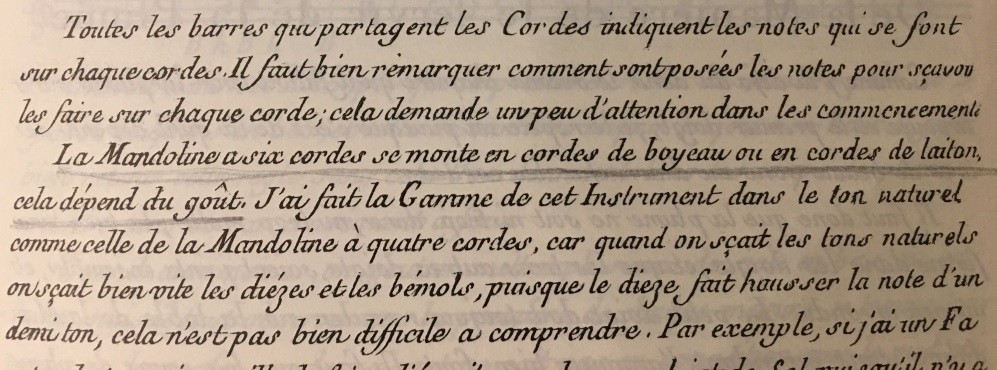
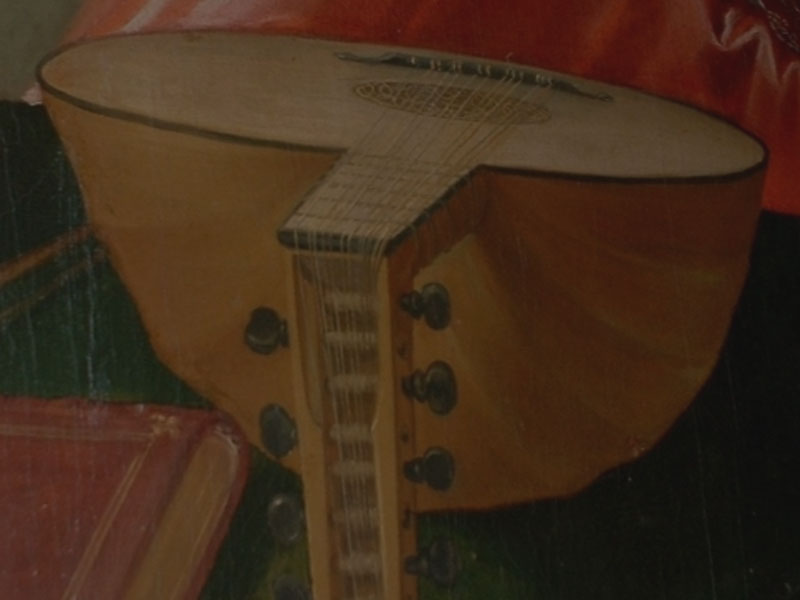
We nevertheless have serious doubts about the real feasibility of using rigid brass harpsichord wires as the third course, and this is because of the type of bridge, which in this type of instrument is similar to that of the Lute, i.e. glued on the soundboard. Fixing a metal string is practically impossible, making it mandatory, as already in the citterns of two centuries before, to use a movable bridge and anchoring at the bottom of the instrument, as is done in the 4-course Neapolitan mandolin.
Practical tests
4-course mandolin (Fouchetti)
The Fouchetti setup.
- First course, unison: .56 mm gut gauge string, no mechanical or acoustic problems were found.
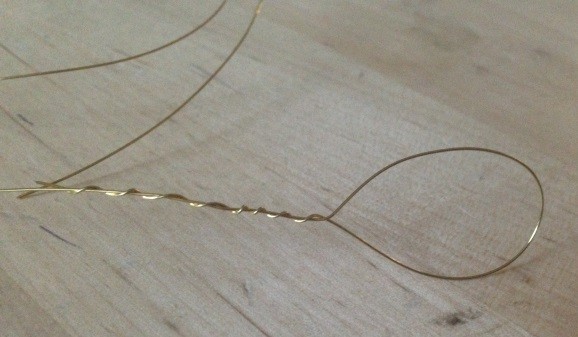
- Second course, unison: hard yellow commercial brass wire for harpsichord, diameter .35 mm. The main problem encountered was how to tie it up to the tailpiece. Being a very hard brass wire, the problem is its fragility. In our case, we solved the problem by making a very long loop, so that when put in tension it locks itself, eliminating any string-breaking problem at the tuning pegs due to the presence of bend points or over-sharp bends.
- Third course, unison: we used .30 mm hard commercial yellow brass wire. It is not possible to twist the two wires together directly, because, being very hard, the wire tends to break during twisting, resisting the operation until it ends up with differing degrees of twist along the string. The solution to this problem was to soften the two wires a little (not totally) by heating them to 350 degrees — in this regard we did a number of tests, whose final result indicated that the wire has to be heated between 330 and 370 degrees Celsius — for one minute. The wire thus obtains an intermediate degree of hardness, allowing it to be twisted while still retaining a residual degree of hardness that counteracts the yield of the wire under tension. The degree of twisting of the string is a crucial aspect: if it is very high, the sound is very bright, but the tensile strength is also reduced. With less twist, the sound is less metallic; you have less sustain, but you have a higher tensile stress. In other words, depending on the degree of twisting, you can modulate the desired tone output until you find an acoustic balance between the second and the fourth course.
- Fourth course, octave: we obtained a wound Violin G whose equivalent gut is 1.80 mm, following the historical instructions (a slightly lighter second Violin string, covered with silver wire); for the octave, a second yellow brass wire was used, the same as those of the 2nd course.
Conclusions: the overall acoustic balance of the set was discreetly homogeneous, and so also was the feel of tension among the strings (standard pitch of 392 Hz).
Six-course mandolin (our interpretation of Corrette)
Setup according to our Corrette interpretation, with a cherry-bark pick.
- First course, unison: .46 mm gut, no acoustic or mechanical problems found.
- Second course, unison: .56 mm gut, no acoustic or mechanical problems found.
- Third course, unison: .35 mm yellow brass wire; the tension feels a little higher than the upper strings, and it sounds more brilliant than the second and fourth course. For better balance the diameter should be reduced to .33–.34 mm; there is, however, no solution that keeps the brilliant acoustic output. Alternative: .88 mm gut string, no mechanical problem, acoustically aligned with the first two top courses and with the fourth course.
- Fourth course, unison: two violin-3rd demi-filé strings are used, equivalent gut of about 1.15 mm. There were no mechanical problems. The sound was a bit dimmer compared to that of the third course, when the latter is done using yellow brass instead of gut.
- Fifth course, octave: the bass consists of a fourth string wound with silvered copper wire on a silk core, whose equivalent gut is about 1.40 mm. The octave string is a gut third string of the five-course Guitar, .73 mm.
- Sixth course, octave: the bass consists of a fourth string wound with silvered copper wire on a silk core, whose equivalent gut is about 1.80 mm. The octave string is a gut fourth string of the five-course Guitar, .88 mm.
There is no mechanical problem; acoustic and dynamic balance are good, also in relation to the fifth course. According to the writer, an experimental set of this type is totally satisfactory. Critical points revolve around the use of brass wire in the third course, because the wire tends to break at the bridge. The best balancing set therefore is the one that uses gut strings for the first three courses and for all the octaves, close-wound silk-core strings for the fifth and sixth course, and a demi-filé wound gut string for the fourth course: however, for this course, the experimentation of a silk-type string on a silk core remains open, which however has so far not been found in the records of the 18th century, and which, from the first experiments we made, proved totally unsatisfactory for the kind of sound obtained.
Conclusions
Although some 18th-century Mandolin methods have survived, when it comes to understanding what kind of strings were used, we have only two sources available: Fouchetti and Corrette. The data provided by the first on the 4-double-string Mandolin are technically and acoustically consistent: they shape a set whose tension value is within a range of acceptability and homogeneity between the various strings. The strings of the four courses are close, from the technological and acoustic point of view, to almost perfection, considering what was available at that time. Unfortunately, Fouchetti says nothing about the 6-course Mandolin.
The description provided by Corrette, however, is incomplete and sometimes confusing: it is not possible to directly extract anything usable unless you go through a critical re-elaboration of the data he provided, as we have done here. So, comparing what he wrote with Fouchetti (in some ways there are interesting overlaps), and always taking into account what could or could not be done at the time — in short, the technical limits and the materials available to make strings — it is possible to formulate a concrete proposal even for the six-course Mandolin. For the 4-course Mandolin, therefore, only the Fouchetti data holds, validated only partially by Corrette’s (the gauge 5 for the second course, for example). For the six-course Mandolin, as we have seen, we can only refer to Corrette: we believe that our elaboration is interesting not only from the acoustic point of view, but also from the point of view of the materials available at the time to make strings.
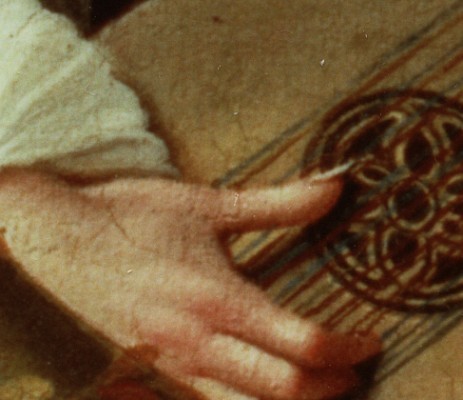
However, we have a last consideration: Corrette does not clarify whether the six-course Mandolin should be played with a plectrum or with the fingers, like the Lute. We point out that from the tension values we calculated, you could have considerable difficulty playing a six-course Mandolin directly with the fingertips. As an example, the tension range currently accepted in the Lute today (which is a much larger instrument) is, at its maximum extent, between 2.7 and 3.3 kg per string. The rules of the time are clear and repeated several times in historical documents: longer the scale, thinner the strings — i.e. small strings on smaller Lutes. A Mandolin played with the fingers only, with a vibrating length of only 31.5 cm at the reference pitch of 392 Hz, giving a tactile feel of tension similar to that of the lute, should therefore work at considerably lower tensions, say around 2.0 kg. This would however involve a gut string for the 1st course of only .31–.33 mm gauge: this is not possible. In fact, the thinnest, unpolished gauge that comes from a single lamb gut of a few months of life — as indicated by ancient sources — is about .40–.46 mm in diameter, and produces a working tension higher than the 2.0 kg indicated above.
One possible solution — the only one that can work out, in my opinion — is that the six-course Mandolin with a glued bridge may have been played exclusively by means of nails. Such a solution would have enabled it to work easily without a plectrum (the nail itself can act close to a plectrum), with a clear and crystalline sound and even under considerable working tensions — like on the modern classical/flamenco guitars that cannot be used without nails — otherwise objectively difficult to deal with using only the fingertip. On the other hand, it is historically known that among eighteenth-century mandolinists there are also many Theorbo and Archlute players, who used the nails of their right hand, such as Filippo da Casa. It is hard to imagine that they would cut them off for the chance to play the Mandolin, while at the same time also playing the Theorbo. I pass the question on to all the similar Mandolin players; on the other hand, these are the calculations and this is the result that emerged.
Vivi felice.
References
- D. Abbott, E. Segerman, "Strings in the 16th and 17th centuries", Galpin Society Journal XXVII, 1974, pp. 48–73.
- Treble gut strings are made for maximum tensile strength, with elasticity neglected.
- On French pitch 385–400 Hz: Ellis, Studies in the History of Music Pitch; Mendel, "Pitch in western music since 1500", Acta Musicologica L, 1978; Segerman, FoMRHI Quarterly 30, 1983, comm. 442.
- E. Segerman, comm. 1545, FoMRHI Quarterly 89, October 1997.
- E. Segerman, comm. 1593, FoMRHI Quarterly 92, July 1998.
- D. Bartoli, Del suono, de’ tremori armonici e dell’udito, Tinassi, Rome 1679, p. 263.
- W.R. Thomas, J.J.K. Rhodes, "The string scales of Italian keyboard instruments", Galpin Society Journal XX, 1967, p. 48; M. Spencer, "Harpsichord physics", GSJ XXXIV, March 1981, pp. 3–7; Segerman, FoMRHI 39, April 1985.
- Marin Mersenne, Harmonie Universelle, 1636, Livre Troisième, Propositions XII and XIII.
- E. Segerman, "New Grove DOMI: ES Mo 4: Ca to Ci entries", FoMRHI 43, April 1986, comm. 698.
- Harvey Hope, "Ref J.M.S. remarks on the New Grove Chitarra battente", FoMRHI Quarterly 43, April 1986, comm. 709; Peter S. Forrester, "Citterns and chitarras battente: re. Comm. 698, Grove Review", FoMRHI Quarterly 44, July 1986, comm. 740; E. Segerman, "Response to Comms 739 and 740", FoMRHI Quarterly 44, July 1986, comm. 742; Peter S. Forrester, "17th c. Guitar woodwork", FoMRHI Quarterly 48, July 1986, comm. 825; James Tyler, The Early Guitar – A History and Handbook, Early Music Series 4, Oxford University Press, London 1980 (quoted in Ciro Caliendo, La Chitarra battente. Uomini, storia e costruzione di uno strumento barocco e popolare, Edizioni Aspasia, April 1998, pp. 24–25).
- C. Karp, "Strings, twisted and Mersenne", FoMRHI 12, July 1978, comm. 137; E. Segerman, D. Abbott, "On twisted metal strings", FoMRHI 13, October 1978, comm. 164.
- Cary Karp, "On Mersenne’s twisted data and metal strings", FoMRHI Quarterly 14, January 1979, comm. 183; E. Segerman, "Mersenne untwisted – a counter-Carp to comm. 183", FoMRHI Quarterly 15, April 1979, comm. 199.
- C. Karp, The pitches of 18th-century strung Keyboard Instruments, SMS-Musikmuseet TR 1, Stockholm 1984.
- "On wire-comms and wire-comm comments", FoMRHI Quarterly 11, April 1978, comm. 134.
- R. Gug, "About old music wire", FoMRHI 10, January 1978, comm. 105.
- M. Tiella, "Problemi connessi con il restauro degli strumenti musicali", pp. 22–23.
- Ephraim Segerman, "Neapolitan mandolins, wire strengths and violin stringing in late 18th-c. France", FoMRHI Quarterly 43, April 1986, comm. 713 — the first study we are aware of dealing with 18th-century mandolin string setups.
- Gianni Podda, "Prove di trazione e determinazione della tensione di rottura per corde antiche e moderne", pp. 36–38, in Atti del seminario per la didattica del restauro liutaio, estate musicale 1981, Premeno.
- R. Gug, "Jobst Meuler or the secret of a Nuremberg wire drawer", FoMRHI 51, April 1988, comm. 866.
- G. Fouchetti, Méthode pour apprendre facilement à jouer de la mandoline à 4 et à 6 cordes, Paris 1771; reprint Minkoff 1983.
- M. Corrette, Nouvelle Méthode pour apprendre à jouer en très peu de temps la Mandoline, Paris 1772.
- F. De Lalande, Voyage en Italie, vol. IX, Paris 1786, pp. 514–9, ch. XXII.
- M. Peruffo, "Italian violin strings in the 18th and 19th centuries", Recercare IX, 1997, pp. 155–203; see also Antoine Germain Labarraque, L’art du boyaudier, Imprimerie de Madame Huzard, Paris 1812, pp. 31–2.
- P. Barbieri, "Giordano Riccati on the diameters of strings and pipes", Galpin Society Journal XXXVIII, 1985, pp. 20–34.
- E. Segerman, "Strings through the ages", The Strad, parts 1–3, January–April 1988.
- G. Cryseul, Moyen de diviser les touches des instruments à cordes, Paris 1780.
- P. Frisoli, "The Museo Stradivariano in Cremona", GSJ XXIV, July 1971, p. 40.
- G. Hart, The violin and its music, Dulau and Schott, London 1881, pp. 46–7.
- M. Corrette, Les Dons d’Apollon, Paris 1763, p. 22, ch. XVI.
- A. Kircher, Musurgia Universalis, Rome 1650, ch. II, p. 476.
- D.J. Guerrero, Méthode pour apprendre à jouer de la guitarre, Paris 1760.
- Philippe Savaresse, "Cordes pour tous les instruments de musique", in Charles-P.-L. Laboulaye, Dictionnaire des arts et manufactures, 3rd ed., vol. I, Lacroix, Paris 1865.
- S. de Brossard, Fragments d’une méthode de violon, ms. c. 1712.
- J.-B. De Laborde, Essai sur la musique ancienne et moderne, Paris 1780.
- J. Grassineau, A musical Dictionary, London 1740.