Summary
A foundational essay by Mimmo Peruffo reconstructing, through a wide network of documents and surviving artefacts, the characteristics of violin strings produced and used in Italy from the first half of the 18th century to the end of the 19th. The author introduces the "four ages" of gut strings, describes in detail the 18th-century manufacturing cycle in comparison with today’s, maps the production centres (Rome, Naples, Padua, Salle, Verona), discusses quality criteria, string types, the pitch jungle and especially gauges (three lamb guts = c. 0.70 mm for the violin first string), arriving at a synoptic table of historical gauges and an analysis of the wound fourth string. Key finding: old setups were much thicker and scaled in tension, not light and equal-tension as currently believed.
Key takeaways
- The four ages of gut strings: from medieval empirical selection, through the rise of the professional stringmaker in the 16th century, the weighted basses of the 17th, to wound strings from 1659 onward.
- The 18th-century Italian process uses whole lamb gut from 8–9-month-old animals, vegetable potash, long sulphuring (up to eight days) and hand polishing with horsetail.
- The violin first string almost always took three whole guts (sometimes four), giving diameters of 0.65–0.75 mm; Paganini explicitly asked for four-strand first strings "to endure".
- The leading production centres were Rome until the late 18th century, then Naples (with stringmakers of Abruzzese origin from Salle, Musellaro and Bolognano) throughout the 19th century; Padua was active until 1911.
- The tension profile of 18th- and 19th-century violin strings is always scaled; "at-rest" equal tension is a mistaken modern reading.
- The Palazzo Rosso Paganini relics (Genoa) confirm historical gauges: E 0.70–0.72 mm, A 0.87–0.89 mm, D 1.15–1.16 mm in high twist.
- The fourth string has been wound since the last third of the 17th century: a light second-string core wrapped with round silvered-copper or pure-silver wire (Galeazzi).
Violin string types, manufacturing techniques and setup criteria in 18th–19th century Italy
by Mimmo Peruffo
"This little art, which contributes so much to our pleasure, is perhaps one of the least known, since those who practise it keep its practices as a secret." — Francesco Griselini, Dizionario delle arti e mestieri, Venice 1765.
Updated version of the original article published in Recercare IX, 1997, pp. 155–203. In the first version some of the conclusions reported in section 8 (Equal tension, equal feel, scaled tension) turned out to be incorrect; the text below corrects them.
Contents
- The four ages of gut
- Gut string manufacturing technology in the 18th–19th century
- Production centres
- Criteria for evaluating strings
- Types of string
- Pitches
- String gauges
- Equal tension, equal feeling, scaled tension
- The fourth string
- Appendix: "Stringmakers" (Cionini, 1902)
Introduction
The in-depth study of material gathered in recent years, specifically from the first half of the 18th century to the end of the 19th, has caused some surprise when compared with what is now established practice among early-music lovers. For at least a decade scholars have realised that a hurried interpretation of the historical sources by the authors of widely-used violin methods of the first half of the 20th century (e.g. Flesch) has unfortunately misled those who first tried to recover the past repertoires according to criteria of authenticity. It was widely accepted (as dogma in any early-music work) that 18th- and 19th-century bowed instruments — the violin in particular — had a thin and nasal sonority, opposed to today’s metal-strung sound. The main cause was assumed to be a supposed choice of very light string setups.
This idea spread without resistance (especially because no in-depth research existed in the field before the 1970s), to the point that some leading string manufacturers today suggest very thin setups for those wishing to play baroque, classical or romantic repertoire "philologically". The systematic study of surviving material points instead to a substantially different reality, opening the door to the founded doubt that what is heard today in "philological performances" does not actually match what was once generally heard, performance practice aside. So, if a proper reconstruction of the repertoires of the past — and of the instruments related to them — cannot possibly do without a correspondingly careful and comparative study of the various historical elements, then the string — as the very generator of sound — is certainly a cornerstone: not the stone the builder rejected, but the cornerstone of the temple.
1. The four ages of gut
A material of millennia-long use (catgut strings have been found in ancient Egyptian plucked instruments of the 3rd dynasty), gut underwent over the centuries a refinement of manufacturing techniques. Only in the late 17th century, however, did this evolution reach the revolutionary discovery and diffusion of wound bass strings: a gut core completely covered in fine metal wire, generally silver but also copper and brass.
The development of gut-string technology probably did not proceed in a slow progression but rather through abrupt changes caused by some technological novelty, which spread with surprising speed across coeval musical instruments, causing the appearance or disappearance of some classes that had otherwise remained in a relatively stable state in the intervening periods. This can be verified in part by examining the effects that the appearance of wound bass strings had on certain instruments: it was directly responsible, for example, for the rapid abandonment of the cumbersome Bass Violins in use until the end of the 17th century — or a little beyond — in favour of the emerging cello.
It seems fair to say that, in periods of relative technological stagnation in string manufacture, strings were probably made to the best of the stringmakers’ skill and to the highest perfection then possible. In other words, the recurring notion that the strings of old were somehow primitive, far from the supposed perfection of ours, deserves to be debunked. Research, as noted, allows us to propose to the reader the hypothesis of four characteristic ages, or evolutionary stages if one prefers, in the technology of manufacturing a gut string.
First age
The first age of musical strings is lost in the mists of time and corresponds essentially to that long process of empirical selection of natural raw materials capable of a certain degree of tensile strength and a natural aptitude for producing sound once twisted together — first among them silk and gut. Gut, being easier to obtain, prevailed in the Christian West and in the civilisations of the Mediterranean basin. There followed the identification and progressive refinement of the most suitable manufacturing system, essentially the one set out in the many do-it-yourself medieval recipe books: a procedure remarkably similar to the modern one. Here, for example, is an anonymous recipe from the Secretum Philosophorum, 15th century:
Ad faciendum cordas lire. Cum autem volumus facere cordas lire… recipe intestina ovium et lava ea munde et pone ea in aqua vel in lexivia per dimidium vel plus usque caro se separet leviter a materia corde que est similis quasi nervo. Post depone carnem de materia cum penna vel cum digito mundo. Post pone materiam in lescivia forti vel rubio vino per 2 dies. Post extrahe et sicca cum panno lineo et iunge 3 vel 4 simul secundum quantitatem quam volueris habere et atturna ea usque sufficiat. Et extende ea super parietem et permitte sicare…
The finished product, because manufacture was not yet a professionalised trade, must in all likelihood have shown a fairly wide range of quality.
Second age
The second evolutionary stage can probably be placed between the second half of the 15th century and the middle of the following one. This seems to coincide with the appearance of the professional stringmaker, who refined and rationalised the manufacturing techniques already in use, taking the quality of gut strings to its highest level. Telling in this respect is the near-total disappearance, from the recipe books of the time, of instructions for making strings oneself — recipes that had been fairly widespread throughout the Middle Ages. Throughout the 16th century the most renowned centres of gut-string production were also major centres of silk and cotton dyeing and spinning: Florence, Venice, Nuremberg and Lyon spring to mind, but also Brussels, Rome and Munich. We cannot rule out, as a hypothesis, that the stringmakers of these cities acquired the more complex spinning techniques used for silk, allowing a first significant reduction in the stiffness of the thicker strings used in the low registers of instruments.
These basses were probably still more elastic, and hence more efficient, than those used up to that point, if an important morphological change could then be afforded: the lute, for example, already by the second half of the 15th century, could expand decisively downward by an interval of a fourth, sometimes a fifth, gaining a sixth course doubled at the octave (the so-called ordine) in addition to the fifth it already had, and the same happened for the bowed viols.
Third age
The third evolutionary stage can be placed from the second half of the 16th century, when instruments took an important step forward in quality: the six-course lute gained a seventh, lower course (and later several more on the same fingerboard), tuned straight away a fourth, sometimes a fifth, below the sixth. On large bowed instruments, the hypothesis has gained credit of a certain contraction of vibrating lengths, at equal pitch, compared with those previously in use.
Recent studies tend to show that the reason for these sudden changes should be traced to the application of a strongly innovative idea: increasing the specific weight of the gut used to make bass strings through appropriate loading treatments with heavy-metal salts, pigmented deep red or brown. In 17th-century musical iconography it is not in fact uncommon to observe that bass strings appear in colours entirely different from the yellow typical of natural gut, tending instead toward deep red through to brown, and that these colours appear precisely where modern basses are used today. But the most authoritative confirmation has come from the diameters of the bass-string holes in the bridges (those held to be original, naturally) of surviving lutes preserved in museums: such holes are too narrow for a natural gut string, once brought to correct pitch, to then possess sufficient working tension — unless it had been properly weighted. Such a stratagem would therefore have allowed the production of bass strings much thinner and more resonant than those used until then, capable of passing through those holes without losing tension. Against this theory stands the fact that strings of this kind, as made today, do not appear transparent to light — a feature that period treatises would instead have been expected to emphasise. On this point it should be further specified that the historical documents (with the exception of the Burwell Lute Tutor) in fact refer only to strings for the treble and middle registers of the lute, certainly not to the basses.
This third evolutionary phase, which characterised the age of Monteverdi and Stradella, was certainly the one in which the overall manufacturing complexity of gut strings reached peaks probably never surpassed since.
Fourth age
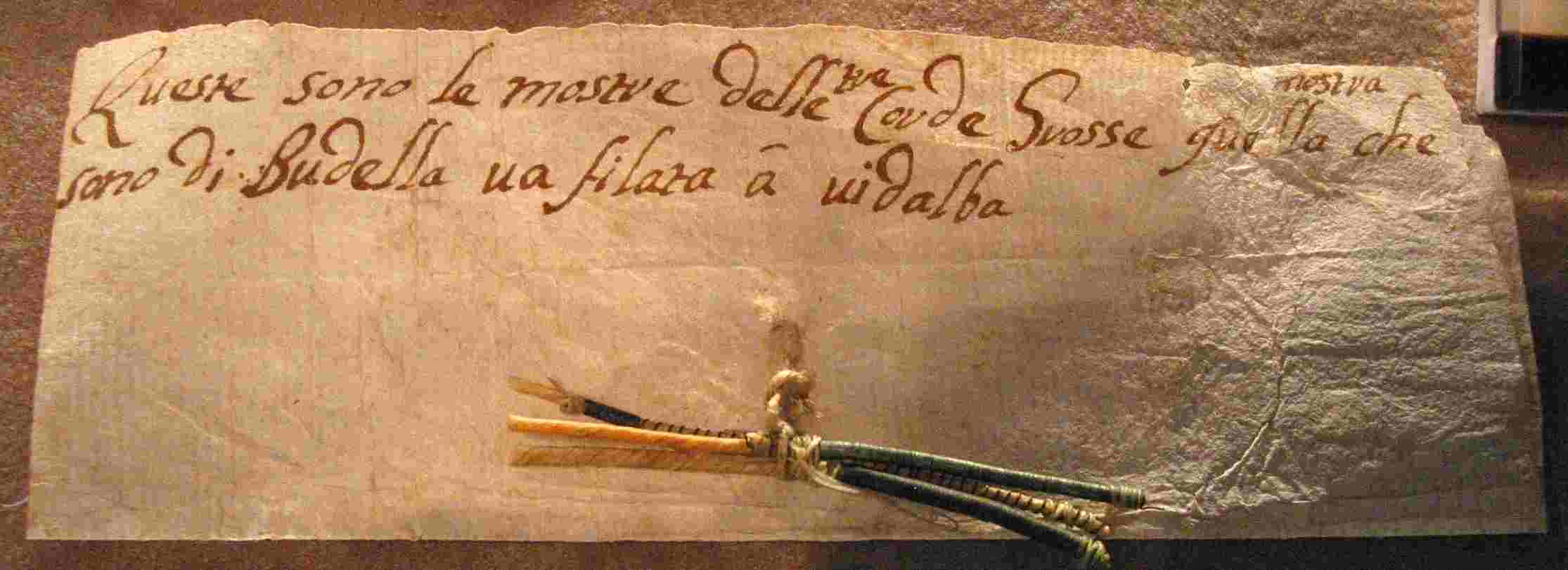
Stradivari’s wound strings, Museo Stradivariano, Cremona.
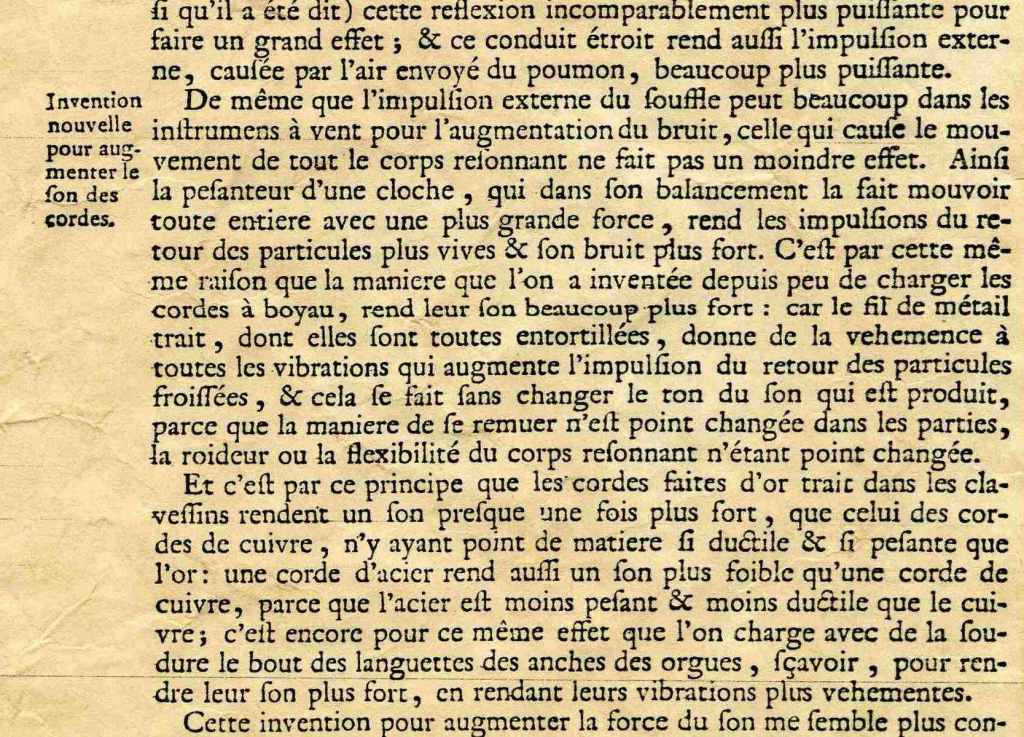
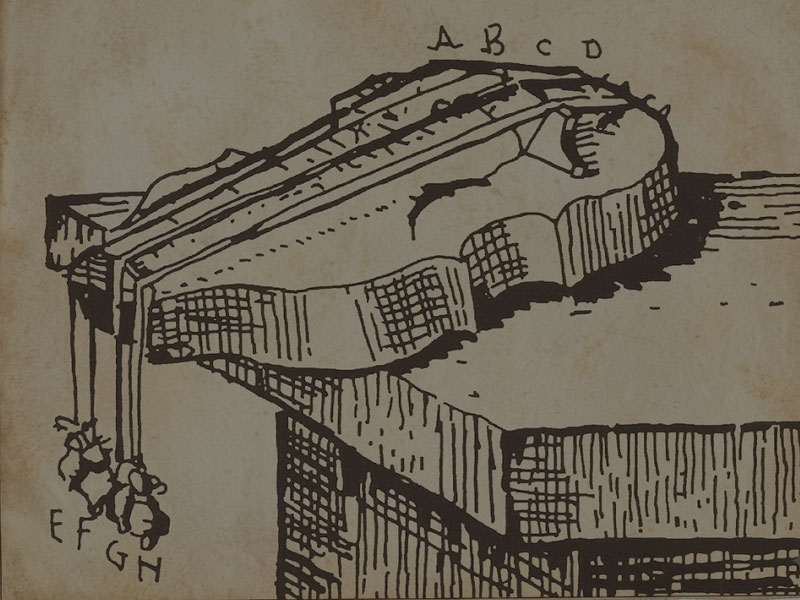
Claude Perrault, Œuvres de physique, Amsterdam 1680, detail.
The fourth and last age of musical strings — which continues to this day — is characterised by the appearance of wound bass strings, made of a gut core (in practice an ordinary string) or silk, tightly wrapped, in close or spaced turns, with a thin round-section metal wire. The earliest handwritten source at our disposal dates from 1659: "Goretsky hath an invention of Lute strings covered whith silver wyer, or strings which make a most admirable musick. Mr Boyle."; and again: "…string of guts done about with silver wyer, makes a very sweet musick, being of Goretsky’s invention…". This was followed, chronologically, by John Playford’s Treatise for the Bass Viol of 1664, which represents, so to speak, the official announcement made to the musical world of the time, and then by others.
The diffusion of these new and more efficient basses does not, however, appear to have been as rapid as one might expect, if the gambist Sainte Colombe introduced them in France only around 1675, and in Italy — a country that had always produced renowned gut strings — they are recorded only from 1677; the earliest European pictorial depiction known to us of a violin in which the fourth bass string can be seen as white against the three more acute strings, dark yellow — wound, in all likelihood, in silver or silvered copper — dates nonetheless from 1685.
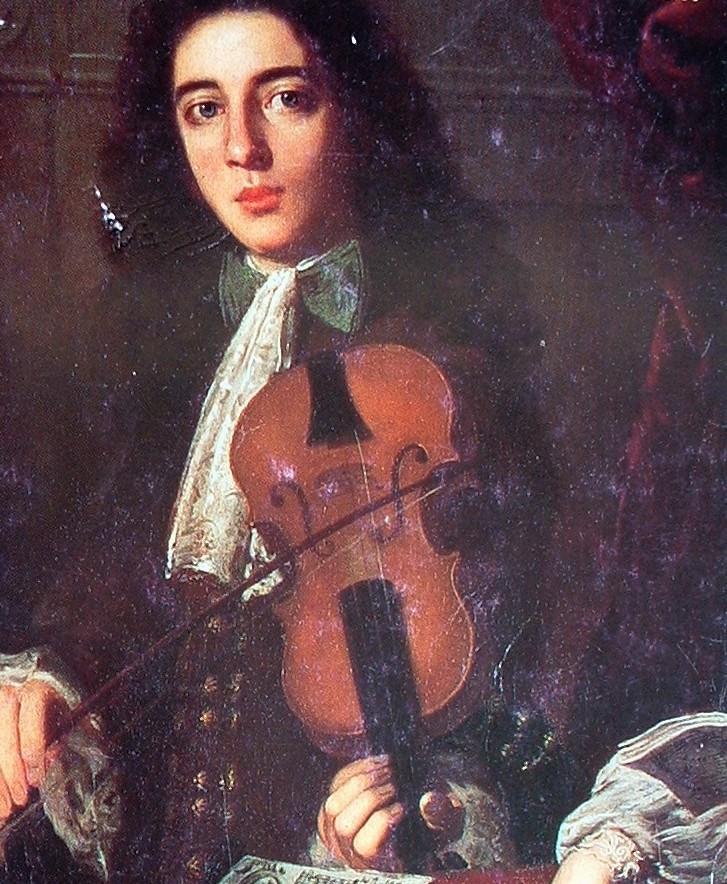
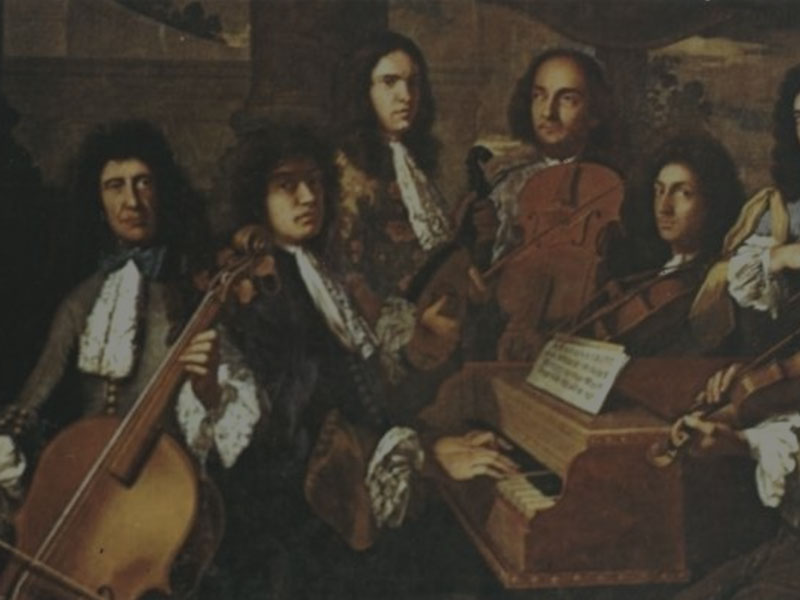
Antonio Domenico Gabbiani, Ritratto di musicisti alla corte medicea, Florence, Palazzo Pitti, 1684–7: the earliest known example of a wound fourth string on the violin.

François Puget, Les musiciens de Louis XIV, c. 1687, Paris, Musée du Louvre.
The consequences for instrument building and for music were profound, so much so that one can rightly speak of a true dividing wall between "before" and "after". Indeed, while on the more acute instruments such as the violin the vibrating lengths had always been of human scale, on larger instruments they had always been badly disproportionate to what the fingers of the left hand could easily reach. It stands to reason that, as soon as the old makers had access to much more efficient basses, one of the things that occurred to them was precisely to shorten systematically the vibrating lengths of the fundamental instruments, making them far more agile. This paved the way for new musical forms, while for the violin it meant a more frequent use of the stopped fourth string than in earlier periods.
2. Gut string manufacturing technology in the 18th–19th century
Before examining the typical characteristics of 18th–19th-century violin setups — a period belonging to the fourth evolutionary age of gut strings — it is necessary to open a specific parenthesis on the period that immediately precedes it, that is, before the coming of wound bass strings, in order to know which types of string were available in the late 17th century and which were used on our instrument.
The Treatise of the Englishman Thomas Mace (London 1676) is undoubtedly the most exhaustive document, as far as strings are concerned, from the period before the age of Bach and Mozart. What immediately strikes the eye — though this already appeared in John Dowland’s lute instructions — is their division into three basic categories: strings for the trebles (Minikins, Romans), strings for the middles (Venice Catlins), strings for the basses (Lyons or the "deep dark red colour" Pistoys). This arrangement strongly suggests not merely a commercial distinction or one of place of origin (from the early 16th century strings already took their names from their place of origin) but also a technological one. Each of these three classes seems, in other words, to indicate that specific, differentiated manufacturing strategies were followed in order gradually to ensure the mechanical and acoustic characteristics needed for every register of the instrument, thereby securing a perfect and homogeneous transition between the various registers. In more general terms it is clear to any stringmaker today, for example, that one cannot employ the specific technology used to make gut trebles for the lute (where everything is invested in achieving maximum resistance to tension and fraying) in order to make, say, "D" strings for the violin, where on the contrary the guiding criterion is the greatest possible reduction of the string’s stiffness. As can be observed, despite the fact that the earliest mentions of the appearance of wound strings are still of English origin and predate this treatise, the basses described are still those of pure gut, of Italian or French origin.
A 17th-century violin setup is described for us by Talbot, corroborated also by some iconographic evidence in which one can observe a clear chromatic differentiation between the first two treble strings — light yellow in colour — and the third and fourth, distinctly brown: "Best strings are Romans 1st and 2nd[;] of Venice Catlins: 3rd & 4th best be finest & smoothest Lyons, all 4 differ in size." Mersenne, so far as our information goes, is the only 17th-century source to have given us a rough but useful indication of violin string gauges: "…la chantarelle des Dessus est aussi grosse que la quatriesme des Luths, que la force des sons de cet instrument vient de la briesueté de les chordes." This means a diameter probably between 0.70 and 0.80 mm.
With the rise of wound strings (and as a consequence of the strong commercial demand, especially for bowed instruments), the traditional and perhaps also secret techniques for constructing basses in pure gut were rapidly lost, forgotten by the new generations of stringmakers: a thin metal wire wound around a gut string was in fact enough to obtain an extraordinarily resonant bass string. As a consequence, their manufacture probably passed straight away into the hands of luthiers and sometimes of musicians themselves: winding an ordinary gut string with wire taken from a spinet or cittern was certainly no problem for the enterprising luthiers and musicians of the time.
For the stringmakers of the early 18th century there must therefore have been a drastic narrowing of their productive versatility: in the exhaustive treatises and documents of the mid-18th century the rich variety of string types described in those of the 17th century has in fact been completely lost, in favour of a single manufacturing system — the one that then remained in use in the following centuries and, in substance, to this day.
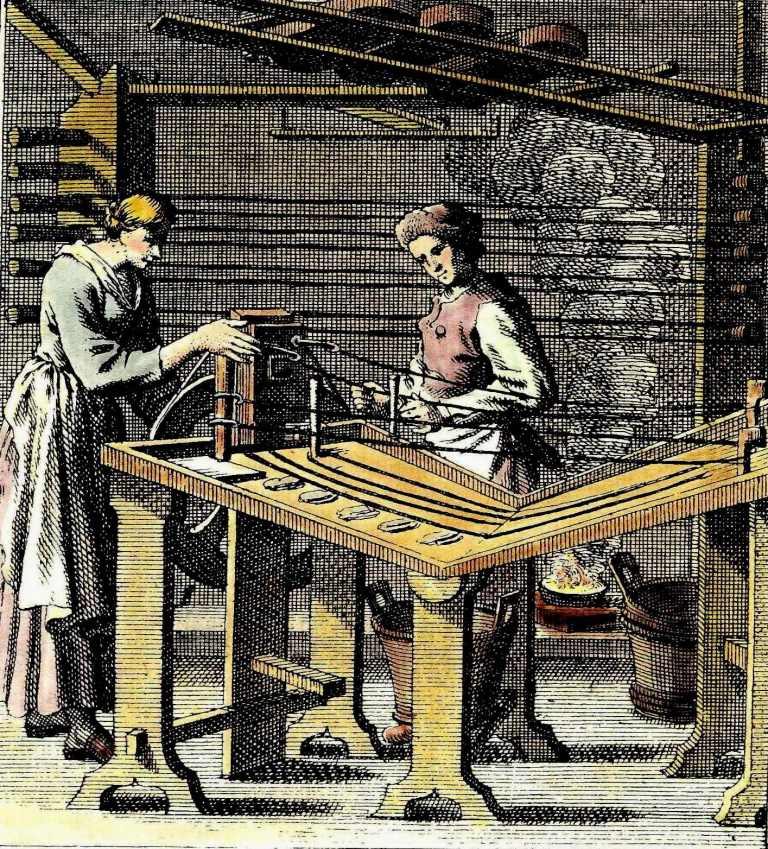
Fig. 1: Christoph Weigel, Der Saitenmacher, Regensburg 1698.
The procedure followed during the 18th century (Fig. 1) appears at first sight surprisingly similar to today’s, but there are in fact some substantial differences that suggest the strings of that time — at least until the end of the 19th century — were probably less stiff, above all because more twisted, and hence generally better than ours.
The procedure of the time first called for the use of whole lamb gut — at least 50 feet long — which, after being carefully emptied and rinsed for several days in running water, underwent a series of treatments aimed at removing non-muscular membranes and fatty substances. This was achieved by leaving the guts immersed for several days in alkaline baths of increasing concentration, so that the non-muscular membranes and the fat that always accompanies gut could easily be removed by means of a simple but delicate scraping performed with the back of a knife or with a fragment of marsh reed.
The alkaline baths consisted of vegetable ashes dissolved in water (potash). The progressive increase in the concentration of the baths is explained by the fact that at the start of the degreasing treatment dilute alkaline solutions are already sufficient to remove the more easily soluble fatty substances; maximum potash concentration is reserved for the end, when a much more energetic action is needed against whatever still resists removal. At this stage a modest addition of rock alum could also follow, whose astringent and tanning effect slightly hardened the gut. The alkaline baths, in other words, allowed a concomitant process of fermentation and saponification of the organic matter, facilitating the mechanical detachment of the useless parts and leaving free and perfectly degreased only the muscular membrane — the part that mattered to the stringmaker.
Several degreased guts were then carefully selected and gathered into parallel bundles (according to the diameter of string required), knotted at the ends and subsequently twisted by means of a small winch (the opposite end of the proto-string was fixed to a peg fastened to a side post of the drying frame). Once the string had been properly twisted, the free end was in turn fixed to the peg on the opposite post of the frame, putting the damp string under tension.
When the frame was well laden with strings it was carried to a special room where it was bleached by sulphuring — in other words, burning flowers of sulphur in a basin and subjecting the strings for days to the bleaching action of the sulphur dioxide released by the combustion. At the end of this operation the strings were further twisted, and then finally air-dried, a process that took only a few hours.
The last stage consisted of polishing, by rubbing their surface with a plant possessing abrasive properties (soaked in the alkaline degreasing liquid, or "temper"): horsetail, or scouring rush. The polished strings were then greased with olive oil, cut at the ends of the frame and packed into coils: each package could contain from 15 to 30 strings or more, immersed in olive oil.
There are, then, substantial differences between the procedure followed today and that of the past. The first thing to note is that lamb gut is used far less often nowadays, in favour of material from older animals.
The practice generally followed by stringmakers of the 18th century and much of the 19th also called for the use of whole gut, whereas today strips are used, obtained by cutting the raw material lengthwise, with special machines or even by hand. This limits the degree of conicity of the resulting string, a problem that had always plagued the treble strings of the past, since intestines naturally present a diameter that increases along their length. The longitudinal cutting of gut is commonly traced back to the late 18th century and to German stringmakers; in reality this operation was already practised in Italy well past the mid-16th century (see for instance the second Statute of the Roman Stringmakers: the document, dated 1587 and discovered in 1999 by Marco Pesci of Rome), so much so that some of the period’s guild regulations threatened heavy penalties against stringmakers (Roman ones, in this case) caught "…splitting the strands, or the guts, down the middle…". Evidently it was not considered good practice — whatever advantages it brought to the regularity of the resulting gauge — if the most prestigious and powerful guild of stringmakers of the time, the Roman one, forbade its use.
Further points of difference are the current use of pure alkaline salts (such as sodium carbonate) in place of vegetable potash — impure potassium carbonate, obtained by burning grape marc and wine lees — to degrease the guts, while for bleaching one now relies on oxidising agents such as hydrogen peroxide or sodium peroxide. The last and most substantial difference from the past lies in the fact that raw, dried strings are no longer lightly polished with abrasive plants — or with powdered pumice — but are instead ground on a special machine (centreless grinding), which produces the rich range of commercial diameters required today.
It might therefore seem at first glance that the modernisation of this centuries-old and essentially unchanged string-making technology was an entirely positive development, but things are by no means so simple. Some apparently trivial steps of the old manufacturing system have never been investigated as they should have been, and the practical difference can be widely observed by comparing the few surviving string samples — even from the early 20th century — with those available today: the former are often well twisted and soft, the latter frequently stiff, hard and poorly twisted. Our strings, moreover, if not varnished, statistically have a short working life once mounted on the instrument.
The matter of durability is easily explained: a string made of whole guts that has undergone only a light polishing treatment with abrasive plant or pumice shows a much smaller number of broken surface fibres than a string made from strips of gut whose final diameter has been forcibly imposed by mechanical grinding, which may remove a considerable amount of material if, unluckily, one starts from a raw string too thick relative to the required final diameter.
The second important aspect — which weighs heavily on overall acoustic performance — concerns the fact that today’s gut strings seem in many cases directed towards giving up the search for maximum elasticity in favour of tensile strength alone, forgetting that the task of a musical string is to sound as well as possible, certainly not to compete with a towing rope. In other words it must show the capacity to transform the mechanical impulse imparted by the bow hair or by a finger into a vibrational motion as free as possible from internal friction (damping) within the string itself.
Today’s string production gives up the search for maximum elasticity from the moment it stops systematically using the gut of young animals (which is less stiff than that of older beasts), from the moment it overuses hardening substances such as alum, and from the moment vegetable potash (once called oil of tartar, and widely used until the early years of this century to soften the skin of the hands) was replaced by sodium carbonate, which does not appear to share that property. Further support for the importance of vegetable potash to the final quality of the gut strings produced (potash that 18th-century Italian stringmakers made exclusively by calcining wine lees, while the French, in the same period, used for the purpose the so-called sifted ashes, which however contained decidedly less potash) comes from Jaubert’s Dictionnaire raisonné:
On pense qu’il a encore une légere opération à faire aux cordes avant de les exposer en vente; elle consiste raisemblement à les frotter d’huile pour les adoucir et les rendre encore plus souples: mais les Boyaudiers en sont un mystere; ils assurent qu’ils ne se servent point d’hule, et que c’est dans cette derniere manœuvre que consiste tout le secret de leur art. Le Boyaudiers ont raison d’assurer qu’ils ne se servent point d’uile pour assouplir et donner du son à leurs corde, mais ils y emploient des sels qui sont extraits de la lie de vin.
Finally, sonority is lost because modern strings are often less twisted than those of the past. This can be deduced not only from information found in old documents but also by examining surviving fragments. It is hardly necessary to recall that the twist factor is fundamental in determining the degree of elasticity of a gut string. It should be said that the softening effect induced on gut by oil of tartar allows a higher degree of twist to be achieved than the maximum obtainable today.
Perhaps no one has investigated thoroughly enough why the old stringmakers made the bleaching operation last — though in truth it would be completed within a few hours of exposure to sulphur dioxide fumes — for several days, up to eight. Only recently has it come to be believed that this laborious and inconvenient procedure produces something more in the gut than a mere — and perhaps pointless — bleaching of the material (Galeazzi disapproved of strings being excessively white), something the old stringmakers had long been empirically aware of: the probable formation of bridges made by sulphur atoms, linking together the long chains of collagen — the main constituent of gut — and so increasing its elastic properties at the expense of its plastic ones. A true vulcanisation, so to speak, rather like turning a soft iron wire into spring steel.
In Griselini’s Dictionary (vol. V, p. 131 or thereabouts, 1765) one can read, on this point, a decidedly illuminating passage:
- Griselini (1765): "But the operation we have described is not enough to give the string the right elasticity, and to make it resonant. There is, it is said, yet another secret… that they dry slowly to the vapours of sulphur, and become elastic."
- Labarraque (1823) takes up the same idea: "The action of sulphur vapour is indispensable for obtaining good musical strings…"
- Philippe Savaresse (1865), the great 19th-century French stringmaker: "Sulphuring also greatly affects the quality of strings. It is indispensable to obtain good ones."
Because sulphuring of strings has been held to be an operation intended only to bleach the gut, it has since been carried out by convenient chemical reagents in solution, whose excessive use can however weaken the tensile strength of the material.
The function of olive oil, too, seems to go well beyond what has been supposed — that is, a merely cosmetic function after polishing. All this would make sense if the string were only lightly oiled shortly before packaging. According to Italian tradition, strings were instead left literally immersed in oil — inside the waterproof package — for a long time, months probably, given the custom of never using strings that were too fresh on musical instruments. It will not escape a careful observer that gut immersed for a long time in olive oil acquires a particular "hand", as if it had undergone a genuine hardening tanning treatment, the kind performed since the most remote times on hides and leathers to make them more durable (oil tanning, or fat-liquoring). The durability of a string so treated is indeed increased. This also appears to be the function of the rock alum added to the alkaline solution before the twisting stage.
The logical conclusion is that the gut strings of the past were, in certain respects — acoustically, but above all in terms of durability — superior to ours, which can at least boast dimensional precision and hence are rarely "false": the real and constant problem of strings from the period before the advent of mechanical grinding. Indeed, until almost the middle of the 20th century every musician had to be able to tell a false string from a good one by the test described by Ganassi (first half of the 16th century) and by Mersenne: that is, plucking with the little finger, at one end, a string held taut between the hands and observing the way the string under examination vibrates.
3. Production centres
During the 17th century the most prestigious centre of gut-string production, in Italy and in Europe as a whole, was certainly Rome, which in 1735 boasted about twenty stringmaking workshops (governed by precise guild statutes) supplying the whole of Europe with gut strings of excellent quality. Roman first strings remained famous until well past the end of the 18th century, the period in which the powerful guild of the Eternal City’s stringmakers was dissolved. Quality primacy then passed, throughout the 19th century and beyond, to the accomplished stringmakers of Naples, closely followed by those of the city of Padua (in 1786 the names that stand out are the stringmaker Antonio Bagatella and the firm "Gio. Battista, ed Antonio fratelli Priuli detto Romanin", founded in 1613 by Antonio Romanin, possibly a native of Rome), which ceased the production of gut strings for good in 1911. Research carried out at the Padua Chamber of Commerce has shown that the Romanin workshop was later taken over by the Calegari family from 1849, and the firm was then continued by the "Eredi Nicola Bella" of Giuseppe Drezza in Verona in the early 1900s: in 1911 production ceased, and with it the long and glorious Paduan stringmaking tradition.
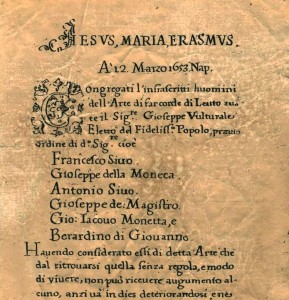
Opening page of the Neapolitan stringmakers’ statute, 12 March 1653.
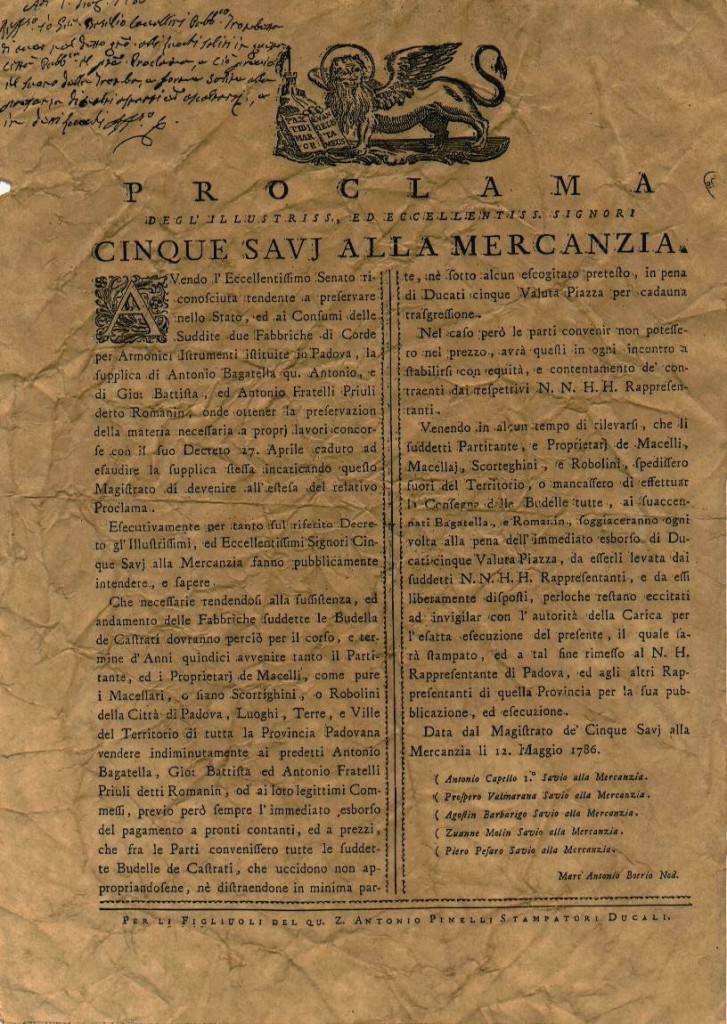
Proclamation of the Cinque Savj alla Mercanzia concerning the two Paduan string workshops (Bagatella and Priuli detto Romanin), 12 May 1786.
De Lalande (op. cit., p. 514, in 1769) wrote:
La fabrication des cordes de violon est une chose qui est presque réservée à l’Italie, Naplés & Rome en fournissent toute l’Europe & il y a toiours beaucoup de mystère dans ces branches exclusives de commerce…
Here now are Galeazzi’s indications:
We come finally to strings: strings must be supplied by the best factories of Italy; namely those of Padua; of Naples; of Rome; of Budrio in the Bolognese; and of L’Aquila in Abruzzo. There are also other factories in Città di Castello; Perugia; Rieti; Teramo; and other places; but the first ones carry the honours; especially those of Padua; and of Naples.
Spohr reports as follows, in the original German: "Es giebt Italiänische und Deutsche Saiten. Letztere sind aber viel schlechter wie jene und zum Solospiel gar nicht zu gebrauchen. Auch die Italiänischen Saiten sind von ungleicher Güte und in der Regel die Neapolitanischen den Römischen und diese denen von Padua und Mailand vorzuziehen" (there are Italian strings and German strings, of which the former are to be preferred, although even among Italian strings some are bad. Ordinarily the best are the Neapolitan strings, then come those of Rome, and finally those of Padua and Milan; but these last are worth little).
The unequalled quality of the violin first strings — but also for other instruments — produced in Naples had always been a genuine puzzle for the French, who were skilled at making any kind of string well except the first strings for this instrument. These were therefore imported in large quantity from Italy, and at prices that seem to have been prohibitive. The French, towards the end of the 18th century, even instituted a prize for whoever could match the quality of the Neapolitan product. The gold medal was in the end awarded to the Paris stringmaker of… Neapolitan origin, Savaresse, who brilliantly solved the case: the secret lay in the fact that in Naples, and in numerous other parts of Italy, gut from rather young animals was used — unlike the French; but this had in truth already been written by De Lalande in his Voyage some decades earlier.
The primacy of the quality of strings made in Italy is found unaltered even at the end of the 19th century, so much so that George Hart wrote:
Musical strings are manufactured in Italy, Germany, France and England. The Italians rank first, as in the past times, in this manufacture, their proficiency being evident in the three chief requisites for string, viz. high finish, great durably, and purity of sound. There are manufactories at Rome, Naples, Padua and Verona […]. The German strings now rank next to the Italian, Saxony being the seat of manufacture […]. The French take the third place […]. The English manufacture all qualities, but chietty the cheaper kinds…
Forino (1905) in turn reports the following:
…the workshops of Berti and of Colla in Rome, of Ruffini in Naples, were once famous. Today the products of Righetti in Treviso, of Raffaele di Bartolomeo in Naples, of Nicola Morante at Tavernale di Barra (Naples), of Nicola Di Russo and of Raffaele Pistola Profeta (Ruffini’s successor) at Salle (Pescara), of Luigi D’Orazi also at Salle and of Conti at Mugellano (Rieti) are much appreciated […]. After Italy and Germany comes France in third place, which produces excellent strings above all for the harp: the strings of Lyon enjoy a reputation for excellence.
4. String evaluation criteria
What were the guiding criteria that set a good string apart from a poor one? The first thing to note is that professional musicians of the time seem to have possessed great skill in recognising good-quality material by touch and sight (even though the region of origin was already in itself considered a reliable index of a product’s quality), and in telling a false string from one that vibrates well: this knowledge was always handed down from master to pupil, in a kind of oral tradition that began to break down perhaps from the dawn of this century, when it gradually became customary to rely blindly on the large stringmaking firms that were developing chiefly in Germany and France at the end of the 19th and start of the 20th century, but not in Italy (the Italian stringmaker, understood as a craft figure employing a handful of people, was by then in decline: before and after the First World War most of them began to close their workshops or chose to emigrate abroad, America above all, bringing about the rapid end of the glorious, centuries-old Italian tradition). It was these large firms that in effect imposed their own choices in terms of manufacturing strategy and standard commercial gauges. The age-old custom of oral transmission may explain why so little was ever written down about the criteria for choosing strings in the paper documents of the time. Here is what a few sources in our possession report:
- Galeazzi: "A good string must be diaphanous; the colour of gold, that is, tending to light yellow, and not pure white as some would have it; smooth and polished, though this is independent of whether it has been pumiced; without knots or joins; supremely elastic and strong; and not limp and yielding."
- Labarraque: "La corde la meilleure et qui doit faire le plus long usage, est celle qui change le moins d’aspect quand on la monte…"; those that tarnish and lose their transparency will not last.
- Spohr: "Die äussern Kennzeichen einer guten Saite sind: weisse Farbe, Durchsichtigkeit und glatte Oberfläche. Doch darf letztere nicht, wie bey den deutschen Saiten, durch das Abschleifen mit Bims-Stein hervorgebracht seyn, da geschliffene Saiten stets schreiend und falsch im Ton sind" (the good string is distinguished by its white colour, its clarity and smoothness […]. Old, spoiled strings, or those of poor manufacture, are recognised at once by their dull yellow colour; they are neither transparent nor elastic like good strings).
- Maugin & Maigne (quoting Philippe Savaresse): "Les chantarelles, dit M. P. Savaresse, doivent ètre transparentes, parfaitement unies et assenz régulières de grosseur. Elles ne doivent pas être trop blanches, car cela prouverait qu’elles ont été faites avec des agneaux trop jeunes, et lorsqu’on serre un paquet de chantarelles sous la main, elles doivent paraitre élastiques et revenir promptement comme le ferait un ressort d’acier. […] Les grosses cordes, deuxième et troisième, doivent, au contraire, être transparentes et très blanches. Il faut, en outre, qu’elles soient très molles quand on en comprime un paquet, mais elles ne doivent pas changer de couleur et elles doivent revenir promptement à leur état cylindrique; si elles présentaient trop de raideur, cela indiquerait qu’elles ont été faites avec des boyaux trop résistants, et, dans ce cas, elles auraient une mauvaise qualité de son."
- George Hart (op. cit., pp. 49–50): "In selecting the E string, choose those that are most transparent; the seconds and thirds, as they are made with several threads, are seldom very clear […] and hence, absence of transparency in their case denotes inferior material."
The last document we present was printed in 1905 and is probably the last text still to set out the criteria for choosing a gut string according to the 19th-century tradition:
- Forino (op. cit.): "German strings have the merit of durability and, like all the products of that nation, also that of a good price. They are extremely smooth, hard to the touch, so much so that they seem made of steel [!]: the tone too suffers from that hardness […]. A good string must be neither too smooth nor too white, for pumicing does not help good sonority: it must be very elastic and perfectly cylindrical […]. To test elasticity it will suffice to press a still-twisted string between the fingers and compare, for instance, a German one with an Italian one."
5. Types of string
The types of string available from the early 18th century onward for the violin — and for the other bowed instruments — can be summed up in two main classes: oiled natural gut strings for the treble and middle registers, and wound strings on a gut core for the basses. Compared with the 17th century, one can observe that strings in plain gut made specifically for the middle registers (the "Venice Catlines", the thin "Lyons" etc.) have essentially disappeared from the scene, tending to make the timbral and dynamic transition between the more acute plain-gut strings and the following wound ones more difficult.
This was especially evident in the fourth string of the baroque bass viol, which had to solve this awkward problem by using an openly-wound string, wound, so to speak, only halfway (hence called by the French demi-filée), which best joined the sonority of the third, plain-gut string with the fully wound fifth.
The typical Italian setup — but then, during the 18th century, also the English and German-speaking one — for the violin, already from the late 17th century, comprised, presumably always, the use of the first three treble strings in plain gut and only the fourth of the wound type. As for France, only one source made clear that the third string, too, was wound like the fourth, but with the turns of metal wire not touching one another, rather with a certain spacing, in other words wound "demi". This should not lead us to rule out categorically a potential use, in 18th-century France, of a plain-gut third as well.
The Italian setup (the first three in gut and the fourth of the wound type) does not appear to have undergone the slightest change over the course of the 19th century, at least until the 1920s, when the plain-gut third string began to be gradually supplanted by an aluminium-wound one, generally paired with more acute strings made of piano steel.
6. Pitches
An important element, indispensable for determining the possible working tensions of the violin, is the frequency of the pitch standard (or rather standards) in use during the 18th and 19th centuries. At the time these varied considerably, and not only from state to state but even in the same place in different years.
In 1834, it is true, the Stuttgart Congress approved a standard pitch of 440 Hz, but this recommendation was never followed. In 1858 the French government reported that the standard pitch of the Paris Opéra and of Italian opera was 448 Hz, but a year later the commission for standardising pitch (made up of illustrious figures such as Halévy, Auber, Berlioz, Meyerbeer, Rossini and Thomas) — the first such body in Europe — set an A of 435 Hz by imperial decree. In England the orchestral pitch stood at 424 Hz in 1813, but rose to 452 Hz by 1859. The supposed 19th-century pitch of 435 Hz appears to be more a chimera than a historical reality, and this certainly holds true even in the second half of the century. With the 1885 Vienna Congress pitch was officially fixed at 870 simple vibrations, or 435 double ones, a recommendation adopted by the Italian government only in 1887. But in practice pitch went on fluctuating undisturbed. Only with the 1939 conference convened by the International Organization for Standardization was clarity finally brought to the jungle of pitch standards, proposing an A of 440 Hz. The rest is recent history. Here, for simplicity of calculation and by convention, we assume a pitch of 435 Hz.
Here is the data reported by Alexander J. Ellis (The History of Musical Pitch, London 1880), as reproduced in Pietro Righini, La lunga storia del diapason, Berben, Ancona 1990:
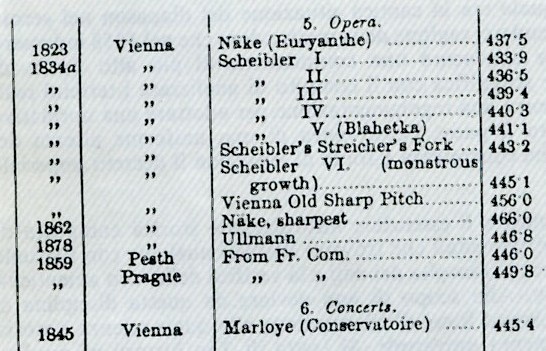
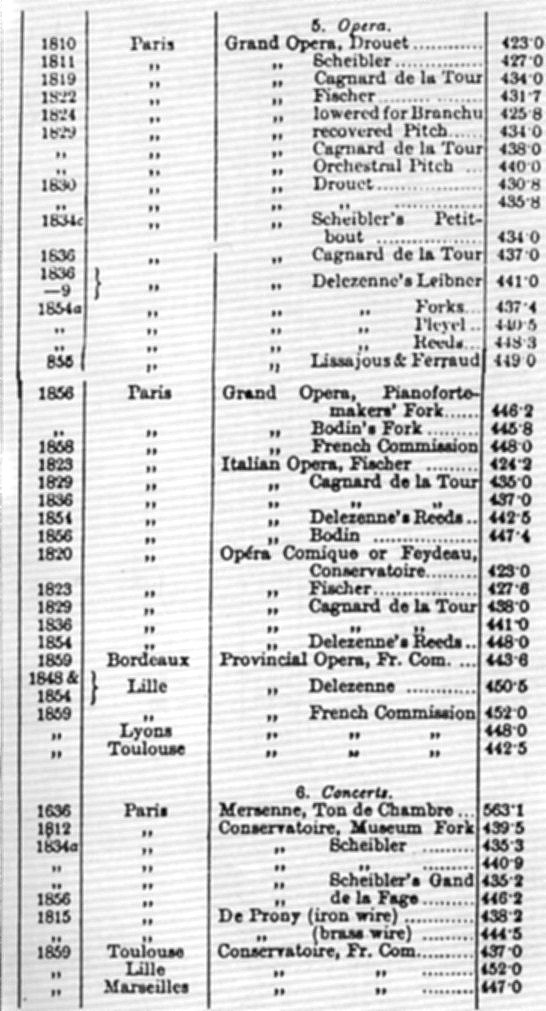
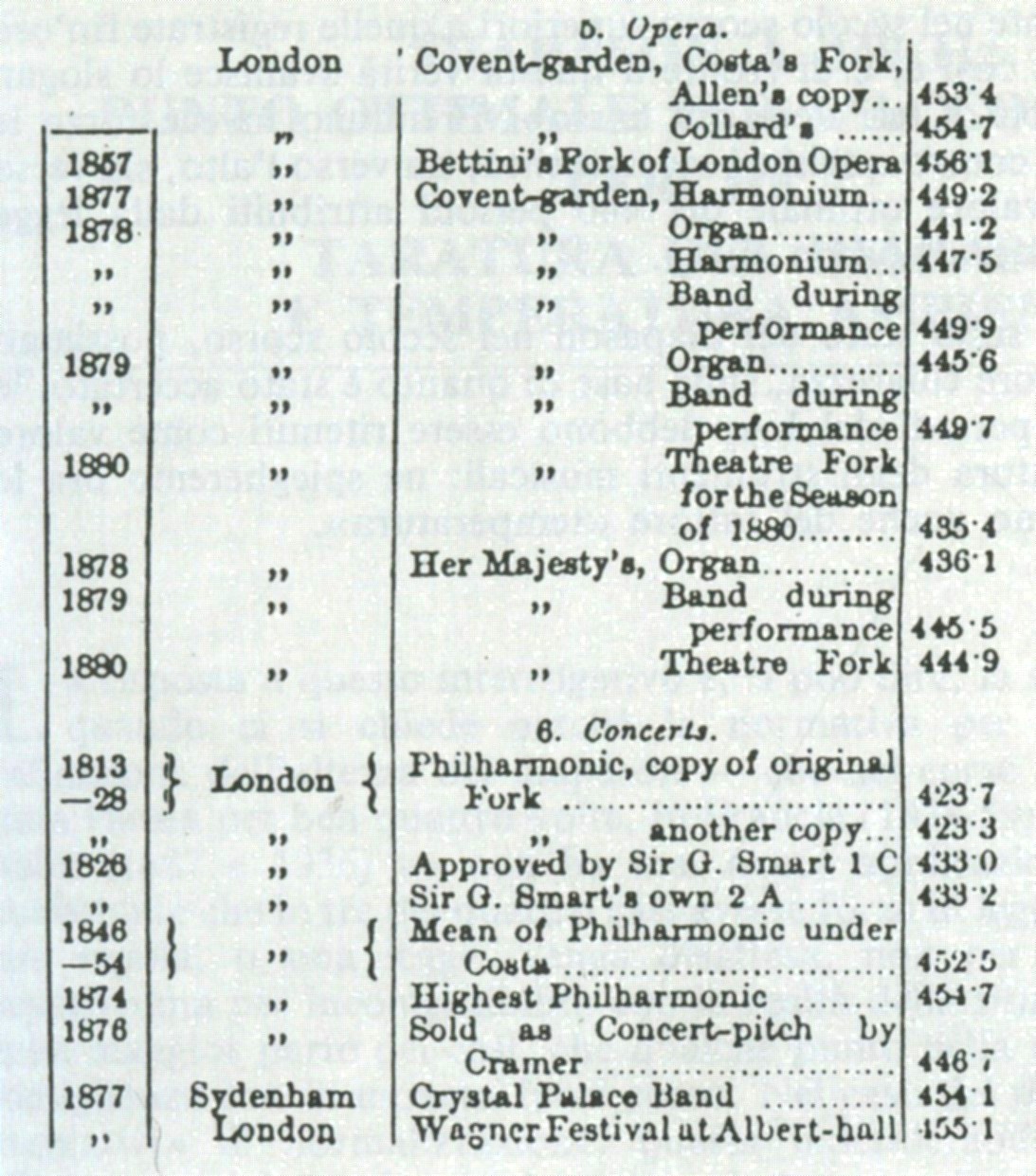
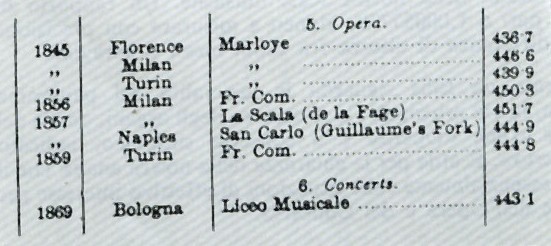
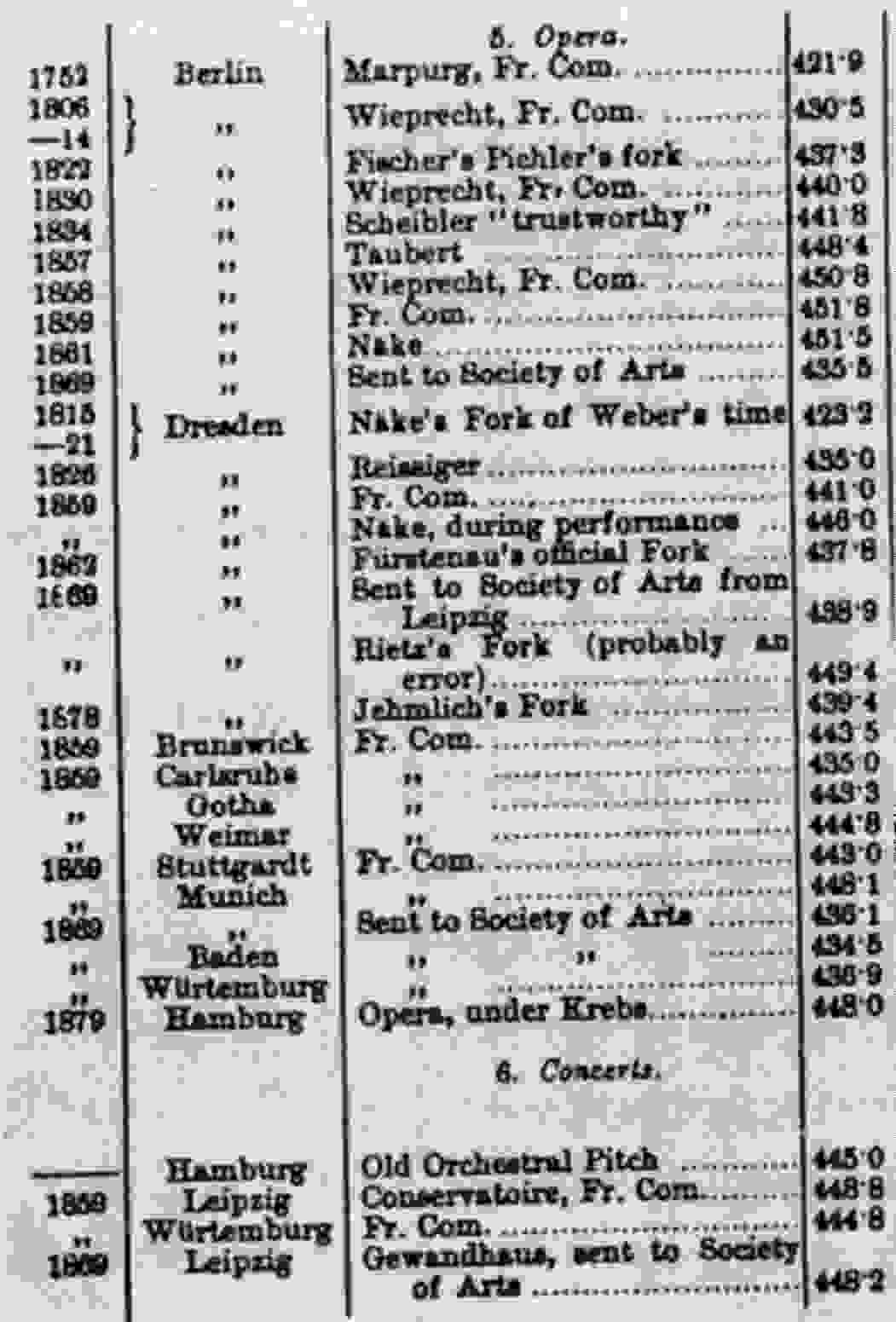
7. String gauges
To answer this fundamental question one must necessarily take into account the treatise literature of the time — as other researchers have already done — but from a different angle than usual, namely starting above all from the information handed down to us by the stringmakers of the period. This approach, in our view, allows one to start off on the right foot because, whatever may have been written in period treatises and violin methods, it was the stringmakers who, in the end, established (or rather imposed) the commercial diameters of the strings of their time.
The diameter of a string is inseparably linked to the number of guts of which it is made, which in reality determine — for a given number employed — not a single final gauge but rather a certain oscillation around an average value, because guts, being a natural product, are never perfectly identical to one another. This is a fundamental point that must be made clear from the outset.
Unlike today, when a great variety of commercial string sizes is available, increasing in a constant progression imposed by mechanical grinding (0.60 mm, 0.62 mm, 0.64 mm and so on), the final gauge of strings produced up to the early decades of the 20th century was determined almost exclusively by the number of guts coupled to make a string of a given diameter. As some documents report, strings were in fact distinguished commercially not by their diameter in mm but by a number written on the package, indicating the quantity of guts used to make the strings inside the oiled envelope.
Stringmakers always took care to standardise as far as possible the quality of the guts they used (seeking material from lambs of the same age, breed and place of origin, and finally selecting the guts carefully before pairing them). Nonetheless a certain degree of uncertainty — or rather oscillation — in the final gauge was unavoidable, and this could not be remedied by generous hand polishing (which is not, after all, a precise mechanical grinding operation but a surface-smoothing one), since there was a real risk of making a string false through the practical difficulty of maintaining, by hand, a perfectly round gut so worked, or of causing excessive breakage of surface fibres. Indeed violin first strings were often not polished at all, precisely to avoid this ever-present risk.
A string made, say, from three guts would therefore take on a range of diameters well represented by an inverted bell curve (a Gaussian). This naturally holds true for strings of other gauges too, obtained by pairing different numbers of guts. The stringmaker’s skill lay, then, in ensuring that the package marked, for example, with the number three showed only a small variation around the average diameter, as well as a certain reproducibility of that average across production batches made at different times — an aspect understandably appreciated by musicians of the day. In other words, obtaining a very narrow base to the Gaussian curve. Some idea of the width of the diameter range obtainable from strings made from the same number of guts can perhaps be gathered from the three degrees of tension suggested for the violin first string by George Hart, corresponding to the following extremes of diameter: 0.65–0.73 mm. It stands to reason that, as the number of guts to be coupled increases — in order to obtain greater thicknesses — the width of the resulting diameter variation shrinks rapidly, owing to the averaging effect produced by the many coupled guts, and so too does the gauge gap between two adjacent strings differing by one gut, as for instance between a string made of ten strands and one made of eleven. The whole thing is rather like the frets of a guitar drawing closer together as one moves toward the higher positions on the fingerboard.
Let us now turn to the historical information coming from — or at least traceable to — the stringmakers themselves.
De Lalande / Angelucci (c. 1760)
The earliest source known to us reporting data from Italy appears to be De Lalande’s Voyage en Italie, which gave very interesting information on the activity of the most accomplished Abruzzese stringmakers — Angelo and Domenico Antonio Angelucci, the latter dying in 1765, who around the first half of the 18th century owned an important string factory in Naples. In this first document we learn that making the violin first string requires three whole lamb guts eight or nine months old, while the last (that is, the last plain-gut string, and so the "D", certainly not the fourth, which is, as we shall see, wound) takes seven. The use of three guts (also called strands) to make the violin first string is also confirmed by a do-it-yourself recipe probably dating from the early 18th century.
This same tendency — that is, the use of three whole guts, but sometimes also four, thinner ones — to make the violin "E" continues uninterrupted throughout the 19th century. It is echoed also in the manual of Maugin & Maigne, which reports information supplied by the French stringmaker of Neapolitan origin Henry Savaresse: "Les chantarelles se composent de 4, 5, ou 6 fils, selon la grosseur du boyau, et chaque fil est formé d’une moitié de boyau divisé dans sa longueur. Les mi de violon ont de 3 à 4 fils pleins, mais très fins. Les la en ont le meme nombre, mais plus forts. Quant aux re, ils en ont de 6 à 7 pleins." This is confirmed also by Philippe Savaresse, who in turn wrote in 1874: "On a longtemps attribué la supériorité des cordes de Naples aux secrets de fabrique, plus tard on l’a attribuée à la petite espèce de moutons qui permettait de faire les chantarelles à trois fils…" He went on to write: "La chantarelle ayant trois fils, si les autres cordes sont faites avec les mêmes intestins, la seconde aura 5 ou 6 fils et la troisieme 8 et 9…" It is evident that where the gut had been split down the middle, twice the number of strands would then be needed.
One can therefore conclude, with a fair degree of confidence, that a violin first string was universally made by Italian stringmakers — but also by French and German ones — from three (sometimes four, if thinner) whole lamb guts about a year old, or in double quantity if these had previously been split lengthwise into two strips. But how does all this translate into actual string diameters? The answer can be obtained both experimentally and by examining the historical record. Today’s manufacture of strings from three whole lamb guts normally yields a window of unpolished-string diameters between 0.66 and 0.75 mm. And as for the historical record?
Riccati (1767)
In Italy, by far the most significant 18th-century source for determining diameters is undoubtedly Count Giordano Riccati of Treviso. Riccati was not only an accomplished physicist in the field of acoustics and a theorist of harmony but also a good amateur violinist. In his work Delle corde, ovvero fibre elastiche, the drafting of which began as early as 1740, we discover that he carefully measured the weight and length of the first three gut strings of his violin (p. 130):
Colle bilancette dell’oro pesai tre porzioni egualmente lunghe piedi 1 ½ Veneziani delle tre corde del Violino, che si chiamano il tenore, il canto e il cantino. Tralasciai d’indagare il peso della corda più grave; perché questa non è come l’altre di sola minugia, ma suole circondarsi con un sottil filo di rame.
If one assumes an average specific gravity of gut of 1.3 g/cm³, the resulting diameters are, respectively, 0.70, 0.91 and 1.10 mm for the "E", the "A" and the "D". This same E diameter can also be found on an unused silk violin first string (silk has roughly the same density as gut) dating from the last years of the Age of Enlightenment, still preserved, together with some harp strings, at the Académie des Sciences in Paris. A third piece of evidence — though its dating cannot unfortunately be guaranteed with certainty — may probably be considered an E string from a violin found "in its original state", built by Nicolas Lambert in 1765 and reputed "never out of its case for at least a century". The string, which perhaps dates from the second half of the 18th century, made with a high twist, has a diameter of 0.71/0.72 mm. Further evidence comes from a few violin first strings preserved in their original packaging, dating from the early years of the 20th century and belonging to the present writer: the measured gauges lie between 0.66 and 0.68 mm at high twist, going on to confirm the hypothesis, formulated above, of a constant manufacturing tradition.
Paganini’s strings
Among the inventoried relics kept at the Palazzo Rosso in Genoa (for further detail see Recercare XII, 2000, pp. 137–47) — consisting of a violin bridge, two bows, one of them broken in several places, a case of rosin made by Vuillaume — there is also a roll of gut strings in fair condition. Our attention focuses on this last item, which represents the first, if not the only, case of gut-string samples whose dating can presumably be considered certain, that is, dating from the early decades of the 19th century. The material, examined in April 2001, was kept inside an envelope stamped Cartoleria Rubartelli Genova, with a red sealing-wax seal bearing the emblem of the municipality of Genoa and a handwritten inscription in black ink: "Corde e ponticello che trovansi sul violino di Paganini all’atto della consegna al municipio". Inside was a further envelope made from a sheet folded in two, with a second handwritten inscription in ink: "Antiche corde del Violino di Nicolò Paganini". The string gauges were measured with a micrometer and can presumably be grouped into two "D", three "A", two "E" strings: in practice they appear as segments cut to violin length, probably each taken from the same longer piece. The relics are straw-yellow in colour, fragile, slightly rough and intact. Here are the ranges of diameter found across the whole sample:
| String | Diameter | Notes |
|---|---|---|
| E | 0.70–0.72 mm | medium twist |
| A | 0.87–0.89 mm | high twist |
| A* | 0.80–0.83 mm | high twist |
| D | 1.15–1.16 mm | high twist |
* found on a single segment. The segments — straw-yellow, fragile and never used — were kept in an envelope bearing the stamp of the Cartoleria Rubartelli Genova, a red sealing-wax seal with the arms of the City of Genoa and the handwritten inscription Antiche corde del Violino di Nicolò Paganini.
Other data
Other data on strings produced in Italy relate to the late 19th century, specifically to English violin methods. Huggins, for instance, wrote as follows: "The measures of a set of Ruffini’s strings were found to be": 1st 0.0265 in. (0.67 mm), 2nd 0.0355 in. (0.90 mm), 3rd 0.0460 in. (1.17 mm), 4th 1.41 grams. Ruffini — probably the greatest Neapolitan stringmaker of the late 19th century (and not an Italian violinist working in London, as Segerman suggests) — exported his excellent products to other cities across the rest of Europe as well. Strings made in Naples — Ruffini’s in particular — were highly sought after in Victorian London: "The best strings in the market to-day are imported from Signor Andrea Ruffini of Naples, which are sold by all the leading violin-dealers in London." As can be seen, the strings produced by this Neapolitan maker — whose diameters, W. Huggins further wrote, "…were found to be in about the same relative proportion to each other as the sizes indicated on the gauges sold by several makers" — coincide almost entirely with those determined by Count Riccati more than a century earlier on his own violin; this should come as no surprise if one considers that the raw material (gut from eight- or nine-month-old lambs) and the manufacturing procedure, according to the documents, do not appear to have undergone in Italy — nor in France — any change whatsoever from that described by De Lalande in the full Age of Enlightenment. This was probably equally true for other Italian cities of the time renowned for producing fine gut strings, such as Padua and Rome, themselves heirs, it seems, to the tradition of a single lineage of stringmakers that had in the past spread across the rest of Italy: the Abruzzese stringmakers of Salle, Musellaro and Bolognano.
The strings sold in London by George Hart, Edward Heron-Allen and Bishopp — most probably imported for the most part from Italy — show the following gauges (Hart used the terms Small, Medium and Thick), derived by us from the tensions in pounds given in their various tables (pitch 435 Hz; vibrating length 0.33 m):
| String | Hart (small/medium/thick) | Heron-Allen | Bishopp |
|---|---|---|---|
| E | 0.65 / 0.72 / 0.73 mm | 0.69 mm | 0.61 / 0.68 / 0.69 mm |
| A | 0.84 / 0.89 / 0.90 mm | 0.93 mm | 0.80 / 0.85 / 0.85 mm |
| D | 1.14 / 1.23 / 1.25 mm | 1.22 mm | 1.08 / 1.16 / 1.19 mm |
Assuming that the type of gut used to make the violin "E", "A" and "D" was similar and had the same degree of twist, then the number of guts associated with each and the final diameter are — at least in theory — mathematically related. Since, as we have seen, the violin first string was essentially made from three whole lamb guts and took an average gauge of — let us say, for convenience — 0.70 mm, the theoretical diameter of the second and third strings — made respectively of five and seven or eight guts — works out at 0.90–0.99 mm and 1.14–1.21 mm: the agreement with Riccati, Savaresse, Ruffini and other French sources is undoubtedly striking, lending support to the hypothesis of a great standardisation of the manufacturing procedure, Italian as well as French (for France, as seen above, probably from the early 19th century onward). The variations in working tension of the violin recorded during the 18th and 19th centuries — since the vibrating length of this instrument was sufficiently standardised, as was the number of guts — seem to result chiefly from the pitch variations typical of those historical periods, and secondarily from the possible deliberate choice of thicker gauges within the packages (each package of "E", "A" and "D" strings contained, coiled up and steeped in olive oil, several dozen strings made with the same number of strands) selected by means of the gauge plate.
In support of the hypothesis that in the early decades of the 19th century the violin underwent a sharp rise in working tensions purely because of an increase in the diameters involved, some researchers have cited data derived from Spohr’s gauge plate. The measurements printed on this instrument are 18, 23, 31, 25 respectively for the "E", the "A", the "D" and the wound "G" (outer diameter). Since the conversion system was not known, it was thought reasonable to refer to the one still used today by some German string firms, whereby one millimetre contains twenty gradations, a scale also current in the 19th century (the PM scale). According to this system a string marked 20 PM signifies a gauge of 1.0 mm (20×5 = 100 hundredths of a millimetre). On this basis Segerman deduced the following gauges: "E" 0.90 mm; "A" 1.15 mm; "D" 1.55 mm and "G" (the outer diameter) 2.22 mm.
In our view this interesting hypothesis is inconsistent, because Spohr in his text recommends both preferring strings made in Italy over German ones and choosing preferentially light string setups. If one then considers the dimensions of the gauge plate reproduced in his text and the position of the notches marking the string sizes, it is easy to verify that, given the proportional relationship between the total length of the slot and the approximate estimate of its width at the entrance — about 2 mm —, the distance to the notch marking the "E" places the width at that point closer to 0.70 mm than to the 0.90 mm he assumed. So the correct ratio looks more like a fictitious conversion factor of 4, not 5, which in any case he related to a submultiple of the modern unit system, not of the — unfortunately unknown — system of his own time. On this basis the resulting gauges would be as follows: "E" 0.72 mm; "A" 0.92 mm; "D" 1.24 mm; "G" 1.00 mm (presumably the outer diameter of the wound string): the alignment with the data from the other sources is evident.
8. Equal tension, equal feeling, scaled tension
It is commonly believed today that a violin (or other instrument) setup, to be considered correct, must have all strings at the same tension — in other words with the same kg. But things are, in reality, not so at all. A careful eye will certainly not have missed that the string diameters described so far do not lead at all to setups with an equal-tension profile, but rather to a scaled one (purely for comparison, an equal-tension arrangement, starting for instance from an E first string of 0.70 mm, would have given the following diameters: E = 0.70 mm, A = 1.05 mm, D = 1.60 mm).
Before proceeding with the analysis of the documentation, it is therefore necessary to address this fundamental point, which weighs heavily on the reconstruction of the setups of all Renaissance and Baroque plucked and bowed instruments, and so not only the violin. Let us approach this subject starting first of all from the concept of "tactile sensation of stiffness". It should be duly noted that when a musician, by pressing with the fingers, judges the so-called tension of the strings of his or her instrument, what is actually being judged is not at all the tension in kilograms but the sensation of tension, which is a different thing. It is natural to wonder by what criteria a string setup was judged in the past. Here, for example, is what some 17th-century treatises say with regard to the lute:
Of setting the right sizes of strings upon the lute. […] But to our purpose: these double bases likewise must neither be stretched too hard, nor too weake, but that they may according to your feeling in striking with your thombe and finger equally counterpoyse the trebles.
When you stroke all the stringes with your thumbe you must feel an even stiffnes which proceeds from the size of the stringes.
Another general observation must be this, which indeed is the chiefest; viz. that what siz’d lute soever, you are to string, you must so suit your strings, as (in the tuning you intend to set it at) the strings may all stand, at a proportionable, and even stiffness, otherwise there will arise two great inconveniences; the one to the perfomer, the other to the auditor. And here note, that when we say, a lute is not equally strung, it is, when some strings are stiff, and some slack.
From the treatises of the time, then, one gathers that the criterion for choosing the strings of a setup proceeded first of all according to empirical principles: strings should be neither too tight nor too slack but at a proper degree of tactile tension and, importantly, this tension had to be evenly distributed across all of them. It goes without saying that the judgement of the degree of tension can only be subjective. Different, however, is the pursuit of homogeneity of tension between strings, which represents the real, shared point of reference. In conclusion, when old documents use the term equal tension (at least until the end of the 18th century), what is actually meant is equal feeling, and not equal kilograms, as is done today instead.
A relevant example is the following passage from Galeazzi: "the tension must be the same for all four strings, because if one were more taut than another, this would produce, under the fingers and under the bow, a noticeable unevenness that would greatly harm the evenness of the sound." Here "tension" clearly means feeling, as better shown in Bartoli’s treatise: "The closer a string is to the start of its tensioning, the more taut it is there. […] Let us now consider any lute string: it has two points of tensioning entirely equal in power, the pegs at one end and the bridge at the other; therefore, by the above, it is the more taut the closer one gets to them, and consequently is less taut in the middle."
Trying to translate into scientific terms the concepts of even stiffness, equally strung etc. described in the treatises is in itself a rather complex matter, both because there is no evidence that by feeling all these authors meant exactly the same thing, and because feeling can also be understood in a broader sense.
A first distinction can be drawn from having to decide whether it is the fingers of the right hand, or the bow hair, that press the strings when judging their degree of "tension" — and against the bow hair, progressively thicker strings can offer increasing resistance to friction, giving the musician a sense of a certain unevenness. It was precisely to resolve this specific problem that the engineer Plessiard justified, for the violin, the use of scaled tension.
On the likely assumption that it is the fingers (rather than the bow) that judge how taut the strings are, feeling can here too be understood in at least two ways. The first, commonly accepted and also endorsed by us, considers the effort needed to displace a string laterally by a certain amount, the string naturally resisting the pressure applied: by substituting for the finger a weight acting at the same point, it becomes possible to measure exactly the amount of lateral displacement for each string examined. The second hypothesis, introduced by Segerman, holds that a thinner string, sinking further into the fingertip that presses it, would produce a sensation of greater tension than a thicker string, which, having a larger surface, does not sink into the finger in the same way. On this second interpretation, then, an equal feeling would entail a greater tension in kg for the thicker strings than for the thinner ones. As Segerman himself points out, no practical evidence has ever been found that basses were in fact set at a higher tension than trebles.
Let us look more closely, then, at the first hypothesis — the one that takes feeling to be the sensation of resistance a string offers when pressed by the fingers, and "equal feeling" to mean that this sensation is the same even for strings of different diameter under tension. In other words, for the same weight acting at the same point, one should find the same lateral displacement. The vibrating length must of course remain constant.
According to the laws of physics, equal feeling understood in this way corresponds exactly to an equal-tension setup. This holds true, however, only on condition that the strings keep their starting diameters unchanged (as derived from calculations for strings not yet mounted) even after being brought to pitch, that is, under tension. In practice, and especially with gut, this never happens: once the strings are brought under tension to the required pitch, each shrinks in gauge by a different amount from the others. This happens because the material has a certain longitudinal creep, itself a function of diameter as well (in gut this splits into recoverable and non-recoverable creep: in practice, a new string that has undergone its first tensioning never again recovers, at rest, its starting diameter); this reduction in gauge will therefore entail a corresponding reduction in working tension as well. It is observed experimentally that thinner strings stretch more and so shrink, in gauge, by a greater percentage than thicker ones (it is well known that thinner strings need many more turns of the peg than thick ones). It follows that the respective working tensions (set at the outset as identical), once at pitch, will no longer be equal but scaled: thinner strings will, in other words, have less tension than thicker ones. So the "feeling" between strings can no longer be equal (because the tensions are now different) but skewed in favour of the thicker strings; in other words, more finger pressure will be needed on the latter to obtain the same amount of lateral displacement as on the thinner ones. So, physically, if the tensions are not equal, neither is the lateral displacement any longer; consequently neither is the feeling any longer homogeneous.
By way of example we tested two gut strings made with a similar degree of twist and calculated so as to have the same tension (8.3 kg at a pitch of 440 Hz) once brought to the required pitch (a violin "E" and "D", in our case). The vibrating length is obviously the same for both (33 cm). They were calculated as 0.65 mm for the "E" and 1.45 mm for the "D", measured "at rest", that is, not under tension. Once tuned and stabilised, their diameters were then checked with a micrometer: the gauges had shrunk to 0.62 mm for the "E", while for the "D" no instrumentally measurable drop was found. The thin string thus showed a 5% reduction in diameter; the thicker one, by contrast, was found to be practically unchanged. It should be stressed that these figures come from an experimental test: strings made differently from the samples examined may give different reduction percentages. The common denominator is that, for the same manufacturing technique, it is always the thinner string that contracts more. In our case the tension of the strings under load on the instrument thus fell to 7.6 kg for the "E" and 8.3 kg for the "D", relative to the theoretical calculated value of 8.3 kg for both.
In order to have an "E" and a "D" that, once at pitch, retain the kg chosen at the outset, one must therefore increase the starting diameter of the "E" alone (recall that the "D" has hardly changed) by 5%, that is, to 0.68 mm, while the "D" remains at 1.45 mm. Working out the tensions for this second pair of strings reveals, then, a scaled pattern, specifically 9.2 kg for the "E" and 8.3 kg for the "D" string. In summary: the experiment shows that gauges of 0.65 and 1.45 mm lead only to a theoretical state of equal tension; conversely, using a diameter of 0.68 and 1.45 mm, once brought to pitch (that is, under tension) they will take on a new and reduced set of diameters, such as to lead exactly to equal tension, that is, to equal feeling. A second experiment, carried out on this second pair of strings once tuned, in fact confirmed — by micrometer — this very situation.
Wanting an equal feeling setup thus makes it unavoidable to start from a choice of "at rest" string diameters (that is, not under tension) following a scaled criterion. Once the condition is met that the tension of the various strings, once at pitch, is equal, one concludes that scaled tension (at rest) and equal tension (measured instead at pitch) express one and the same thing: equal feeling.
The test carried out in the first version published in Recercare IX in 1997 turns out to be substantially correct in its results, even though the interpretation of the data was later found to be mistaken. The same holds for another example cited at the time: that of an elastic band and a steel string, whose diameters are calculated at the outset to have the same value of tension. Brought to the same pitch, only the elastic band will shrink markedly in cross-section, taking on a new and lower tension setting relative to the inextensible steel string. Hence the feeling will turn out to be different.
Let us now look at the cases of Serafino Di Colco and Leopold Mozart. Di Colco wrote: "Let the strings of a violin be proportioned […] stretched, and drawn out by equal weights […]. If, plucking them, or bowing them, they produce a violin very well in tune, they will be well proportioned; otherwise they will have to be changed as many times as needed, until the tuning comes out in fifths, two by two, which is indeed the tuning of the violin." Barbieri holds these to be purely speculative, not practical, considerations. Mozart, taking up the same idea, likewise suggests hanging equal weights from each pair of adjacent strings: the diameters will be well proportioned when the open fifth is obtained, otherwise they must be changed until the desired result is achieved.
The Mozart and Di Colco cases can lead to a certain interpretive confusion; one is tempted to conclude too hastily that these are equal-tension setups calculated "in the abstract", that is, straight from the formulas. But things are quite different from how they appear: the test described by Mozart takes place under a regime of equal weights (that is, equal tension) already acting on the string; this situation does not therefore mirror the apparent "equal tension" obtained by calculation, that is, by putting the same kg into the string formula in order to derive all the diameters of the setup (a tension which, as we have seen, will then diverge owing to the differing degree of thinning each string undergoes once brought to pitch). In his case the pairs of strings are chosen under a condition of tension already acting, not from a desk calculation. Since this is therefore a case of true dynamic equal tension (because the weight always stays the same), the strings then also display equal feeling. The method suggested by Leopold Mozart achieves, in other words, what has been described above, but by an alternative route. It is evident that the strings that then proved suitable for the fifths-based tuning chosen by Mozart would have shown, in their envelope, diameters that theoretically point to a scaled-tension profile, exactly as in the other cases described.
The degree of scaling referred to so far, curiously, does not correspond to what is then found in the historical documentation: the slope of the tensions turns out, in the latter case, to be markedly more pronounced. The reasons that led violinists of the time to this practical choice are not currently known. Huggins puts forward two hypotheses. The first considers the pressure exerted by each individual string on the soundboard. He points out that, under equal tension (but also, we would add, under equal feeling), the pressures in kg exerted by the first three strings on the soundboard beneath are by no means equal, as a consequence of the angle of incidence of the string on the bridge, which becomes progressively more acute towards the thicker strings. This produces a greater pressure on the soundboard. In order to obtain equal pressures from each individual string on the soundboard, an "additional" degree of scaling beyond what has been considered so far therefore becomes necessary.
The second hypothesis considers the fact that progressively thicker strings customarily sit at a greater distance from the fingerboard: it follows that, under equal tension/equal feeling, the fingers of the left hand would have to exert additional effort to press them onto the fingerboard. Hence the reduction in tension, in order to restore homogeneity in the left-hand fingers’ feeling. A third and final hypothesis weighing in favour of a (pronounced) scaled tension profile lies in the search for the greatest possible homogeneity of friction against the bow hair, as advocated by Riccati as early as the 18th century and later taken up by Plessiard in the second half of the 19th: "It must be premised that, although the bow touches a greater surface on the thicker strings, its action is nonetheless constant, provided equal force is used in pressing the bow upon the strings. This force is distributed equally over all the parts touched, and hence two equal particles on different strings undergo pressures in inverse proportion to the total surfaces contacted by the bow." (Giordano Riccati, Delle Corde…, op. cit., p. 129)
Let us continue now with our examination of the documents. The study of the historical sources relating to violin string setups has led some researchers to believe that, in the 18th and 19th centuries, two systems of stringing coexisted: the scaled one and the one based on (theoretically calculated) equal tension. In the light of what has just been discussed, the hypothesis of theoretical equal tension no longer appears tenable.
Here are some further examples on this point:
- Tartini, 1734: Fétis wrote that Tartini in 1734 found the sum of the tensions of the four strings of his violin to be 63 pounds. Setting aside how Tartini arrived at this tension value (and whether the figure was correctly converted into other units of measure), it must be stressed that this figure — for the simple reason that Tartini expressed it as a single overall value — does not by itself confirm that we are dealing with an equal-tension setup (as some scholars have argued), but very probably with a scaled one, as shown by the calculations below. Being a violin, we may reasonably take a vibrating length of 0.32 m, while for the standard "A" we may assume an 18th-century Venetian pitch of 460 Hz. Assuming, as we do, that 63 pounds correspond to about 31 kg, the equal-tension hypothesis would give roughly 7.7 kg per string, leading to the following gauges: E 0.61 mm; A 0.92 mm; D 1.38 mm; G 2.06 mm (expressed in equivalent gut). As can be seen, such a first string has a diameter that falls sharply outside the range of gauges obtainable with three lamb guts, which is, as we know, the basic historical figure: this hypothesis must therefore be discarded. Starting instead from an average E value of 0.70 mm (three lamb guts…), with a setup still in equal tension, one finds that things do not work out at all: the resulting overall tension value would be as much as 42 kg. This hypothesis, too, is therefore implausible. It is worth noting in passing that the sum of the tensions of the three treble strings alone (about 30 kg) would by itself almost reach the tension value Tartini gave for all four strings. The scaled-tension hypothesis (again starting from an average E value of 0.70 mm, and using for the "A" and "D" gauges what is on average found in the historical sources) gives the following: E 0.70 mm (9.9 kg); A 0.90 mm (7.3 kg); D 1.16 mm (5.4 kg); total 22.6 kg. To reach the 31 kg indicated by Tartini one necessarily needs a wound "G" producing roughly 6.5 kg of tension: this corresponds to a theoretical plain-gut string of at least 1.90 mm. Making such a string, wound according to Galeazzi’s instructions, in fact falls within the range of this value, substantially confirming the scaled-tension hypothesis (see chapter 9, "The fourth string").
- Foderà, 1834: in his violin method Filippo Foderà gave the string measurements based on the notches cut into the gauge plate, under the heading Misura delle corde alla trafila delle grossezze — Violino di Guarnerio. The terms "front" and "back" most likely correspond to notches cut on the front and back of the gauge plate (having them all on one side would, in our view, have caused confusion when reading) and probably referred to the extremes of the gauges available — or recommended — for the violin. Unfortunately we do not know the conversion scale into metres (the author lived in the Kingdom of the Two Sicilies: with a little luck one might trace the unit of length then in use and convert it to our own); nonetheless, if one assumes the "front" diameter value of the first string to be 0.70 mm (in agreement with the historical information), one obtains a scaled profile: E 0.70/0.66 mm; A 1.03/0.92 mm; D 1.19/1.15 mm; G 0.96 mm (outer diameter). The fictitious conversion factor is 3.3 times. The scaled tension profile is evident, just as it is clear that the so-called cordone is a wound string. Note the analogy with Spohr’s gauge plate and gauges, particularly the degree of scaling and the outer dimensions of the cordone. Given that the "back" measurement is expressed in hundredths, the unknown unit of measure should be around 33–35 cm.
- Savart, 1840 and Fétis, 1859: continuing along this path, one notes that the indications given by Savart in 1840 and by Fétis in 1859 (who simply repeats Savart’s) are, in our view, better explained by a scaled-tension hypothesis than by an equal-tension one.
- Maugin & Maigne, 1869: in the Maugin & Maigne manual a deep contradiction emerges between the data given, in the same text, by the stringmaker Philippe Savaresse (namely the number of guts to use) and the tension in kg given in the manual for each string, at the pitch of the Paris Opéra: 7.5 kg for the "E", 8.0 kg for the "A", 7.5 kg for the "D" and finally 7.25 kg for the "G", assuming a pitch of 435 Hz. With a violin vibrating length of 33 cm one obtains the following diameters respectively: E 0.63 mm; A 0.96 mm; D 1.40 mm (the "G" is wound). The first contradiction concerns above all the working tension of the first string relative to the "A", which turns out strangely lower. If this were a simple printing error — supposing 8.5 kg instead of 7.5 kg — then the first string would have a diameter of 0.68 mm: perfectly in line, then, with Italian and French tradition. But what is less convincing about the reliability of these working tensions concerns the breaking load of gut strings as specified in the document: the first string (0.63–0.68 mm) breaks between 12 and 13 kg; the second (0.96 mm) at 15 kg and the third (1.40 mm) between 40 and 45 kg. According to our own measurements, the breaking load of ordinary gut strings lies between 31 and 38 kg/mm² (average 34 kg/mm²). These values also proved reliable for gut string samples dating from the early 20th century: it should be noted in passing that, were this not so, no violin first string of the time could have been brought to "E" pitch at the typical violin vibrating length (32–33 cm) without breaking immediately from exceeding gut’s breaking index. Well then, according to the tensions given in the text, Savaresse’s gut would show a breaking load of 38–41 kg/mm² for the "E" (33–36 kg/mm² if a diameter of 0.68 mm is assumed) — and so far so good — but only 21 kg/mm² for the second and 17–19 kg/mm² for the third! Since the breaking load of gut proves experimentally to be a figure of little variability — especially for material of the same origin and processing, as is always the case here — one may ask what string diameters would break at the tensions given by Maugin, at, say, the average breaking load of 34 kg/mm². The answer is 0.75 mm for the "A" and 0.98–1.04 mm for the "D": gauges entirely different from those derived from the working tensions Maugin gives for each individual string. But there is more: it is further specified that the second and third strings weigh respectively twice and three times the first. On this basis — assuming at least that the first string’s diameter is correct and the density of the material is, of course, constant — one would obtain respectively 0.89 mm and 1.09 mm diameter for the second and third strings. It hardly needs pointing out that these figures fall among those that determine a scaled profile of working tension, in perfect agreement with the number of guts given in the same text, as well as with De Lalande’s information. The tension profile given by Maugin thus carries contradictions serious enough to render it unreliable when tested against the facts reported by Savaresse in the same text. The information on string manufacture given in the Maugin & Maigne manual was copied verbatim into other English, German and French methods of the late 19th/early 20th century, including the Hoepli manual by Angeloni, which reproduced the erroneous data unchanged.
- Huggins, 1883: there are a few other authors — toward the end of the 19th century — who supported, at least in theory, an equal-tension string profile, and among them the already-cited Huggins. But this author, after giving the theoretical gauges derived from the proportionality between diameter and frequency — that is, following an equal-tension profile — wrote: "A violin strung with strings of the theoretical size was very unsatisfactory in tone." Huggins then immediately went on to give the gauges sold in sealed packages by Ruffini, highlighting the scaled-tension character shown by these strings and, importantly, that only by following this system could perfect fifths be obtained. Many other late-19th-century English documents suggest, like Huggins, string setups following a scaled tension profile, with diameters again similar to those of Ruffini/Hart and, more generally, to the French and Italian tradition. These indications survive intact, especially in English violin methods, right up to the eve of the Second World War.
Filippo Foderà’s measurements nonetheless deserve to be given in their original form as well, that is, in notches of the string-gauge. In his manuscript violin method of 1834 he records, under the heading Misura delle corde alla trafila delle grossezze — Violino di Guarnerio, the following values:
| String | Front (notch) | Back (notch) | Front (mm) | Back (mm) |
|---|---|---|---|---|
| cantino (E) | 17/80 | 20/100 | 0.70 mm | 0.66 mm |
| seconda (A) | 25/80 | 28/100 | 1.03 mm | 0.92 mm |
| terza (D) | 29/80 | 35/100 | 1.19 mm | 1.15 mm |
| cordone (G) | — | 29/100 | — | 0.96 mm (outer gauge) |
9. The fourth string
As already mentioned, the violin "G" — the cordone, as Galeazzi calls it — was substantially a wound string during the 18th and 19th centuries. During the 18th century and much of the following one this particular type of string was characterised by the use of a gut string (sometimes silk too, see Huggins) around which was wound, in close turns, a round-section metal wire, generally silver but also copper or false silver (that is, silvered copper). Galeazzi wrote on this point: "The Silver commonly used for this purpose is silvered copper, and must be very thin. Plain copper works equally well, and even steel: I deliberately had some fine Silver wound, but found no difference from ordinary false silver, except that it does not turn red, but stays always white and shining, as if always new." It is interesting to note the use of the technique of depositing silver — a few microns thick — onto copper by simple chemical "displacement" between metals of different oxidation potential, without the use of electric current: true electroplating, at the end of the 18th century, had not yet been invented, and only began to take hold towards the middle of the following century.
According to Spohr: "Silver-wound strings are to be preferred over others, because they give a cleaner sound, and do not attract verdigris [copper carbonate, ed.] as the copper-wound ones do." Paganini himself preferred silver above all other metals: "I shall return to Milan for your violins and shall have your fourths wound with silver wire." George Hart gives us this description of the wound strings of his time: "There are those of silver wire, which are very durable, and have a soft quality of sound very suitable to old instruments, and are therefore much used by artistes; there are those of copper plated with silver, and also of copper without plating, which have a powerful sound; and lastly, there are those which are made with mixed wire, an arrangiament which prevents in a measure the tendency to rise in pitch…"
Since wound strings combine materials of a fundamentally different nature, namely metal and gut, it has become customary to characterise them in terms of gut equivalent: this refers, in practice, to the diameter of a theoretical gut string possessing the same weight, for the same length, as the wound string. At the same pitch and vibrating length it will therefore have the same working tension. But beware: even for the same gut equivalent, countless ratios between the amount of metal and the amount of gut are possible. Obviously, as one increases the other must decrease, in order to keep the total weight of the string — that is, its gut equivalent — constant. The greater the prevalence of gut over metal, the duller and less brilliant the sonority will tend to be; the exact opposite where there is more metal.
By what criteria was the correct ratio between metal and gut chosen for the fourth strings of the time, so as to guarantee a balanced timbral and dynamic result? According to Galeazzi, "To make a violin Cordone, one uses a not-very-thick second string…" It is interesting to note how this indication, dating from the late 18th century, remained unchanged even towards the second half of the 19th: Maugin, for instance (p. 168), wrote that "La quatriéme, qui est un peu plus fine que la seconde…" What does "a not-very-thick second" mean in practical terms? In our interpretation it could mean a string made, still, with the number of guts needed to build the "A", but with a diameter falling within the lower range of the average obtainable gauges. Experimentally this should correspond to 0.80–0.82 mm, as also shown by the Paganini relics and by ordinary present-day string manufacture.
Plessiard appears to have been the first to depart from the custom of using a not-very-thick second string, indicating instead as core a violin "E" string, to be wound afterwards with silvered copper. As for the diameter of the metal wire to be used, nothing is known until the late 19th century; Galeazzi wrote, however, that "it must be very thin…" The hypothesis of using a somewhat light second string is certainly also valid for Spohr (and probably for Foderà too), given that he expressly advises the reader to stretch the core on the violin for a few days, tuning it to "c" (second finger position on the second string), in order to stretch it well before winding it — in practice, three semitones of extra tension beyond the ordinary, if the string is of the section suited to an "A"; an operation with no usefulness whatsoever if the string were instead only a thinner "E". Spohr indicated on his gauge plate an outer diameter of 1.0 mm. Assuming a core of 0.82 mm, say, in order to obtain an outer diameter of 1.0 mm, a metal wire is needed that, after winding (and hence after undergoing a certain stretching), has a diameter of only 0.09 mm; in other words, a starting gauge of at least 0.12–0.13 mm is required. By means of an appropriate formula one can thus derive the gut-equivalent diameter: 1.70 mm and 1.85 mm respectively if the wire is silvered copper or pure silver. Since the diameter of the fourth string thus turns out to be fairly large in itself, it could rightly earn the title of cordone given to it by Galeazzi.
To make wound strings a special machine was used: "Everyone knows what a heavy, and crude Machine is commonly used for this purpose…" (Galeazzi), like the one shown in Fig. 7, which remained in use at least until the end of the 19th century. Because the string was spun on its own axis from one side only (today both hooks rotate in synchrony), it is clear that it was not easy to impart a strong tension to the core and to the metal wire during manufacture: a guarantee, paradoxically, that the string was properly made.
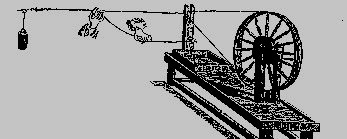
According to Spohr, the gut core had to be pre-stretched on the violin up to "c" and left there for a day before being wound. Galeazzi suggests "…fastening it at one end to a nail, and then hanging beneath it a still weight…" By means of this preliminary operation the gut released much of its "non-elastic" longitudinal creep, so as to guarantee the metal wire the greatest adherence to the gut core over time and under tension on the instrument.
Despite this important precaution, wound strings must in all likelihood have suffered fairly widely from that particular problem caused by the metal wire vibrating against the core, especially on extremely dry days. The only remedy proposed before the general adoption of the technique of interposing a thin layer — or wisp — of silk or rayon between the gut and the metal wire (mid-20th century) was to moisten wound strings, when necessary, with olive oil, so as to make the gut swell slightly and thereby restore the wire’s perfect adherence. This operation, if properly carried out, also benefits the sonority of the string, besides forming an acceptable barrier against the absorption of atmospheric moisture.
In the second half of the 19th century further improvements were made to the manufacture of wound strings, such as the simultaneous use of two wires of different metals, in order to achieve better stability of the string against climatic events. Neither Hart nor Huggins yet mentions polished wound strings or flat wire (the latter in common use today), which only became widespread at the start of the 20th century.
By the late 19th century the considerations drawn from Galeazzi’s information seem to have been forgotten: Hart, for instance, also gives the tension of the fourth string, from which one can readily derive the gut equivalent corresponding to the various degrees of tension he suggests for the strings, and from that in turn a graph of the tension of all four strings whose trend is homogeneously scaled. In addition, from this period onward a violin "E" string begins to be used extensively as the core, in place of the traditional second string.
Conclusions
From what has been set out, it seems to emerge with sufficient clarity that violin setups, and the type of strings used in the past, followed criteria profoundly different from those commonly followed today for the so-called baroque and classical setups — setups in which gut strings prevail that are too thin, too stiff, together with essentially modern wound strings (Perlon or steel cores, flat metal wires etc.) and which, even when made with a gut core, are in any case too different in acoustic result and constructional criteria from the historical ones.
What has been described here for the violin can in turn be applied to the viola and cello of the period: if a modern "baroque" cello first string uses on average a gauge only slightly over one millimetre, according to the documentation gathered it oscillated around 1.5 mm; the same for the viola, where, on the basis of the proportional relationships with the violin, it would evidently follow that the strings of this instrument — excluding the first — became respectively the first, second and third strings of the viola. As for the fourth, Galeazzi (p. 75) recommended winding a violin third string.
And so today’s second strings were, broadly speaking, the first strings of the past. The strings themselves, as noted, were in all likelihood very different from today’s: far more elastic (few people today, however, are able to tell, as they once could, a good string from a bad one). The sonority of the Italian violin, in the Age of Enlightenment, must therefore have been anything but thin and nasal, as testified moreover by various observers of the period and by the tests carried out today.
As for the supposed variations in tension — expressed in kg — that occurred over the historical period considered, one can state, as a consequence of the great standardisation of the violin-string manufacturing process, that they probably fell within the natural spread of the gauges available within the "standard" of the time, as well as resulting from the variations then occurring in pitch. The tension range given by Hart, for example, allows for a tension excursion corresponding to a rise in frequency of as much as a whole tone between the thinnest and thickest first strings, while still always starting from three base strands (six if split down the middle). It follows that one could have string setups more or less strong, according to personal taste and the type of instrument, simply by looking in the usual package (marked with a number indicating the quantity of strands making up the strings it contained) for those, by means of the gauge plate, judged right. It is not uncommon to find the suggestion to mark, on the gauge plate itself, the measurement of the strings found to be to one’s own subjective liking, and always to stick to these (Spohr). This does not rule out, however, that certain virtuosi of the calibre of a Pugnani, a Dragonetti or a Lindley may have deliberately used diameters genuinely above the common norm.
There would be more to add on the conditions that strings thicker than ours imposed on the instruments of the time, such as the need for a smaller angle of the strings over the bridge (which Boyden, paradoxically, took as proof that tensions then were lower than ours), their height above the fingerboard — which, according to Galeazzi, should on the violin be as low as possible provided they did not buzz against the fingerboard —, the bass bar — generally shorter and thinner —, the sound-post, the bridge and their position, and lastly the type of rosin of the period, which in Galeazzi’s case we have been able to test successfully. Everything, in short, seems tightly and inexorably linked in a precise sequence whose starting point is always the string: once this fell, over the course of the 20th century, a kind of domino effect must have followed, drawing in all the other elements in cascade. But that is another story.
Live happily.
Mimmo Peruffo
The scaled tension profile of the violin’s first three strings
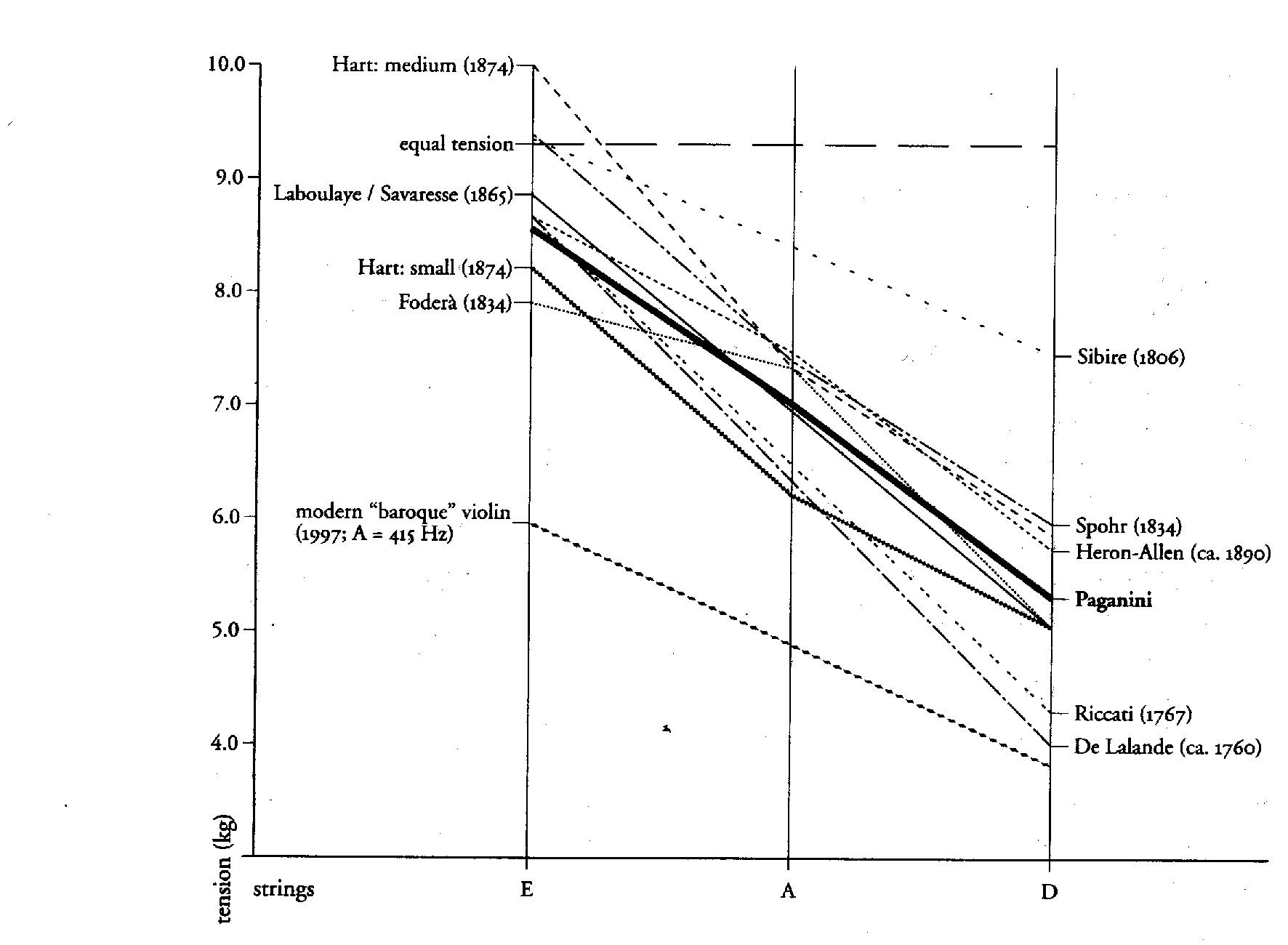
Synoptic table of historical gauges according to 18th- and 19th-century sources
| Source | E | A | D |
|---|---|---|---|
| De Lalande / Angelucci, c. 1760 (a) | c. 0.70 mm | — | — |
| Riccati, 1767 (b) | 0.70 mm | 0.90 mm | 1.10 mm |
| E-string fragment, c. 1770 (c) | 0.71–0.72 mm | — | — |
| Fouchetti, c. 1770 | 0.70 mm | — | — |
| Baud, c. 1795 (d) | 0.70 mm | — | — |
| Sibire, 1806 (e) | 0.70/0.73 mm | 0.98–1.03 mm | 1.38–1.45 mm |
| Foderà, 1834 (f) | 0.66–0.70 mm | 0.92–1.03 mm | 1.15–1.19 mm |
| Spohr, 1834 (g) | 0.72 mm | 0.92 mm | 1.24 mm |
| Paganini, c. 1840 | 0.71–0.72 mm | 0.87–0.89 mm | 1.15–1.16 mm |
| Delezenne, 1853 (h) | 0.61–0.70 mm | 0.82–0.96 mm | 1.02–1.39 mm |
| Laboulaye / Savaresse, 1865 (i) | 0.70 mm | 0.89 mm | 1.14 mm |
| Maugin & Maigne, 1869 (l) | 0.63 mm | 0.89 mm | 1.09 mm |
| Hart, 1874 (m) | 0.65/0.72/0.73 mm | 0.84/0.89/0.90 mm | 1.14/1.23/1.19 mm |
| Huggins / Ruffini, 1883 | 0.67 mm | 0.90 mm | 1.17 mm |
| Bishopp, 1884 (m) | 0.61/0.68/0.69 mm | 0.80/0.85/0.85 mm | 1.08/1.16/1.19 mm |
| Heron-Allen, 1890 | 0.69 mm | 0.93 mm | 1.22 mm |
| E samples (c) | 0.66–0.68 mm | — | — |
| Aquila Corde Armoniche, 2003 (n) | 0.62 mm | 0.79 mm | 1.04 mm |
Key: (a) three guts = 0.70 mm; (b) E = 6 grains; A = 10; D = 15; each string = 1.5 Venetian feet; (c) high twist; (d) silk; (e) for A = 415/435 Hz; (f) 20/100 gauge = 0.70 mm; (g) no. 18 on gauge plate = 0.71 mm; (h) commercial averages; (i) E = three guts; A = five; D = eight; (l) A weighs twice the E; D three times; (m) light/small/thick; (n) Baroque violin set, medium tension.
Appendix: "Stringmakers" (Cionini, 1902)
From Natale Cionini, Teatro e arti in Sassuolo, Forghieri, Modena 1902, pp. 273–5.
§ — Stringmakers. — Besides the tanning of hides, the tanning of violin strings also flourished in Sassuolo, found likewise in the quarter of the constables, or Racchetta, called Delle Concie. Valdrighi, in his Musurgiana, notes that the Zibini sisters Giulia and Teresa, living 1716–28, and the Zibini Calvi sisters Anna and Marianna, living 1726–1803, were celebrated makers of gut strings in Sassuolo; but this is not accurate, because the first to introduce this craft here was Paolo Cecchelli of Bolognano in the Abruzzi, in the year 1767, and here is how.
In a petition of 16 February of that year, addressed by him to the Magistrate of Commerce and Agriculture of Modena, after stating that his ancestors were the ones who had brought the art of making musical strings to the Este States, and that he had been working in Modena for 56 years under an exclusive privilege, having taken over the Cibini sisters’ concern by paying 1,400 Modenese lire a year, he complained that both he and his partner and countryman Vincenzo de’ Angeli had been thrown out of the factory of Dr Paolucci, who claimed the privilege had passed to him and had already brought in an outsider, to whom he had entrusted the factory itself. He asked to be allowed to resume the concern, or else to be taken on as a partner, otherwise he, his wife and his children would be forced to starve. The magistrate, on the 23rd of that same month of February, wrote to the governor of Sassuolo in the following terms:
Dr Paolucci having represented to our Magistrate that he has entered into the rights of a Zibini, concerning the exclusive privilege of violin strings in this district, and being unwilling to employ the Neapolitan Paolo Cecchelli for the making of the said strings, although the latter has for many years, together with a cousin (the aforesaid De Angeli), practised this art under the same Zibini, so that he does not leave the state, we direct him to your most illustrious lordship, and we do not doubt that you will grant him all necessary assistance so that he may introduce and establish in your jurisdiction the manufacture of the said strings, and we kiss your hands affectionately.
Thus Cecchelli resumed the making of gut strings in Sassuolo. Indeed, in a further letter of the following 30 April, the same magistrate wrote to the lieutenant of the government of Sassuolo:
Since Dr Paolucci, who holds the exclusive privilege of violin strings in this city and district, can be amply supplied with the guts needed within the jurisdictions of the state, excepting this one in which Paolo Cecchelli has established himself to make strings of the same kind, we have forbidden the former to continue making, directly or indirectly, new purchases of guts from the butchers of this place after the 8th of next month. Your lordship will watch over the observance of our intention and, when occasion requires, will lend assistance to the said Cecchelli.
After Cecchelli left Sassuolo, the making of gut strings was taken up by the Giovanardi family, known as Quaranta, originally from Fiorano. This family kept its workshop in the Ghiarona quarter, now Caula, in a house belonging to the Panini family, and specialised in first strings, which it sold chiefly in Modena, Reggio and Parma. Production, interrupted in 1857, was resumed by Vincenzo Pellati of Sassuolo, who carried it on until 1869. Count Valdrighi laments the end of this industry, observing "that the convenience of the water supply and the ease of obtaining sheep gut from the nearby mountains were the occasion for perfecting it and making it most useful, given the great lack of good production elsewhere".
References
- Patrizio Barbieri, "Giordano Riccati on the Diameters of Strings and Pipes", Galpin Society Journal XXXVIII, 1985, pp. 20–34; Ephraim Segerman, "Strings through the ages", The Strad, parts 1–3, January–April 1988.
- Carl Flesch, The art of violin playing, 2 vols., Fischer, New York 1924–30.
- David Dodge Boyden, The History of Violin Playing from its origins to 1761, Oxford University Press 1965; Eduard Melkus, Il Violino, Giunti, Florence 1975; Robin Stowell, Violin technique and performance practice, Cambridge University Press 1985.
- Djilda Abbott, Ephraim Segerman, "Strings in the 16th and 17th centuries", Galpin Society Journal XXVII, 1974, pp. 48–73.
- Werner Bachmann, The Origins of bowing, Oxford University Press 1969, p. 79.
- Stephen Bonta, "From Violone to Violoncello", JAMIS III, 1977, pp. 64–99.
- Christopher Page, Voices and Instruments of the Middle Ages, J.M. Dent & Sons, London, pp. 234–5.
- Abbott–Segerman, op. cit.
- Mimmo Peruffo, "The mystery of gut bass strings in the 16th and 17th centuries", Recercare V, 1993, pp. 115–51.
- Samuel Hartlib, Ephemerides, ms. 1659.
- John Playford, An introduction to the skill of music, London 1664; Claude Perrault, Œuvres de physique, Amsterdam 1727.
- Jean Rousseau, Traité de la viole, Paris 1687.
- Patrizio Barbieri, "Cembalaro, organaro, chitarraro…", Recercare 1, 1989, pp. 123–209.
- Antonio Domenico Gabbiani, Ritratto di musicisti alla corte medicea, 1684–7, Florence, Palazzo Pitti.
- John Dowland, "Other necessary observations belonging to the lute", in R. Dowland, Varietie of lute-lessons, London 1610.
- Thomas Mace, Musick’s Monument, London 1676, pp. 65–6.
- Robert Donington, "James Talbot’s Manuscript II: Bowed strings", Galpin Society Journal III, 1950, p. 30.
- Rutilio Manetti, Amore trionfante, 1625, Dublin, National Gallery of Ireland.
- Marin Mersenne, Harmonie universelle, Paris 1636, p. 189.
- Segerman, op. cit. part 2, p. 197.
- Patrizio Barbieri, op. cit. note 13, p. 74.
- Francesco Griselini, Dizionario delle arti e mestieri, vol. V, Venice 1769; François De Lalande, Voyage en Italie, vol. IX, Paris 1786, pp. 514–9.
- De Lalande, op. cit., p. 514.
- 17th-century iconography often shows strings coiled into a bundle of excess length, suggesting great softness.
- Klaus Osse, "Highly strung in Markneukirchen", The Strad, October 1993, pp. 964–7.
- Vittorio Villavecchia, Dizionario di merceologia, 5th ed., vol. I, Hoepli, Milan 1955, pp. 768–9.
- Pierre Jaubert, Dictionnaire raisonné universel des arts et métiers, vol. I, Lyon 1801.
- De Lalande, op. cit., p. 516; Griselini, op. cit., p. 130.
- Abbott–Segerman, op. cit.
- Griselini, op. cit., p. 131.
- Francesco Galeazzi, Elementi teorico-pratici di musica con un saggio sopra l’arte di suonare il violino, Pilucchi Cracas, Rome 1791, p. 71.
- Griselini, op. cit.
- Antoine-Germain Labarraque, "Minugiaio", in Nuovo dizionario universale tecnologico, vol. VIII, Antonelli, Venice 1823, pp. 373–6.
- Savaresse, quoted in Maugin–Maigne, Nouveau manuel complet du luthier, 2nd ed., Roret, Paris 1869, p. 184.
- Augusto Gansser, Manuale del conciatore, Hoepli, Milan 1949.
- Rome, Archivio di Stato, Camerale II, Arti e mestieri, Statuti, coll. 312, busta 12, year 1642.
- Padua Chamber of Commerce, research on Romanin / Calegari.
- De Lalande, op. cit., p. 514.
- Galeazzi, op. cit., p. 71.
- Louis Spohr, Violinschule, Vienna 1832, pp. 13–4.
- Forqueray’s letter to Prince Wilhelm, 1767–68.
- Labarraque, L’art du boyaudier, Paris 1812, pp. 31–2.
- George Hart, The violin: its famous makers and their imitators, London 1875, pp. 46–7.
- Luigi Forino, Il violoncello, il violoncellista ed i violoncellisti, Hoepli, Turin 1905, pp. 54–5.
- Arthur Broadley, "String gauges", The Strad, April 1900, p. 371.
- Galeazzi, op. cit., pp. 71–2.
- Labarraque, L’art du boyaudier, p. 131.
- Spohr, op. cit., p. 14.
- Maugin–Maigne, op. cit., pp. 183–4.
- Hart, op. cit., pp. 49–50.
- Forino, op. cit., pp. 55–6.
- Forqueray, letter cited.
- 18th-century iconography.
- Sébastien de Brossard, Fragments d’une méthode de violon, ms. c. 1712; J.-B. De Laborde, Essai sur la musique ancienne et moderne, Onfroy, Paris 1780.
- Segerman, op. cit., p. 54.
- Jacques Savary des Bruslons, Dictionnaire universel de commerce, vol. II, Copenhagen 1759, entry "Corde", p. 248.
- Edward Heron-Allen, Violin-making as it was and is, London 1884, p. 212.
- Segerman, op. cit. part 2, p. 197.
- Uberto Andrea, L’antico abitato di Salle, vol. I.
- Patrizio Barbieri, Acustica, accordatura e temperamento nell’illuminismo veneto, Rome 1987, p. 42.
- Libro contenente la maniera di cucinare e vari segreti, ms., Biblioteca Panizzi, Reggio Emilia.
- Edward Neill, Nicolò Paganini: Registro di lettere, 1829, Graphos, Genoa 1991, p. 80.
- Maugin–Maigne, op. cit., p. 182.
- Philippe Savaresse in Laboulaye, Dictionnaire des arts et manufactures, 3rd ed., vol. I, Paris 1865.
- Domenico Angeloni, Il liutaio, Hoepli, Milan 1923, pp. 279–98.
- Riccati, op. cit., p. 130.
- Albert Cohen, "A cache of 18th century strings", Galpin Society Journal XXXVI, 1983, pp. 37–48.
- Lambert fragment, supplied by Christophe Coin.
- William Huggins, "On the function of the sound-post", Royal Society Proceedings XXXV, 1883, pp. 241–8.
- Segerman, op. cit. part 1, p. 199.
- Heron-Allen, op. cit., p. 209.
- Huggins, op. cit., p. 247.
- Uberto Andrea, op. cit., p. 111.
- Segerman, op. cit. part 2, p. 201.
- Assumption based on Savaresse.
- S.-A. Sibire, La chélonomie, Paris 1806, pp. 112–3; Fouchetti c. 1770; Delezenne 1853.
- F.-J. Fétis, Antoine Stradivari, Vuillaume, Paris 1856, p. 92; Gervasoni, La scuola della musica, Piacenza 1800, vol. I, p. 126.
- Hart, op. cit., p. 51.
- Spohr, op. cit., pl. 1, fig. IV.
- Segerman, op. cit. part 2, pp. 198 and 201.
- Dowland, op. cit.
- Burwell Lute Tutor, c. 1670.
- Mace, op. cit., ch. VI, p. 65.
- Galeazzi, op. cit., p. 72.
- Daniello Bartoli, Del suono, Rome 1679, p. 157.
- Joseph-Antoine Plessiard, "Des cordes du violon", Congrès de Lille 1874.
- Segerman, "Modern lute stringing", FoMRHI Quarterly 98, January 2000, p. 59.
- Segerman, op. cit. part 1, p. 55.
- Leopold Mozart, Versuch einer gründlichen Violinschule, Augsburg 1756, p. 6; Serafino Di Colco, Lettera prima (Venice 1690).
- Huggins, op. cit., p. 248.
- Foderà, quoted in Barbieri, op. cit., p. 41.
- Maugin–Maigne, op. cit., pp. 168, 181–3.
- Angeloni, op. cit., p. 281.
- Abbott–Segerman, op. cit.
- Fétis, Antoine Stradivari, p. 92.
- Savart and Fétis, quoted in Segerman part 2 and in Barbieri, op. cit.
- Huggins, op. cit., p. 248.
- Hart, op. cit., p. 54; Bishopp 1884 and Heron-Allen 1885 in Segerman part 2, p. 201.
- Galeazzi, op. cit., p. 75.
- William Nicholson, A dictionary of chemistry, London 1795, vol. II, pp. 820–4.
- Spohr, op. cit., pp. 12–3; Neill, Paganini: epistolario, p. 67.
- Hart, op. cit., p. 52.
- Galeazzi, op. cit., p. 75.
- Maugin–Maigne, op. cit., p. 168.
- Plessiard, op. cit.
- Galeazzi, op. cit., p. 74.
- Galeazzi, op. cit., p. 74.
- Heron-Allen, op. cit., p. 213.
- Galeazzi, op. cit., p. 75.
- Friedrich Dotzauer, Methode de violoncelle, Richault, Paris n.d., Supplement, p. 48.
- Heron-Allen, op. cit., p. 213.
- Forino, op. cit., p. 60.
- Abbott–Segerman, "Overspun string calculations", FoMRHI Quarterly 13, October 1978, comm. 163, pp. 50–2.
- On pitch standards: Segerman, "On German, Italian and French pitch standards", FoMRHI Quarterly 30, January 1982; Arthur Mendel, "Pitch in western music since 1500: a re-examination", Acta Musicologica L, 1978, pp. 1–93.
- On the bridge: D. Badiarof and coeval iconography; Galeazzi, p. 71; Antonio Bagatella, Regole per la costruzione de’ Violini-Viole-Violoncelli e Violoni, Padua 1786, p. 27.
- Valdrighi, Nomocheliurgografia, Modena 1884, pp. 112–3.
- Archivio di Stato di Modena, Musica, filza 3a; Cionini records, 1902.