Summary
Essay by Mimmo Peruffo clarifying the distinction between equal tension, equal feel and scaled tension in plucked- and bowed-instrument setups from the 16th to the 19th century. The author shows physically that theoretical equal tension calculated on "envelope" strings does not match the equal tactile feeling sought by 17th-century treatises: once at pitch, the strings shorten by different percentages, generating a scaled profile. Only by starting from a scaled at-rest calculation can one obtain true equal feel under tension. Historical sources (Kircher, Riccati, De Lalande, Huggins, Delezenne) and iconographic and museum evidence confirm a markedly scaled tension on the 18th–19th-century violin. The experimental verification of Serafino Di Colco's test (1692) and the calculations on the Roman Chelys Maior described by Kircher (1650) support the thesis.
Key takeaways
- At-rest equal tension does not coincide with equal tension at pitch: thin strings shrink more and lose tension.
- The "equal feel" of 17th-century lute treatises (Dowland 1610, Mace 1676, Burwell c. 1670) corresponds in practice to a scaled at-rest profile, not to theoretical equal tension.
- The Roman Chelys Maior described by Kircher (1650) shows in proportion strongly scaled tensions (35–16 kg from treble to bass).
- The tests by Tartini, L. Mozart, Di Colco, Maugin & Savaresse and Huggins are all coherent with a scaled profile, not with theoretical equal tension.
- Violin scaling is greater than that required by equal feel alone: reasons in Huggins (bridge angle, distance from the fingerboard) and Riccati (uniform bow friction).
Experimental verification of Serafino Di Colco's test (1691). Di Colco wrote that under the same weight, at the same string length and double gauge, there is an octave interval between strings (the equal-tension idea, the same explained by Mersenne 1636 and, differently, by Mozart's father). Unfortunately this is not true. As shown in the video, to obtain an octave interval one needs to press the second fret of the thicker string. Why? Under the same weight, two strings of different gauges undergo different elongations — the thinner the gauge, the greater the stretch. In the end the thin string shrinks in percentage more than the thick one. From the string formula a thinner string produces a higher frequency. The solution: calculate a scaled tension instead of equal tension. When the strings come up to pitch the thinner one stretches more and reduces to the correct gauge.
The modern concept of equal tension for period instruments is a misunderstanding. Di Colco and Mersenne never considered what really happens when the strings are tuned under tension.
PDF document to read or download
by Mimmo Peruffo
Introduction
The choice of the tension profile of a set-up for a bowed instrument for historical repertoires raises a number of doubts, all concerning two fundamental questions: a) will what I choose be historically correct? b) is it going to cause problems of instrumental technique and/or of sound quality? Questions like these are by no means negligible, especially considering that the answer rests on a subject — the study of string set-ups for historical instruments — which is relatively young and therefore subject to continual, potential updating.
A careful re-reading of already known historical sources and of those more recently discovered, together with the contemporary rediscovery of the Italian and French historical method of manufacturing gut strings (a method that produces results substantially different from those obtained by following modern techniques, which are aimed above all at the stiffer strings used for the modern harp, for tennis, or for surgical purposes), is allowing us to fill, step by step, what until a few years ago was essentially an uncertain jigsaw puzzle full of gaps. Is it possible nowadays to provide a convincing picture of the tension profile at different historical periods? We shall first define some terms.
Definitions
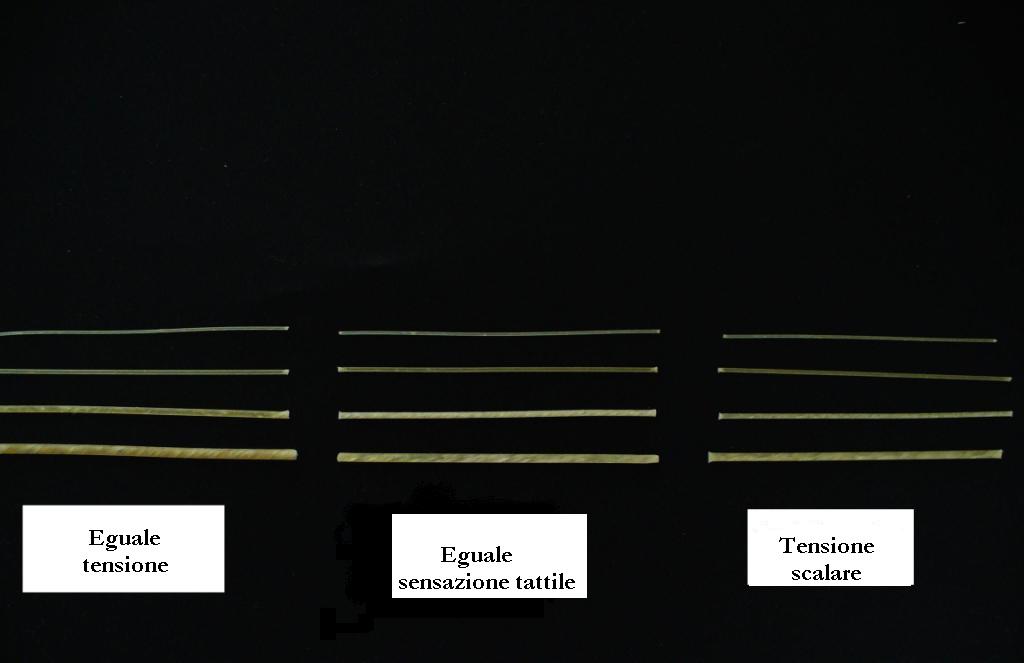
- Equal tension: the diameter of the strings of a set-up is calculated all at the same value of tension, expressed in kg.
- Equal tactile feel of tension: the strings, pressed one by one at the same distance from the bridge (and in a state of intonation), express the same sensation of tactile "hardness".
- Scaled or degrading tension: going from the thinner first string and passing to the thicker strings, they are calculated so that the tension is gradually decreasing.
Equal tactile feel and equal working tension
It is widely believed that the rule to follow in set-ups for bowed instruments for the repertoire of the sixteenth and seventeenth century is the one that leads to a profile in equal tension between the strings. If we observe it more in detail, we come to a different result. Three basic elements should first be clarified.
- In seventeenth-century treatises and methods that deal with music and/or musical instruments, tension is almost never expressed by a unit of measurement: the term used is rather what leads us to consider the tactile sensation of tension. This, as it is stated in the treatises themselves, must be equal between all the strings of the set-up ("equal feel"). From a historical point of view, the first document of our knowledge in which the tension of each string (in this case of the violin) is expressed in kg dates only from 1869.
- A second element to be remembered concerns the relative importance that a speculative document has compared to other sources that report information obtained instead from stringmakers of the time, or concerning tutors for musical instruments such as the lute. We believe that daily practice is better described in these tutors, or by the construction data of contemporary stringmakers, than in scarcely accessible contemporary disquisitions focused only on theoretical speculation. It is the same even today: in most cases it is indeed the stringmakers who push the market towards the use of certain gauges and certain tension profiles rather than others.
- There is a third element: the treatises of the seventeenth and eighteenth centuries can easily lead to ambiguous situations. A typical example that brings confusion between the equal tactile sensation of tension of the strings and the equal working tension is, for instance, the following passage from Galeazzi: "la tensione dev'esser per tutte quattro le corde la stessa, perché se l'una fosse più dell'altra tesa, ciò produrrebbe sotto le dita, e sotto l'arco una notabile diseguaglianza, che molto pregiudicherebbe all'eguaglianza della voce" ("the tension must be the same for all four strings, because if one were more tense than another, that would create under the fingers, and under the bow, a considerable inequality very prejudicial to the equality of tone"). Reading this passage with more attention it is clear, however, that the "equal tension" is actually referring to the feel of tension that one feels under the fingers or under the bow. Here is another potentially misleading one: "Quanto una corda è più vicina al principio della sua tensione, tanto ivi è più tesa… Consideriamo hora una qualunque corda d'un liuto: ella ha due principj di tensione ugualissimi nella potenza, e sono i bischieri dall'un capo, e 'l ponticello dall'altro; adunque per lo sopradetto, ella è tanto più tesa, quanto più lor s'avvicina: e per conseguente, è men tesa nel mezzo" ("The closer a string is to the beginning of its tension, the tenser it is… Just consider any lute string. It has two beginnings of tension that are absolutely equal in power: the pegs at one end, the bridge at the other. As a result, it will be tenser the nearer it is to those points, and less tense in the middle"). The concept of more or less tension expressed above is certainly related to a tactile sensation of tension and not to a real tension in kg which, under static tension conditions of the string, is obviously the same at any point on the string. From a tactile point of view, however, the closer one moves toward the fixed ends, the more "tightened" it feels to the touch.
Tension assessment in the lute
The evaluation method of string tension by finger pressure (or more exactly by the right-hand thumb), which tests their "hardness" near the bridge, was the universal criterion used for balancing a set-up of lute strings:
- John Dowland (Varietie of Lute Lessons, by Robert Dowland, 1610): "Of setting the right sizes of strings upon the lute… But to our purpose: these double bases likewise must neither be stretched too hard, nor too weake, but that they may according to your feeling in striking with your thombe and finger equally counterpoyse the trebles".
- Mary Burwell Lute Tutor (c. 1670): "When you stroke all the stringes with your thumbe you must feel an even stiffnes which proceeds from the size of the stringes".
- Thomas Mace (Musick's Monument, London 1676): "Another general observation must be this, which indeed is the chiefest; viz. that what siz'd lute soever, you are to string, you must so suit your strings, as (in the tuning you intend to set it at) the strings may all stand, at a proportionable, and even stiffness, otherwise there will arise two great inconveniences; the one to the perfomer, the other to the auditor. And here note, that when we say, a lute is not equally strung, it is, when some strings are stiff, and some slack".
From these statements the following results: 1) the criterion for selecting the diameters of the strings of a lute set-up was carried out according to criteria of empiricism — the strings should not be too stiff or too slack, but with a subjectively right degree of tension feel; 2) that "right" feel of tension should be the same across all the strings of the set-up. If this does not happen, then a serious mistake occurs. It goes without saying that the judgment on the degree of tension can only be subjective. What is instead different is the appearance of homogeneity of tension among the strings, which represents the true common criterion of lute players of the past.
The tactile sensation of tension
When a string is moved laterally by means of a pressure exerted on it (by fingers, bow, etc.) it exerts, against the pressing element, an equal and opposite action aimed at counteracting that pressure. Such contrast, for a particular value of lateral shift, produces a certain feel of effort on the part of whoever puts pressure on the string. We speak of equal feel when, with the same lateral displacement, the sense of effort is the same even between strings of different type, diameter, etc., provided, however, that the point of pressure is always the same.
Trying to bring in scientific terms the notions of "even stiffness", "equally strung" and the like, described in the seventeenth-century treatises just cited, is something complex in itself, both because there is no evidence to confirm that they all intended the same thing by "feel", and because the so-called feel can also be understood in a "broader" way. There is meanwhile a first distinction to be made: whether the strings are pressed to evaluate the degree of "tension" directly by the fingers of the right hand, or by the bow hair. In the second case, thicker strings (having a greater surface area in contact with the horsehair), even if at the same working tension as thinner ones, can put up a higher resistance to friction, thus giving the player the feeling of a certain higher "tension".
In the likely hypothesis that it is the fingers and not the bow (as the seventeenth-century treatises, practically always referring to the lute, suggest) that are entrusted with judging how taut the strings are, we can understand feel in at least two different ways. The first — commonly accepted, and also upheld by us — considers the effort that must be made with a finger (usually the right-hand thumb) to move a string laterally, usually downward, by a certain amount; the string will obviously generate a resistance against the pressure exerted. By substituting the finger with a weight acting at the same point, the extent of the lateral shift for each string examined can be measured accurately. Feel will therefore be the same when the lateral displacement is the same for all the strings tested. The second interpretation considers that the thinner string, sinking further into the tip of the finger that presses it, would produce a higher feel of tension than a thicker string, which, having a larger surface, does not sink into the finger in the same way. According to this second interpretation, an equal feel would require a higher working tension in the thicker strings than in the thin ones. There is, however, no practical evidence that bass strings ever presented a tension in kg higher than the trebles; if anything, there is evidence to the contrary.
Let us investigate further the first hypothesis — that which considers as feel the sensation of resistance offered by a string pressed by the fingers, irrespective of its diameter, and as equal feel the fact that the opposing force is the same (with the same displacement caused by the acting finger) even for strings of different gauge or different manufacturing technology when put into traction. Physics has shown, by calculation, that equal feel as stated above corresponds exactly to an equal-tension set-up. But here comes something that has not been revealed so far: equal feel does correspond to equal tension, but only on condition that the strings are already in a state of traction. This condition, however, has nothing to do with common practice, where the diameters of the strings of a set-up "in equal tension" are obtained directly by mathematical calculation. In this way the diameters are in fact those of the strings "packaged", i.e. at rest.
The difference between the two conditions is crucial: a string already in a state of tension is a string that has undergone some stretching, and therefore no longer has the diameter for which it was calculated, but a smaller one. In order to achieve the condition equal feel = equal tension in kg, the strings should therefore keep their diameters unchanged even after being brought up to pitch, or at least all reduce according to the same percentage. In practice (and this is more evident in gut than in other, more rigid materials) this does not happen: once the strings are brought into traction, each of them will reduce its diameter by a certain percentage, which is a function of the position it occupies in the instrument — in other words, of its Working Index — and of how the string was made.
The Working Index is the parameter indicating the fraction of tensile strength used by the string compared to its maximum strength. This value derives from the vibrating length multiplied by the frequency of the string. Its maximum value coincides with the breaking stress and is a function, as mentioned before, of construction parameters such as the amount of twist, the kind of twist used (similar to a nautical line, high or low twist, etc.), the quality of the raw material, and the use of specific chemicals which may contribute to increasing or reducing it. It goes without saying that the higher the working tension, the greater the stretching of the string.
Tensile-stress usage is highest for trebles (the lute and violin trebles exploit as much as 91–95% of their total available reservoir of tensile strength, which means that they undergo, among all, the greatest stretching under tension) and progressively lower, in smaller percentage, on the bass-string positions, which have a lower Working Index. But this is not because the trebles are thinner, but because their Working Index — the product of frequency and string length — is the highest among those of every string of the set-up.
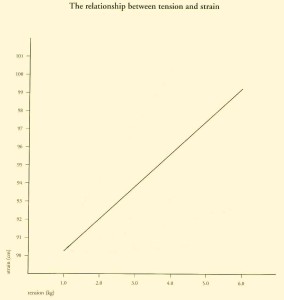
The explanation is simple: in a larger string the same tension is, so to say, spread over a bigger section than in a thinner string. Consequently, the applied tension referred to the unit section will be lower, hence a lower stretch of the string. A thicker string, in other words, can be considered as composed of many hypothetical thin strings stuck together to make up the diameter required. It is obvious that if the full tension were applied to just one of these hypothetical thin strings, it would stretch a great deal (as happens with the thin treble); but if the same tension is instead spread among this theoretical quantity of thin strings, each of them will be subject only to a fraction of the total tension, thus producing a lower final stretch.
Summary: between two strings of different diameter, constructed in the same manner and subject to the same tension, the thinner one will stretch much more than the thicker one, because of the larger load insisting on the cross-section. On gut strings in particular, the longitudinal give is divided into a recoverable and a non-recoverable part: in practice a new string that has undergone an initial tensioning, when placed to rest, does not completely recover its starting length. As the string stretches, due to the increasing tension, its diameter gradually reduces — and the reduction in diameter will also result in a simultaneous decrease in working tension, since tension and diameter are directly proportional. As mentioned above, the strings that occupy the treble position, because of the higher traction per unit cross-section, are those that decrease by the highest percentage compared to the others, and so on in progression as one moves towards the thicker strings (it is well known that many more turns of the peg are required for the treble than for the third string of a violin).
It follows, therefore, that the respective working tensions, which were established at the outset by theoretical calculation as identical, will in the final state of tune no longer be equal but will assume a new, scaled arrangement: the treble strings will be, among all, those with the lowest working tension. And if the tension of the strings differs once at pitch, then the "feel" between the strings can no longer be the same either: the treble will feel softer to the touch, while the lower strings will require greater pressure from the fingers. At this point the equation equal feel = equal tension is no longer valid.
Conclusion: a set-up calculated in equal tension cannot be considered a historical set-up. We wish to stress once again that the seventeenth-century treatises for the lute rather clearly condemn a set-up that presents an uneven feel.
Experimental verification
Using a violin (though a guitar or a lute would serve equally well), we tested two gut strings calculated to have both the same tension (8.3 kg at a pitch of 440 Hz) at the required tuning (E and D, in our case). The vibrating length is of course the same for both (33 cm). The diameters we used are as follows: .65 mm for the E and 1.45 mm for the D, measured "at rest", i.e. not under tension. The thinner string had a so-called "medium" twist (c. 45°), while the thicker one was of "high" twist (<60°).
Once tuned and stabilised, we proceeded to verify their diameters by micrometer: the E gauge had dropped to .62 mm, while for the D we did not find an instrumentally appreciable decrease. The thin string had therefore shown a reduction in diameter of 5% (.62/.65 mm); the D, on the other hand, was considered virtually unchanged (<0.1%), despite the fact that its degree of twist — and hence its elasticity — is markedly higher than that of the treble. It should be emphasised that these measures derive from a single experimental test: strings manufactured differently from the samples examined by us may provide different reduction percentages. In our case the underlying tension of the strings on the instrument dropped to 7.6 kg for the E and 8.3 kg for the D, compared with the theoretical tension used for the calculations, equal to 8.3 kg for both.
In order for an E and a D to keep the same kg once at pitch, it is therefore necessary to increase the initial diameter of the E alone (the D being virtually unchanged) by 5%: this extra amount is then lost once the string is brought to pitch. In conclusion, a "packaged" diameter of .68 mm is required for the E, while the D remains at 1.45 mm. Deriving the tensions of this second pair of strings in the resting state, we therefore obtain a scaled tension: 9.2 kg for the E and 8.3 kg for the D — a profile which, once under traction, converges on equal tension, that is, on equal feel.
Unfortunately it is not possible to determine by mathematical calculation how much a string will reduce its diameter under load, since this parameter is the result of several variables specific to the system with which it was built; the only valid method is therefore the experimental one, starting from a set-up whose gauges are known, provided that the type of strings remains the same.
Summary: the experiment shows that gauges of .65 and 1.45 mm, calculated in equal tension, once at pitch reconvert, producing a certain scaling in the working tension and, consequently, a lack of homogeneity even in the tactile feel. Using instead a compensatory diameter of .68 mm and, again, 1.45 mm — according to a "resting" scaled tension profile — the working tensions will then re-set themselves so as finally to bring about the hoped-for equal tension, that is, the same tactile sensation, i.e. equal feel. If one wishes a set-up in equal feel according to the historical criterion, it is therefore necessary to start with a choice of "packaged" string diameters calculated according to a scaling profile. What has been expressed so far finally gives an explanation of the relationship between feel and working tension. It can be applied readily to the family of the lute and plucked instruments — but what about bowed instruments?
Historical setup criteria for bowed instruments
We do not know of any sixteenth–seventeenth-century treatise able to provide an explanation of the criteria followed in daily practice at that time for bowed instruments. In practice, today — and lacking anything better — the criteria established for the lute (equal feel of tension, equal tension) are applied, even though the lute is itself a plucked instrument. But are we sure that this operation is technically correct also for bowed instruments? The lute is in fact quite different from bowed instruments: 1) it is played by plucking and not with a bow; 2) it has courses in octaves and in unison, and not single strings; 3) its working tensions are significantly lower than those of bowed instruments; 4) it has a fingerboard and a bridge that are flat, not arched; 5) it is fitted with frets, which determine with some accuracy the frequency of the notes played.
Only one of these criteria — the frets — is shared with part of the bowed-instrument family, the viols; excluded are the violin, the viola da braccio, the bass violin and some large violoni. We shall therefore now analyse in detail the historical sources in our possession that relate in some way to bowed instruments.
16th century
No non-speculative document exists on the tension profile of a bowed instrument in the daily practice of contemporary musicians and of the area in which its author lived. On the other hand, we do have the tailpiece-hole measurements of two viola da braccio instruments at the Ashmolean Museum, Oxford (both instruments are known to have been re-necked). Our 2008 survey shows that the fourth-string hole on the original tailpiece of Andrea Amati's "Charles IX" viola (built around 1570) is only 2.3 mm.
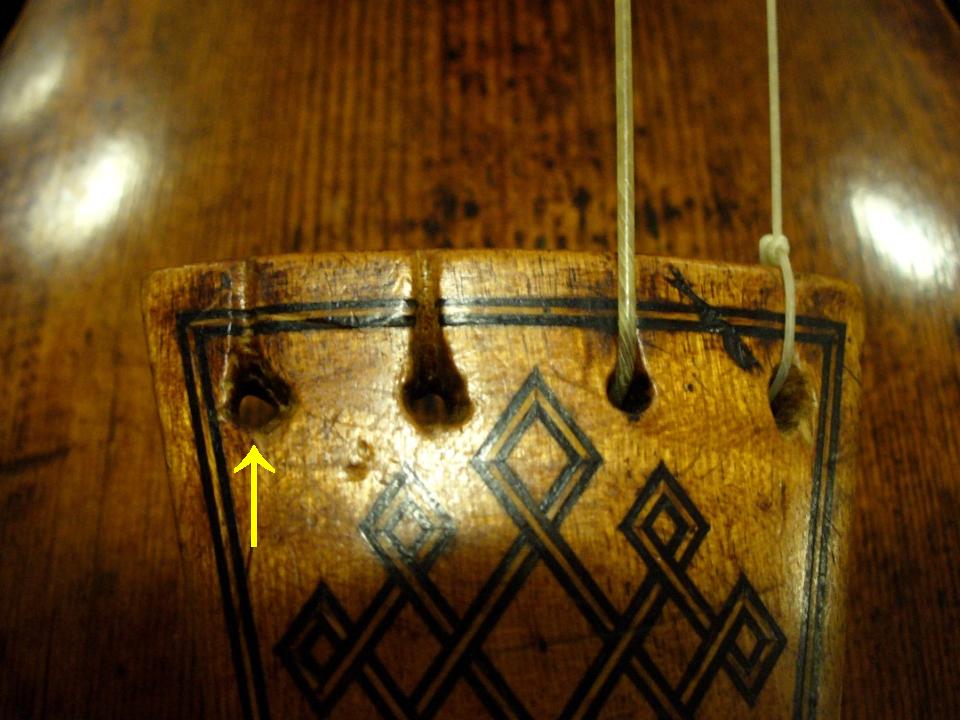
What plausible explanation can we provide for this direct piece of evidence? Whereas, at a hypothetical Venetian pitch of 465 Hz, vibrating length of 36 cm, with a string diameter equal to 90% of the hole (c. 2.1 mm) for a fourth-string C you get a tension equal to 4.6 kg only (the range of working tension of a viola da braccio today in equal tension is around twice that, close to 3.0 mm in string diameter). In this period of history, according to some researchers, low strings made with a rope-twist construction had not yet come into use, which from an acoustic point of view makes things even more difficult.
17th century
Mersenne (1636)
The 17th-century scholar Marin Mersenne, in his Harmonie universelle (1636), is considered the first music theorist to present the concept of equal tension as a theoretical principle, explaining the mathematical relationship existing between diameter, vibrating length, string density and working tension. In other words, Mersenne enunciates for the first time what was subsequently referred to as the Mersenne-Taylor law, which is still applied in the calculation of strings.
However, on closer examination fundamental discrepancies emerge with respect to the rule of proportions which he enunciated (and the concept of equal tension deriving from it) when the same is to be applied in a practical manner in a musical instrument. On page 123 of the original work (Proposition VII, Book III, cfr. Chapman, pp. 176–77) we read the following:
First Rule. Si les chordes sont esgales en longueur & grosseur, & que l'une fasse le son grave qui est en C fa ut, quand elle est tendue avec le poids d'une livre, il faut tendre l'autre avec quatre livres pour la faire monter à l'octave, d'autant que les poids sont en raison doublée des intervalles harmoniques, ausquels on fait monter les chordes; or l'intervalle de l'octave est de 2. à 1. dont la raison 4. à 1 est double. ("If the strings have the same thickness and length and one produces a low note, which is a C fa ut, when it is stretched with a weight of 1 pound, the other must be stretched with four pounds to make it rise to the upper octave, insofar as the weights are twice the harmonic intervals to which one makes the strings rise; now, the interval of the octave is 2 to 1, of which the ratio 4 to 1 is the square.")
In the First Rule, Mersenne thus establishes the perfect proportionality that exists between tension and frequency at an equal vibrating string length and diameter (as seen from his trials on the monochord). He then writes the following in his second rule:
Second Rule. Il faut encore adiouster au susdit poids la seiziesme partie du plus grand poids, ou ¼ du plus petit, afin que l'accord soit iuste: par exemple, il faut adiouster quatre onces aux quatre livres precedentes pour faire l'octave iuste: par consequent 4 ¼ livres contre 1, estant suspendues à deux chordes esgales sont l'Octave parfaite. ("It is necessary to further add to the aforementioned weight the sixteenth part of the larger weight, or one fourth of the smaller, to achieve a proper or 'just' chord. For example, it is necessary to add four ounces to the preceding four pounds to obtain a perfect octave. Consequently 4¼ pounds against 1, being suspended on two equal strings, produce the perfect octave.")
Oddly enough, Mersenne does not provide any motivation for this Second Rule, which contradicts the First Rule that he has just enunciated. In the first rule, confirmation is in fact provided of the perfect proportionality existing between tension and frequency in square terms. Why does it therefore become necessary to have an additional corrective coefficient if the proportionality is already mathematically "perfect" as has been stated? The necessity for the compensation (for otherwise things don't quite add up) is also applied in the Third Rule, where it is established that to ensure two strings having the same diameter and different vibrating string length are in unison, the tension must be squared with respect to the initial value, plus a corrective coefficient equal to 1/16th of the increase in tension referred to. It is evident that Mersenne was aiming solely at solving the anomalies, but avoiding any explanation regarding the same. Nevertheless, in any case an explanation must exist.
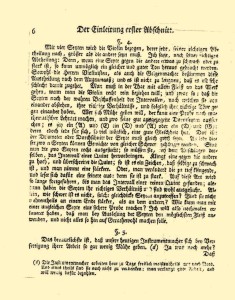
However, this evident contradiction — requiring an act of faith on the part of the reader — was not missed by Bartoli (Fourth Treatise, pp. 248–249), who says:
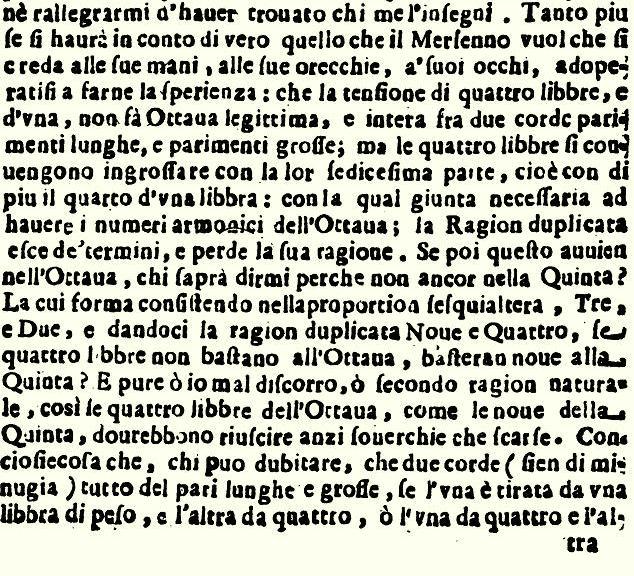
Briefly, and with a discreet touch of sarcasm, Bartoli wonders why one should blindly believe Mersenne's statements regarding the fact one must introduce a correction coefficient, as otherwise it is not possible to obtain the correct octave ratio. For Bartoli it is evident that Mersenne had committed an error. According to the law of proportions, everything should go smoothly; this means that the relation between the diameters must be equal to the square-ratio between the tensions. However, Bartoli later highlights the fact that a string subjected to traction will be stretched, meaning that it loses a part of its diameter and that such reduction is proportional to the weight bearing on the string in question, but goes no further.
Like many others before him, Mersenne also used the monochord as a basis for his experiences. He then extends the acquired rules to keyboard instruments, the harp, the viol and the violin, introducing the concept of equal tension, which derives from the proportionality encountered between diameter, frequency, vibrating string length and string tension. In another known example he uses the lute as his point of reference, illustrating the inverse proportion existing between the diameter of a string and its frequency (at equal tension, vibrating string length and specific gravity of the material). In his writings, however, he was evidently unaware of the gap existing between the proportion's law (found with the monochord) and what actually happens in reality with a musical instrument. The strings in a tuned state are stretched in a different manner with respect to each other (in terms of a percentage) because the weight itself acts on different sections of a string, determining a new situation in the traction state. Moreover, he appears not to conceive that the tension is perceived by the performer by means of tactile feel. In the case of the First Rule the final diameter of the string loaded four times with respect to the initial tension leads to the string's stretching, which causes a consequent reduction of its diameter. And herein lies the explanation for the need to introduce a corrective coefficient. Thus, we are no longer dealing with a proportionality that is perfect but with a scaled type.
In another chapter of his work, Mersenne (Chapman, Book IV, Proposition I, p. 238) emphasizes that in his day neither the lutemakers nor musicians strictly followed, in their daily practice, what he sustained. This is certainly not a point to be overlooked as it means that equal tension, in the day-to-day reality of his time, was not a practice that was really followed but the result of a speculation on the part of those who trained their minds (just as he had done) by studying the Quadrivium (comprising also mathematics and music), of which ministers of the Church were the principal guardians. If his recommendations had been followed, the spinet and harp would have had serious problems of balance in the setup of the strings and under the total tension an instrument would be subject to. In the case of the harp, for example, it is common practice for the shorter strings to have a lower working tension with respect to the longer strings. The aim is for the entire string setup to produce, at touch, an even feel of tension across all of the strings, even though in fact it is obtained with a gradually increasing tension profile. Following Mersenne's proportions, strings gradually decreasing in length would be progressively harder to the touch: the soundboard ought to withstand a very high global tension. The same would occur in the case of the spinets.
Mersenne was most certainly a great and ingenious scholar and remains a precious source of information, however he occasionally commits a few errors in his calculation and evaluation, besides presenting evident conceptual contradictions. These appear even more evident when he leaves the theoretical dimension and moves on to proposing practical applications of his concepts. Some examples: in his second Proposition in Book II (Chapman, p. 78) he correctly states that smaller lutes must have proportionally thinner strings (so as to preserve the same 'right' feel of tension of the strings with respect to a larger instrument) but this affirmation then contradicts the law of proportion of the strings which he himself had enunciated. According to this law if the vibrating length decreases and one wants to maintain the same value of tension (deemed appropriate by the musician for a larger instrument), the diameters must increase. However, this is exactly the opposite of the contemporary recommendation proposed by methods and lute treatises. A smaller lute set up in this way would have (in tactile terms) excessively taut strings.
The breaking load value of gut strings, according to his calculations, results in a value of just 19 Kg/mm². In such conditions no lute, violin or instrument of the gamba family of his time would be able to exist. The breaking load of a gut treble necessary to withstand the vibrating length of a lute tuned to its own pitch, in accordance with the data in the tables of Praetorius, must be of the order of at least 34 Kg/mm² (which, one should note, is also the average value of present-day gut trebles). In brief, with 19 Kg/mm² a lute nominally in G should have a vibrating length of just 33 cm rather than approximately 60 cm. In a violin this should be just 15–16 cm instead of 32–33. With the right vibrating string lengths the treble strings on both instruments would break instantly.
When discussing the strings of the theorbo, he points out that the thickest (which, in his example, is the 11th) is composed of 48–50 or 60 guts. Present-day string makers with 50–60 gut strands (i.e. the whole gut cut into strips) produce a diameter between 3 and 3.5 mm; a diameter of at least 4–5 mm in the case of unsplit whole gut, as was the general case in Mersenne's time — this is the third string of a double-bass! An 11th string for a present-day theorbo has a diameter that is certainly smaller than 1.4 mm. A theorbo built to this proportion for the remaining strings would break instantly; on the other hand, examinations of the hole diameter for the bass strings of surviving theorbos have so far not shown anything of the kind.
In providing the diameters and the proportions to be adopted for lute strings, there is absolutely no consideration that the first string is single (while the others are double), nor that each string of the set loses its own percentage of diameter when subjected to traction. The tactile feel of such a set of strings would in actual fact differ quite considerably from the recommendations of contemporary treatises on the lute (equal tactile feel). Finally, his ideas are contradicted by the reduced dimensions of the holes for the lower strings in the bridges of surviving historical lutes, this being one of the few really unquestionable pieces of evidence we may refer to. A practical application of his suggestions produces a set-up, the tactile feel of which is found to be increasingly taut, proceeding from the treble to the lower strings with a brusque drop in the treble itself. Moreover, it is quite a singular fact that in practice the diameter of the first and second strings cannot be achieved at all; practical tests demonstrate that from a single, whole gut taken from a lamb of three months (the age-limit) one obtains, after light polishing, a range of string diameters between .45 and .50 mm, while from Mersenne's data one obtains diameters which are a lot smaller and could not be produced in any way whatsoever.
Researchers have highlighted various clumsy calculation errors and discrepancies in the chapter where he describes metal wire strings and the string diameters for keyboard instruments. He is never clear when he uses the term "grosseur": occasionally he will be referring to diameters; however, at other times he refers to the square section of the string and even the circumference of the string in question. In some cases he uses two different concepts indifferently to express a measurement of a string also within the well-defined context and discussion of a single argument.
Mersenne informs us that the Dessus 1st string (i.e. violin) is as thick as the fourth string of the lute. On the basis of the measurements he himself provides in the chapter on the lute it is understood that the first string of the violin had a diameter of about 0.75 mm. Following the equal-tension rule which he upheld, the following diameters are established: E 0.75 mm, A 1.12 mm, D 1.70 mm, G 2.50 mm. We will leave it up to the reader to decide what the situation would be in terms of ease of emission and issues relating to fifths on the fingerboard etc. with a set of strings of this kind.
Athanasius Kircher (1650)
In Preludium 1 Kircher gives the number of guts for the strings of the Roman Chelys Maior (Roman 5-string violone): "Est hic Romae Chelys maior, quàm Violone vulgò vocant pentachorda, cuius maior chorda consesta est ex 200 intestinis. Secunda ex 180. Tertia ex 100. Quarta ex 50. Quinta denique ex 30". These figures are especially valuable because they record at first hand the number of guts used for this large instrument, and they were certainly supplied to Kircher — who lived in Rome — by the Roman stringmakers, the most active in Europe.
Since our aim is only to verify the tension profile, it is not necessary to know exactly which gut was used, but only to assume that all strings were made from the same material. Assuming that three whole lamb guts of about eight months give a mean diameter of 0.70 mm, the gauges follow by simple proportion. Kircher fortunately specifies that the Chelys Maior is tuned E (treble), A, DD, GG; the small gap between the 4th and 5th suggests a single interval, hence low FF. Tensions are calculated with a Roman pitch of 392 Hz and a notional vibrating length of 90 cm.
| String | Note | Guts | Diameter | Tension |
|---|---|---|---|---|
| 1st | E | 30 | 2.21 mm | 35.50 kg |
| 2nd | A | 50 | 2.85 mm | 26.31 kg |
| 3rd | DD | 100 | 4.04 mm | 23.54 kg |
| 4th | GG | 180 | 5.42 mm | 18.88 kg |
| 5th | FF | 200 | 5.71 mm | 16.64 kg |
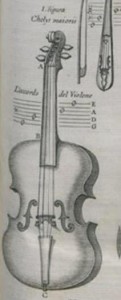
A scaled profile, probably consistent with equal feel. A direct piece of evidence for a scaled profile in the 17th century, from Roman stringmaking data — that is, from those who were certainly in a position to set the commercially available gauges. (Sidenote: the table for the Chelys exachorda on p. 486 does not list diameters but the proportions between the frequencies of the open strings; the column is indeed headed "propor.".)
Serafino Di Colco (1692)
Serafino Di Colco (together with Mersenne and, as we shall see, also Leopold Mozart) is undoubtedly considered one of the main battle horses by those who support the equal-tension hypothesis. Di Colco wrote: "Siano da proporzionarsi ad un violino le corde… distese, e distirate da pesi uguali… Se toccandole, ò suonandole con l'arco formeranno un violino benissimo accordato, saranno bene proporzionate, altrimenti converrà mutarle tante volte, sin tanto che l'accordatura riesca di quinta due, per due, che appunto tale è l'accordatura del violino" (the proportioning of the strings must be based on a violin […], extended and stretched by equal weights […]. If, when touching them or playing them with the bow, they form an excellently-tuned violin, they can be considered as well-proportioned, otherwise you will need to change them as many times as necessary until the tuning is successful and fifths are obtained between pairs of strings, which is precisely the tuning of the violin).
The Di Colco case may indeed result in a certain interpretational confusion. In accordance with modern custom, one is in fact tempted to conclude that these are setups having equal tension, i.e. as if the diameters had been obtained starting from a calculation on packaged strings (i.e. not yet placed in a state of actual traction). On closer examination things appear to be quite different, however. It is true that the test indicated by Di Colco is carried out under an equal-weight regime (i.e. a real equal tension imposed by means of identical weights) but in a condition entirely different from the equal tension as it is sustained nowadays. The modern equal tension is that which obtains — by mathematical calculation or from a chart — the string diameters (still "packaged") not yet placed under a state of traction, while in Di Colco's case the strings are actually already in a state of intonation, i.e. they have already undergone the process of stretching and loss of diameter due to the tension imposed by the static weights.
As this is a situation of equal dynamic tension (the weight always remains the same even though the strings are stretched), the strings thus reveal a condition not of equal tension according to the modern principle (i.e. obtained from a theoretical calculation) but of equal feel. In other words, the method suggested by Di Colco achieves what we previously discussed in relation to the behaviour of strings of differing diameter subjected to the same tension, but following an inverse path. The strings suitable for providing open fifth intervals must present diameters in the package relating to a scaled tension profile, just like the other cases described. Once placed in a state of traction, these strings will be stretched in a manner proportionate and suitable to obtain, under the same working tension (given by the same bearing weight), the fifth intervals that are being sought.
The question now is: how many of the "equal tension supporters" have actually gone to the trouble of checking the Di Colco test so as to see what really happens? In any case we decided to do it ourselves. For the pure sake of practicality we used a ukulele, from which we removed the head (i.e. pegbox) and added an arched bridge positioned at the violin's vibrating length, and finally added the corresponding tailpiece (frankly speaking, we did not fully understand why the instrument drawn by Di Colco does not have a neck — was the test really carried out by him? And if it was in fact carried out, does it only concern half of the vibrating length? Rather than a musical instrument, what we have here is just a sound box). We checked the bearing weights (2.5 kg) on a balance to verify their calibration; one was readjusted with an addition of 2.4 g. The strings used were exactly .60 and 1.20 mm, measured with a micrometer and also with a laser measurement device for safety. They were produced with a centreless grinding machine to ensure maximum precision and were both worked under the same conditions of ambient moisture. The nut was extremely well-polished, with no grooving so as to avoid useless additional friction, and treated with a graphite paste to ensure a maximum degree of string slide. The knots on the side that had to bear the weights were made in such a way that the strings would present the same overall length.
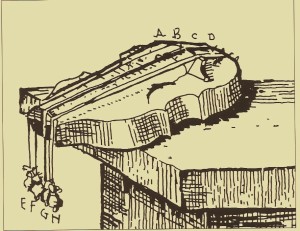
The two strings, placed under traction with the static weights, showed that the thinner string was stretched more than the thicker one. This indicates that it had also become thinner in percentage terms with respect to the other string, thus altering the initial 1:2 ratio of the diameters (in the drawing by Di Colco you notice something absolutely unnatural and contrary to the laws of physics: the equal weights acting on the four different strings of the violin stretch each string by the same amount despite the fact that these gauges are very different among them — was it a mistake of the artist? Did Di Colco not notice the error, or did he actually never carry out this test?). Consequently, when plucked, the strings did not show at all the octave interval as should have occurred according to the theoretical rules laid down by Mersenne; on the contrary we found an octave and two additional semitones. But it could not have been otherwise. On the basis of the law applying to strings, having an equal vibrating string length and tension, the frequency and diameter are inversely proportional. The ratio existing between the two diameters — which in a state of non-traction reproduced perfectly the 1:2 ratio of the octave — in the traction state (the real condition in a musical instrument) is instead placed severely out of balance, as the finer string is stretched more than the other one.
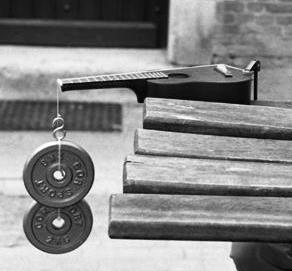
To return to a situation capable of reproducing the exact octave interval in a state of traction, the initial diameter (obtained using the string formula) of the thinner string must be increased by a value exactly equal to that percentage of diameter it will subsequently lose under traction. This means that in the calculation using the string formula one must consider a tension of the scaled type. Once the equal weights have been applied to the strings, after having been securely stretched, they will spontaneously assume a condition in accordance with the 1:2 diameter ratio. We carried out the test referred to various times (also changing the weight value and string diameters) and demonstrated it in public during the course of a conference at a symposium held at Puurs in Belgium ("Corde Factum", 2012).
So the truth emerges from this test and also from our own previous considerations. Di Colco's test (which, together with Leopold Mozart's, is nowadays considered one of the main proofs of the equal tension principle, in which diameters are obtained by calculation using the string formula) is in actual fact the one that demolishes it, unquestionably demonstrating what really happens to two strings having different diameters submitted to the same working tension. Thus, the only path forward to safeguard the "equal tactile feel" rule, so widespread in the sixteenth and seventeenth centuries, is the use of a certain gradient of scaled tension in the calculation of initial diameters. To conclude, Di Colco may in no way be considered a good battle horse for the "equal tension" supporters but rather should be seen as one of the principal adversaries of this particular school of thought.
As with Mersenne, it remains unclear whether what Di Colco demonstrated theoretically was then actually the daily practice of the musicians of his time. On this point the other historical sources in our possession unfortunately report nothing useful, and it is hard to believe that every musician of the period owned a contrivance such as the one used by Di Colco for his demonstration.
Iconographic survey
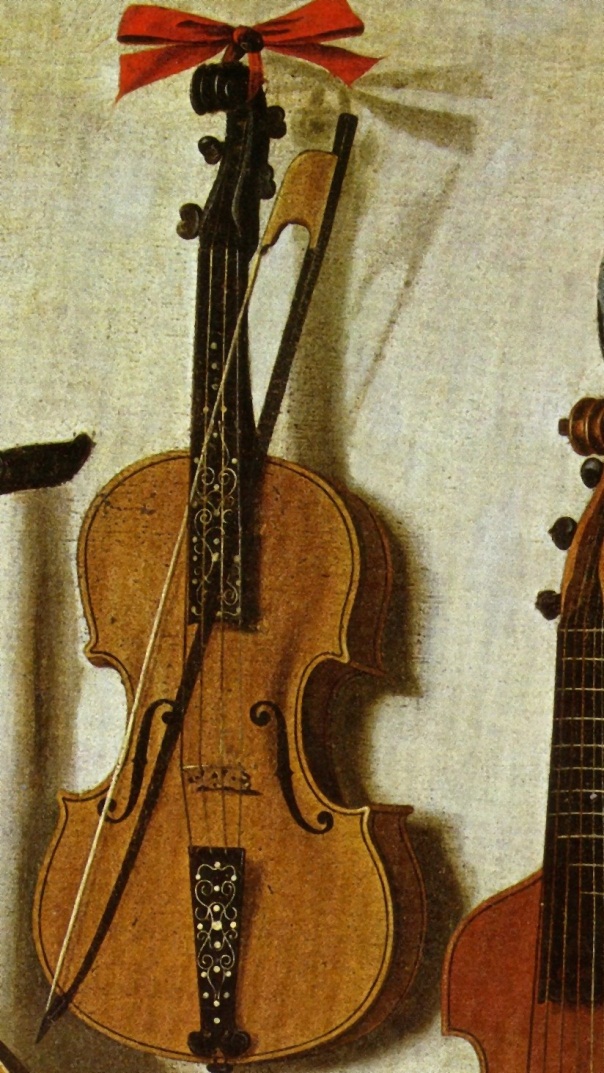
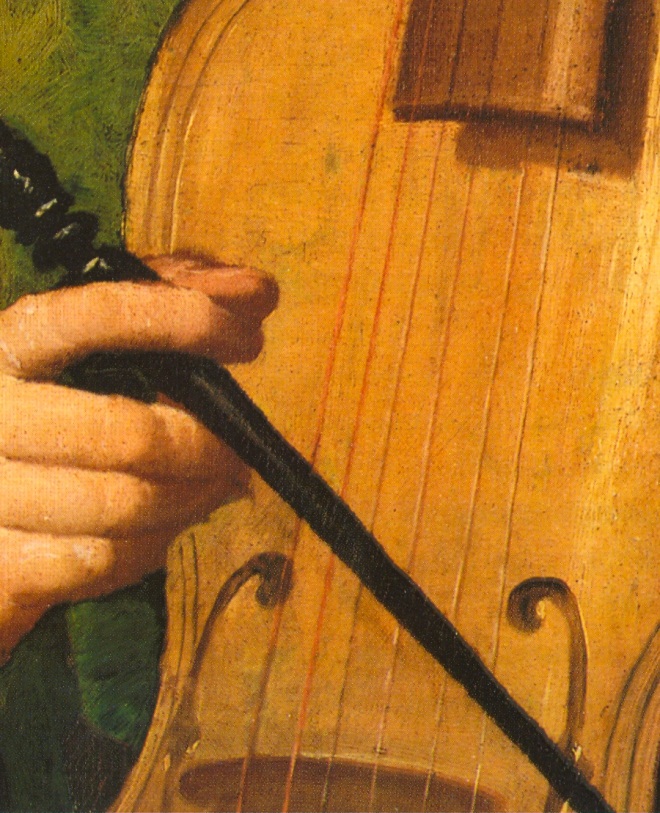
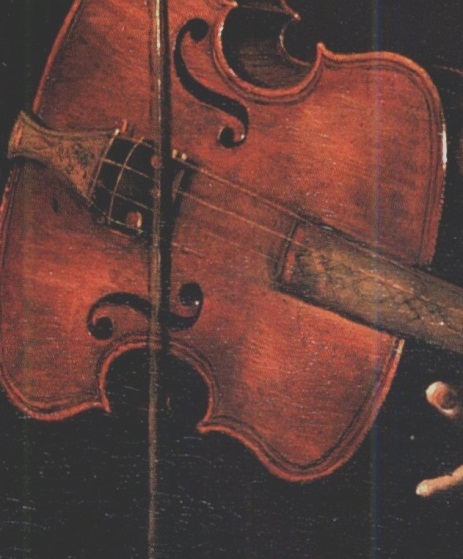
16th–17th-century iconographic sources can provide general indications, provided they are realistic. In an equal-tension setup the difference between the first and last strings is very marked, and therefore easy to see. Most examples show profiles that deviate not only from equal tension but, in some cases, also from equal feel.
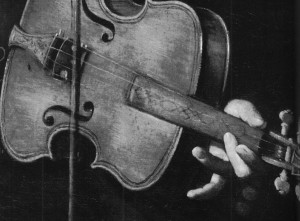
Indeed the iconographic examples where you can find an interesting difference between the apparent diameter of the first string compared to the lower strings are only a few:
 |
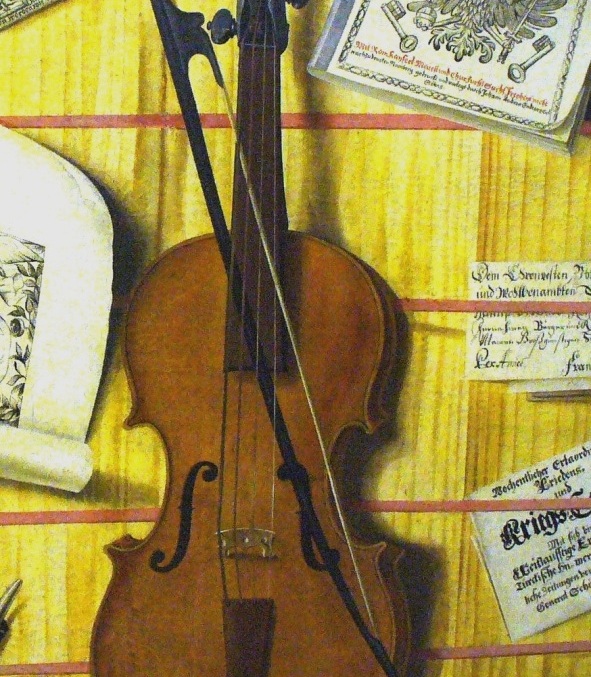 |
Images where the diameter difference between first and fourth strings is most evident.

Later 18th-century documents
By the mid-18th century the typical features of bowed-instrument setups (mostly violin) are defined:
- scaled tension profile;
- scaling steeper than that required by equal feel alone.
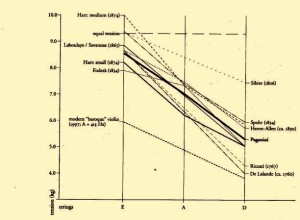
We do not know what led the violinists of the time to this choice, unless it was already part of 16th–17th-century daily practice (see the iconography and the tailpiece-hole measurements of the Amati violas). We can see no logic that would justify abandoning an equal-feel profile in order to adopt so decidedly scaled a tension; the adoption of wound strings certainly does not require it.
18th-century documents with clear indications of scaled tension
- Manuscript recipe (probably early 18th c.): the number of guts for the upper three violin strings yields a strongly scaled profile.
- De Lalande (1765–66): he reports on the leading Abruzzese stringmakers, Angelo and Domenico Antonio Angelucci (the latter died in 1765), who in the first half of the 18th century owned the largest string factory in Naples, with over a hundred workers. The first violin string uses three whole lamb guts of 8–9 months; the last plain-gut string (the "re", not the fourth, which is wound) uses seven.
- Riccati (1767): no new theory, but a mathematical explanation of the scaling of the commercial strings he found on his own violin. His book was begun around 1740, so violin strings on the Italian market in the first half of the 18th century already showed a markedly scaled profile. He weighed on gold scales three equally long portions (1½ Venetian feet) of the strings called tenore, canto and cantino, leaving aside the lowest because it is not of plain gut but wound with a thin copper wire. Assuming a mean gut density of 1.3 g/cm3, these give 0.70, 0.91 and 1.10 mm for E, A and D.
- Donato Vincenti (1785): the number of guts for the three upper violin strings yields a strongly scaled profile, of the same kind as De Lalande's.
The supposed coexistence, in the 18th and early 19th centuries, of an equal-tension profile (we would rather call it equal feel) and a strongly scaled one is not, in our view, historically sustainable.
Re-examining the sources claimed for equal tension
Stradivari (early 18th c.)
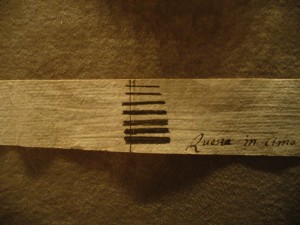
The hypothesis of a possible equal-tension set-up for the violin that Stradivari used as a reference for the type of string to use on his "Chitarra Tiorbata" arises from the traces marked in charcoal on the template of the "Chitarra Tiorbata": next to one of these traces is in fact written: "Questa in cima deve essere una quarta da Violino…" ("this at top must be a violin fourth"). Since the trace referring to the violin's fourth string is of rather considerable thickness, it has been concluded that this was not only a gut-only set-up, but also one in equal tension.
Our hypotheses are different. On this template Stradivari draws, with rather wide and coarse strokes, even what must necessarily be very thin strings, such as the first three courses on the fingerboard or the intermediate strings on the neck. The trace he refers to has, on the cardboard template, a thickness of 3, perhaps 4 mm: this is the measurement of the second or third string of a double bass. We do not really want to believe that this was actually the real diameter of the violin's fourth string in pure gut. We think instead that Stradivari meant to indicate that the string to be used in that position had to be a violin fourth — an instrument certainly far better known to stringmakers and musicians — without any intention of indicating the real diameter in the charcoal trace itself.
In conclusion, it is not possible to determine anything about the tension profile of that violin, nor can we conclude with certainty that it was set up only with gut strings: Stradivari could in fact have wanted to suggest that for that particular string of the Chitarra Tiorbata the wound violin fourth should be used.
Tartini (1734)
Fétis wrote that in 1734 Tartini found that the sum of the tensions of the four strings of his violin was 63 pounds. Apart from knowing how Tartini determined that value of tension (and whether the figure was then correctly converted into other units of measurement), it should be emphasised that the mere fact of its being expressed as a single global value does not at all mean that we are witnessing confirmation of a set-up in equal tension: the same identical value can in fact also be obtained from the sum of completely different tensions. Through some calculations we have come to the conclusion that we are perhaps faced with a scaled-type set-up. Being a violin, we consider a vibrating length of 0.32 m; for the standard A we can assume a theoretical eighteenth-century Venetian pitch equal to 465 Hz.
Equal-tension hypothesis: assuming that 63 pounds actually equate to 31 kg, following the equal-tension hypothesis would give about 7.7 kg per string, leading to the following gauges: E .61 mm, A .92 mm, D 1.38 mm, G 2.06 mm (expressed in equivalent solid gut). As can be seen, the treble has a diameter that falls outside the range of gauges obtainable with 3 or 4 lamb-gut casings, which is, as we know, the typical constructive characteristic of that particular historical period. Starting instead from an average supposed E of .70 mm (obtainable from 3–4 whole lamb casings), with a set-up still in equal tension, one observes that things do not add up at all: the total tension would come to as much as 42 kg. This hypothesis, too, is therefore not plausible — and it should be stressed that the sum of the tensions of the three thinnest strings alone (about 30 kg) would by itself be almost enough to reach the value of tension indicated by Tartini for all four strings.
Scaled-tension hypothesis: starting with an average value for E of 0.70 mm, and using for A and D the gauges commonly found in the historical sources close to him in time (Riccati, De Lalande), we arrive at the following: E .70 mm (9.9 kg), A .90 mm (7.3 kg), D 1.16 mm (5.4 kg), total 22.6 kg. In order to reach the 31 kg indicated by Tartini, one must have a wound G that produces about 6.5 kg of tension: this corresponds to a bare-gut string of about 1.90 mm. Manufacturing such a wound string as specified by Galeazzi indeed falls within the required range, thus confirming the hypothesis of scaled tension over equal tension.
Leopold Mozart (1756)
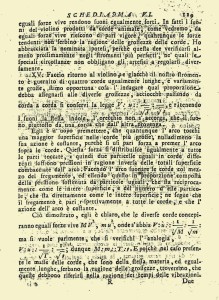
Mozart takes over, point for point, Di Colco's own concepts. He suggests attaching equal weights to each pair of adjacent strings and changing one of the diameters (the A relative to the treble E) until the open-fifth interval is obtained; one proceeds in this manner with the third string, and apparently also with the fourth. Our conclusions are therefore the same as those reached for Di Colco: we are faced with a tension profile that, if calculated according to today's practice, leads to an at-rest tension profile of a moderately scaled type, not to equal tension according to the current conception.
19th century
- Fétis and Savart (1840 and 1856): both give the total value of the violin's tension, specifying how it was divided between the treble and the other strings. If the strings were in equal tension, what reason was there to specify that the treble took 20–22 pounds and the rest of the strings up to a total of 80 pounds? It would have been enough to define a single value of tension. We therefore lean toward a scaled tension profile, also as a result of what was verified by their contemporary Delezenne.
- Delezenne (1853): he first formulated the theoretical hypothesis of equal tension, but when he came to examine a dozen commercially available string sets supplied to him by the luthier Lapaix, he realised that all of them followed instead a strongly scaled tension profile. Commercial gauge ranges measured by Delezenne: E .61–.70 mm; A .82–.96 mm; D 1.01–1.39 mm.
- Maugin & Maigne / Savaresse (1869): the tension values indicated in the text for the four strings are unreliable, being fully in contradiction with the number of guts necessary to produce them, which instead leads to a scaled tension profile similar to all the other examples. One should note a mistake in calculation or typesetting in the text: the treble is given a working tension lower than the second string (7.5 kg against 8.0 kg for the A) — probably the correct value is 8.5 kg. After deriving from this an estimate of the diameters (at a vibrating length of 33 cm and a pitch of 415 Hz) and relating them to the breaking loads given in the text for each string, a further fundamental inconsistency emerges: the breaking indices of the gut turn out to be too low, outside any acceptable standard — 33–36 kg/mm² for the E (which is fine), but only 21 kg/mm² for the A and 17–19 kg/mm² for the D. This makes it unreliable for drawing any definite conclusion in favour of equal tension. If instead one starts from the number of guts given in the text by the stringmaker Savaresse, for a scaled tension profile, the breaking indices again become entirely reasonable.
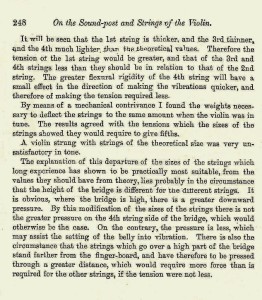
- Huggins (1883): after calculating the theoretical diameters according to an equal-tension profile, he realised that they did not work as expected. He went on to recognise the validity of the strongly scaled commercial gauges, such as those produced by the Neapolitan stringmaker Ruffini, and argued that the theoretical equal-tension gauges give neither properly tuned fifths nor a satisfactory acoustic response — setting himself to understand why.
Why such marked scaling?
Huggins offers two hypotheses:
- The angle of incidence on the bridge becomes sharper for thicker strings, increasing downward pressure. To equalise pressure, more scaling is needed.
- Thicker strings stand higher above the fingerboard: reducing their tension restores left-hand finger feel.
A third hypothesis: maximum uniformity of bow friction, already in Riccati (18th c.) and Plessiard (late 19th):
"…though the bow touches a greater surface on thicker strings, its action is constant provided that equal force is used to press the bow on the strings. This force distributes equally over all the parts touched, so two equal particles in different strings suffer pressures in inverse ratio to the total surfaces touched by the bow." (Riccati, Delle corde, 1767, p. 129)
Conclusions
The examination of the different historical and iconographic sources in our possession might possibly allow us to draw a sufficiently clear picture of the criteria for choosing a set-up for bowed instruments in the seventeenth, eighteenth and nineteenth centuries, as seen in everyday practice, and not at the level of pure theoretical disquisition. If we cannot say with certainty which were the criteria used in the seventeenth century, we can emphasise with some certainty which ones were not. In first place there is the concept of equal tension "by calculation" so prevalent today: despite the writings of Mersenne, it does not appear to have been followed as common practice in the seventeenth century. However, the Di Colco and Leopold Mozart tests are indeed very clear on this point. Moreover, equal tension "derived from calculation" is unfortunately based on an error of scientific evaluation of the proper relationship equal tension = equal feel: the tension of this equivalence is that of the string which is already tuned, not the one set by the known formula for the calculation of the diameters.
It must be emphasised that this criterion of equal feel is in any case derived from the treatises for plucked instruments only, like the lute, and not for bowed instruments, for which we do not actually have anything really exhaustive concerning real daily practice. The first useful practical information dates back only to the second half of the eighteenth century. Our point of view, summarising the corpus of information examined, aims to suggest in practice a scaled-type tension for most bowed instruments: Kircher, moreover, provides real evidence of this. To determine how scaled it could be is unfortunately impossible to establish. It remains an open question regarding the open fifths on the fingerboard, which was for some nineteenth-century researchers the topic used to explain the need for scaled tension in bowed instruments. But if the problem of having the fifths in tune was a real problem in the nineteenth century, was it a problem even in the seventeenth century?
Live happily.
Mimmo Peruffo, 2010
Independent contribution: by Miles Golding — milesgolding.com/StringTension
References
- Oliver Webber, Rethinking Gut Strings: a Guide for Players of Baroque Instruments, King's Music, London 2006.
- Ephraim Segerman, "Strings through the ages", The Strad, part 1, January 1988, pp. 54-55.
- Maugin & Maigne, Nouveau manuel complet du luthier, pp. 168-181 (string section added in 1869 edition).
- Francesco Galeazzi, Elementi teorico-pratici di musica, Pilucchi Cracas, Rome 1791, p. 72.
- Daniello Bartoli, Del suono, de' tremori armonici e dell'udito, Tinassi, Rome 1679, p. 157.
- John Dowland, "Other necessary observations belonging to the lute", in R. Dowland, Varietie of lute-lessons, London 1610.
- The Burwell Lute Tutor, ms. c. 1670; facsimile ed. R. Spencer, Boethius Press, Leeds 1973.
- Thomas Mace, Musick's Monument, London 1676, pp. 65-66.
- Galeazzi, op. cit., p. 72 (only document evaluating feel through bow contact).
- Ephraim Segerman, "Modern lute stringing and beliefs about gut", FoMRHI Quarterly, bull. 98, January 2000, p. 59.
- Serafino Di Colco, Lettera prima (Venice 7 January 1690), in Le vegghie di Minerva nella Accademia de Filareti, Venice 1690.
- Marin Mersenne, Harmonie universelle, Cramoisy, Paris 1636.
- Mersenne, op. cit., cited by Stephen Bonta, "Further thoughts on the history of strings", Catgut Acoustical Society Newsletter n. 26, November 1976, p. 22.
- Ephraim Segerman, "String tension on Mersenne Lute", FoMRHI Quarterly, bull. 11, April 1978, p. 65.
- Mimmo Peruffo, "Il Chitarrone e le corde di metallo", Bollettino della Società Italiana del Liuto, year VII, n. 2–4, vol. 24, February 1999, pp. 8–15.
- Mimmo Peruffo, "The mystery of gut bass strings in the sixteenth and seventeenth centuries: the role of loaded-weighted gut", Recercare, V, 1993, pp. 115–151.
- Ephraim Segerman and Cary Karp, communications in FoMRHI Quarterly, 12 July 1978, p. 25; 14 January 1979, pp. 44–46; April 1979, pp. 56–57.
- Ephraim Segerman, "String tension on Mersenne Lute", FoMRHI Quarterly, bull. 23, April 1981, pp. 79–83.
- Athanasius Kircher, Musurgia Universalis, book V, Rome 1650, p. 440.
- Cf. the account of the experimental verification of the Di Colco test, presented by the author at the "Cordefactum" symposium, Puurs (Belgium), 2012: cmbpuurs.be/cf12_mimmo_peruffo.php.
- Patrizio Barbieri, Acustica, accordatura e temperamento nell'illuminismo veneto, Rome 1987, p. 42.
- Libro contenente la maniera di cucinare e vari segreti, ms., Biblioteca Panizzi, Reggio Emilia.
- François De Lalande, Voyage en Italie, vol. IX, Paris 1786, pp. 514-9.
- Ephraim Segerman, "Review: Italian violin strings", FoMRHI Quarterly, bull. 98, January 2000, pp. 26-33.
- Giordano Riccati, Delle corde, ovvero fibre elastiche, Bologna 1767, p. 130.
- Patrizio Barbieri, "Roman and Neapolitan gut strings, 1550-1590", Galpin Society Journal, May 2006, pp. 176-7.
- Leopold Mozart, Versuch einer gründlichen Violinschule, Augsburg 1756, p. 6.
- Cf. Segerman, "Strings through the ages", part 2, p. 198.
- F.-J. Fétis, Antoine Stradivari, Vuillaume, Paris 1856, p. 92.
- C.-E.-J. Delezenne, Expériences et observations sur les cordes des instruments à archet, Lille 1853 (cited in Barbieri, op. cit., p. 48).
- William Huggins, "On the function of the sound-post…", Royal Society Proceedings XXXV, 1883, pp. 241-8.
- J.-A. Plessiard, "Des cordes du violon", Congrès de Lille 1874 (cited in Barbieri, op. cit., p. 46).
- Huggins, op. cit., p. 248.