Summary
An extensive popularising dialogue by Mimmo Peruffo (updated November 2005) in which a group of string players visits an Italian stringmaker's workshop on the eve of a late-Baroque and Classical concert tour. Through a sustained question-and-answer the author dismantles the commonplaces of current historically informed practice: he explains the historical gut-string manufacturing cycle, shows why true historical gauges are much thicker than today's "Baroque" strings, refutes the theoretical equal-tension setup, distinguishes equal feeling from equal tension, recounts the transition from plain-gut to wound basses, and gives a synoptic table of violin gauges from 1760 to 1890. The "philological dilemma" of the title concerns the widespread use of modern instruments and accessories disguised as historical, against which the author proposes a coherent path: well-twisted strings, little alum, round-wire wound basses, mounted on properly proportioned instruments.
Key takeaways
- Strings are the starting point of the sound chain: luthiers and bow makers built instruments around the mechanical and acoustic limits of the available strings.
- Historical violin gauges (1760–1890) are much thicker than today's "Baroque standards": E 0.65–0.75 mm, A 0.85–0.95 mm, D 1.10–1.25 mm.
- Period strings were far more twisted than modern ones, making them softer, more elastic and capable of the full dynamic range from pianissimo to fortissimo.
- The "equal feeling" of 17th-century treatises corresponds to an at-rest scaled profile that converges to equal tension once at pitch; theoretical equal tension is an interpretive error.
- Historical wound strings use round wire over a gut core (no silk underlay) and precise metal-to-gut proportions documented by Galeazzi and Savaresse.
- String colour does not identify either the type of gut (lamb, beef, mutton) or the quality: it depends only on the bleaching treatment.
- Surface philology (colour, animal, bleaching) must give way to substantial philology: twist, gauges, type of winding, vibrating length and the string angle over the bridge.
Bow instrument string setups and the philological dilemma. A dialogue
updated: 18 November 2005
by Mimmo Peruffo
"What is essential is invisible to the eyes" — Antoine de Saint-Exupéry
Preface to the reader
The stringmaker enjoys the privilege of being a determining factor in the reconstruction of early music repertoires played with so-called historical setups. It is to him that musicians often turn not only to order strings of various gauges but also for advice on the setups suitable for one repertoire rather than another. In seeking acoustic optimisation he is often forced to address subjects that properly belong to lutherie, such as the bridge, the soundpost and the tailpiece. Following such a broad slice of the bowed and plucked community, the stringmaker can also sense the direction of the early-music world and gauge its level of organological (and practical) knowledge about strings. With his suggestions and, more markedly, with his production choices, he is genuinely able to shift the centre of gravity of what we call historically informed performance. A change of direction in the type of string produced sets off a chain of adaptations that involves luthiers, bow makers and performers, because the string is the basic starting point, the generating essence of sound.
The opposite risk also exists: the stringmaker, seeking productivity and cost reductions, may be tempted to simplify operations that are essential to the sound. This is precisely what happened in the past, when stringmaking, in order to convert to the industrial production of surgical sutures and tennis strings, underwent profound changes. The return to music-string production necessarily implies a new strategy: it is not enough that a string be made of gut to recreate a quality sound, just as it is not enough to have tomatoes to make a good sauce. Where this shift has not occurred (and largely it has not), the result is the spread among musicians of a frustrating and poor acoustic yield imposed by bad strings, accepted as the norm only because the criteria distinguishing a good string from a bad one are no longer known, as they were in the past.
If the stringmaker can also be a researcher, then the wonderful and responsible possibility opens up of aligning his production with historical construction and quality criteria, triggering a beneficial chain reaction among the professionals downstream and reaching a sound that is more beautiful and historically correct. By analogy: car builders (luthiers) should be guaranteed a type of fuel that, although produced by different firms, meets specific quality criteria. Both the carmaker and the driver would benefit. For strings, this does not yet exist. Hence the reasons for the following dialogue, intended to foster a better shared responsibility in the reconstruction of the historical sound.
Vicenza, 25 June 2004
Prologue
In May 2004 a group of musicians devoted mainly to late-Baroque, Classical and early-Romantic repertoires happened to pass near a southern-European town renowned for the production of gut strings. Lacking such accessories they decided to contact the stringmaker and use the chance to visit his workshop. The group consists of violins, violas, cellos, double bass and violone, all strung with gut, along with wind players, harpsichord and theorbo. After ringing the bell they are welcomed by the stringmaker himself…
Stringmaker: Good morning. How may I help you?
Musicians: We're travelling towards central Italy for a series of productions ranging from Stradella, Corelli, Bach and the early 19th century. We've fortunately noticed we're short of strings — gut strings, of course. Our group plays these authors with strictly historical criteria, so gut strings are essential to us.
S: Of course. Which gauges do you need?
M: We're short of strings in general: violas, cellos and especially violins. We may need something for the double bass too. Since we have some time, we'd like to chat and visit your workshop if you'd allow us.
Workshop secrets
S: Gladly. This is an unusual event: since the dawn of time the art of stringmaking has been jealously guarded, but I think the time has come to open the doors to legitimate curiosity. Secrecy was once a necessary choice: entire territorial areas (Abruzzo, Rome, Naples, Padua here in Italy; Munich, Lyon and other European centres) owed their wealth to their ability to bring strings to the ultimate degree of perfection and to defend their manufacturing secrets handed down from father to son.
M: Some of us would like to learn how to make strings at home, to get truly historical results…
S: Don't fall into this trap. Stringmaking is a complex craft: in 17th-century Rome an apprenticeship of nearly a decade was required before one could call oneself a master stringmaker registered with the guild. There are some medieval recipes, but they are extremely brief and hermetic. From the late 15th century onwards, stringmaking became a true profession governed by strict guild statutes. Making a string properly requires at least 10–12 days of work.
M: And some of us complain about how expensive gut strings are!
S: Strings used to cost much, much more than today. We are dealing with a product whose manufacture takes all this time and is still done almost entirely by hand according to ancient techniques almost vanished from the planet: there are barely four or five workshops left in the world. A violin first string — a rare artisan product mounted on instruments worth thousands of euros — costs less than a couple of cappuccinos, which last only minutes, while a good first string can last several weeks.
The old manufacturing process
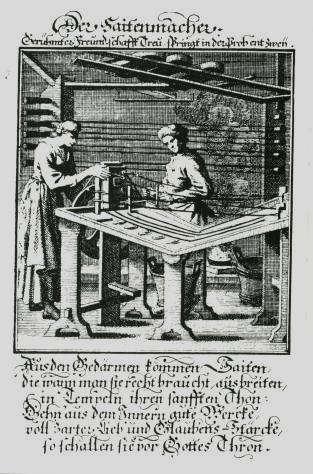
The procedure prevalent in Italy from the mid-18th century to the early 20th century (cf. De Lalande, Voyage en Italie, 1786, vol. IX, pp. 514–9) used lamb or wether gut of 7–8 months of age. After being emptied and rinsed for several days in running water to remove excrement, the guts went through a series of treatments meant to soften and detach the non-muscular membranes and the fatty substances. This was done by soaking the guts for several days in alkaline baths (made by dissolving wine-lees ashes — containing potash, i.e. potassium carbonate — in water) and gently scraping the material with a piece of marsh reed. These baths left only the muscular membrane, which is what the stringmaker wanted.
Several degreased guts were then carefully selected and assembled in parallel bundles (according to the required diameter), tied at the ends and twisted with a small winding device. The other end was then fixed to the opposite peg of the drying frame, putting the wet string under tension. When the frame was full it was carried into a sealed room where the strings were exposed for several days to the bleaching action of sulphur dioxide fumes from burning sulphur. The strings were then twisted again, sulphured again and finally dried outdoors. Once dry they were smoothed by rubbing the surface with an abrasive herb such as horsetail (Equisetum), or pumice powder; then oiled with olive oil, cut from the frame and packed into coils.
A question of limits
S: Strings are not an accessory: they are the centre around which everything turns. Just as a liquid poured into a vessel fills its free surface, so was the musical instrument: it was sized to fully exploit, both at the upper limit (the pitch of the first string) and at the lower limit (the lowest open-string pitch), the mechanical and acoustic qualities of the strings of the time. This explains the Renaissance and partly 17th-century rule of tuning an instrument to the highest possible pitch. Luthiers actually worked in reverse: given a pre-set pitch for the first string, they determined the exact vibrating length that would make the chanterelle work at its upper limit. This explains why a violin has a 33 cm vibrating length, or a mean lute (in g) 62 cm.
The canoe and the Indian
S: Imagine being an Indian in a canoe. A thin stick for an oar would only cut the water. You need a paddle whose wide surface adapts the stick to the water — an impedance match, as radio amateurs would say. The same applies to the string: vibrating it cuts the air. A wide surface (the soundboard) is needed to match the string to the air. But unlike the oar, the soundboard demands payment for its service: it asks the string to carry its own "chromosomes", its specific timbral character. Hence the great variety of colours that the same string gives on different instruments.
The ugly duckling becomes a swan
S: In reconstructing the sound of the past the string can hardly be called an accessory: it is the cornerstone of the temple. We all think of the ugly duckling, whereas we are dealing with the swan. Without the string, the sound produced by our precious Amati or Gagliano would be reduced to mere percussion noise. But now we find ourselves working backwards: we have lost the strings for which those instruments were sized and optimised, so we simply need to recreate for them the environment and the conditions of the time in which they lived. To do so we must first try to understand, in its most hidden secrets, the old way of making strings.
The philological deception
S: Imagine being sold a beautiful 1950s valve radio (briar wood, "Medium Wave, Short Wave…") and finding cold transistors inside. Wouldn't you feel cheated? Today we are seeing something similar. Is it not true that many performers, under the official label of "historical performance", use the most modern flat-wire wound basses, perhaps made of perlon, tungsten or polyvinylidene fluoride? That sometimes only the first string of gut is fitted while the rest remain modern metal? That all this is sometimes done on instruments set up modernly (long thick bass bar, modern bridge model, retroflexed neck, modern tailpiece, chinrest), of which we know the difference from the old ones? Not to speak of the occasional use of the modern bow… Putting just a top hat on does not make us dressed as in the 19th century.
Historical gauges
M: The idea of thin strings has guided generations of performers. We deduce it from the fact that the bass-bar was generally thin and short, suited to bear less string pressure.
S: I used to think the same. You cannot imagine the effort it took me to accept the truth emerging from historical documentation. This conclusion may have been influenced by our habit of feeling, under fingers and bow, extremely thin modern metal strings. In the past, setups were anything but light: gauges were generally much thicker than today's, not only in Italy but across Europe.
M: Our attempts with thicker strings failed: they whistled, the sound was poor and glassy, hard to set in vibration.
S: If strings are not made by certain criteria (the historical ones), they reject us. We are not allowed access to historical gauges. The same applies to modern instruments: copies of originals or not, they should be set up and optimised by the luthier for historical gauges, not those thin hairs.
The colour of gut
Any gut, once dried, looks brown if untreated. It is not true that mutton has a yellow-brown colour while beef or lamb is light yellow: it is simply that those mutton strings you use have not been bleached. The reverse may happen: brown beef or lamb gut and straw-yellow mutton. Today we stringmakers use hydrogen peroxide; in the past, sulphur fumes. The same the Romans did at Pompeii with their cloth. The colour today says nothing about the gut type.
Beef, mutton and lamb
S: All historical sources agree that the material used in Italy was above all lamb or wether gut not more than one year of age, not mutton. In France, until c. 1850, mutton gut was used (Labarraque, L'art du boyaudier, Paris 1812), then they switched to lamb. In the late 18th century the French government offered a gold medal to whoever matched the quality of Neapolitan first strings: it was won by the Savaresses, stringmakers of Neapolitan origin, who used lamb instead of mutton.
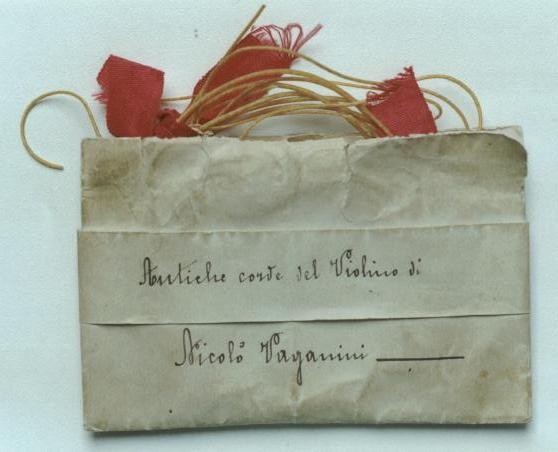
Mutton gut is too coarse: a violin first string in Italy used 3–4 whole lamb guts coupled, while with mutton only two were needed, giving a less regular diameter and lower resistance to fraying. With more thinner gut strands the result is more regular and uniform. Paganini had Neapolitan stringmakers specially make four-strand first strings instead of the canonical three; being thinner but more numerous, the finished diameter still fell within the traditional range (Edward Neill, Nicolò Paganini: Registro di lettere, 1829, Graphos, Genoa 1991, p. 80). This is shown by a letter of his from Breslau, 31 July 1829, to the Neapolitan luthier Onorio de Vito: “I need a favour: take every care and diligence. I am short of first strings […]. However thin, they must be of 4 strands to hold. See that the string is smooth, even, and well drawn […]. I beg you to watch over the makers and be quick, and good.”
Experimental trials show that the global acoustic yield of a gut string does not depend, in any audible way, on the starting material or feeding type. It rests on two pillars: the specific weight of the starting material and the elastic modulus of the finished string. Gut, regardless of animal or feed, remains at about 1.3 g/cm³. The elastic modulus depends on chemical treatment and twist. The feeding-type story is a recurring legend.
Until the mid-17th century, in the various regions of Italy, goat, lamb, wether, mutton, sheep, wolf and beef guts were used indifferently (Athanasius Kircher, Musurgia Universalis, Rome 1650). On the scale of values, choosing lamb, beef or mutton seems more a matter of surface philology than substance.
Whole or split gut
The use of split gut is also a very ancient practice. In the Roman stringmakers' statutes of 1587, 1599 and 1642 the longitudinal cutting of gut was forbidden, but the very prohibition shows that someone applied it. In the 18th century, splitting the fresh gut to obtain two strips was a common European practice coexisting with whole gut (Klaus Osse, "Highly strung in Markneukirchen", The Strad, October 1993). Acoustic difference: nil.
A common defect of strings made from "whole" gut was conicity, as Leopold Mozart confirms (1756) and the Renaissance lutenists already noted (Capirola, c. 1517). The small intestine, physiologically, is not a cylinder of constant calibre. Strings made from split-gut strips are far more regular along their section.
Chemical treatment and why the ancients twisted their gut so much
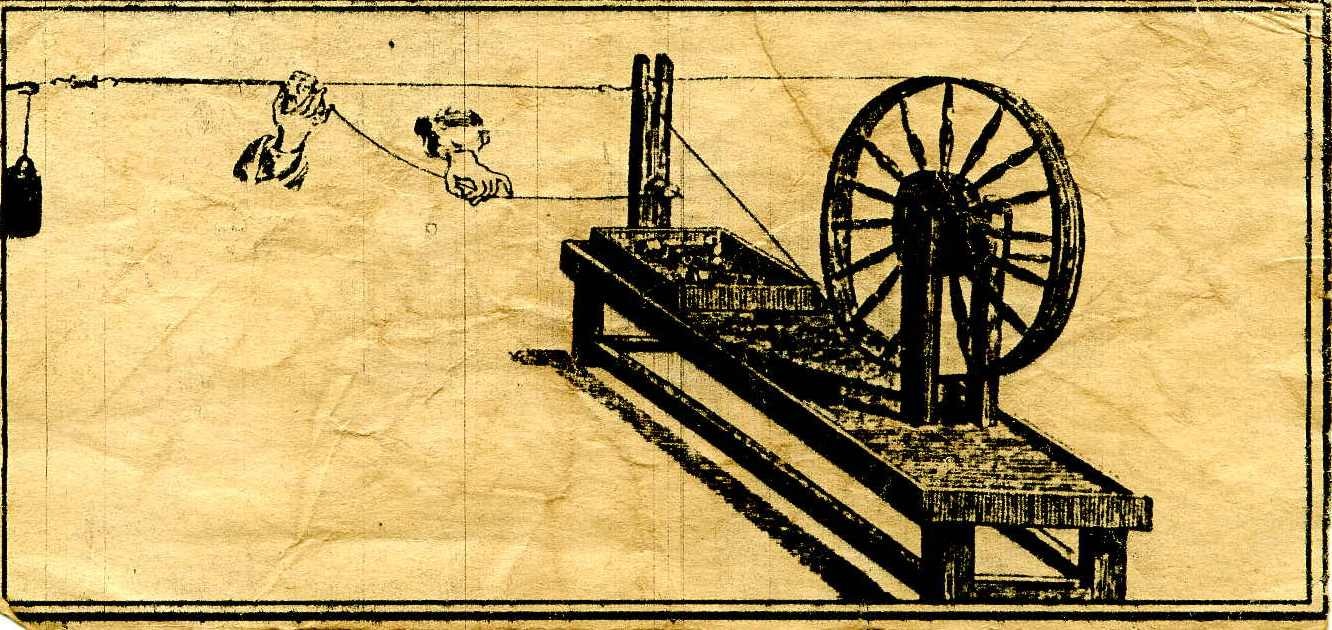
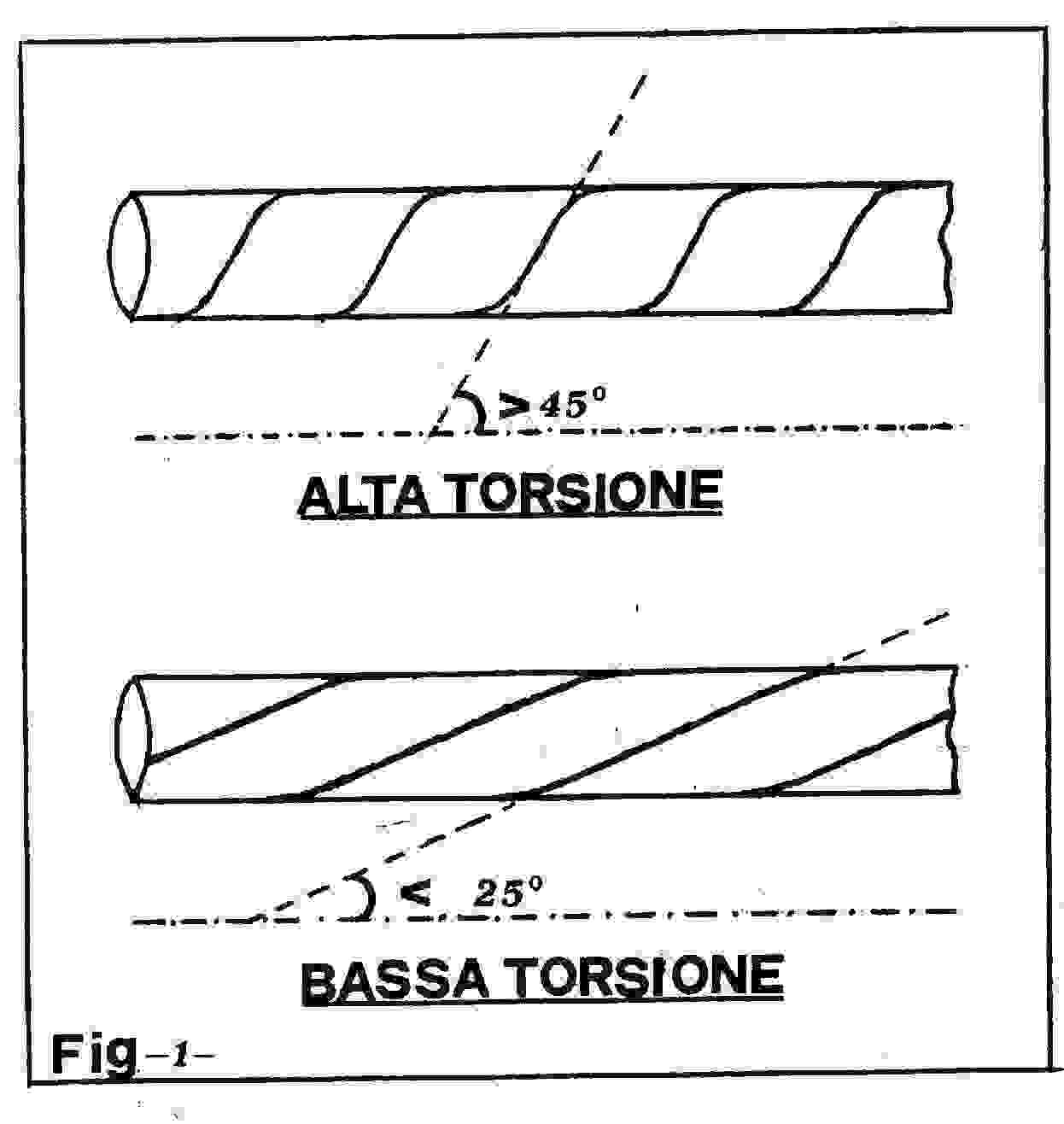
The first difference between today's strings and old ones is that ours are generally twisted too little, and twist is the first factor in acoustic success. The ancients twisted their gut a lot, knowing well the importance of the procedure. The more a string is twisted, the softer and more elastic it becomes, with better attack, more harmonics, a rounder and warmer tone, less nasal and "glassy". Only a well-twisted string offers total acoustic mouldability, like soft clay in the potter's hands. As Labarraque writes (Minugiaio, in Nuovo dizionario universale tecnologico, vol. VIII, Venice 1823, p. 375): "The secret of the most skilled makers of these strings consists in the daily-acquired aptitude to give the guts, lye more or less strong, an appropriate twisting and re-twisting, to stop the sulphuring when needed, and finally to do every operation properly."
Always ask for highly-twisted strings, except for first strings, which need slightly less twist. The greater the twist, the greater the longitudinal elongation under tension and the more prone to surface-fibre fraying. The compromise is: low twist only for lute first strings, medium for violin and cello first strings, very high for the lower strings.
M: But how is it that strings made the same way give such different timbral results from one instrument to another?
S: Indeed! A well-made string is entirely analogous to a painter's palette, on which we find a rich variety of colours available. The same is true of a good string: it holds within itself, dormant, a great variety of timbral potential, just as a good palette holds every imaginable colour — it is then up to the painter, that is, the instrument the string is mounted on, to choose, among the many, those it needs to create its own work. A poor string, by contrast, is much like a mediocre palette which, instead of possessing that rich variety of reds, greens, violets and blues, possesses only a few of them.
Another factor abused today is alum, used massively to harden any kind of gut string (Philippe Savaresse, in Laboulaye 1865). Many stringmakers think it helps the sound, but it stifles it: a stiff string is easier to grind and smooth. Alum-treated strings also break suddenly without warning. To recognise alum, taste an end: an astringent effect like an unripe persimmon means alum.
Very stiff strings, hardened with alum, probably began to spread around the early 20th century, alongside the decline of Italian artisan manufacture (decimated by emigration, wars and famine) and the rise of German industrial production. Luigi Forino wrote of this in the 1930s (Il violoncello, il violoncellista ed i violoncellisti, Hoepli, Turin 1905, pp. 54–5): «German strings have the merit of durability and, like all products of that nation, also that of a good price. They are highly polished, hard to the touch almost like steel: the sound, too, suffers from such hardness.»
Snow White's apple: grinding versus hand polishing
M: What's wrong with a perfectly smooth string?
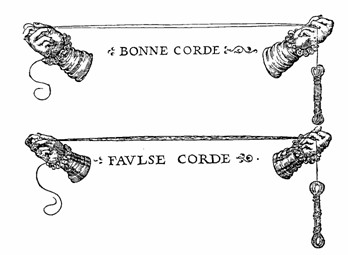
S: A string is an irregular bundle of dry gut fibres glued in cylindrical form. Even perfectly cylindrical, it has irregular diameter fluctuation over 6–7 metres of frame and an irregularly rough surface. The ancients used dried abrasive herbs like horsetail to regularise it (Griselini 1769), sometimes pumice powder. Mechanical grinding spins the string against an abrasive wheel, imposing a precise diameter and removing material; hand polishing respects the underlying diameter and fibre integrity, essential for durability and tuning stability. Aesthetic beauty and functional beauty do not coincide. The only advantage of grinding is that strings are never false. Once this was the main problem and all musicians tested strings as Ganassi (1543) and Mersenne describe. With grinding, surface fibres are inevitably broken, reducing durability and acoustic yield.
Micrometer and the gauge plate
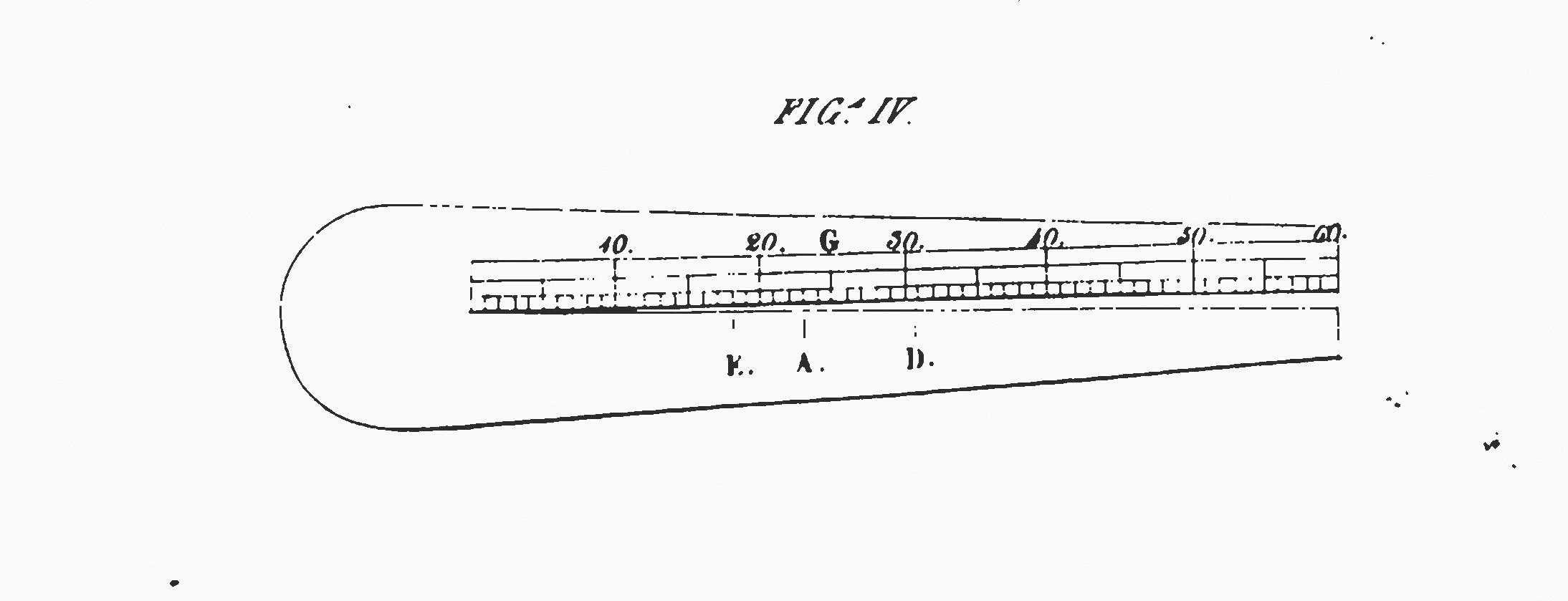
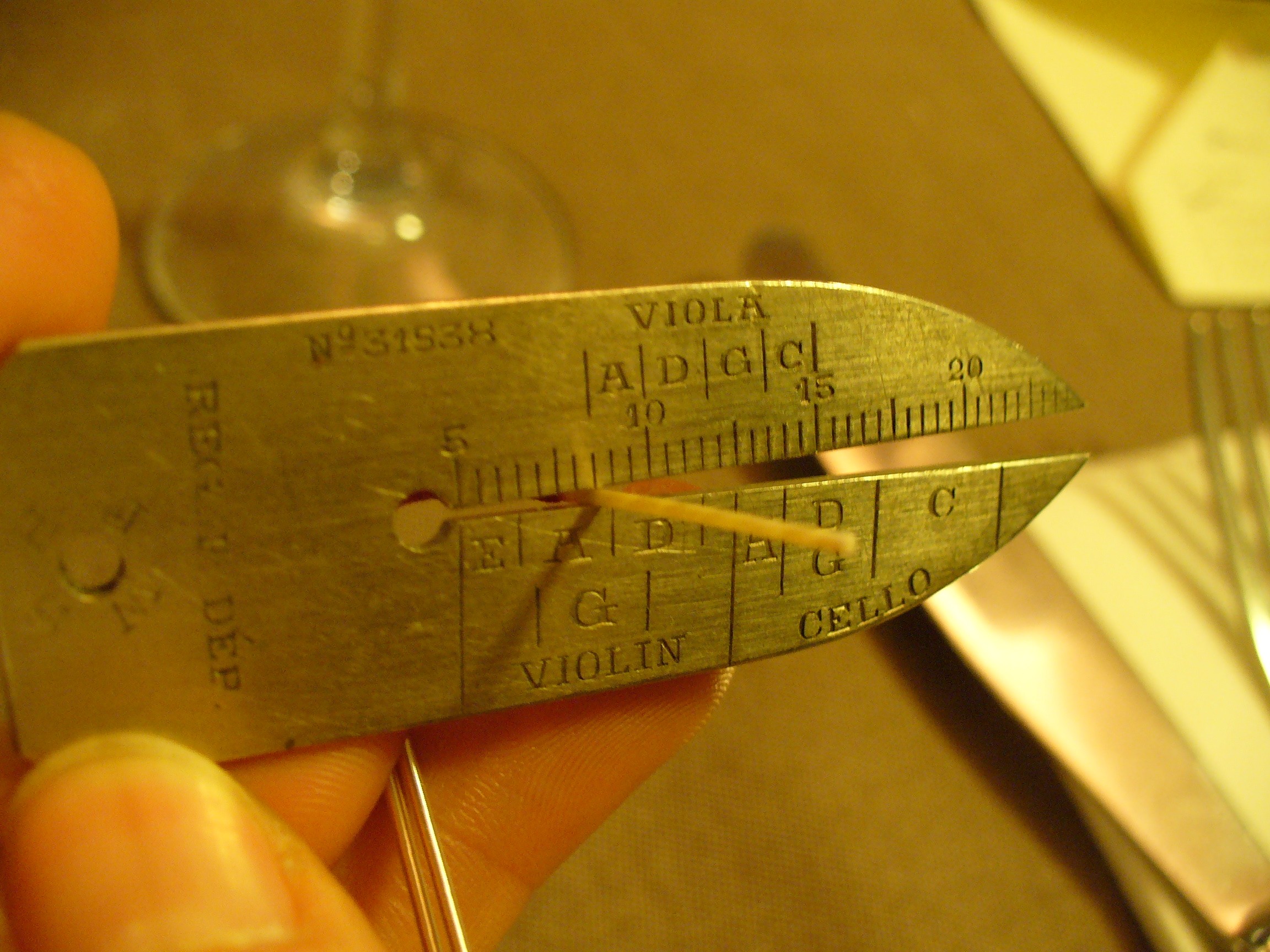
Hand polishing cannot produce what machines do, and the micrometer only spread after the early 20th century. Mersenne suggested winding several tight coils on a cylinder and dividing the total width by the number of turns. In the 19th century and into the mid-20th century musicians used a rectangular metal plate with a narrow V-shaped slot called misuracorde or gauge: pushing the string into the slot showed how thin it was. Marks and letters (E, A, D, G) along the V indicated violin gauges. See Louis Spohr's gauge in Violinschule (Wien 1832).
Gut strands and falseness
In the past, gauge was determined by the number of guts coupled. A violin first string almost always used 3 strands; 5 for the A and 9 for the D (De Lalande c. 1760; Reggio Emilia ms. early 18th c.; Maugin & Maigne, Paris 1869, p. 184). The viola followed the violin's gauges exactly: its strings were the violin's second, third and fourth, plus an added wound fourth.
Customers bought first strings in bundles of about 30 strings rolled inside an oiled envelope marked "3" (i.e. three strands). Inside was a mixed assortment: hand-polished strings whose diameters varied within a wide range. A violin no. 3 first string could vary between 0.65–0.75 mm. With the V-gauge plate, the player would skim off those judged too thin or too thick, then test each remaining string for falseness.
A modern compromise between the old system and machinery is semi-grinding: only diameter regularity is enforced (eliminating falseness), leaving the surface fibres essentially intact. The string shows a delicate undulation barely perceptible to the touch, a sure sign that the fibres are healthy. The “macaroni effect” helps rosin adhere. The trap of modern diameter scaling (0.60, 0.62, 0.64) is illusory: the average musician's tension-sensitivity is barely a semitone, and gut is so hygroscopic that a 0.62 mm string can swell to 0.64 in humid weather or shrink to 0.61 in dry.
Characteristics of a good string
Best strings have: full, vocal sound (not nasal or glassy), wide dynamic range, easy speech, climate stability, durability. To achieve this they should be:
- highly twisted (medium twist only for violin first strings);
- with little or no alum;
- semi-ground or lightly ground ("first polish").
Oiling and varnishing
Varnishing is a relatively recent invention: it patches the damage done by modern grinding, locking down surface fibres and protecting from sweat and wear. As a kind of armour it slightly hampers vibration and can make horsehair slip, causing whistles.
Oiling is historical. It works only if the string is left immersed for at least a week (for the thinnest) up to 15–30 days for double bass strings. Suitable oil: first cold-pressed olive oil (low acidity) or sweet almond. The real enemy of a gut string is humidity, not heat: sealed in plastic bags strings can last decades.
Rosin and its recipe
Rosin formulation is always related to the string it must move. Modern rosins are balanced for metal strings; old rosins were balanced for gut. Rosin is to the string as the rider's seat is to the saddle.
Wound strings and their period
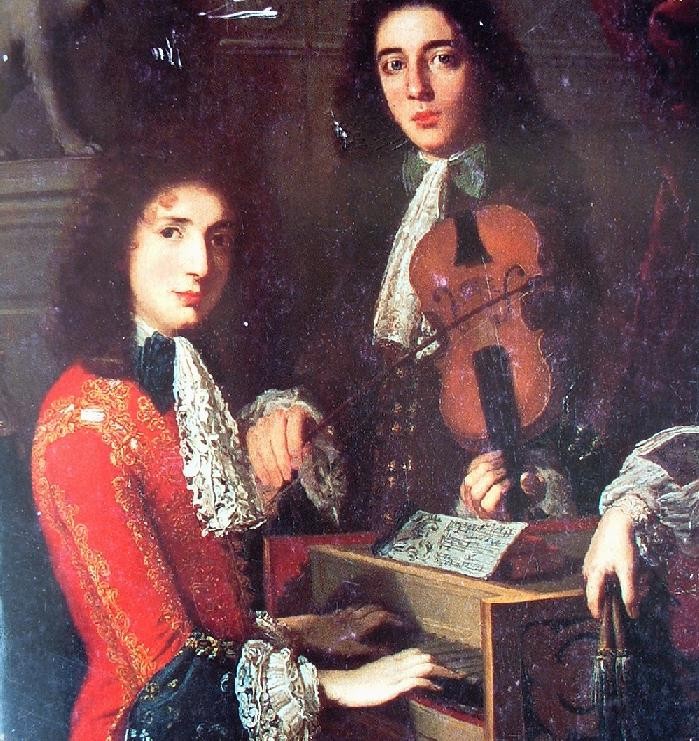
The first mention of wound strings is in a recently discovered 1658 English manuscript (Hartlib, Ephemerides); the first printed announcement is from 1664 (Playford, An introduction to the skill of music). Thomas Mace (1676) does not mention them in his rich discussion of lute and viol strings, nor does Talbot at the end of the 17th century (Donington 1950). An Italian document of 1677 mentions silver-wound bass strings for a violone. The first documents clearly showing wound fourth strings on violin and cello date from 1685–87 (two Antonio Gabbiani paintings). A transitional period exists between 1670 and 1690.
Hypotheses on 17th-century basses: Catlines and weighted gut
A gut string, no matter how well twisted, cannot beyond certain diameters produce acceptable sound because of internal damping. Yet 17th-century setups were all gut: how did they manage?
The first solution proposed (from 1975) was to twist two or three strings together as in marine rope, increasing elasticity and yield. Such strings are sold today as "Catlines", in tribute to the 17th-century Catlins or Catlines. Some derive the name from "line" (rope) and "cat" (a point on the ship); others (from 1994) from Catalonia. No documentary evidence links Catalonia to historical Catlins.
The second hypothesis, developed from 1990 by the author himself, starts from a key observation: on the bridges of many surviving original lutes the bass string holes are far too narrow for a plain-gut string at adequate tension. Period iconography often shows bass strings of dark red or brown colour, just where today we use wound basses. The hypothesis: the gut of these basses was tanned or weighted by powdered heavy elements such as cinnabar (mercury) or litharge (lead). Such a treated string easily doubles its initial weight and reduces its diameter by 30%. The "gravitational perturbations" of the late 16th century — basses added to the lute, shortening of viol vibrating lengths — would have been impossible with ordinary gut.
M: But for this weighting theory, do you also have direct documentary evidence?
S: No; but I believe the mathematics, based on the measured holes, has amply demonstrated the validity of this hypothesis in light of the fifty-odd historical lutes on which these measurements have been taken, reinforced further by the iconographic evidence. Remember, in any case, how astronomical discoveries are made: Pluto, if I am not mistaken, was discovered because of the gravitational perturbations it produced on the planet Uranus, even before it was actually seen. Only many years later was it possible to observe it visually, not merely calculate its existence. Well, we know a good deal about the "perturbations" induced on instruments in the second half of the 16th century — whether from rope-like construction or weighted gut — even though we do not yet possess the direct document describing their manufacturing technique.
A further, direct terminological clue supports this. Talbot, referring to the violin, wrote in the late 17th century: «Best strings are Romans 1st and 2nd [;] of Venice Catlins: 3rd & 4th best be finest & smoothest Lyons, all 4 differ in size» (Robert Donington, "James Talbot's Manuscript, II: Bowed strings", The Galpin Society Journal III, 1950, p. 30) — the first two strings of one type, the second two of another; note that Lyons and Catlins are here already strings specific to the basses. In an interesting piece of iconography by Rutilio Manetti (Amore trionfante, 1625, Dublin, National Gallery of Ireland), the violin depicted shows its first two strings as yellowish and the other two dark brown: precisely the chromatic distinction between plain and loaded strings that the hypothesis predicts.
The dividing wall and vibrating length
Before wound strings everything was much harder. Makers used the maximum vibrating length because they knew that at the same tension and pitch the string becomes thinner the greater its length. Early-17th-century bass viols should have at least 80 cm of vibrating length (Syntagma, Praetorius 1611) versus today's 70 cm.
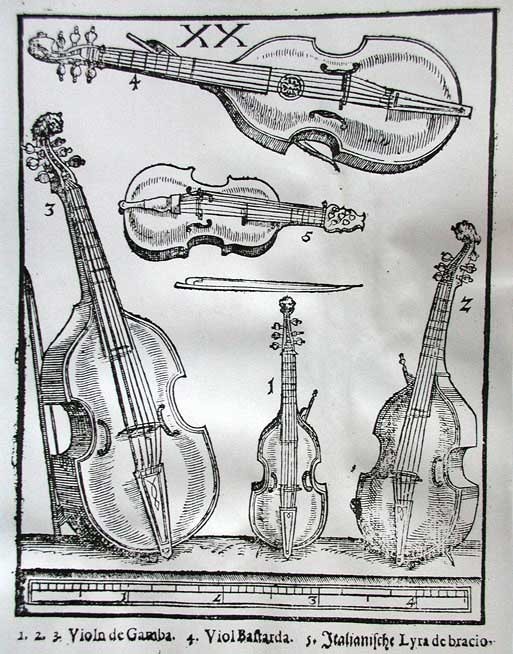
For early-17th-century repertoires played on plain-gut setups, instruments must have period-appropriate vibrating lengths. Suggested: bass viols of at least 80–82 cm, tenor viols 60–62 cm, treble viols 40–41 cm. The traditional viola da braccio (38–40 cm) is too short for a plain-gut fourth. Today's cello is too short: it descends from the Basso di violino by shortening that came with wound basses. To use plain-gut setups one would have to return to the instruments of the time: to those vessels shaped to measure for those types of string. When plain-gut basses sound poor on a too-short bass viol, the fault lies not with the string but with whoever proportioned the instrument.
The bridge and its liberties
S: The violin always saves itself in terms of sound — especially if you are not ashamed to move the bridge slightly towards the tailpiece, a common 17th-century habit shown by period iconography. And do not listen to those who claim that painters were not accurate enough to place the bridge exactly where it really stood: the sound can gain a great deal. Consider too the matter of black horsehair, which dominates 16th- and 17th-century iconography: my suspicion is that it relates to the need to secure a good attack on setups without wound strings.
That bridge and soundpost are elements to be adjusted, not fixed once and for all, is stated explicitly by the treatise writers. Antonio Bagatella (Regole per la costruzione de' Violini-Viole-Violoncelli e Violoni, Padua 1786, p. 27) writes that the bridge, both by its construction and by its position further forward or further back, can cause the greatest alteration, so that handling soundpost and bridge demands great practice and care: badly placed, they can make a good violin seem a bad one. Galeazzi, in 1792, likewise invites the player to combine the positions of soundpost and bridge until the desired quality of voice is obtained. These are rules, and rules deserve respect even when their purpose is not immediately clear.
Historical wound-string types
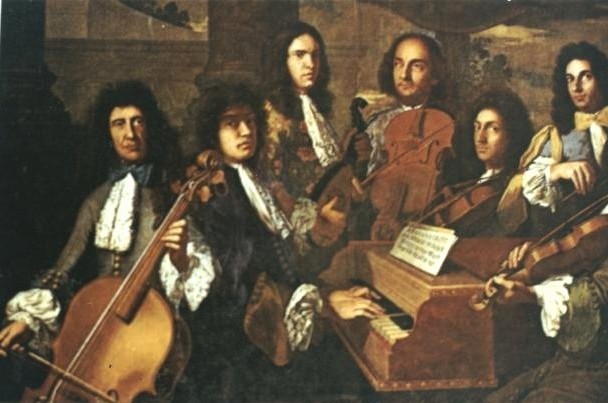
Three types: with closely-spaced wire wraps, with spaced wraps (demi-filée), and with double winding. All used round wire (pure silver, silvered copper or brass) wound directly on a normal gut string. Aluminium, tungsten and steel alloys did not exist. Strings were not sold in shops: they were made by luthiers or musicians as needed. Demi-filée strings were used only in the 18th century as transitional strings (the third on French violins, the fourth on bass viols).
Which wound string for which instrument and repertoire
- Violin: always and only fourth string wound; the others gut. Exception for 18th-century French repertoire: third wound demi. This setup remained essentially unchanged until WWII.
- Viola: third and fourth wound.
- Cello: from c. 1680 to 1730, only fourth wound; afterwards also the third.
- 4-string double bass: from mid-18th century, only fourth or fourth-and-third wound. Wound fifth strings appear only late 19th century.
- 5-string violone: only fourth and fifth wound.
- 7-string bass viol: fourth gut or wound demi on gut (Forqueray to Prince Wilhelm, 1767–68).
No to gut-core strings wound in flat aluminium tape: this appears only c. 1920 (Carl Flesch, Die Kunst des Violinspiels, Berlin 1924–28).
Round-wire winding and the silk underlay
S: What I have told you so far about wound strings is, however, only the general introduction.
M: What, isn't that enough to define a sound?
S: Not at all! What remains to be defined is the ratio the ancients followed between the quantity of gut and the quantity of metal, because the same string weight can be obtained with infinitely many ratios between the two quantities. As metal predominates the sound becomes ever brighter and, at a certain point, harsh — that is, outside the range of the human voice; conversely, as the gut component grows, the timbre becomes progressively more — if you will forgive the term — "gutty".
None of your modern wound strings should be saved. The silk or rayon underlay between core and wire is not historical: it dates from between the world wars (the earliest documentation I know is Savarez 1952). It prevents the string from "buzzing" in very dry weather. If buzzing occurs, dampen the string with a little olive oil (Dotzauer, Méthode de violoncelle, Paris 1830). Never use water: dilation is too great and damages the string.
Historical proportions for making wound strings:
- Violin 4th: a light second string, wound (Galeazzi 1791, Savaresse c. 1860). After c. 1870 the first string was used as the core, with a thicker metal wire.
- Viola 3rd: the violin's wound fourth as Galeazzi describes.
- Viola 4th: a plain violin third, wound.
- Cello 3rd: a slightly thin first string, wound (Raul, Paris 1770).
- Cello 4th: a slightly thin second string, wound (Raul 1770).
- Double bass: as for the cello.
Flat-wire winding sounds like a wind instrument; historical strings are far more open, harmonically rich and acoustically powerful. Round-wire winding under the bow responds exactly like plain gut, eliminating the "step" between modern flat-wire wound basses and plain gut. To stabilise wound strings, pull them sharply over the tense tip of the thumb so the inner gut fibre opens (already practised by 19th-century double bass players).
In summary, ask your stringmaker for a historical wound string made like this: no flat wire; no silk or other underlay between gut and metal wire; a real string as the core, not those stiff, barely twisted guts made today for the purpose. An external decorative silk covering is however admissible, since it does not affect the acoustic yield at all.
Equal feeling, equal tension and scaled tension
The ancients, when setting up their instruments, sought equal tactile feeling among strings (equal feeling). Pressing two strings at the same point with the same force, they should be deflected the same amount: physics tells us they then also share the same tension in kilograms (equal tension). The fatal error was to try to obtain equal tension from theoretical calculation, from strings "in the envelope". Equal tension is in fact a condition obtained from strings already at pitch.
When we tighten a string it shrinks in diameter as it stretches. The peg turns are far more numerous for the thin string than for the thick one. Strings whose diameters are calculated for theoretical equal tension will not actually share equal tension when tuned: the thin one shrinks more in percentage. To achieve true equal tension (= equal feeling) we must start from a certain scaling in the theoretical calculation. This is the true interpretation of Leopold Mozart's example, wrongly considered a violin setup in theoretical equal tension.
From the 18th century onwards the violin profile is even more scaled than necessary for equal feeling. Three hypotheses explain this further scaling (Huggins 1883):
- The string's angle on the bridge becomes sharper for thicker strings, increasing pressure on the soundboard. To equalise pressure, extra scaling is needed.
- Thicker strings stand higher above the fingerboard: reducing their tension restores left-hand finger feeling.
- Maximum uniform friction with the bow hair (Riccati, Delle corde 1767, p. 129; Plessiard 1874).
- Huggins adds that the only way to obtain well-tuned stopped fifths is to arrange the strings according to a certain tension scaling.
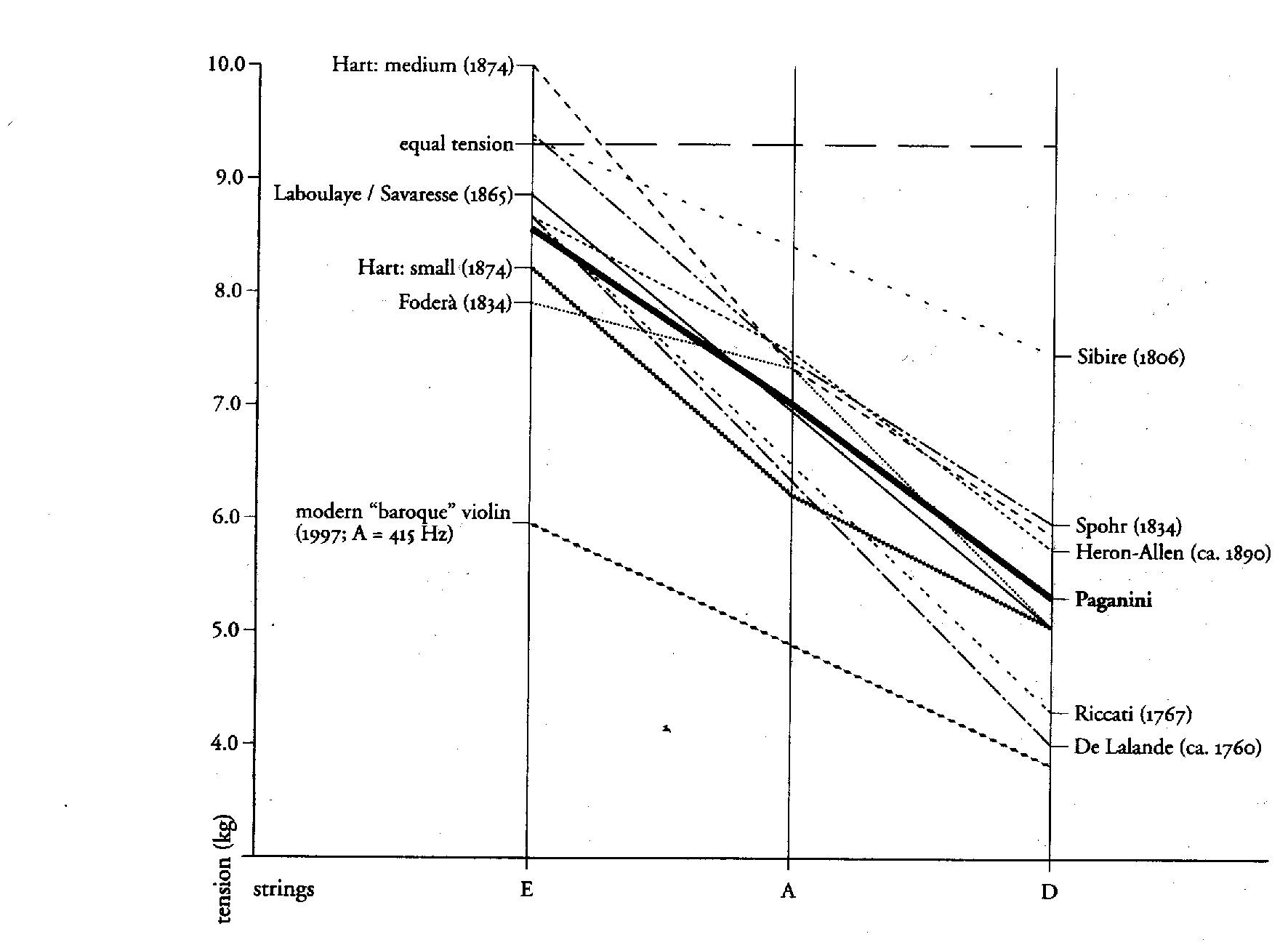
Sources re-read:
- Tartini, 1734: Vuillaume reported 63 lb total tension. Any profile (scaled included) yields the same total.
- L. Mozart, 1756: finds gauges by hanging equal weights and adjusting until adjacent open strings produce a perfect fifth. This is true equal tension (equal feeling), not theoretical.
- Savart, 1840 (cited by Fétis 1859): E of at least 22 lb, others a little less, total 80 lb. Moderate scaling.
- Delezenne, 1853: first proposed theoretical equal tension, then realised all commercial gauges followed a scaled profile.
- Huggins, 1883: started from theoretical equal tension, then found such a setup does not work.
The "ropes": how the thin-string myth arose
S: In the past, string-quartet setups generally used thicker strings than are commonly used today. One can indeed state, without fear of contradiction, that today's "philological" setups were then virtually unknown.
M: Then what are we all doing? How did we reach such a paradoxical situation?
S: I do not think hunting for the culprit helps. Over time the first researchers tried to account for those thin, short bass bars, those low bridges, those barely angled necks — but they drew their conclusion in the absence of specific historical documentation on strings. Today we are perfectly able to change the ship's course. As early as 1900 Arthur Broadley complained in The Strad that the question of string thickness had been left entirely to the makers, the player having practically to take whatever he was given. It is time each player became again the personal tailor of his own instrument.
M: Isn't it harder to get a sound out of these "ropes"?
S: Not at all, if they are properly made. But the instrument must be well set up: the strings should sit very low over the fingerboard, provided they do not rattle (Galeazzi's suggestion, 1792). And one must check the type of bridge and above all the angle the strings make over it.
The bridge and its string angle
S: The angle is often too sharp and, with historical gauges, the pressure on the soundboard can become excessive: nothing breaks, the sound is simply stifled and the instrument responds badly. The angle may be too sharp because the instrument is in fact a modern one disguised as Baroque, or because it was built that way to compensate for the thin, nasal yield of light setups. By reducing the string angle, the optimal pressure on the soundboard can remain much the same even when moving to historical gauges.
This is not the first time I meet instruments unable to work with historical gauges. Solutions exist, and sometimes consist simply in readjusting the tailpiece–soundpost–bridge system, with genuine miracles in balance and power of sound, promptness, absence of bow-attack noise and superior beauty of timbre. At other times matters are more complex, above all because of the age of the soundboard wood on some original instruments, too weak to bear thicker gauges. The domino rule and the synergy between trades still apply: we stringmakers share the responsibility for obtaining the sound of the period.
M: In practice, what would we gain from historically correct strings?
S: Besides secondary factors such as durability, tuning stability and ease of speech even in the softest pianissimo, a round, powerful sound rich in both fundamental and upper harmonics: able, that is, to give voice to the various affections of the human soul. In a word, there is only something to gain.
Synoptic table of historical violin gauges (435 Hz, vibrating length 32–33 cm)
| Source | E | A | D |
|---|---|---|---|
| De Lalande / Angelucci, c. 1760 (a) | c. 0.70 mm | — | — |
| Riccati, 1767 (b) | c. 0.70 mm | 0.90 mm | 1.10 mm |
| gut E-string fragment, c. 1770 (c) | 0.71–0.72 mm | — | — |
| Fouchetti, c. 1770 | c. 0.70 mm | — | — |
| Baud, c. 1795 (d) | c. 0.70 mm | — | — |
| Sibire, 1806 (e) | 0.70 / 0.73 mm | 0.98–1.03 mm | 1.38–1.45 mm |
| Foderà, 1834 (f) | 0.66–0.70 mm | 0.92–1.03 mm | 1.15–1.19 mm |
| Spohr, 1834 (g) | 0.72 mm | 0.92 mm | 1.24 mm |
| Paganini, c. 1840 | 0.71–0.72 mm | 0.87–0.89 mm | 1.15–1.16 mm |
| Delezenne, 1853 (h) | 0.61–0.70 mm | 0.82–0.96 mm | 1.02–1.39 mm |
| Laboulaye / Savaresse, 1865 (i) | 0.70 mm | 0.89 mm | 1.14 mm |
| Maugin & Maigne, 1869 (l) | 0.63 mm | 0.89 mm | 1.09 mm |
| Hart, 1874 (m) | 0.65 / 0.72 / 0.73 mm | 0.84 / 0.89 / 0.90 mm | 1.14 / 1.23 / 1.19 mm |
| Huggins / Ruffini, 1883 | 0.67 mm | 0.90 mm | 1.17 mm |
| Bishopp, 1884 (m) | 0.61 / 0.68 / 0.69 mm | 0.80 / 0.85 / 0.85 mm | 1.08 / 1.16 / 1.19 mm |
| Heron-Allen, 1890 | 0.69 mm | 0.93 mm | 1.22 mm |
| E-string samples (c) | 0.66–0.68 mm | — | — |
| Aquila Corde Armoniche, 2002 (n) | 0.62 mm | 0.79 mm | 1.04 mm |
Key: (a) three guts = 0.70 mm. (b) E = 6 grains; A = 10; D = 15; each string = 1.5 Venetian feet. (c) high twist. (d) silk string. (e) for A = 415/435 Hz. (f) 20/100 gauge = 0.70 mm. (g) no. 18 on gauge plate = 0.71 mm. (h) commercial averages. (i) E = three guts; A = five; D = eight. (l) A weighs twice the E; D three times. (m) light/small/thick. (n) Baroque violin set, medium tension.
A historical violin setup has E 0.65–0.75 mm, A 0.85–0.95 mm, D 1.10–1.25 mm. Recommended alignment with the Paganini relics: 0.70 / 0.88 / 1.16 mm.
Viola: A 0.85–0.95, D 1.10–1.25, third and fourth wound.
Cello: A 1.20–1.35, D 1.70–1.80, G and C wound. Exceptionally A and D up to 1.45 and 2.00 mm (Romberg 1840).
Double bass: 1st G 2.40–2.60 mm (sometimes 2.80), 2nd D 3.20–3.40 mm (sometimes 3.80), 3rd and 4th wound; the third, if gut, between 4.60 and 5.00 mm (De Lalande, Paris 1768).
The pitch jungle
In 1834 the Stuttgart Congress approved a standard of 440 Hz, but the recommendation was not followed. In 1858 the French government declared the Paris Opéra and Italian opera standard to be 448 Hz; a year later the French Commission (Halévy, Auber, Berlioz, Meyerbeer, Rossini, Thomas) set "a" at 435 Hz by imperial decree. In England the orchestral pitch was 424 Hz in 1813 and 452 Hz in 1859. The 1885 Congress of Vienna fixed the standard at 435 Hz (adopted in Italy only in 1887), but pitch continued to fluctuate. Only the 1939 ISO conference proposed 440 Hz. (See Pietro Righini, La lunga storia del diapason, Berben 1990; Ellis, The History of musical pitch, London 1880.)
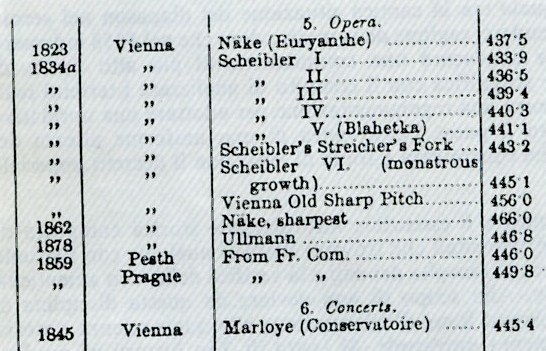
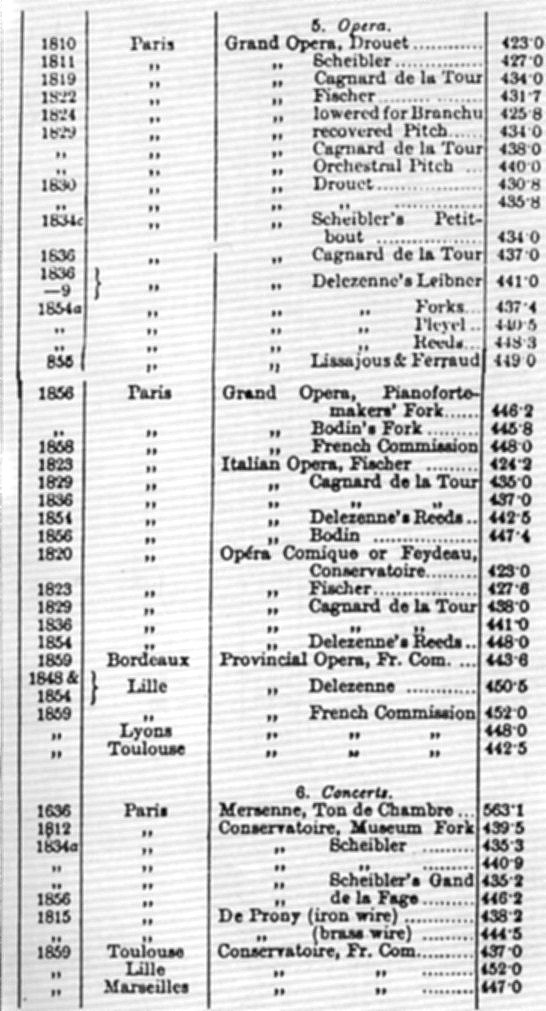
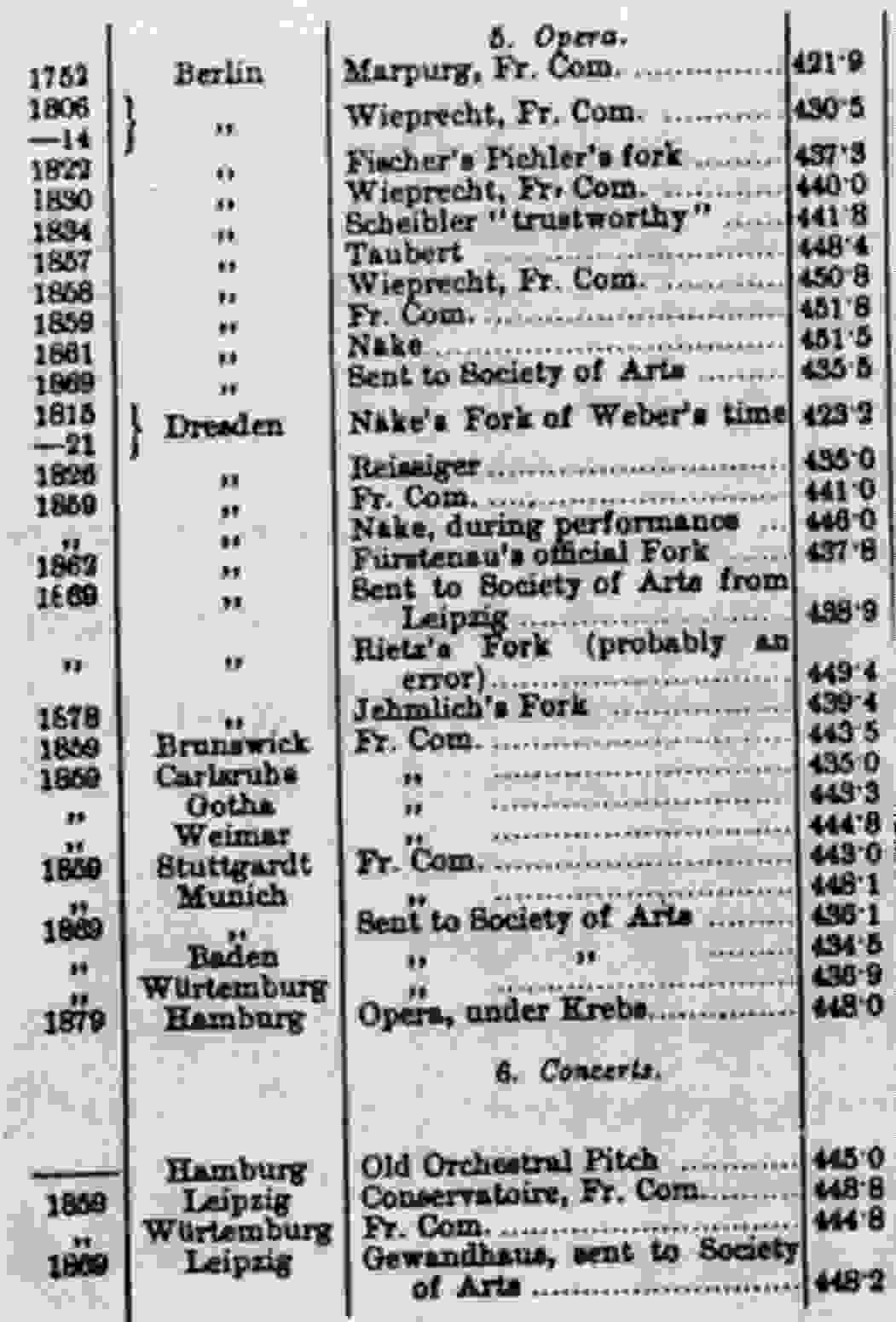
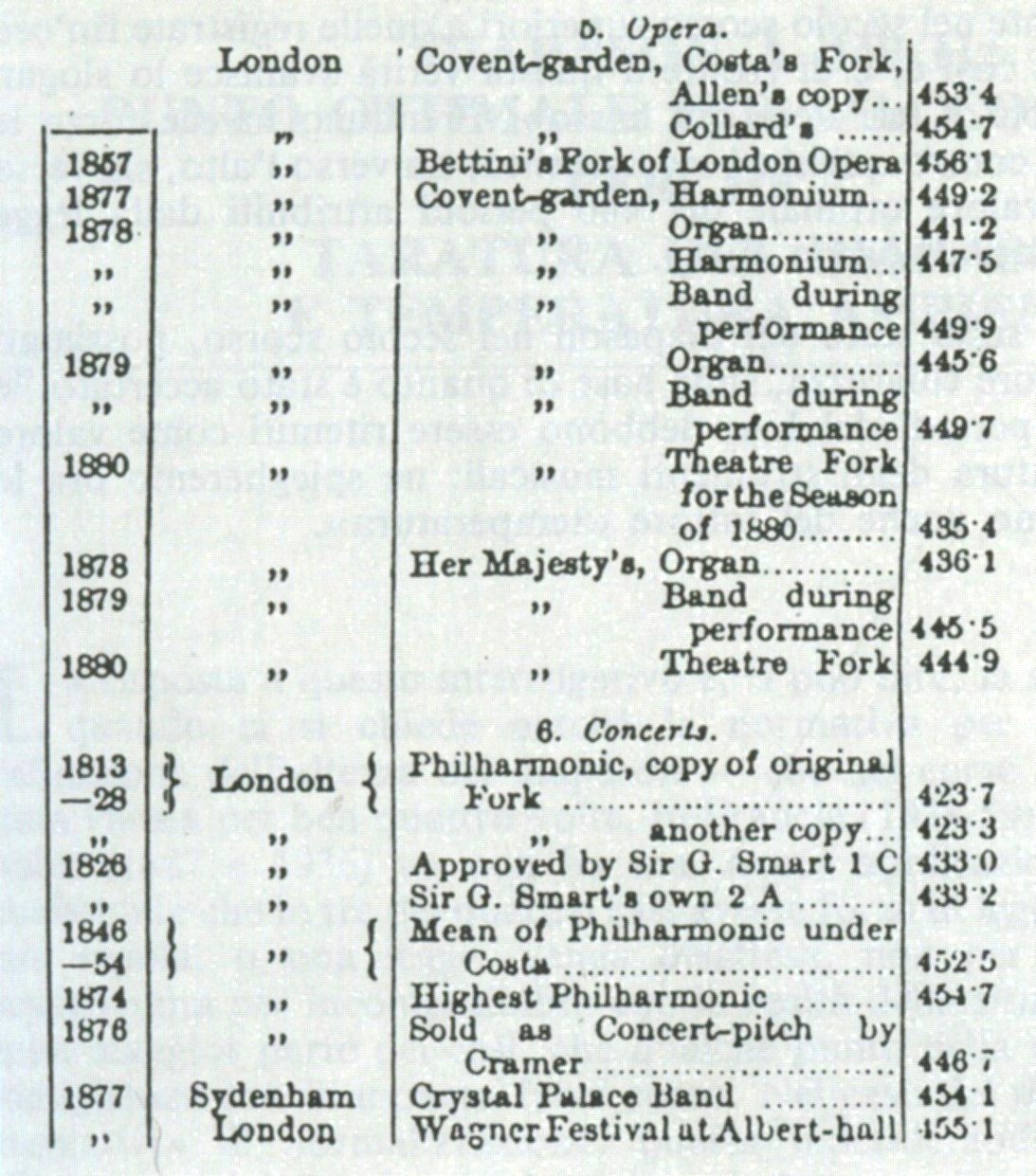
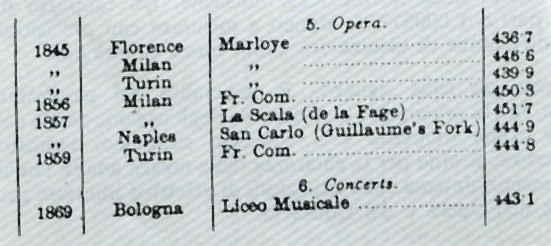
S: As for choosing gauges in relation to local pitches, remember that the diameters then available depended exclusively on the number of guts coupled, not on polishing. That typical range of violin first-string diameters obtained with three guts, used in France at a pitch of about 390 Hz, made violins work at tensions probably lower than those of the Italians, whose pitches were almost all — Rome and Naples excepted — considerably higher. The same strings therefore produced heavier setups in Italy, with greater acoustic presence: this may well explain the more powerful sound of Italian violinists compared with the French in the Age of Enlightenment.
Tricks from the treatises
- When mounting a new string, as you bring it up to pitch, pull it firmly several times in the middle; afterwards check that the bridge still stands vertical.
- Mark nut and bridge slots with a pencil lead.
- Wind little string on the peg: tuning stability improves.
- Before threading a gut string into the peg hole, twist it on itself by 5–7 turns in the tightening direction.
- When not playing, lower the first string by a semitone: it lengthens the most stressed string's life.
- (Not historical but practical) Some attack problems can be eased by tightening the bow hair less than usual.
The scale of values
- Knowing how to distinguish a good string from a poor one.
- Knowing string types used in the various periods.
- Adapting the instrument to historical gauges (bridge, soundpost, bass bar).
- Knowing the historical gauges.
- Using a historical rosin.
- The kind of polishing or grinding used.
Then the issues of pure philology that do not affect acoustic performance:
- Lamb or mutton gut instead of beef.
- Strings bleached with sulphur vapour instead of hydrogen peroxide.
- Arriving at the concert venue… by carriage (joke).
The musicians take their leave. Thanks to Daniela Gaidano for the tireless collaboration and kind revision of the text.
References
- Patrizio Barbieri, "Giordano Riccati on the Diameters of Strings and Pipes", The Galpin Society Journal XXXVIII, 1985, pp. 20–34.
- Ephraim Segerman, "Strings through the ages", The Strad, 3 parts, 1988.
- Carl Flesch, The art of violin playing, Fischer, New York 1924–30.
- David Dodge Boyden, The History of Violin Playing from its origins to 1761, Oxford University Press 1965.
- Eduard Melkus, Il Violino, Giunti, Florence 1975.
- Silvestro Ganassi, Lettione Seconda, 1543.
- Vincenzo Galilei, Fronimo, Dialogo, Florence 1584.
- Robin Stowell, Violin technique and performance practice in the late 18th and 19th centuries, Cambridge University Press 1985.
- Pietro Righini, La lunga storia del diapason, Berben 1990.
- Djilda Abbott, Ephraim Segerman, "Strings in the 16th and 17th centuries", The Galpin Society Journal XXVII, 1974, pp. 48–73.
- Werner Bachmann, The Origins of bowing, Oxford University Press 1969.
- Stephen Bonta, "From Violone to Violoncello", Journal of the American Musical Instrument Society III, 1977, pp. 64–99.
- Alexander Ellis, The History of musical pitch, London 1880.
- Christopher Page, Voices and Instruments of the Middle Ages, J.M. Dent & Sons, London.
- Djilda Abbott, Ephraim Segerman, "Catline strings", FoMRHI Bulletin n. 12, comm. 138, November 1978.
- Charles Besnainou, "Les cordes et leurs mystères", Tablature, July 1987.
- Frank Eyler, "The modern Venice Catlines reconsidered", Lute Society of America Bulletin, August 1986.
- Mimmo Peruffo, "The mystery of gut bass strings in the 16th and 17th centuries", Recercare V, 1993, pp. 115–51.
- Mimmo Peruffo, "Italian violin strings in the 18th and 19th centuries", Recercare IX, 1997.
- Mimmo Peruffo, "Nicolò Paganini and gut strings", Recercare XII, 2000.
- Mimmo Peruffo, "On Venice catlins, lyons, Pistoy basses and loaded-weighted bass gut strings", FoMRHI Quarterly n. 76, comm. 1288, July 1994.
- Mimmo Peruffo, "New hypothesis on the construction of bass strings for lutes", FoMRHI Bulletin n. 62, comm. 1021, January 1991.
- Samuel Hartlib, Ephemerides, ms., 1659.
- John Playford, An introduction to the skill of music, London 1664.
- Statutes of the Naples stringmakers, 1653 and 1685, Archivio Nazionale di Napoli.
- Claude Perrault, Œuvres de physique, Amsterdam 1727.
- Patrizio Barbieri, "Cembalaro, organaro, chitarraro e fabbricatore di corde armoniche nella Polyanthea technica di Pinaroli (1718–32)", Recercare 1, 1989, pp. 123–209.
- Giordano Riccati, Delle corde, ovvero fibre elastiche, San Tommaso d'Aquino, Bologna 1767.
- John Dowland, "Other necessary observations belonging to the lute", in R. Dowland, Varietie of lute-lessons, London 1610.
- Thomas Mace, Musik's Monument, London 1676.
- Robert Donington, "James Talbot's Manuscript, II: Bowed strings", Galpin Society Journal III, 1950.
- Marin Mersenne, Harmonie universelle, Paris 1636.
- Francesco Galeazzi, Elementi teorico-pratici di musica, Rome 1791.
- J.J. Dotzauer, Méthode de violoncelle, Richault, Paris 1830.
- Ernst Gottlieb Baron, Historische Theoretisch Und Practische Untersuchung Des Instruments Der Lauten, Nürnberg 1727.
- P. Skippon, A journey through the Low-Countries, Germany, Italy and France, London 1732.
- Francesco Griselini, Dizionario delle arti e mestieri, vol. V, Venice 1769.
- Athanasius Kircher, Musurgia Universalis, Rome 1650.
- Antonio Bagatella, Regole per la costruzione de' Violini-Viole-Violoncelli e Violoni, Padua 1786.
- Encyclopédie, vol. II, Paris 1751.
- François De Lalande, Voyage en Italie, vol. IX, Paris 1786.
- Klaus Osse, "Highly strung in Markneukirchen", The Strad, October 1993.
- Statute of the Rome stringmakers' guild, 1642, Archivio di Stato di Roma.
- Vittorio Villavecchia, Dizionario di merceologia e di chimica applicata, 5th ed., Hoepli, Milan 1955.
- Pierre Jaubert, Dictionnaire raisonné universel des arts et métiers, vol. I, Lyon 1801.
- Antoine-Germain Labarraque, "Minugiaio", in Nuovo dizionario universale tecnologico, vol. VIII, Venice 1823.
- Antoine-Germain Labarraque, L'art du boyaudier, Paris 1812.
- Jean-Carl Maugin, Walter Maigne, Nouveau manuel complet du luthier, 2nd ed., Paris 1869.
- Augusto Gansser, Manuale del conciatore, Hoepli, Milan 1949.
- Louis Spohr, Violinschule, Vienna 1832.
- Yves Gérard, "Notes sur la fabrication de la viole de gambe", Recherches sur la musique française classique, 1961-1.
- George Hart, The violin: its famous makers and their imitators, London 1875.
- Luigi Forino, Il violoncello, il violoncellista ed i violoncellisti, Hoepli, Turin 1905.
- Arthur Broadley, "String gauges", The Strad, April 1900.
- Joseph Friedrich Bernhard Caspar Majer, Museum musicum theoretico practicum, Nürnberg 1732.
- Johann Joachim Quantz, Versuch einer Anweisung, die Flöte traversiere zu spielen, Berlin 1752.
- Georg Simon Löhlein, Anweisung zum Violinspielen, Leipzig 1774.
- Leopold Mozart, Versuch einer gründlichen Violinschule, Augsburg 1756.
- Sébastien de Brossard, Fragments d'une méthode de violon, ms. c. 1712, BnF Paris.
- Jean-Benjamin De Laborde, Essai sur la musique ancienne et moderne, Paris 1780.
- Jacques Savary des Bruslons, Dictionnaire universel de commerce, vol. II, Copenhagen 1759.
- Edward Heron-Allen, Violin-making as it was and is, London 1884.
- Uberto Andrea, L'antico abitato di Salle, Casamari.
- Patrizio Barbieri, Acustica, accordatura e temperamento nell'illuminismo veneto, Rome 1987.
- Libro contenente la maniera di cucinare e vari segreti, ms., Biblioteca Panizzi, Reggio Emilia.
- Edward Neill, Nicolò Paganini: Registro di lettere, 1829, Graphos, Genoa 1991.
- Edward Neill, Paganini: epistolario, Comune di Genova 1982.
- Charles-P.-L. Laboulaye, Dictionnaire des arts et manufactures, 3rd ed., Paris 1865.
- Domenico Angeloni, Il liutaio, Hoepli, Milan 1923.
- Albert Cohen, "A cache of 18th century strings", Galpin Society Journal XXXVI, 1983.
- William Huggins, "On the function of the sound-post", Royal Society Proceedings XXXV, 1883.
- Luigi Francesco Valdrighi, Nomocheliurgografia antica e moderna, Modena 1884.
- Sébastien-André Sibire, La chélonomie, ou Le parfait luthier, Paris 1806.
- Giovanni Fouchetti, Méthode pour apprendre facilement à jouer de la mandoline, Paris c. 1770.
- Charles-Edouard-Joseph Delezenne, Expériences et observations sur les cordes des instruments à archet, Lille 1853.