Summary
Interview published in 2002 in "Guitart" (Italy) and "Gendai Guitar" (Japan): Ermanno Bottiglieri meets Mimmo Peruffo, founder of Aquila Corde Armoniche, in Vicenza and reconstructs the history of guitar strings — from Torres' and Segovia's revolutions, through the post-war introduction of nylon thanks to Albert Augustine and D'Addario, to the discovery of Nylgut in Peruffo's chemistry workshop. The conversation also clarifies the notions of scaled tension and "equal feeling", the historical primacy of the Italian stringmaking tradition, and the collaborations with Jacob Lindberg and Stefano Grondona.
Key takeaways
- The guitar has gone through two decisive revolutions: Torres on the body of the instrument and Segovia on the adoption of nylon.
- The arrival of nylon penalised the trebles (lower density than gut) but revolutionised the basses, allowing more metal and less core.
- Peruffo, a chemist, developed Nylgut: a synthetic material that restores the sound of gut with the stability and strength of nylon.
- Aquila string sets introduce a scaled-tension profile and near-pure silver windings on the basses to compensate for the different acoustic perception.
- Italy was the cradle of European stringmaking: Savarez (Savaresse), Pirastro (Pirazzi), D'Addario and La Bella all descend from Italian stringmaking families.
by Ermanno Bottiglieri
From "Guitart" (Italy) and "Gendai Guitar" (Japan), 2002. During my Italian tour with the Moisycos Guitar Duo I went, on a day off, to Vicenza, where I met Stefano Grondona; together we visited the Aquila Corde workshop. There I met Mimmo Peruffo, who together with his partner founded the company. The following conversation is the result.
 |
 |
How Aquila Corde began
EB — First of all I want to thank you, Mr Peruffo, for agreeing to this interview. Recently Aquila strings have been making a strong entry into the market: can you tell us how your company began?
MP — The company was born from the attempt to find an answer to an unsolved secret.
EB — Can you tell us which one?
MP — Willingly, but first we should look at the history of strings and how we have arrived at today's results.
The guitar's two revolutions: Torres and Segovia
EB — All right. What was the decisive turning point for strings, and when did it happen? In the past gut was used.
MP — The guitar has gone through two extremely fundamental revolutions, so much so as to make it unrecognisable from what it had been before. The most exquisite revolution came with Torres: in bowed instruments there had been changes, but they were always traceable to what existed before. With Torres things changed entirely — he acted on the wood of the guitar, on the body, revolutionising it completely. You can hear it when you play a Panormo and when you play a Torres. The second revolution came with Segovia. In those years the string supply problem had worsened because of the war: gut strings all went to surgical use to treat thousands of wounded soldiers. Stringmaking activities were under top-secret regime from American MP and the Italian villages where strings were still made were assigned exclusively to surgical gut.
EB — In the middle of this crisis, how did Segovia intervene?
MP — Segovia was not a soldier, he was a concert artist. He had gone to the United States and South America just in the years when a Dupont researcher made a fundamental discovery: nylon. We must remember that "nylon" actually covers a whole range of products with similar characteristics: not one nylon but "the nylons". Segovia was at dinner in New York with some ambassadors and complained about the difficulty of finding guitar strings. A general nearby heard everything and promised to send him samples of this new material, mainly used for military purposes. Segovia tried it and, also driven by a certain frustration with the problems gut gave him and the difficulty of finding new strings, welcomed the novelty very positively. At that moment Segovia was at the top, his word could move mountains, and he was obviously a powerful force in the development of nylon.
EB — Segovia, as a guitarist, endorses the use of nylon strings instead of gut ones. In practice, however, who took over the actual making of the strings?
MP — One of the many luthiers Segovia knew: Albert Augustine. Segovia had heard that Augustine too had been experimenting with this filament, and pushed him to the point that Augustine, by modifying spectacle-polishing machines, managed to produce the first guitar nylon strings. Augustine was closely followed by D'Addario, so the American string industry — which was not the same as the European one — appropriated the novelty; from America nylon practically arrived in Europe in the 1950s.
The arrival of nylon: what was lost and what was gained
EB — What are the positive and negative effects of the arrival of nylon?
MP — Today, because of this shift from an artisanal tradition to a mass, aseptic culture in which everything is made by machines and perfectly reproducible, there is the obvious advantage of lower prices and the fact that we can easily find strings everywhere. Unfortunately there is also a standardisation of the material; and let's not forget that gut has the soul of the human voice, synthetic materials do not. Why is the human voice associated with gut? Because gut is of the same nature as the vocal cords.
EB — Is it possible that the positive effects of nylon have been only economic? There must surely have been some change on the technical side of string construction?
MP — For the three trebles there has not been a major change; on the basses, however, there was a real revolution. For the trebles, the change is that nylon strings are not only cheap, they are reliable, reproducible, and there is no longer the problem that at some point you may not find them. But compared to gut the sound has lost something, because nylon has a lower specific weight than gut. The real revolution, as I was saying, came with the basses, because nylon used in fibre form has a much greater tensile strength than silk, which had been the only material used for bass cores until then. The revolution is that one can now obtain a string in which the metal winding prevails over the synthetic core. The change is therefore radical, the sound becomes in some respects more sustained and brilliant. So with the use of nylon something was lost in the three trebles and something was gained in the three basses: a reversal that no one ever talked about. Moving from an instrument used by Segovia or by Pujol — with gut and silk-cored basses — to one with nylon trebles and nylon-core basses was an incredible change. Those who listen today to recordings from the 1920s without knowing these things are somewhat puzzled, trying to understand that sound but unable to explain it. Today we can.
Lamb gut and the working life of a string
EB — Which animal's gut was used to make the strings?
MP — The gut that was used — and is still used today, with refinements — to make strings is lamb gut.
EB — One issue guitarists feel strongly about is string life. How long does a gut string usually last?
MP — A gut string has a variable life because it depends on the one hand on how it has been made, and on the other on the conditions of the player. For example, if the player plays a lot and has a certain kind of sweat, the life is shortened. Temperature too plays a big role: this is a typical day on which a string doesn't last long — very hot, very humid (the interview was conducted on 19 June 2002). On the contrary, when one sweats little and the weather is cool and dry, strings last longer. To give an example, in the 1920s a violin first string was known to last a day and a half (Carl Flesch). At that time strings were only treated with a bit of olive oil, in a much simpler way than today. We now exceed this duration: where in 1924 they lasted on average a day and a half, today an average of one month can be achieved. Despite this performers say it is too little, but they forget to say that strings in the past cost ten times more than today's ones.
The string as the origin of sound
EB — In concert, is it preferable to use gut strings — closer to the human voice — or synthetic nylon or carbon strings, with a sharper and more brilliant attack?
MP — The final outcome of a performance draws on apparently heterogeneous elements: different minds working towards the same result — the composer, the performer, the luthier and the stringmaker. The most visible figure is of course the performer, and the final choice is his; but everyone forgets that the starting point of what produces sound is the string. The instrument is simply a medium; the generating essence of sound is the string. It produces the primal vibration, the instrument only elaborates it. If I take a string and set it vibrating on its own, it cuts the air and we cannot hear the sound; we need a system to amplify and process it, and that is the instrument. In exchange the instrument asks something of the string: "I do this service for you, but in return, in the sound you produce, you carry my chromosomes, my personality".
Italy, cradle of European stringmaking
EB — What role has Italy played, historically, in string manufacturing?
MP — From a historical point of view Italy has been the cradle of the perfecting of string production, closely followed by France; indeed France itself owes a great deal to Italy. It is enough to recall that one of the most famous firms, Savarez, takes its name from an Abruzzese Italian stringmaker who emigrated to France in the 18th century — Savaresse. Pirastro itself comes from the name Pirazzi, who was Italian. In the years before and just after the war some stringmakers, especially from Abruzzo, emigrated to the United States and became today's D'Addario and La Bella-Mari families: they were all of Italian origin, and there was a real transfer of our culture to the new continent.
The secret of historical basses: gut loaded with heavy metals
EB — And today there is also Aquila Corde, with an unsolved secret at its origin…
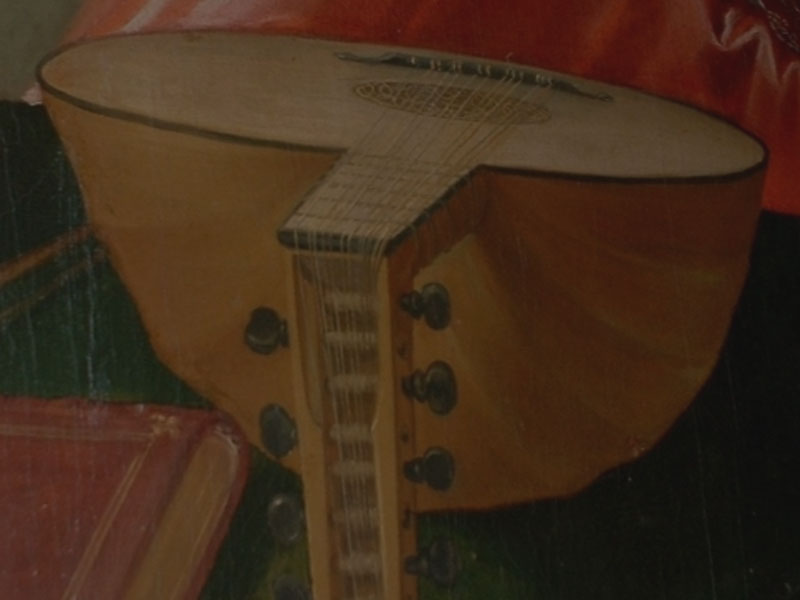
MP — Yes, as I said at the beginning, the company was born from the attempt to find an answer to an unsolved secret. The company is run by myself and a partner. Many years ago I used to build instruments as a hobby, lutes. On those instruments I mounted gut strings that sounded fine, but the basses were completely stiff and dull. In the 1980s, together with other collaborators, we started trying to unravel the mystery. It was impossible that Monteverdi and other musicians had been content with such a thudding sound and huge strings. In those years we and other researchers and stringmakers thought that the problem was the stiffness of the string and that we no longer knew how to make the old strings. This theory spread for ten years, after which it was supplanted — rather brutally — by a new theory of mine and my collaborators, supported for the first time by some evidence. It all started when we noticed that in the old lutes the holes for the bass strings in the bridge were very small. A gut string passing through those holes, when tuned to give the bass pitch, would be completely slack. All the treatises, on the other hand, said that trebles and basses had the same tension feeling. The intuition was that the old makers probably treated the gut with heavy metals to increase its specific weight, so the string remained thin yet provided the right kilograms. And in fact in old paintings the basses appear dark, while the gut is yellow.
EB — When did this research begin?
MP — It began in Florence in 1982–83, and in seven years of research I carried out 1,500 experiments. I read countless volumes searching for a recipe. The 1,500 experiments, in which I tried to weight the gut with everything that came to hand, are all catalogued, until one day, by chance, I tried something different from the usual, and could verify that it was indeed possible to increase the weight of the gut.
From nylon to carbon: the birth of Nylgut
EB — What has Aquila Corde brought that is innovative compared to existing strings?
MP — Nylon ruled unopposed until the 1970s, when carbon appeared at the end of the decade. Carbon was the first alternative to nylon, just as nylon had been the first alternative to gut. If we place gut at the centre, to its left we put nylon, which is lighter, and to its right carbon, which has a higher specific weight than gut. We know that the heavier the material, the brighter the sound. Among the materials normally used today we have nylon on one side, carbon on the other, and nothing in between. Vocality had not yet been recovered. Only recently has research uncovered materials that can restore the sound of gut. They have very recent applications, mainly on lute strings; on the guitar they are only beginning to appear and they have some peculiarities — for example, oddly, in addition to restoring the gut sound they are also tender like gut. To a modern guitarist it may seem strange that a string shows wear marks; to the guitarist of the past it did not, because gut was just like that.
EB — What are these materials you are talking about?
MP — The material is sold under the trade name "Nylgut"; it was developed here in Italy and discovered in my own laboratory — I am a chemist. As a former player as well as a stringmaker, I asked myself whether one could find a material that gave the gut sound but with the advantages of nylon: something with the strengths of both and the defects of neither. Today I can say yes, and the remarkable thing is that this material, used in fibre form for basses, has an even higher tensile strength than nylon. So here too, for the first time, we have crossed a boundary. This material in turn allows less core and more metal, with bass performance that can far exceed that of traditional nylon-core basses.
EB — So now there is one more option for string users?
MP — Now the options are three: nylon, which has been improved (there is now a version called Crystal); then carbon, which pushes attack response and brilliance to extreme levels; and Nylgut, which restores the sound of historical gut. And of course… gut itself.
How a string is made
EB — Does it take long to make a string?
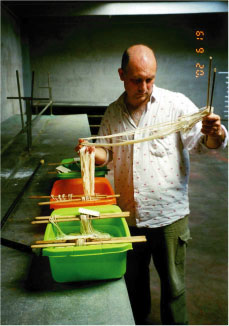
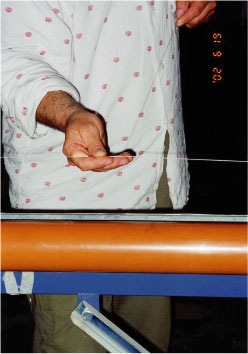
MP — Making a modern string takes little time, but extreme precision is required: we use materials and machinery of our own invention that produce a synthetic filament whose roundness exceeds existing standards. One should know that nylon and carbon suffer from the fact that they cannot maintain a uniform roundness along the entire filament, because these materials are melted and, after extrusion, returned to the solid state. Achieving a perfectly round string is therefore a great problem, because one starts from a molten material that may be subject to turbulent motion inside the soft mass while it cools into the form of a round filament. Making a synthetic string is relatively simple. Making a string from gut requires many days of work, because you are instantly thrown back into the past: the only modernisation is the grinding that produces perfectly round strings, but that is the final stage. Everything that comes before is almost as it once was, so a single string takes at least 15 days. Of course we don't make one at a time. And one must also account for the weather: rain or sun, it is not the same thing for a stringmaker.
The Alchemia and Perla sets
EB — How many types of sets does your company produce?
MP — We have two sets (year 2002, ed.): the first is called Alchemia, in which the three trebles are made of synthetic gut and the basses, since the synthetic gut fibre is very strong, have a high percentage of metal. To avoid thick diameters we have moved for the first time to almost pure silver. Stringmakers seldom say what percentage of silver their basses contain; the silver we use is close to 100%, with an undeniable benefit to the sound. The interesting point is scaling: by a natural acoustic effect, the human ear perceives bass notes less than treble notes, so playing the fourth, fifth and sixth strings with the same intensity gives a sensation of progressively weaker sound. To counter this we use different percentages of metal on the basses, giving the perception of equal output across the three strings, because the lower perception is balanced by greater output. This is a new approach that nobody had used before. So this set introduces new criteria for the type of trebles, for the type of metal basses and for the design principles. The other set, Perla, follows the tradition more closely: Crystal nylon on the trebles and silver-plated copper on the basses.
Tension, feel under the fingers and scaling
EB — Can you tell us the tension of your strings?
MP — When we speak of tension we need to distinguish: the tensile strength of a material is one thing, and the tension of strings is another, depending on the choice of diameters. The capacity of a material to resist tension much better than another means that you can use less of it for the same performance. Using less material means the sound is freed more effectively. The thicker the string, the more the sound suffers for the same tension. For example, a fishing line of about 1 mm has a certain acoustic performance; its brass equivalent is much thinner and, at the same tension and frequency, has a much livelier, harmonic-rich sound. But there is a limit, and that limit is aesthetics. We have always sought, implicitly or not, to imitate the human voice. Vocality is always fundamental.
EB — What can be said about the "tension" issue on guitar strings?
MP — The issue of tension on instruments like the guitar arises at the beginning of the 20th century. The musician is interested in the feeling under the fingers, which seems to be tension but is something else: feeling is the tactile sensation of stiffness. When I mount strings on a guitar, I subjectively say "this string feels too tight" or "too loose". That is a subjective matter, and everyone has an opinion. What is interesting — and what absolutely must be recovered — is that, when speaking of mounted strings, the subjective sensation of correct stiffness comes back into play: "neither too tight nor too loose", as John Dowland wrote around 1600. This "neither too tight nor too loose" is today mystified into tension in kilograms, but they are different things. Let us take an example: kilograms are kilograms, but the tactile sensation of stiffness depends on many variables. Here is one: if I have two strings of the same diameter mounted at the same load, say 5 kg, with a vibrating length of one metre I feel a certain stiffness; if the vibrating length is two metres, those same 5 kg feel slacker, because the string is much longer. When I test tension by pressing the strings with my fingers I am simply asking them to stretch, and they resist; if the string is very long, those 5 kg are spread over two metres and it feels softer to me. One normally assumes that strings that feel uniform carry the same kilograms of tension. That is not true, because thicker strings resist finger pressure more. The tension of modern guitar sets, derived from 19th-century violin sets, is therefore scaled already on the first three strings (homogeneous in material) and scaled too on the second three (wound). For the first three the trebles go from 9½ kg — if not 10½ kg — down to 7 kg and to about 6 kg by the third. The fourth, fifth and sixth follow the same rule. You feel them equally stiff but they actually have a scaled tension. If I set the strings at identical kilograms I would find, on pressing them, that they feel progressively harder. With scaling I am reviving the criteria typical of the Renaissance and Baroque: in lutes one never spoke of equal kilograms, but of the same uniform feeling under the fingers.
Jacob Lindberg and Stefano Grondona: the field test
EB — Who promoted your research by mounting your strings directly on his own instrument?
MP — For lute strings the development was extremely fast: it happened when the lutenist Jacob Lindberg mounted weighted gut basses on his instrument, then phoned the record label that was preparing his disc to say that now a truly philological recording could be made, because in Italy a procedure had been invented to obtain heavy gut strings as in the past. When the recording came out, the stringmaker's name appeared for the first time: it had never been done before. He cited my name, and from there we started a considerable production of lute strings and other instruments. For the guitar, instead, we relied on the help of our friend and professional Stefano Grondona. We experimented for a few years (Stefano, besides being a wonderful guitarist, also has remarkable intuition) and arrived at today's results.