Summary
Account of the discovery, at Palazzo Rosso in Genoa, of a roll of gut strings traditionally attributed to Nicolò Paganini’s violin and dated to the early 19th century. The author measures the diameters with a micrometer, estimates the twist angle and compares the data with contemporary sources (Riccati, Ruffini, Hart): the result is a scaled tension profile fully coherent with the Neapolitan tradition and with the practice of making the first string from four strands, which Paganini himself explicitly requested in his letters. The relics refute the widespread belief that 19th-century violins used very light strings, and document a very high twist on the lower courses.
Key takeaways
- The Palazzo Rosso relics include a bridge, two bows, a Vuillaume rosin box and a roll of unused gut strings.
- Measured gauges: E 0.70–0.72 mm (medium twist), A 0.87–0.89 mm and D 1.15–1.16 mm (high twist, close to 80°).
- The diameters match almost perfectly the late-19th-century Ruffini set and Giordano Riccati’s measurements a century earlier.
- Paganini explicitly asked for "very thin" first strings but built "from four strands to endure": a technical choice that reduces false strings and increases durability.
- The strings exhibit a scaled tension profile in line with early 19th-century practice, refuting the idea of very lightly strung period violins.
The history of a happy find
by Mimmo Peruffo
PDF document to read or download — updated version of the original article in Recercare IX, 1997, pp. 155–203.
Download the article in Recercare XII, 2000, pp. 137–147.
Thanks to a series of fortunate circumstances, abetted by the tenacity of Dr Tatiana Berford, correspondent in Novgorod of the Istituto di Studi Paganiniani in Genoa, and later of Dr Philippe Xavier Borer of Boudry (Switzerland) on a communication by Dr Maria Prestia Sanfilippo (former director of the Ufficio Promozione Città Turismo e Spettacolo), a series of finds from Paganini’s day have recently been discovered in Genoa.
These finds consist of a violin bridge, two bows (one broken at various points), a box of rosin made by Vuillaume and a roll of gut strings in a reasonable state of preservation.
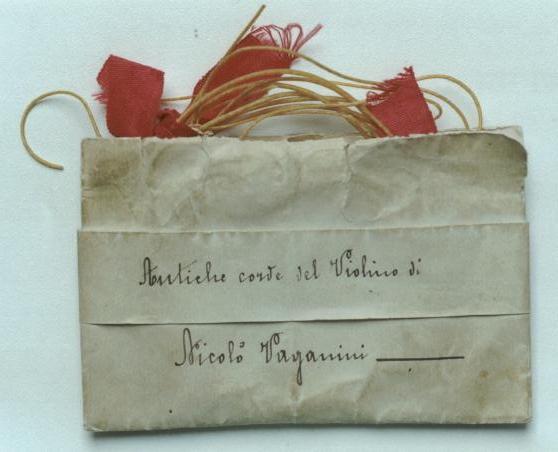
It is on this last item that our attention is focused. For it is the first, if not only, instance of gut string samples that can be dated with some certainty: in this case to the early decades of the 19th century. The material I inspected is preserved in an envelope that had already been opened by its discoverers. It bears the stationer’s stamp of the "Cartoleria Rubartelli Genova", has a seal of red sealing wax showing the symbol of the City of Genoa and a manuscript inscription in black ink: "Antiche corde del Violino di Nicolò Paganini".
I measured the string gauges with a micrometer, and also calculated the degree of twist given to each sample during the manufacturing stage: a highly important parameter for assessing the acoustic yield of any gut string. It would also be very interesting to assess the number of guts used to make the various strings. But the "strands" could be separated with the required delicacy and counted only by specially hydrating some small fragments of the strings. Unfortunately this operation is not advised, because items of such antiquity could easily dissolve completely in the watery solution; in any case, the technique is in itself destructive.
The letters: the chanterelles Paganini ordered
As Edward Neill has pointed out, in some of his letters Paganini already provided interesting information about the strings he used: "Ho bisogno di un favore: ponetevi tutta la cura, e la diligenza. Mi mancano i cantini. Io li desidero sottilissimi … Quantunque tanto sottili devono essere di 4 fila per resistere. Badate che la corda sia liscia, uguale, e ben tirata … Vi supplico di sorvegliare i fabbricanti e di far presto e bene." (I need a favour: to be done with care and solicitude. I am without chanterelles … Even if they are very thin they must be made of four strands to endure. Make sure the string is smooth, even and well stretched … I beg you to keep an eye on the makers and do this soon and well). And in a letter written from Naples to his friend and confidant Germi, shortly before, on 29 May 1829, we read: "Il tuo Paganini desidera sapere … quanti mazzi di cantini e quanto di seconde, e a quante fila si desiderano da Napoli, perché ora si avvicina il mese di Agosto, epoca giusta per fabbricar le corde" (Your friend Paganini wants to know … how many bundles of chanterelles and how many of second strings, and with how many strands, are wanted from Naples, because the month of August is approaching: the right time for making strings).
Further information is provided by Carl Flesch: "Some thirty years ago the owner of the Schott firm showed the celebrated violinist Hugo Hermann one of Paganini’s letters, wherein the latter begged the head of the firm at the time to procure strings for him like the samples enclosed. Hermann obtained the loan of these strings. After measuring them on a string-gauge, he found to his astonishment that the D-string had the strength of the A-string used today and the A-string the thickness of our E-string, and that the latter was not unlike a strong thread".
In an earlier paper I suggested that these strings were in actual fact guitar strings, given that Paganini was also a brilliant guitarist. But this conjecture needs revising in the light of recent research I have done on the contemporary guitar. In brief, the study shows that the guitar made use of violin strings for the first three strings: in other words, it didn’t use thin gauges at all, as is commonly believed today.
Flesch’s information is in any case insufficient to offer any certainty on the matter. First, it is not clear whether the notes (D, A, etc.) associated with each sample were actually named by Paganini himself, or whether that was what Hermann imagined (in which case Paganini might have merely enclosed the string samples without specifying either their notes or the instrument they were needed for). Second, we must remember that Paganini also played the mandolin, so it is quite possible that the strings ordered were for this instrument. And finally, we cannot exclude the possibility that his request was merely a favour on behalf of some musical acquaintance.
In any case, if we disregard the thinnest string (for which we have no term of comparison) and compare Hermann’s specifications with the table of tensions given by George Hart towards the end of the 19th century, we may estimate the presumed "D" as circa 0.84–0.90 mm and the presumed "A" as 0.65–0.73 mm: diameters that are decidedly thin for any violin of the time. About the presumed "E", we frankly cannot say, since Hermann merely tells us that it "was not unlike a strong thread". Was it perhaps a chanterelle for the mandolin? There is no way of telling.
The gauges measured on the relics
The strings recently found can be assumed to be two "Ds", three "As" and two "Es": it would seem likely that they are segments taken from longer lengths and cut to size for the violin. They are straw-yellow in colour, fragile, slightly wrinkly and intact (i.e. never used). The "E" strings have a medium twist (ca. 45° angle), while the "A" and "D" strings have a decidedly high twist (close to 80°). We can well imagine, therefore, that this guaranteed excellent acoustic results, in certain respects different from that of strings today, which are often much less twisted and hence stiffer.
Below are the diameter ranges found over all the samples:
| String | Diameter | Twist |
|---|---|---|
| E | 0.70–0.72 mm | medium twist |
| A | 0.87–0.89 mm | high twist |
| A* | 0.80–0.83 mm | high twist |
| D | 1.15–1.16 mm | high twist |
*this measurement was found on only one segment of string.
As we notice, there is no fourth string. This, however, is hardly surprising, because it was customary at the time for the fourth string to be made not by string makers but by instrument makers (if not by the musicians themselves), using a fairly thin second string.
Comparison with Ruffini and Riccati
What is altogether surprising, on the other hand, is how remarkably close the calibres of the above table are particularly to those of Andrea Ruffini, the famous Neapolitan string-maker of the late 19th century (despite some uncertainty over the final diameter, owing to the fact that the strings were smoothed exclusively by hand and the thickness of the original material was in any case variable, no matter how well selected the gut). And they also agree with the data given a hundred years earlier by Count Riccati:
| String | Ruffini | Riccati |
|---|---|---|
| E | ± 0.67 mm | ± 0.70 mm |
| A | ± 0.90 mm | ± 0.90 mm |
| D | ± 1.17 mm | ± 1.10 mm |
However, this shouldn’t come as a surprise if we remember that in Italy — from the 17th century, or even earlier — the strings were produced preferably from whole guts of lamb (and not ram, which is the male of sheep and which in Italy seems not to have been as "popular" as it was in France) of 8–9 months of age, according to a practice that was strictly standardised and handed down from father to son. As reported in both Italian and other sources, the making of a violin chanterelle generally required three "strands" (i.e. guts), but sometimes even four. We find this both in the 18th and late 19th centuries. The fact of using four strands doesn’t necessarily imply that the chanterelles were particularly thick (if with three guts the diameter is ca. 0.70 mm, with four it would be ca. 0.82 mm), but merely that there were times when the gut available to the string maker was a little thinner than usual. This is also confirmed by a passage from one of Paganini’s letters. And as a string-maker myself, I can affirm that, final diameters being equal, a string made of four thin guts is much more regular and durable and also truer than one made of three "standard" guts.
Paganini evidently knew what he was doing when he ordered the strings: he specially asked for chanterelles of four strands (which would enhance the durability and limit the number of false strings) and he even went to the length of asking a trusted person to keep an eye on the Neapolitan string makers.
If we consider that the diameters measured agree almost entirely with those of numerous other contemporary sources, and if we also remember that manufacturing was considerably standardised, I think we can rule out the possibility that the individual items shrank as a consequence of further drying. Besides, a finished gut string is already in itself what one might call a "mummified" material.
The profile of the working tensions
The following graph superimposes onto Graph 2 of my previous paper (p. 187) the scaling of working tensions for the average diameters of the E, A and D strings under the same working conditions (vibrating length 0.33 m; a’ = 435 Hz):
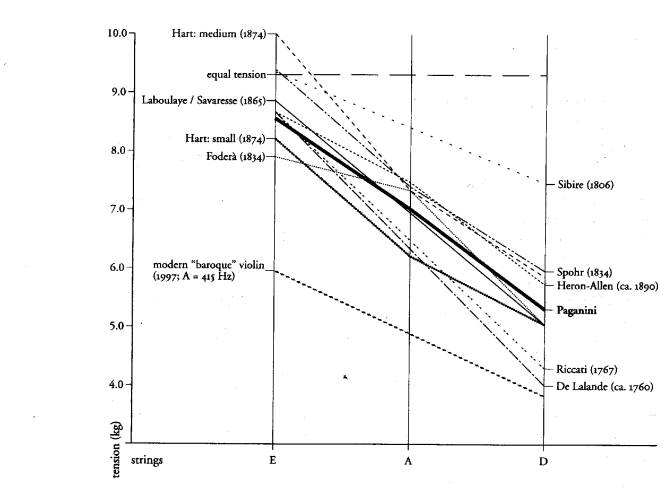
One observes that the working tensions of the string samples present an almost perfectly progressive profile, exactly as one would expect and as is consistent with the surviving historical information.
Conclusions
Regardless of whether or not the strings in question actually belonged to the great violinist, in all likelihood they are the only surviving exemplars that certainly date to the early 19th century. In agreement with the studies carried out on the subject, they once again refute the deeply-rooted opinion that the stringing of violins was then much lighter than it is today. In addition, the strings were subjected to a judicious degree of twisting. Though this was less pronounced on the chanterelles (which thus gained in resistance to tension and fraying), there was a high degree of twist on the second and, above all, third strings, which worked only at a fraction of their breaking load and needed as much elasticity as possible to yield the best acoustic results.
These finds seem to document that Paganini also used strings with diameters customary for his day. Though we do not know for certain that they were made in Naples, they were undoubtedly made skilfully. There is some doubt, however, about the meaning of the request in his letter ("I want them to be very thin"), which seems to contradict the other statement that he wants the strings to be "of four strands to endure".
Finally, we cannot exclude the possibility that, in the course of his career, even Paganini (like any other musician today, for that matter) indulged in a little experimentation with different calibres on the only material available, which he also considered as the best: Neapolitan gut.
References
- The material was found and is still preserved at the Archivio di "Palazzo Rosso" in Genoa.
- Attached to the bow in question is a sheet of paper bearing the following note: "Arco di Nicolò Paganini, che adoperò durante tutta la sua carriera artistica. Rottosi l’arco a Newcastel [sic] (Inghilterra) in otto frantumi. Lo fece rimettere insieme dal celebre liutista [sic] Vuillaume di Parigi, ne cercò di valersi di quest arco esclusivamente. In attestato di verità Achille Paganini figlio di Nicolò" (Bow of Nicolò Paganini, which he used throughout his artistic career. The bow broke into eight bits in Newcastle (England). He had it put together by the famous lutenist [sic] Vuillaume of Paris, and tried to make exclusive use of this bow. In attestation of the truth, Achille Paganini, Nicolò’s son).
- The following is written on the cardboard back of the box: "Vuillaume, rue… Paris".
- The strings are all rolled up and bound tightly together by three small ribbons of red silk.
- Edward Neill, Nicolò Paganini: Registro di lettere, 1829, Graphos, Genoa 1991, p. 80. Letter from Breslau, 31 July 1829, to "Signre Profre Onorio de Vito, Napoli".
- Edward Neill, Paganini: epistolario, Comune di Genova, Genoa 1982, p. 49.
- Carl Flesch, The art of violin playing, 2 vols., Fischer, New York 1924–30 (orig. ed. Die Kunst des Violinspiels, Ries, Berlin 1924–28).
- Mimmo Peruffo, "Italian violin strings in the eighteenth and nineteenth centuries: typologies, manufacturing techniques and principles of stringing", Recercare IX, 1997, p. 176.
- George Hart, The violin: its famous makers and their imitators, Dulau and Co., London 1875, section 3, p. 54.
- Edward Neill, Nicolò Paganini il cavaliere filarmonico, De Ferrari Editore, Genoa 1990, p. 27.
- Edward Neill, op. cit. note 6, p. 67: Milan 28 June 1823: "… colà mi restituirò a Milano per li tuoi violini, e ti farò fasciare delle quarte di filo d’argento" (… I will go back to Milan for your violins, and I will have some fourth strings wound with silver wire).
- Edward Heron-Allen, Violin-making as it was and is, Ward, Lock & Co., London 1884, ch. XII, "The strings", p. 213: "I always obtain my covered strings [i.e. the fourth, n.d.r.] for violin or viola from Mr. G. Hart, who covers them with alternate spirals of gun-metal and plated copper".
- Francesco Galeazzi, Elementi teorico-pratici di musica con un saggio sopra l’arte di suonare il violino, Pilucchi Cracas, Roma 1791, p. 74: "Non sarà, cred’io, discaro al mio lettore, che io qui gli descriva una picciola semplicissima macchinetta, e l’uso glie ne additi per filarsi, e ricoprirsi d’argento da sé i cordoni" (It will not, I believe, be unwelcome to my reader if I describe, and explain the use of, a small and very simple machine for threading and covering the fourth string with silver wire).
- William Huggins, "On the function of the sound-post and the proportional thickness of the strings on the violin", Royal Society Proceedings, XXXV, 1883, pp. 241–8: 247.
- Patrizio Barbieri, "Giordano Riccati on the diameters of strings and pipes", The Galpin Society Journal, XXXVIII, 1985, pp. 20–34.
- Statute of the Roman stringmakers’ guild, Roma, Biblioteca Angelica, Camerale II, Arti e Mestieri, Statuti, coll. 312, busta 12, anno 1642.
- François De Lalande, Voyage en Italie… fait dans les années 1765–1766, 2nd ed., vol. IX, Desaint, Paris 1786, pp. 514–9.
- Edward Heron-Allen, Violin-making as it was and is, cit., ch. XII, "The strings", p. 212: "for the first, or E string, 3-4 fine threads …".
- Edward Neill, Nicolò Paganini: Registro di lettere, 1829, cit., p. 80. Letter from Breslau, 31 July 1829, addressed to "Signre Profre Onorio de Vito, Napoli": "Quantunque tanto sottili [i cantini] devono essere di 4 fila per resistere" (No matter how thin, they [the chanterelles] must be of 4 strands to endure).