Summary
Mimmo Peruffo’s essay on the Italian gut-stringmakers active between the eighteenth and the late nineteenth century, with particular attention to the centres of Southern Italy — Naples and Abruzzo — alongside Rome and Padua. The author reconstructs in detail the historical manufacturing technique (degreasing in vegetable-potash baths of increasing concentration, prolonged sulfuring of up to eight days, high twist, immersion for months in olive oil), compares it with today’s industrial process, traces the shifting production centres between the seventeenth and nineteenth centuries, and gathers from period sources (Galeazzi, Labarraque, Sphor, Savaresse, Hart, Forino) the criteria by which musicians of the time recognised a good-quality string. A final section reconstructs, from data provided by De Lalande, Riccati, Savaresse and Ruffini, the historical system for gauging strings, based on the number of guts used.
Key takeaways
- The historical technique (whole lamb gut, potash baths of increasing concentration, sulfuring for up to eight days, high twist, months of immersion in olive oil) differs substantially from today’s and, according to the author, produced strings that were more elastic and longer-lasting.
- Rome was the dominant centre in the seventeenth century (some twenty stringmaking workshops in 1735); primacy passed in the nineteenth century to the stringmakers of Naples and Abruzzo, who migrated seasonally to the Naples area, followed by Padua.
- Period sources (Galeazzi 1792, Sphor 1832, Savaresse, Hart 1874, Forino 1905) agree on several quality criteria: transparency, a golden colour not too white, elasticity, absence of knots and of stiffness.
- The Italian violin setup used the first three strings in plain gut and only the fourth wound, remaining virtually unchanged until the 1920s.
- Until the twentieth century string diameter was not mechanically ground but depended on the number of guts paired together: data from De Lalande, Riccati (1767), Savaresse and Ruffini show a striking consistency of gauges across more than one hundred and fifty years.
- The Italian stringmaker as a craft figure fell into decline after the Great War, supplanted by the large German and French industrial firms.
“This modest craft, which contributes so much to our pleasure, is perhaps one of the least known, since those who practise it keep its methods as a kind of secret” — Francesco Griselini, Dizionario delle arti e mestieri (Venice 1765).
Within organological research, the subject of ‘strings’ has always been relegated to a purely subordinate role. Only with the advent of so-called ‘historically informed performance’ did people slowly begin to understand that the subject of the ‘string’ in fact concealed more than one mystery, and that it could no longer be relegated to the role of a mere accessory to an instrument — as strings are considered today. On the contrary, they constituted an element of absolute predominance, not only in order simply to make replicas of period instruments sound decently, but also in order to fully understand their organological nature. Research carried out in this field has therefore recently undergone a considerable acceleration, touching for the first time on areas hitherto completely ignored, among them certainly the rediscovery of the places, names and men (unlike abroad, female labour in gut-string workshops was expressly forbidden by statute: we do not know the reason why) who made the art of properly building a musical string great in Europe — men who, in the statutes of the seventeenth and eighteenth centuries, signed with a simple cross and entrusted their prayers to Saint Erasmus, the patron saint of the craft. Among these places, Italy — central-southern Italy in particular — assumed an absolutely pre-eminent role in the European context because, as De Lalande wrote, “Naples & Rome en fournissent toute l’Europe & il y a toujours beaucoup de mystère dans ces branches exclusives de commerce…”.
A material used for millennia (gut strings have been found in ancient Egyptian plucked instruments dating back to the third dynasty), over the centuries a process of refinement of the techniques needed to produce a good string took place, but only towards the second half of the seventeenth century did this long evolutionary arc lead to the revolutionary discovery and spread of wound bass strings, made of a gut core entirely wrapped in a thin metal wire, generally silver but also copper and brass.
Research has made it possible to formulate the hypothesis that developments in gut-string manufacturing technology were characterised not so much by a slow progression of construction techniques, but rather by periods of abrupt change caused by the introduction of some technological novelty, which then spread with surprising speed to contemporary musical instruments, causing the appearance/disappearance of certain classes of instrument that had remained in a relatively quiescent state during the ‘in-between’ periods.
This statement can be partly verified by examining the effects caused in some musical instruments following, for example, the appearance in the second half of the seventeenth century of wound bass strings, directly responsible, for instance, for the rapid abandonment of the cumbersome bass violins in use until the end of the seventeenth century — or a little beyond — in favour of the nascent cello.
It does not seem out of place to state that, in periods of relative technological stagnation on the part of strings, these were probably made to the best possible skill and perfection by the stringmakers. In other words, the recurring notion that the strings of old were somehow ‘primitive’, far from the supposed perfection of our own, must be dispelled.
The manufacturing technique of the strings
The procedure followed during the eighteenth century by the skilled stringmakers of Naples and Abruzzo — but also French ones — appears at first glance surprisingly similar to today’s, but in reality there are some substantial differences that lead to the conclusion that the strings of that time — at least until the end of the nineteenth century — were in all likelihood better than ours in several respects.
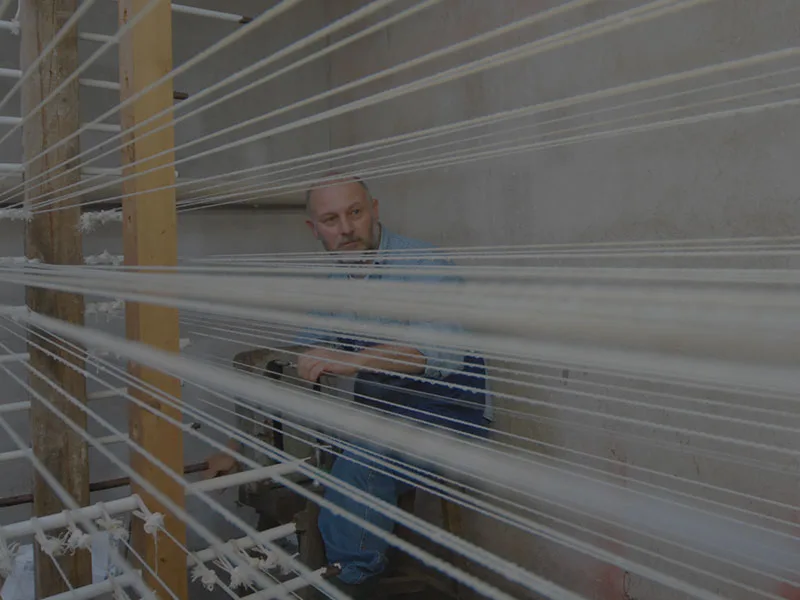
The procedure of the time first called for the use of whole lamb gut — at least 50 feet long — which, after being carefully emptied and rinsed for several days in running water, underwent a series of treatments aimed at removing the non-muscular membranes and fatty substances. This result was obtained by leaving the gut immersed for several days in alkaline baths of gradually increasing concentration, so as to be able to easily remove, by means of a simple but delicate scraping carried out with the back of a knife or with a fragment of marsh reed, the non-muscular membranes and the fat that always accompanies gut.
The alkaline baths consisted of vegetable ash dissolved in water (potash). The progressive increase in the concentration of the baths is explained by the fact that, at the beginning of the degreasing treatment, dilute solutions of alkaline product are sufficient, being already able to remove the more easily soluble fatty substances. Maximum potash concentration is reserved only for the end, when a much more energetic action becomes necessary for whatever still proves difficult to remove. At this stage a modest addition of alum could also follow, whose ‘astringent’ and tanning effect somewhat hardened the gut. The alkaline baths, in other words, ensured that a concomitant process of fermentation and saponification of the organic matter took place, such as to facilitate the mechanical detachment — by means of a fragment of marsh reed — of the useless parts, leaving free and perfectly degreased only the muscular membrane: the part that interested the stringmaker.
Several degreased guts were then carefully selected and gathered into parallel bundles (depending on the diameter of string required), knotted at the ends and subsequently twisted by means of a special reel (the opposite end of the proto-string was fixed to a peg, in turn fastened to a side post of the drying frame). After the string had been properly twisted, the free end was in turn fixed to the other peg of the opposite post of the frame, thus putting the damp string under tension.
When the frame was well filled with strings, it was carried into a special room where the strings were bleached by sulfuring, that is, by burning flowers of sulfur in a basin and subjecting the strings for days to the bleaching action of the sulfur dioxide given off by the combustion process. At the end of this operation the strings were further twisted, and then finally dried in the open air, an operation that took a few hours.
The last stage consisted of smoothing, by rubbing their surface with a plant possessing abrasive properties (soaked in the alkaline degreasing liquid, or ‘tempering bath’): horsetail, scouring-rush. The perfectly smoothed strings were then greased with olive oil, cut from the ends of the frame and made up into coils; each package could contain from 15 to 30 strings or more, immersed in olive oil.
There are therefore substantial differences between the procedure followed today and that of the past.
The first thing to point out is that nowadays lamb gut is practically no longer used, in favour of materials from older animals.
The practice generally followed by stringmakers of the eighteenth century and much of the nineteenth also called for the use of whole gut, whereas today strips are used, obtained by cutting the raw material lengthwise with special machines. This makes it possible to limit the degree of taper of the string produced, a problem that always plagued the treble strings of the time.
The practice of cutting gut lengthwise is commonly traced back to the late eighteenth century and to German stringmakers; in reality this operation was already practised in Italy around the middle of the seventeenth century, so much so that some of the statutory regulations of the time — Roman ones in particular — threatened heavy penalties on stringmakers caught “…splitting the strands, or guts, in half…”. Evidently it was not considered good practice — beyond the advantages it brought to the regularity of the gauge produced — if the most prestigious and powerful stringmakers’ guild of the time, the Roman one, forbade its use.
Further points of difference are today’s use of pure sodium carbonate in place of vegetable potash — which is impure potassium carbonate — (obtained by burning grape marc and wine lees) to degrease the gut, while for the bleaching operation oxidising products such as hydrogen peroxide or sodium peroxide are used.
The last and most substantial difference from the past lies in the fact that the raw, dried strings are no longer lightly smoothed by means of abrasive plant fibre — or powdered pumice — but rather ground with a special mechanical machine, which produces the rich range of commercial diameters required today.
It might at first seem that the modernisation of the age-old and unchanged string-making technology was an entirely positive fact, but things are by no means so simple. Some apparently trivial steps of the old manufacturing system have never been investigated as they should have been, and the practical difference can be widely observed by comparing the few surviving samples of strings — even from the beginning of the century — with those available today: extremely twisted, soft and elastic the former, as much as rigid, hard and poorly twisted the latter. Our strings, moreover, if unvarnished, have a decidedly short lifespan once mounted on the instrument.
The question of durability is easily explained by the fact that a string made from whole gut, which has undergone only a light smoothing treatment with abrasive plant fibre or pumice, has a much smaller number of broken surface fibres compared to a string made from strips of gut whose final diameter has been forcibly imposed by mechanical grinding, which removes a considerable amount of material from the surface of the raw string.
The second important aspect — which heavily affects overall acoustic performance — concerns the fact that today’s gut strings seem in some way inclined to give up the pursuit of maximum elasticity in favour of tensile strength alone, forgetting that the task of a musical string is to sound as well as possible, certainly not to compete with a towing rope. In other words, the ability to transform the mechanical impulse transmitted by the bow hair or by a finger into a vibratory motion that is as free as possible from the internal friction (damping) of the string, which would reduce the efficiency of transformation of the mechanical energy transmitted to the material.
Today’s strings ‘give up’ the pursuit of maximum elasticity for at least the following reasons: since young-animal gut is no longer used (which is less stiff and less innervated than that of older animals), and since vegetable potash — once called ‘oil of tartar’ and widely used until the beginning of this century to soften the skin of the hands — has been replaced by sodium carbonate, which does not possess this property. Further support for the importance that the use of vegetable potash came to assume in the final quality of the musical strings produced (which eighteenth-century Italian stringmakers made exclusively by calcining wine lees, while the French — in the same historical period — used for the purpose the so-called cendres gravelées, which however had a distinctly lower potash content) comes from Jaubert’s Dictionnaire raisonné, p. 319:
“On pense qu’il y a encore une légère opération à faire aux cordes avant de les exposer en vente; elle consiste vraisemblablement à les frotter d’huile pour les adoucir et les rendre encore plus souples: mais les Boyaudiers en font un mystère; ils assurent qu’ils ne se servent point d’huile, et que c’est dans cette dernière manœuvre que consiste tout le secret de leur art. Les Boyaudiers ont raison d’assurer qu’ils ne se servent point d’huile pour assouplir et donner du son à leurs cordes, mais ils y emploient des sels qui sont extraits de la lie de vin.”
Today’s strings are, lastly, generally less twisted than those of the past, and this can be deduced not only from information found in ancient documents but also by examining surviving fragments: it is hardly necessary to recall that the twist factor is fundamental in determining the degree of elasticity of a gut string. In other words, strings of the past were always made with what is called ‘high twist’, except perhaps for lute trebles, which however were, in absolute terms, the most heavily stressed strings.
It should be noted in passing that the softening effect induced on gut by ‘oil of tartar’ makes it possible to achieve a degree of twist considerably greater than the maximum obtainable today.
Perhaps it has not been investigated thoroughly enough why the old stringmakers made the bleaching operation last — which in truth would be completed within just a few hours of exposure to sulfur dioxide fumes — for several days, up to eight. Only recently has it come to be believed that this laborious and uncomfortable procedure produces something more in the gut than a simple — and perhaps useless — bleaching of the material (Galeazzi, 1792, did not approve of strings being excessively white), something the old stringmakers had long since become empirically aware of: the formation of ‘disulfide bridges’ between the long collagen chains — the main constituent of gut — so as to increase the elastic properties at the expense of the plastic ones.
A true ‘vulcanisation’ operation, so to speak, a bit like turning a strand of soft iron wire into spring steel.
In Griselini’s Dizionario (vol. V, p. 131 ca., 1765) one can read, on this point, a decidedly illuminating passage: “Ma l’operazione da noi descritta non basta a dare alla corda l’elasticità convenevole, ed a renderla sonora. Havvi, per quanto dicesi, un altro segreto ancora […] affinché si secchino lentamente ai vapori del zolfo, ed elastiche divengano.”
Labarraque echoes the same idea: “The action of sulfur vapour is indispensable to obtain good musical strings…”
So, finally, does Philippe Savaresse, the great French nineteenth-century stringmaker: “Le soufrage influe aussi beaucoup sur la qualité des cordes. Il est indispensable pour les obtenir bonnes.”
Because the sulfuring of strings has been mistakenly regarded as an operation intended solely to bleach the gut, it has been thought to carry it out by means of convenient chemical reagents in solution, the use of which can however cause a certain weakening of the tensile strength of the material if used clumsily or excessively.
The function of olive oil, finally, seems to go well beyond what has been supposed, that is, being limited to a simple aesthetic function after smoothing. All this would find its justification if one were merely to grease the string lightly shortly before packaging it. According to Italian tradition, however, strings were instead left literally immersed in oil — inside the waterproof package — for a long time; probably months, given the custom of never using strings that were too fresh on musical instruments. It does not escape a careful observer that gut which has been immersed for a considerable time in olive oil acquires a particular ‘hand’, as if it had undergone a true hardening tanning treatment, a tanning process carried out since the most remote times on skins and hides to make them more durable (fat tanning or oil tanning). The lifespan of a string treated in this way is in fact increased. This also appears to be the function of the alum added to the alkaline solution before the twisting stage.
The logical conclusion leads one to believe that musical strings of the past were superior — acoustically and in terms of durability — to ours, which can at least boast of being dimensionally accurate, and therefore rarely false: the true and constant problem of strings from the period before the advent of mechanical grinding.
Production centres
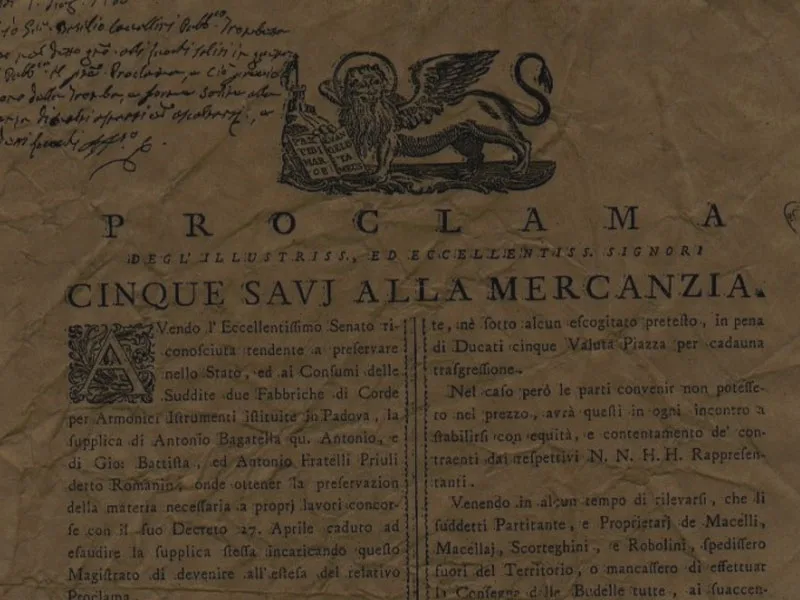
During the seventeenth century, the most prestigious centre of production of musical strings in Italy and Europe was certainly Rome, which in 1735 boasted some twenty stringmaking workshops (regulated by precise statutory rules) that supplied all of Europe at that time with musical strings of excellent quality. Roman trebles remained renowned until well past the end of the eighteenth century, a period in which the powerful guild of stringmakers of the Eternal City was in the meantime dissolved. The primacy of quality was then carried forward throughout the nineteenth century and beyond by the skilled stringmakers of Naples and Abruzzo (who, in fact, moved en masse toward the Naples area and Rome during the summer period in order to work the strings, then returning to their home towns at the end of summer), closely followed by those of the city of Padua (in 1786 the names of the stringmaker Antonio Bagatella and of the workshop “Antonio fratelli Priuli detto Romanin”, founded in 1613 by Antonio Romanin, possibly originally from Rome, stand out), which permanently ceased the production of musical strings in 1911. The suspicion that Romanin might have come from the City of Rome seems to confirm the hypothesis of a stable emigration of stringmakers, which occurred initially towards the large centres of Naples and Rome and then spread to central and northern Italy, Bologna, Modena and Padua foremost among them. It is nonetheless surprising that in several other areas of the South the art of making gut strings never really took hold, except in the Kingdom of Naples and in the Papal States.
- De Lalande (op. cit., p. 514, 1769) wrote precisely that: “La fabrication des cordes de violon est une chose qui est presque réservée à l’Italie, Naples & Rome en fournissent toute l’Europe & il y a toujours beaucoup de mystère dans ces branches exclusives de commerce…”
- Here now are Galeazzi’s indications (Rome, 1792): “Veniamo finalmente alle corde: devonsi provveder le corde alle migliori Fabbriche d’Italia; quali sono quelle di Padova; di Napoli; di Roma; di Budrio sul Bolognese; e dell’Aquila nell’Abruzzo. Vi sono ancora altre fabbriche in Città di Castello; Perugia; Rieti; Teramo; ed altri luoghi; ma le prime portano il vanto; specialmente quelle di Padova; e di Napoli.”
- Sphor (1832) reports the following: “Vi sono corde italiane e corde tedesche, delle quali le prime devono essere preferite; quantunque anche nelle corde italiane ve n’abbia delle cattive. Ordinariamente le migliori sono le corde napolitane, poi vengono quelle di Roma ed infine quelle di Padova e Milano; ma queste ultime valgono poco.”
- The incomparable quality of violin E strings — but also for other instruments — produced in Naples was always a genuine puzzle for the French, who were capable of making any type of string except the E strings for this instrument. These were therefore imported in large quantities from Italy, and, it seems, at prohibitive prices. Towards the end of the eighteenth century the French even instituted an award for whoever could match the quality of the Neapolitan product. The gold medal was in the end awarded to the Paris stringmaker of Neapolitan origin, Savaresse, who brilliantly solved the puzzle: the ‘secret’ consisted in the fact that in Naples, and in numerous other areas of Italy, gut from rather young animals was used — unlike the French; but this had in truth already been written by De Lalande in his Voyage several decades earlier.
- The primacy of quality of strings made in Italy is found unchanged even at the end of the nineteenth century, so much so that George Hart (London, 1874) wrote: “Musical strings are manufactured in Italy, Germany, France and England. The Italians rank first, as in the past times, in this manufacture, their proficiency being evident in the three chief requisites for string, viz. high finish, great durably, and purity of sound. There are manufactories at Rome, Naples, Padua and Verona […]. The German strings now rank next to the Italian, Saxony being the seat of manufacture […]. The French take the third place […]. The English manufacture all qualities, but chiefly the cheaper kinds…”
- Forino (1905) in turn reports the following: “…furono celebri le fabbriche di Berti, di Colla a Roma, di Ruffini a Napoli. In oggi sono assai apprezzati i prodotti di Righetti a Treviso, di Raffaele di Bartolomeo a Napoli, di Nicola Morante a Tavernale di Barra (Napoli), di Nicola Di Russo e di Raffaele Pistola Profeta (successore di Ruffini) a Salle (Pescara), di Luigi D’Orazi anche a Salle e di Conti a Mugellano (Rieti) […]. All’Italia ed alla Germania segue terza la Francia che produce eccellenti corde soprattutto per arpa: le corde di Lione godono fama di ottime.”
Criteria for judging strings
What were the guiding criteria that distinguished a good string from a poor one?
The first thing to note is that professional musicians of the time seem to have shown great skill in recognising, by touch and by sight, material of good quality (the area of origin was already in itself considered a reliable index of the product’s quality) and a false string from one with good vibration: this knowledge was always handed down from master to pupil according to a kind of oral tradition, which began to break down perhaps from the dawn of this century, when the custom gradually took hold of relying blindly on the large stringmaking firms that began to establish themselves in Germany and France at the end of the nineteenth / beginning of the twentieth century, but certainly not in Italy (the Italian stringmaker as a craft figure was by then in decline: after the Great War most of them began to close their workshops or preferred to emigrate abroad, chiefly to America, bringing about the rapid end of the glorious, centuries-old Italian tradition); these firms in effect imposed their own choices in terms of manufacturing strategies and standard commercial gauges.
The age-old custom of oral tradition might explain why so little was written about the criteria for choosing strings in the paper documents of the time.
Here is what is reported by the sources in our possession:
- F. Galeazzi: “La buona corda dev’esser diafana; color d’oro; cioè che dia sul gialletto, e non candida come alcuni vogliono; liscia; e levigata, ma ciò indipendentemente dall’esser pomiciata; senza nodi; o giunte; al sommo elastica, e forte; e non floscia, e cedevole.”
- Labarraque: “La corde la meilleure et qui doit faire le plus long usage, est celle qui change le moins d’aspect quand on la monte… les cordes qui ternissent et perdent leur transparence ne doivent pas résister.”
- L. Sphor: “…La buona corda si distingue pel suo colore bianco, la sua limpidezza e liscezza […]. Corde vecchie, guaste, oppure quelle di cattiva fabbrica si conoscono subito al loro colore giallo e fosco; esse non sono trasparenti, né elastiche come le corde buone.”
- Maugin et Maigne (Paris, 1869): “Les chantarelles, dit M. P. Savaresse, doivent être transparentes, parfaitement unies et assez régulières de grosseur. Elles ne doivent pas être trop blanches, car cela prouverait qu’elles ont été faites avec des agneaux trop jeunes, et lorsqu’on serre un paquet de chantarelles sous la main, elles doivent paraître élastiques et revenir promptement comme le ferait un ressort d’acier. […]. Les grosses cordes, deuxième et troisième, doivent, au contraire, être transparentes et très blanches. Il faut, en outre, qu’elles soient très molles quand on en comprime un paquet, mais elles ne doivent pas changer de couleur et elles doivent revenir promptement à leur état cylindrique; si elles présentaient trop de raideur, cela indiquerait qu’elles ont été faites avec des boyaux trop résistants, et, dans ce cas, elles auraient une mauvaise qualité de son.”
- George Hart: “In selecting the E string, choose those that are most transparent; the seconds and thirds, as they are made with several threads, are seldom very clear […] and hence, absence of transparency in their case denotes inferior material.”
The last document we present was published in 1905 and probably constitutes the last text still to indicate the criteria for choosing a musical string according to nineteenth-century tradition:
- L. Forino (1905): “Le corde tedesche hanno il pregio della resistenza e, come tutti i prodotti di quella nazione, hanno anche quello del buon prezzo. Sono levigatissime, dure al tatto tanto da sembrare di acciaio [!]: anche il suono risente di tale durezza […]. La buona corda deve essere non troppo liscia e bianca, ché l’azione della pomice non giova alla buona sonorità: deve essere molto elastica e perfettamente cilindrica […]. Per provare l’elasticità basterà comprimere con le dita una corda ancora attorcigliata e fare l’esperimento, per esempio, fra una tedesca ed una italiana.”
Types of string
The types of string available from the early eighteenth century onward for the violin — but also for other bowed instruments — can be summarised in two main classes: plain oiled gut strings — made with high twist — for the treble and middle registers, and wound strings for the basses. The typical Italian setup — but later also the English one and that of German-speaking countries — for the violin, from as early as the end of the seventeenth century, presumably always included the use of the first three treble strings in plain gut and only the fourth of wound type.
The violin setup in Italy does not seem to have undergone the slightest variation over the course of the nineteenth century, at least until the 1920s of our own, when the third string in plain gut began to be gradually supplanted by one wound in aluminium, generally paired with higher strings made of piano steel.
String gauges
To answer this fundamental question, one must necessarily take into account the treatise literature of the time — as other researchers have already done — but from a different angle than usual, that is, starting above all from the information that has come down to us — directly or not — from the stringmakers of the time. This kind of approach, in our opinion, allows one to start ‘on the right foot’, because, beyond what may have been written in contemporary treatises and violin methods, it was in any case the stringmakers who ultimately established (or rather imposed) the commercial diameters of the strings of their time, and this fact is inseparably linked to the number of guts that make up a string, which determine in reality — for a given number used — not a single gauge but rather a certain oscillation around an average value, this being due to the fact that guts, being a natural product, are never perfectly identical to one another.
This is a fundamental point that must be clarified straight away.
Unlike today, when a great variety of commercial sizes is available, whose increments follow a constant progression imposed by mechanical grinding (for example 0.60; 0.62; 0.64 and so on), the final gauge of strings produced up to the first decades of the twentieth century was determined exclusively by the number of guts paired together to make a string of a given diameter. As reported by some documents, strings were distinguished commercially by a progressive numbering that indicated the number of guts used to make them.
Stringmakers always took care to standardise as much as possible the quality of the guts to be used (seeking material from lambs of the same age, breed and area of origin, and finally carefully selecting the guts before pairing them together); nevertheless a certain uncertainty — or rather oscillation — in the final gauge was inevitable, and this could not be remedied at all by manual smoothing (which is in fact not an operation of precise mechanical grinding), because otherwise there was a tangible risk of making a string false, given the objective difficulty of manually maintaining a perfect roundness of the gut worked in this way. Indeed, violin E strings were often not smoothed at all, precisely to avoid this ever-present risk.
So it was that a string made, for example, from three guts would take on an interval of diameter that can be represented by a Gaussian curve. This naturally also holds true for strings of other gauges obtained by pairing together a different number of fresh lamb guts. The stringmaker’s skill therefore consisted in ensuring that the bundle marked, for example, number three, was characterised by a small variation in average diameter, as well as by a certain reproducibility of it in production batches made at different times — an aspect understandably appreciated by musicians of the time. In other words, the achievement of a Gaussian curve with a very narrow base.
An idea of the width of the range of gauge obtainable from strings made from the same number of guts can perhaps be deduced from the three degrees of tension suggested for the violin E string by George Hart, which correspond to these extremes of diameter: 0.65–0.73 mm. It is intuitive to understand that, as the number of guts to be paired increases — in order to obtain greater thicknesses — the width of the variation in the diameter produced decreases rapidly, owing to the ‘averaging effect’ induced by the numerous paired guts, and likewise the gauge gap existing between two adjacent strings by number of guts, as for instance between one made of ten and one of eleven strands. The whole thing is similar to the narrowing of the frets on a guitar as one proceeds towards the higher positions on the fingerboard.
Let us now turn to the historical information provided by the stringmakers themselves.
The first source known to us that reports data coming from Italy is the Voyage en Italie by De Lalande (op. cit.), who reported very interesting information on the activity of the most important Abruzzese stringmakers — Angelo and Domenico Antonio Angelucci, the latter having died in 1765 — who owned an important string workshop in Naples around the first half of the eighteenth century. In this first document we learn that to make the violin’s first string three whole lamb guts of seven/eight months of age are needed, while the last — that is, the last one made purely of gut, hence the third, certainly not the fourth, which is wound — takes seven. The use of three guts (otherwise called ‘threads’) to make the violin E string is also found in a ‘do-it-yourself’ recipe dating from the early eighteenth century.
This same trend, that is, the use of three whole guts — sometimes four — to make the violin’s ‘E’, continues uninterrupted throughout the nineteenth century and is also taken up in Maugin’s manual (op. cit.), which reports information provided by the French stringmaker of Neapolitan origin, Henry Savaresse: “Les chantarelles se composent de 4, 5, ou 6 fils, selon la grosseur du boyau, et chaque fil est formé d’une moitié de boyau divisé dans sa longueur. Les mi de violon ont de 3 à 4 fils pleins, mais très fins. Les la en ont le même nombre, mais plus forts. Quant aux ré, ils en ont de 6 à 7 pleins.”
- In 1874 Ph. Savaresse wrote: “On a longtemps attribué la supériorité des cordes de Naples aux secrets de fabrique, plus tard on l’a attribuée à la petite espèce de moutons qui permettait de faire les chantarelles à trois fils…”. Savaresse further wrote that: “La chantarelle ayant trois fils, si les autres cordes sont faites avec les mêmes intestins, la seconde aura 5 ou 6 fils et la troisième 8 et 9…”. It is evident that where the gut had been cut down the middle, it then became necessary to pair a double number of threads.
The information on string manufacture reported by Maugin was taken up wholesale by other late-nineteenth-century methods (for example Huggins and Hart), down to and including Angeloni’s Hoepli manual (early 1900s), which consequently also reported data that, in our opinion, are incorrect, as will be discussed later.
It is natural to wonder what average diameter a violin E made from three whole lamb guts might take (and so on for the other strings), since this figure seems to have remained strongly constant over the centuries.
In Italy, by far the most significant eighteenth-century source is undoubtedly Count Giordano Riccati of Treviso, who was a great physicist in the field of acoustics and a theorist of harmony (as well as a good amateur violinist).
Riccati, in his work published in 1767 (Delle corde, ovvero fibre elastiche, Bologna 1767 — though the drafting of the work, Barbieri notes, had already begun in 1740), carefully weighed and measured the length of the first three gut strings of his violin (p. 130): “Colle bilancette dell’oro pesai tre porzioni egualmente lunghe piedi 1 ½ Veneziani delle tre corde del Violino, che si chiamano il tenore, il canto e il cantino. Tralasciai d’indagare il peso della corda più grave; perché questa non è come l’altre di sola minugia, ma suole circondarsi con un sottil filo di rame.” If one takes an average specific weight of gut equal to 1.3 g/cm³, the results are respectively 0.70, 0.91 and 1.10 mm in diameter for the E, the A and the D.
- This same diameter of the E can also be found in a never-used silk violin E string (silk has roughly the same density as gut) dating from the last years of the Age of Enlightenment, still preserved together with some harp strings at the Académie des Sciences in Paris.
- A third confirmation — though the certainty of its dating is unfortunately not guaranteed — may perhaps be considered an E string from a violin found ‘in its original state’, built by Nicolas Lambert in 1765, said to have ‘never left its case for at least a century’, which perhaps dates from the second half of the eighteenth century, made with high twist and with a gauge of 0.71/0.72 mm in diameter.
- A fourth confirmation is given by some violin E strings kept in their original packaging — dating from the early twentieth century — belonging to the present writer; the gauges measured are between 0.66 and 0.68 mm, high twist.
- Further data regarding strings produced in Italy relate to the late nineteenth century, specifically to English violin methods. Huggins, for example (64), wrote the following: “The measures of a set of Ruffini’s strings were found to be: 1st = 0.0265 inch (0.67 mm); 2nd = 0.0355″ (0.90 mm); 3rd = 0.0460″ (1.17 mm); 4th = 1.41 grm.”
Ruffini — the greatest Neapolitan stringmaker of the late nineteenth century — also exported his excellent products to other cities in the rest of Europe, heir to that centuries-old Neapolitan tradition of gut string making. Strings made in Naples — Ruffini’s in particular — were highly sought after in Victorian London: “The best strings in the market to-day are imported from Signor Andrea Ruffini of Naples, which are sold by all the leading violin-dealers in London.” (Heron Allen, op. cit.)
As can be observed, the strings produced by this Neapolitan stringmaker — of whose diameters W. Huggins further wrote that: “…these were found to be in about the same relative proportion to each other as the sizes indicated on the gauges sold by several makers.” — coincide almost entirely with those determined by Count Riccati more than a century earlier for his violin; this should not come as a surprise if one considers that the raw material (seven/eight-month-old lamb gut) and the manufacturing process do not seem to have undergone, in Italy — but also in France — any modification whatsoever compared to what was described by De Lalande in the full Age of Enlightenment. This probably held equally true for other Italian cities of the time producing renowned musical strings, such as, for example, Padua and Rome, themselves also heirs — it seems — to the tradition of a single lineage of stringmakers that spread in the past through the rest of Italy: the Abruzzese stringmakers of Salle, Musellaro and Bolognano.
The strings sold in London by George Hart and Heron Allen were in all likelihood imported from Italy, and specifically from the Naples area.
Starting from the consideration that the type of gut used to make the violin’s E, A and D was ‘the same’ (Labulaye/Savaresse, op. cit.), then the number of guts used and the final diameter — at least in theory — are mathematically related to one another. Since, as has been seen, the violin’s first string tended to be made starting from three whole lamb guts and took a gauge — let us say, for our convenience — of 0.70 mm, it follows that the theoretical diameter of the second and third strings — made respectively from five and seven/eight guts — comes out at 0.90 and 1.07/1.14 mm: the correspondence with Riccati, Savaresse, Ruffini and other French sources is undoubtedly striking, thereby supporting the hypothesis of a great standardisation of the manufacturing process, Italian but also French (for France, as seen earlier, probably beginning in the early years of the nineteenth century).
There would be more to add on the conditions dictated by strings thicker than ours to the instruments of the time, such as the need for a smaller string angle at the bridge (which Boyden, paradoxically, took as evidence that the tensions of the time were lower than ours), their height above the fingerboard — which, according to Galeazzi, should on the violin be as low as possible, provided they did not buzz against the fingerboard —, the bass-bar — generally shorter and thinner —, the soundpost, the bridge and their position, and finally the type of rosin of the period, which we have been able to test successfully (Galeazzi’s recipes). Everything, in short, seems tightly linked together in a precise sequence whose starting point is the string: once this ‘fell’ in the course of the twentieth century, a kind of ‘domino effect’ would have occurred, involving all the other elements in a cascade.
Mimmo Peruffo, a scholar from Vicenza, has devoted himself to the study and reconstruction of the gut strings used in the Renaissance, Baroque and Classical periods. His contributions on this subject have appeared in Oxford’s F.O.M.R.H.I. Quarterly, the Bollettino della Società Italiana del Liuto, The Lute Society of America Bulletin, Quattrocentoquindici and Il Fronimo. He curated the section on gut strings for the new catalogue of musical instruments of the Germanisches Nationalmuseum in Nuremberg and for the volume of the recent Bergamo exhibition Evaristo Baschenis e la natura morta in Europa. He also carried out, for the first time, careful measurements of the gut string fragments dating from the first half of the eighteenth century held at the Museo Stradivariano in Cremona.
Mimmo Peruffo
© Aquila Corde Armoniche srl. All rights reserved. To request permission to reproduce this work, write to aquila@aquilacorde.com or see the terms of use for content.