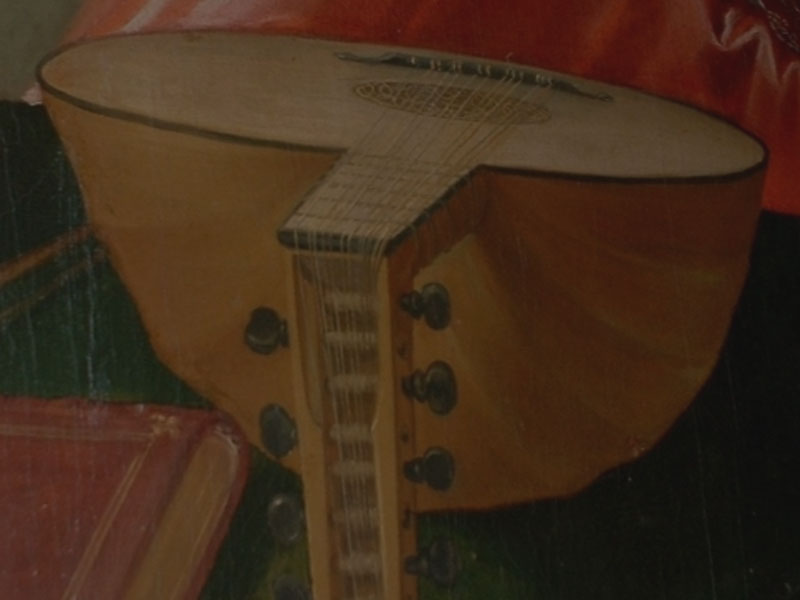
Summary
Mimmo Peruffo recounts, in the first person, a research journey spanning more than thirty years: from the first mentions in the FOMRHI bulletin in the 1990s, through Kenneth Sparr’s research, to a 2017 visit to Linköping, Sweden, home to a small lute attributed to Raphael Mëst (1633), of the Dutch 12-course model. On its bridge, its extension and its pegbox, a handful of original string fragments have exceptionally survived, including three demifilée (open-wound) bass strings — a circumstance more unique than rare, finally allowing theory to be checked against physical evidence. The essay retraces the historical sources on seventeenth-century lute strings (Dowland, the Burwell Lute Tutor, Mace), the birth of covered strings between the 17th and 18th centuries, and the two competing theories on plain-gut basses, before examining in detail the measurements and features of the surviving Mëst lute fragments — and concludes with the commissioning of a faithful copy of the instrument, built by luthier Antonio Dattis and donated to the library, presented at the conference The Raphael Mëst Lute – A Musical Gem in September 2023.
Key takeaways
- Raphael Mëst’s lute (Linköping), dated 1633, preserves on its bridge, extension and pegbox original string fragments: a treble of plain gut only .33 mm thick and three surviving demifilée bass strings — a case more unique than rare among surviving historical instruments.
- Seventeenth-century sources (Dowland 1610, the Burwell Lute Tutor ca. 1670, Mace 1676) describe three sorts of string — Trebles, Meanes, Basses — each requiring a different manufacturing technology, yet none of them names covered strings.
- Covered strings emerge between 1659 (Hartlib) and 1664 (Playford); true demifilée strings are documented from 1712 (Brossard) to 1782 (La Borde), and their appearance on the D-minor lute is attested only from 1715 (Wolf).
- Although the instrument dates from 1633 and contemporary sources (Mace, 1676) still describe plain-gut basses, the Mëst lute carries fragments of covered strings typical of the eighteenth century: a genuine mystery the author leaves open.
- A replica of the 12th-course demifilée string, reconstructed from the original fragment, yields a gut-equivalent diameter that is far too light (0.95 mm against an expected 1.70 mm) and a metallic, dry, almost guitar-like tone.
- Commissioned by Peruffo, luthier Antonio Dattis built a rigorously faithful copy of the Mëst lute, donated to the Linköping library and presented publicly on 16 September 2023 at the conference The Raphael Mëst Lute – A Musical Gem.
Introduction1
The first time I heard of this lute was, I believe, around the early 1990s, when I read something about it, discussed by Ole Vang and Ephraim Segerman2 (the well-known researcher who can rightly be considered the father of research into historical strings, and of concepts such as the FL product, high and low twist, inharmonicity and much more besides) in the FOMRHI bulletin. In some of the ‘comments’ certain aspects of the instrument were considered, in particular the matter of its reduced string length.3
In the bibliographical notes I saw that some works by Kenneth Sparr were cited,4 but at the time, not yet having an internet connection or a PC, I did not pursue it further. A couple of years later I finally managed to find Kenneth’s article on the web, and in the meantime I had heard that this instrument presented what might be some interesting string fragments.
At first this did not surprise me all that much, since lutes in museums often carry mounted strings that, one can tell at a glance, cannot be original. But here the matter was different, also because of the history of the instrument in question, as it emerged from Kenneth’s writings. It was in fact a unicum that had not only never been restored, but was not even kept in a proper museum. Its notably small dimensions and its model (harking back to the Dutch lutes widespread around the middle of the seventeenth century) were, lastly, a kind of guarantee that it could not have undergone alterations.
What interested me was that some string fragments were still present. I therefore decided to write to the library that housed the instrument, and the librarian was kind enough to send me a series of photographs of the whole bridge and others of certain details.
The photographs showed that the three surviving bass strings were of the demifilée type and, barring some mistake on my part, could genuinely be original. Demifilée strings are, as we shall see, a kind of ‘signature’ of the eighteenth century,5 from its final years onward — a period dense with political and social changes that also affected music. One need only think, for example, of the disappearance of the viol family and of the lute, while the guitar did away with doubled courses (barring a few situations, as in Spain, concerning the six-course guitar), moving on to six single strings. In practice, among bowed instruments, those tuned in thirds and fourths and fretted disappeared in favour of those tuned in fifths and unfretted.
On plucked instruments such as the guitar, on the other hand, the move from ‘courses’ to single strings brought a general rise in working tension. All this made the use of demifilée strings pointless, favouring instead the traditional close-wound type, made from this point on almost exclusively on a silk core. Demifilée strings survived only as basses for the fortepiano and for early nineteenth-century harpsichords.
Having examined several hundred lutes in various European museums and private collections, I realised that, in all likelihood, this was an altogether exceptional and unique case: the discovery of original string fragments that could actually be studied.
Only in 2017 did I manage to organise myself and finally travel to this library, where I was kindly allowed to examine the lute as a whole, and above all its strings. I subsequently decided to have a copy of the instrument made, rigorously identical to the original, and to donate it to the library. I would like to publicly thank Antonio Dattis, who with great enthusiasm took on the task of making the copy that you can see today.
To conclude this long but necessary introduction, I will say that I subsequently decided to propose a meeting, here in Linköping, in order to invite all those who had contributed culturally and through research around this singular instrument, so that they might compare notes and listen to the sound of its copy.
We are naturally all aware that what we are about to hear will not be the sound of the instrument fitted also with a reconstruction of its original strings (for instance, it is not strung with gut strings, and at the same time the basses are not a faithful reconstruction of the originals); nevertheless, the kind of sonority — so bright and delicate — may well surprise us all.
Lute string mountings in the seventeenth century
Before discussing the finds and the measurements we have carried out, we believe a brief excursus is needed on the types of strings in use during the seventeenth century for this kind of instrument.
The main sources at our disposal are:
- A) The 1610 Varietie of Lute Lessons, edited by Robert Dowland, in which the section on strings was however written by his father John.6
- B) A manuscript from the second half of the seventeenth century (around 1670) called The Burwell Lute tutor.7
- C) Thomas Mace’s Musick’s monument, printed in 1676.8
For the eighteenth century we have no treatise describing the strings used on the lutes of that period (11- and, above all, 13-course lutes, either with a rider for the last two basses or with a swan-neck extension, archlutes in G with 13 or 14 courses, and finally theorbos with either single strings or courses).
It should be remembered that, although the instrument bears 1633 as its construction date, the presence of demifilée covered strings might suggest (should the bass strings prove to be original) that these fragments belong to the last stringing, probably later than the invention of covered strings (the first official mention is by John Playford in 1664).9
Let us briefly examine the three documents mentioned above:
John Dowland (Of setting the right sizes of strings upon the lute, in Varietie of lute-lessons).
Dowland divides strings as follows:
- ‘Trebles’: «from Rome and other parts of Italy», «from Monnekin and Mildorpe» (most probably Munich and Meldorf, both in Germany); other small-gauge strings are also indicated: «which are made at Livornio in Tuscanio».
- ‘Small and Great Meanes’, which he calls ‘Gansars’.
- ‘Base’: «Nurenburge, and also at Straesburge»; «Venice Catalines» (the best Basses, according to Dowland, are made at Bologna in ‘Lombardy’).
Dowland’s text shows a certain tendency to confusion when describing the ‘Meane’ type of string. For instance, it is not possible to tell whether the smaller strings made at Livorno were strings for the ‘Trebles’ or the ‘Meanes’. Nor is it clear whether the coloured strings belonged to the ‘Treble’ class, the ‘Meane’ class, or both.
In the Mary Burwell Lute Tutor we read the following: «The good stringes are made at Rome or about Rome and none that are good are made in any other place except the great strings and octaves that are made in Lyons att Fraunce and noe where else».10 (Fig. 1)
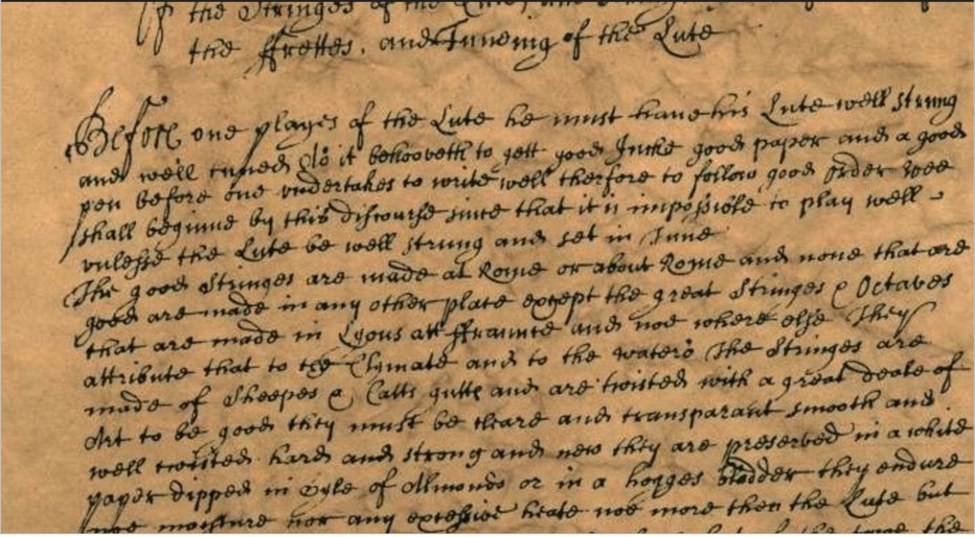
The novelty concerns the bass strings and their octaves, which are made in Lyons.
Thomas Mace is, without doubt, the most valuable and thorough source. As with Dowland, strings are divided into three types, which we believe reflect not their commercial origin but their manufacturing technology:
- ‘Trebles’: (1st, 2nd, 3rd course and the octave of the sixth bass course): Minikins;
- ‘Meanes’: (4th, 5th course and the remaining bass octaves): Venice catlins
- ‘Basses’: Pistoys, Lyons.
Mace too, like Dowland, describes coloured strings, but he is likewise not sufficiently clear as to whether they were meant for the ‘Treble’, the ‘Meane’, or both.
Mace is particularly interesting for at least two reasons: the first is that he discusses the 12-course lute, an instrument especially widespread in the Low Countries between around 1620 and the end of the century, about which little is still known, and which was used precisely in the period when the accords nouveaux were in vogue. The instrument we are concerned with here, although smaller in size, belongs exactly to this type.
The second reason is a curious one: despite having written extensively about the lute, and also about the viol chest in use in his day in England, Mace never mentions covered strings. Yet he lived in London, where the publisher John Playford was well known. In other words, there is no logical reason to think he was unaware of the new type of covered basses, whose first announcement appears in a book printed in London, by Playford himself, a full 12 years earlier.
The Dutch iconography found so far shows examples of stringing where the series of basses beyond, and including, the sixth appear to be of plain gut, with colouring ranging from yellow to brown, blackish and tending towards deep dark red (hence the theory of loaded gut).
The purpose of the three sorts of string — far from being merely a banal description of the various commercial types — was, in the present writer’s view, to bring about a kind of transition, at the right moment, between strings possessing technological and manufacturing characteristics perfectly suited to the progressive reduction of the FL product that occurs as one moves toward lower frequencies, especially at a given string length (in practical terms, this means the reduction in acoustic efficiency that follows an increase in string diameter).
Indeed, as one went down in frequency, serious problems of both a mechanical and an acoustic nature had to be solved one after another.
Working with an open range, between the first and the last open string, of two octaves and a fourth/fifth on a short extension, and especially when working with a single string length, it is by no means enough simply to make progressively thicker strings.
Our hypothesis
Starting from the thinnest of the ‘Treble’ strings (which for Mace are the first three courses), a precise manufacturing path aims entirely at achieving the maximum resistance to tension and to surface wear.
Documents from the late sixteenth and the seventeenth century from Roman string-making workshops add the adjective ‘reinforced’ to treble strings for guitar, lute and violin. The researcher Patrizio Barbieri believes these were particularly hard-twisted strings. It should however be noted that the term in question literally means ‘made stronger’, ‘made more robust’. An increase in twist, in fact, produces a certain reduction in a string’s breaking load, not an increase in it.11
We believe instead that this term was reserved solely for strings undergoing specific treatments (also mentioned in historical sources, such as the one describing a Paduan string-making workshop around 1660)12 intended to make the gut stiffer.
Once we reach the ‘Meane’ register (that is, the fourth and fifth course, still according to Mace), it becomes necessary to move to another, completely different manufacturing path, in which the need to guarantee maximum tensile strength and stiffness of the string takes second place. From this point on, it is far more important to increase elasticity to the utmost, at the expense of tensile strength (tensile strength and elasticity being inversely proportional).
As is unfortunately common in old treatises, there are contradictions: Mace tells us, for example, that the Venice Catlins of the ‘Meane’ are stiff to the touch.
Once the sixth course is reached, the maximum elasticity that characterises the ‘Meane’ strings is no longer sufficient to counter the further-reduced FL product (in other words, the increase in inharmonicity). Hence it becomes necessary not only to keep the paired octave strings, but now also to increase the specific gravity of the strings following the specific ‘Meane’ manufacturing path, by incorporating materials of high specific gravity; density and elasticity working in synergy are, in fact, the secret to excellent acoustic performance in the bass register, that is, wherever the FL product begins to fall below 60 Hz · m.
That this model, as I propose it, may be true can be inferred both from Dowland (1610) and from Mace (1676). The former wrote that the Gansar strings (which he considered excellent for the ‘Meane’) could not be used as ‘Treble’ because they would break immediately under tension (a sign that they were probably very elastic strings, and consequently had a more limited breaking load). The ‘Treble’ strings described by Dowland are, unlike the ‘Meane’, rather stiff and sharp to the thumb pressed against one end.
Thomas Mace too, 66 years after Dowland, stresses that the thin Minikins (‘Treble’), although very thin, are equally robust enough not to break at all under the tension exerted by a man’s hands, indeed cutting deep grooves into the skin of his fingers. By contrast, the Catlins of the ‘Meane’ — though of greater diameter than the Minikins — could sometimes be snapped by a particularly strong man pulling them taut.
According to the historical sources found so far (essentially treatises and manuscripts specifically dedicated to the lute), we know that covered strings were not used at all.
The problem of plain-gut basses
As is well known to anyone who has run trials, basses made of gut alone, even if made with a high twist, simply do not work. Their sonority is very poor, and pitch-distortion phenomena occur when they are pressed onto the frets. The situation can improve only if the basses are placed on an extension of a certain length (but that is beyond our present scope).
The problem of the poor acoustic yield of plain-gut basses is obviously felt more acutely when the string length remains the same for all strings. The problem — as mentioned earlier — nonetheless also exists for instruments with a medium-short extension, such as Italian archlutes, as well as for instruments like this one by Raphael Mëst, which likewise has a rather short extension, the kind typical of 12-course lutes used in the Low Countries, the Netherlands foremost among them.
The only two theories developed so far regarding the problem of plain-gut basses are, I believe, known to everyone: one, put forward by Ephraim Segerman, holds that bass strings were twisted so as to imitate the structure of a hawser, starting from fresh gut, which could then possibly be smoothed until they became sleek.13
The basic argument supporting the first theory, developed in the 1970s, derived solely from the commercial name of certain lute basses from Italy (the venice catlines), where the word Catline contains the word Line: a term of nautical origin referring to ropes for ships. A string made in this way does indeed acquire a certain additional elasticity useful for developing the sound of the basses.
This theory was nonetheless subsequently disproved, over the years, by other researchers, so much so that it led Segerman (in 1994) to put forward an unlikely Catalan origin for the earliest Catlines (deducing this from the fact that the vihuela is thought to have used basses tuned in unison; but in order to allow for a unison arrangement, rather than octaves, these basses would necessarily have had to be of great acoustic efficiency, that is, made very elastic). In short, according to Segerman the word Catline would derive from the name Catalonia. But no historical support for this claim has been found so far.14
Nowadays, however, the theory that the vihuela used unison basses is contested in favour of octaves, with the occasional exception of the fourth course, which was sometimes suggested to be set in unison (Pisador, 1552).15 A suggestion of this kind, deliberately placed among the warnings to the reader, can only mean that the common rule was to have the fourth course usually in octaves; and if the fourth course was octaved, then, all the more so, the bass strings that followed must have been too, since they certainly present greater inharmonicity problems than the fourth. Other arguments, which I must regretfully omit here, are supplied by Bermudo16 and other sources.
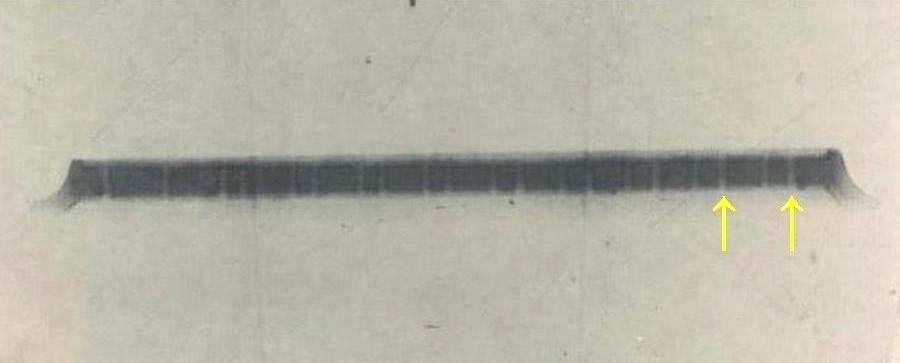
The second theory, developed in the early 1990s, instead rests on the hypothesis that the fresh gut used for the bass strings underwent a process incorporating pigments or metals in an insoluble, powdery state, so as to increase specific gravity and to satisfy certain items of historical evidence, such as the narrow diameters found in the bass-side bridge holes of lutes considered original (Fig. 2), which, from calculations made by Segerman and revised by the present writer, point to a working-tension range of only 0.9 to 1.5 kg.17 This hypothesis would also account for the fact that, before 1580, there were heavy complaints about the poor sonority of plain-gut basses and about the role of paired octaves for the basses themselves (see Tinctoris, Virdung and Vincenzo Galilei),18 only to witness, later on, a complete reversal of the situation, to the point where basses came to be seen as too exuberant, so much so that they blurred the sonority of the higher strings when used on medium- or short-length instruments.
Here are a few passages drawn from the texts just cited:
- Tinctoris, ca. 1487: «An arrangement of five, sometimes six, main strings was first adopted, I believe, by the Germans: that is, two inner strings tuned in thirds, and the others in fourths […]. Moreover, in order to obtain a louder sound, one may add to each of the main strings, except the first, another string tuned an octave higher».19
- Virdung, 1511: «all three of these ‘Prummer’ [the three basses of the 4th, 5th and 6th course] have, in addition to their thick strings, a medium-width string, which is tensioned, or tuned, an octave above their respective Prummer. Why is this done? Because thick strings, being thick, do not carry at a distance the way thin or high ones do. Hence the octaves are added, so that they may be heard just as the others are»20
- Vincenzo Galilei, 1584: «…and God knows how, and how little, they are heard…» and again: «…though with little sweetness, those too are still taken in by the ear, given the feebleness of their sound».
- Here again is what the Mary Burwell Lute Tutor (ca. 1670) has to say about the problems created by the plain-gut basses of the time when set on a short extension with paired octaves: «[…] the confusion that the length of sound produce it alsoe […] every basse sound make a confond with every string». And regarding the eleventh bass: «the lutemasters have taken away that great string because the sound of it is too big and smothis the sound of the others».21 (Fig. 3)

Thomas Mace, in his Musik’s Monument of 1676, says (Chap. XLII, p. 208): «This incovenience is found upon French Lutes, when their heads are made too long; as some desire to have them […]».22
The matter of the colouring of the basses (mistakenly regarded as the most important piece of evidence) is in fact of purely secondary importance, since gut can be loaded with heavy lead-based pigments that produce a deep yellow colour. It nonetheless remains very interesting that the series of uniformly coloured basses, running from the sixth course downward, are all rigorously identical in colour.
The latest developments in this research, supported by the fact that rope-like structures were used in musical instruments as early as the mid-fifteenth century (see Ugolino da Orvieto, as reported by Patrizio Barbieri)23 as well as by the presence of four-hook twisting devices found in certain Roman string-making workshops in the seventeenth century (again according to Patrizio Barbieri’s research), suggest that the sixth course of the lute was added to the other five thanks to the introduction of this type of bass string, to which, in the late sixteenth century, a process for increasing specific gravity was finally added.
Covered strings between the second half of the seventeenth century and the end of the eighteenth: types
The oldest document mentioning wound strings, the manuscript of Samuel Hartlib, Ephemerides, dating from 1659, says: «Goretsky hath an invention of lute strings covered with silver wyer, or strings which make a most admirable musick. Mr Boyle. […] String of guts done about with silver wyer makes a very sweet musick, being of Goretskys invention»24
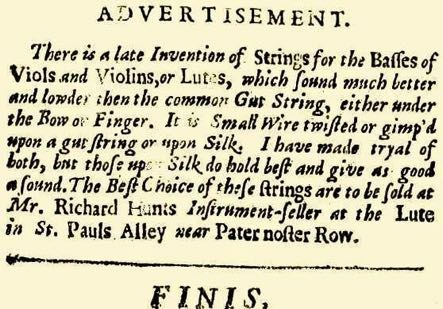
Shortly afterwards, in 1664, John Playford, in his An Introduction to the Skill of Musik, speaks of it again: «There is a late Invention of Strings for the Basses of Viols and Violins, or Lutes, which sound much better and lowder then the common Gut String, either under the Bow or Finger. It is Small Wire twisted or gimp’d upon a gut string or upon Silk. I have made tryal of both, but those upon Silk do hold best and give as good a sound. […]».25 (Fig. 4)
The types of covered strings over a gut core in use between the end of the seventeenth century and the end of the eighteenth can be traced back to three kinds:
- close winding;
- open (non-close) winding;
- double close metal winding.
In the second half of the eighteenth century, type 1) strings began to be made on a silk core as well, but only for plucked instruments (practical tests we carried out have shown that covered silk strings do not perform well under the bow). Close-wound strings over a gut core were the ones that characterised the whole of the nineteenth century, right up to the early decades of the twentieth, when, immediately after the Great War, aluminium-wound strings and/or strings with a partially polished metal winding began to spread.
Type 2) strings were called by eighteenth-century Frenchmen cordes à demi, or more generically demifilée. The first mention of this type nonetheless dates to 1712 (Sebastien De Brossard),26 while the last one known to us is from 1782 (Jean-Benjamin de La Borde).27
Demifilée strings — always made over a gut core — were sometimes used in France both as the fourth string (C) of the seven-string bass viol (see G. B. Forqueray’s letter to Prince Friederich Wilhelm, of 1768)28 and as violin thirds (Brossard, 1712, and Laborde, 1782).
Their constructional feature can be clearly deduced from the name: these are strings whose winding shows a gap between one turn and the next equal to the diameter of the wire, or slightly more for plucked instruments (this precious piece of constructional information — the only one from the eighteenth century — comes to us from Le Coq, Paris 1729, regarding strings for the five-course guitar): «Se charge les deux octaves que la […] ou quatriesme et cinquiesme rang d’un fin filet de laiton ou d’argent, ce dernier en vant mieux […] ne les charge qu’à demi: c’est à dire qu’il reste un espace vide à le corde, de la grosseur du dit filet ou même un peu plus…».29 (Fig. 5)
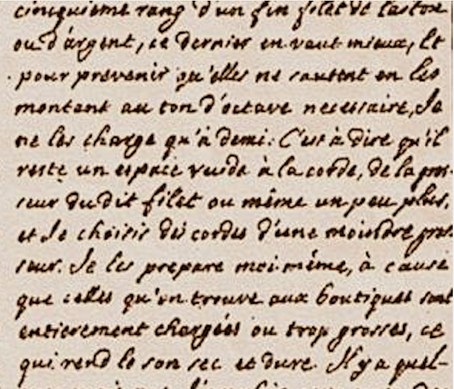
Strings of this kind, however, have the drawback of channelling the bow hair into the gap between one turn and the next of the metal winding; this is why it is thought that, for bowed instruments, this wire was wound more tightly (so that the bow hair would not be channelled in this way):
Demifilée strings were, in conclusion, made in two categories:
- with turns spaced at the same diameter as the wire, or slightly more (hence the name), intended only for plucked instruments;
- with a very tightly spiralled winding, intended for bowed instruments and also for plucked ones, such as the harp. (Fig. 6)

Contrary to what is commonly believed (namely, that à demi strings were merely transitional strings between the plain-gut trebles above and the close-wound ones that followed), these strings became necessary because, at the time, wire-drawing could not go below a certain metal-wire diameter.
The minimum limit we have established is around 0.13–0.14 mm, corresponding to gauge no. 18 on the Nürnberg gauge scale. The subject would call for lengthy further study, which we must necessarily set aside here.
Making a demifilée string is more complex than making a close-wound one; difficulties arise when making the loop at the lute’s bridge, and particular care is also needed at points where direction changes, such as at the nut.
The lute and covered strings
It is our view that the lute, during the course of the seventeenth century, did not commonly benefit from the appearance of covered strings (invented, as we have said, around the second half of that century). Treatises written after their appearance (Thomas Mace, 1676; Talbot, ca. 1690, etc.) do not mention them, even though the earliest documents referring to them, cited earlier, date from 1659, 1664 and 1680.30
Iconographically, the Dutch-model 12-course lutes I have been able to compare do indeed show basses that appear to be of plain gut. (Figs. 7, 7a, 7b, 7c)
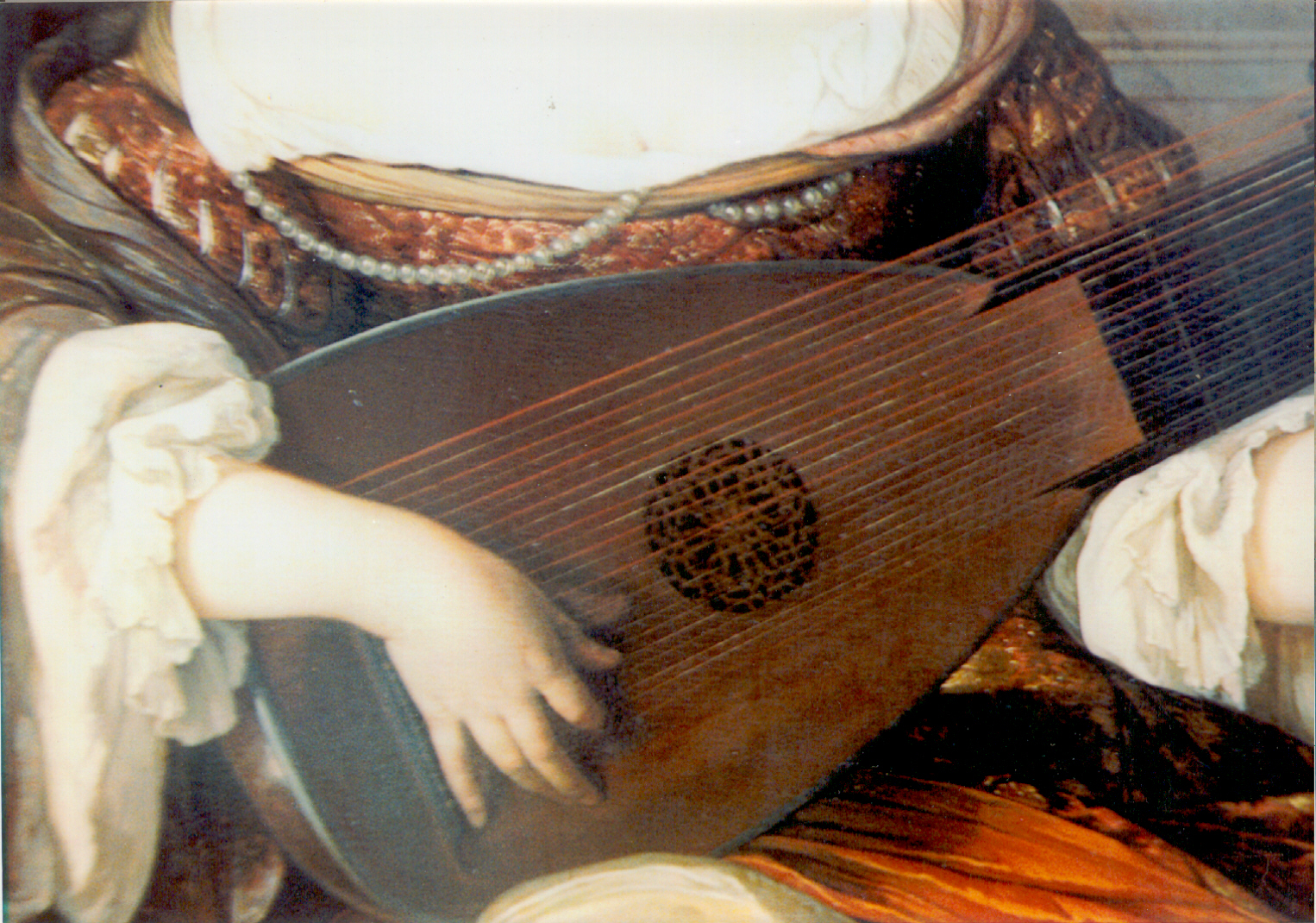

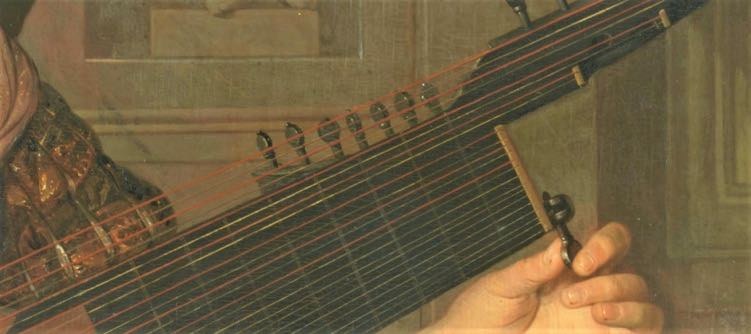
From the early eighteenth century onward, the German D-minor lute with 11 courses begins to benefit from covered strings (though by now the ‘Dutch-style’ 12-course lute has vanished from the radar). From Georg Friedrich Wolf’s Kurzgefaßtes Musikalisches Lexikon (Leipzig, 1715),31 discovered by Andreas Schlegel, we learn that the basses of the 11-course D-minor lute were silver-wound, and the Oeconomische Encyclopädie oder Allgemeines System der Land likewise documents that the lute uses gut basses covered with silver wire.32
From the scant information at our disposal, we venture a few conclusions (concerning here essentially the German D-minor lute):
- The recovered documents, chiefly of German and French origin, confirm that the basses had exclusively a gut core. Silk is never mentioned.
- Because of the technological limits of wire-drawing, and hence the lack of very thin metal wire, it was not possible to make the basses of the 6th, 7th and 8th courses with close winding: these strings had necessarily to be made with open winding. The resulting sound quality (dark and percussive) still made the use of paired octaves indispensable. We do not know whether the whole series of basses was open-wound, or only those of the courses just mentioned; however, for reasons of timbral consistency, and given that octaves were still used, it seems more likely that all the bass strings were open-wound.
- Wound strings with a silk core are first mentioned in 1761, in a French source discussing their use in Spain on the guitar. Because of their better acoustic performance (and lower cost), they rapidly took the place of gut-core strings on the guitar, the harp and the mandolins of the time.33 Of the lute, however, nothing is known. Verification tests we carried out with this type of string nonetheless produced very disappointing results from an acoustic standpoint.
- There are iconographic examples in which details can be observed that do indeed show the use of open-wound strings.
- In the specific case of Raphael Mëst’s lute we are faced with a genuine mystery: this is an instrument built in 1633, of rather small dimensions (which also raises the question of who it was intended for), on which the bass strings, according to sources dated 43 years after its construction, ought still to have been of plain gut (Thomas Mace, 1676), even though the first mention of covered strings dates from around 15 years before Mace’s book (Samuel Hartlib, 1659).
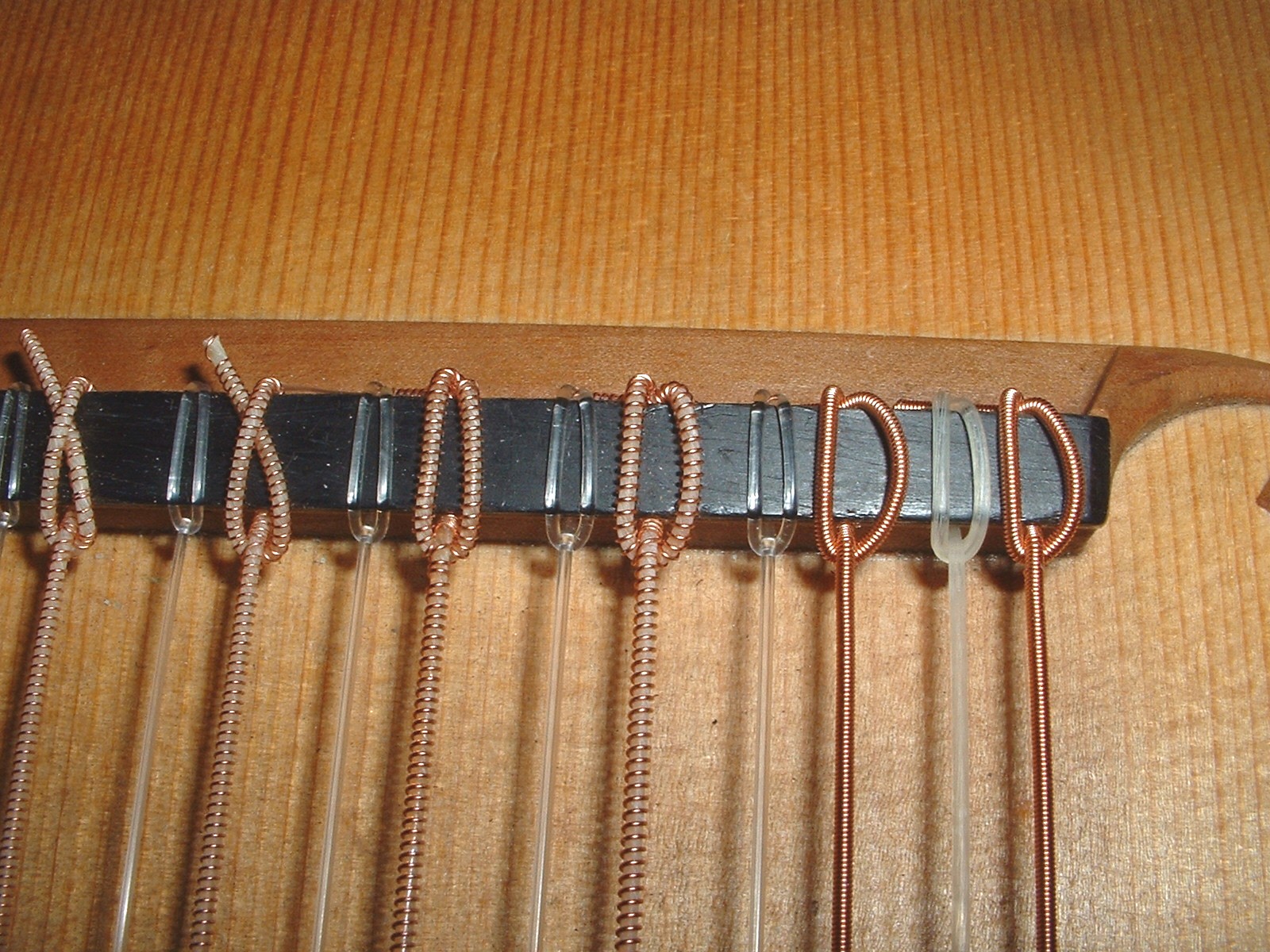
Surviving images of comparable Flemish instruments — which are of normal size — all show gut bass stringing. We repeat that covered strings are not yet named or used, given that the first mention of demifilée strings dates from 1712 and concerns the violin (Sebastien de Brossard), while the first mention of the use of covered strings on the lute is from 1715 (Wolf), and refers to the D-minor instrument.
So how is it that an instrument of this type (which had fallen out of use well before covered strings began to catch on — albeit on the D-minor lute) is found to carry fragments of demifilée strings? Why were those stubs left behind, both at the bridge and along part of the extension and the pegbox?
An exhaustive answer is impossible.
And what of the frequency to be assigned to the first string? Following the rule of maximum feasible pitch (that is, an FL product of 220–230 Hz · m) with a string length of 50 cm, the frequency of the treble works out at between 440 and 460 Hz.
It is impossible to define this frequency by the name of a note: we have, in fact, no certainty as to what the reference pitch standard was.
However, if the pitch standard had been, for instance, 390 Hz, the nominal note could be a natural B.
As for the type of tuning adopted in the past, we can say absolutely nothing: in 1633 (the instrument’s construction date) we are in the full flowering of experimental tunings (accords nouveaux), but on the copy of the Mëst lute, whoever plays it today has chosen to keep the D-minor tuning.
The string fragments
The finds preserved on the instrument can be divided into several types:
- plain-gut strings
- demifilée, or open-wound, strings over a gut core
- a binding cord
At the bridge we find several string fragments. (Tables 1, 2, 3)
| Course | String A | String B |
|---|---|---|
| 1st | Rider: .33 mm diameter, low twist. A 20 cm fragment, of a light, slightly grey/green colour; slightly rough surface (Figs. 8, 8a). | |
| 2nd | .40 mm diameter, low twist | — |
| 3rd | — | — |
| 4th | — | — |
| 5th | — | gut string (around .40 mm diameter) |
| 6th | — | gut string (around .40 mm diameter) |
| 7th | — | — |
| 8th | — | — |
| Course | String A | String B |
|---|---|---|
| 1st | — | — |
| 2nd | — | .42 mm diameter, low twist |
| 3rd | .41 mm diameter, low twist | — |
| 4th | — | .44 mm diameter, low twist (Fig. 8c) |
| 5th | — | — |
| 6th | — | — |
| 7th | — | — |
| 8th | — | — |
| 9th | .44 mm diameter, low twist | .97 mm diameter, high twist (rough surface) |
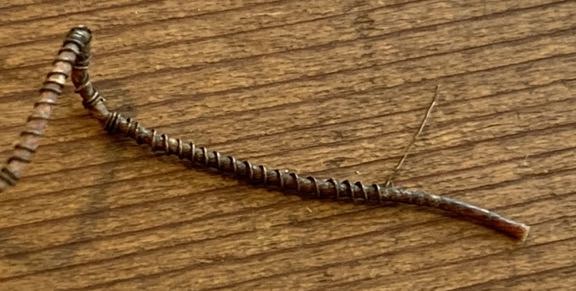
| 10th | — | open-wound (20–22 turns/1 cm; .77 mm ext.; .153 mm wire; .54 mm diameter, gut core) |
| 11th | 0.41 mm diameter, low twist | open-wound (20–22 turns/1 cm; .77 mm ext.; .155 mm wire; .55 mm diameter, gut core) |
| 12th | .42 mm diameter, low twist | open-wound (20–22 turns/1 cm; .95 mm ext.; .158 mm wire; .66 mm diameter, gut core) (Figs. 8b, 8d, 8e, 8f) |
At the hole of the 12th course: a 1.55 mm reference probe passes through; a 1.60 mm reference probe does not. (Fig. 9)
| Course | String A | String B |
|---|---|---|
| 9th | — | — |
| 10th | open-wound (20–22 turns/1 cm; .79 mm ext.; .153 mm wire; .54 mm diameter, gut core) | — |
| 11th | — | — |
| 12th | — | — |
On the neck there is still a double-wrapped binding cord about 1.0 mm in diameter, of high twist.
Conclusions
The gut strings found on the instrument, with the two exceptions of the treble (only .33 mm) and the string of the 9th course, which is nearly 1 mm, all fall within the .42–.44 mm range, low twist.
The first string is, in the present writer’s opinion, genuinely quite interesting. It would truly be worth carrying out a dating analysis using a new scientific method of investigation (an alternative to radiocarbon-14) that works fairly accurately within a range of 50 to 500 years.34
It would likewise be interesting to carry out a qualitative chemical analysis to determine whether aluminium is present, whose salts were used to harden gut, and whose first mention dates from the second half of the seventeenth century.
The colouring of this string suggests it was very probably sulphur-treated (gut strings that have not undergone the sulphur process all appear dark brown, if not blackish, in colour). It is also interesting that this treble is of low twist, a technique suited to achieving maximum breaking load and hardness (Dowland, indeed, writes that the first strings are very hard and sharp to the touch).
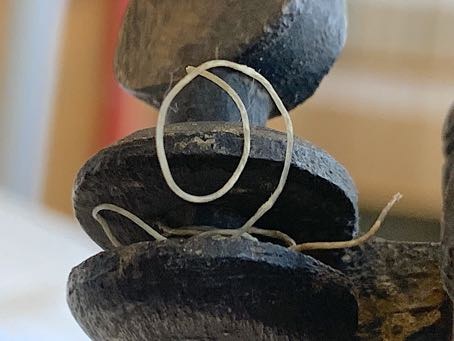
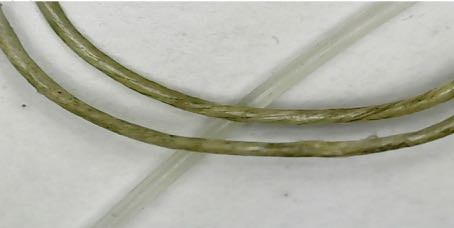
An open question remains: whether this string was made from a whole gut. Athanasius Kircher writes that the lute’s first string is made from a single whole lamb gut.35 Experimental trials we carried out using a single whole lamb gut (following Kircher’s instructions) produced, for hand-smoothed gut, a range of diameters between 0.32 and 0.44 mm.
The problem that emerged is that low-twist strings cannot be obtained from a single gut, unless it is cut into strips, owing to its peculiar nature: on one side it presents a kind of very tough ‘nerve’, around which the rest of the membrane wraps during twisting; if one limits oneself to low twist, this membrane does not adhere completely and evenly around the ‘nerve’, making the string irregular and short-lived.
It may therefore be concluded (pending proof to the contrary, perhaps through the discovery of new documentation) that lute trebles must have been made not with low twist, as is thought today, but with medium/high twist.
It is not of interest here to establish exactly the decade in which this string was made; even a 50-year range would be informative. For dating purposes, however, a calibration curve is needed (to serve as a reference for dating the sample under examination); to build it, the present writer could supply the laboratory with strings certainly made around 1810 (from a stock of six-course Spanish guitar strings wrapped in a newspaper dated ‘Genevre 1812’) (Fig. 10), and others made in the year 2000.
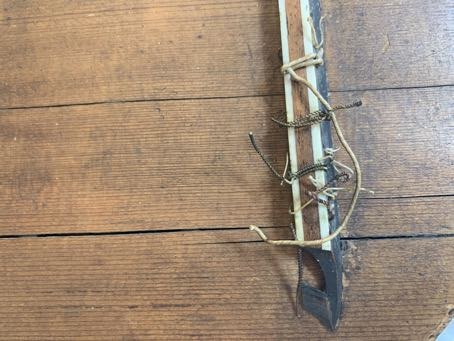
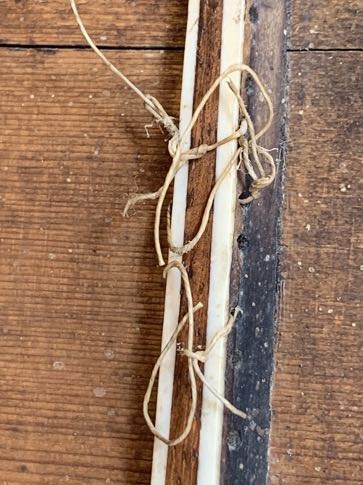
If this analysis were carried out, we might have the happy surprise of finding ourselves facing the only surviving original lute treble, perhaps one of the famous Minikins so often mentioned over three centuries (1520–1740).
As for the demifilée strings, however, we remain in complete mystery.
There are many considerations to bear in mind:
- An instrument of this type had already fallen out of use as the eighteenth century approached, and did not use, as far as we now know, covered strings.
- Demifilée strings, and covered lute strings more generally, are never named during the course of the seventeenth century, not even in the most important treatise, that of T. Mace of 1676, which nonetheless discusses the 12-course lute at length.
- The first mention of the use of wound strings is from 1715 and concerns the 11-course D-minor lute in Germany.
- We have made a copy of the 12th-course demifilée string (Fig. 8e), thereby verifying that it has a gut-equivalent diameter of only 0.944 mm (0.95 mm); this is roughly equivalent to a fifth course of a Renaissance-type tuning on a lute of ordinary string length. However one speculates, a string with this gut-equivalent diameter cannot possibly be a 12th-course bass.
Purely as an example (to better understand what range of gut-equivalent diameter we are dealing with for the basses), our calculations adopted a Renaissance tuning, a pitch standard of 440 Hz and an average tension of about 2.2 kg. Under these conditions, the gut-equivalent diameter of the 12th bass is 1.70 mm, not 0.95 mm. (Fig. 11) The sound quality obtained from the replica made is poor: too metallic and dry, almost guitar-like, to the point of having no need for the paired octave.
- The covering metal should be silvered copper (we scraped off a small sample, a couple of millimetres long, which was given to us, and found the underlying colouring typical of metallic copper).36
- The demifilée strings of the 10th and 11th courses are, in fact, the same string.
The conclusion is that we are faced with a series of serious uncertainties of a general nature, both as regards the instrument and as regards the strings.
Demifilée strings are, in fact, entirely lacking in reliability (they are too light), and so too are the plain-gut strings used as paired octaves. Nor, finally, is it clear what kind of tuning this instrument used. The question remains open as to why an instrument built in 1633 should have demifilée strings fitted, typical as they are of the eighteenth century.
I stress once again that certainly the most interesting aspect is the presence of a gut treble of about .33 mm diameter, rather hard when bent and of a faint greenish-grey colour, of the kind described by Dowland, which certainly deserves to be dated.
Mimmo Peruffo
© Aquila Corde Armoniche srl. All rights reserved. To request permission to reproduce this work, write to aquila@aquilacorde.com or see the terms of use for content.
References
- This article follows the paper Mimmo Peruffo gave in Linköping on 16 September 2023 for the conference The Raphael Mëst Lute – A Musical Gem. Some of the topics discussed here can also be explored further in Mimmo Peruffo, “Il mistero delle corde basse per liuto”, Il Liuto, no. 19, November 2019. (Editor’s note)
- Ole Vang and Eph Segerman, “Two-headed lute news”, FOMRHI Quarterly, no. 13, comm. 156, 1978.
- Ephraim Segerman, “The size of the English 12-course lute”, FOMRHI Quarterly, no. 92, comm. 1592, 1998.
- Kenneth Sparr, http://www.tabulatura.com/Mestweb.htm.
- See for example: Sébastien de Brossard, [Fragments d’une méthode de violon], manuscript, ca. 1712, Paris, Bibliothèque Nationale, Rés. Vm8 c.i, fol. 12r; Jean-Benjamin de La Borde, Essai sur la musique ancienne et moderne, Eugène Onfroy, Paris, 1780, book two ‘Des instruments’, entry Violon, pp. 358–9.
- Robert Dowland, Varietie of lute-lessons […], Thomas Adams, London, 1610; the paragraph Of setting the right sizes of strings upon the lute contains the text titled Other necessary observations belonging to the lute, written by John Dowland.
- Wellesley (Mass.), Wellesley College Library, The Burwell lute tutor, manuscript ca. 1670; facsimile reprinted with an introduction by Robert Spencer, Boethius Press, Leeds, 1973, chapter 4, Of the strings of the lute […].
- Thomas Mace, Musik’s monument […], T.M. & John Carr, London, 1676, pp. 65–6.
- John Playford, An introduction to the skill of music […]. The fourth edition much enlarged, William Godbid for John Playford, London, 1664.
- Burwell, cit., “The good stringes are made at Rome or about Rome and none that are good are made in any other place except the great strings and octaves that are made in Lyons att Fraunce and noe where else”.
- Patrizio Barbieri, “Roman and Neapolitan Gut Strings 1550–1950”, The Galpin Society Journal, 2006, pp. 176–7.
- Philip Skippon, A journey thro’ part of the Low-Countries, German, Italy and France, A. & J. Churchill, A collection of voyages and travels, London, 1732, pp. 532–533; quoted in Jan Woodfield, “String-Making in 17th-Century Padua: An English Traveller’s Description”, The Galpin Society Journal, Vol. 41, 1988, pp. 109–112.
- Djilda Abbot and Ephraim Segerman, “Catline strings”, F.O.M.R.H.I. Bulletin, no. 12, comm. 138, November 1978.
- Ephraim Segerman, “More on the name Catline”, F.O.M.R.H.I. Bulletin, no. 76, comm. 1289, July 1994; Frank Eyler, “The modern Venice Catlines reconsidered”, Lute Society of America Bulletin, August 1986.
- Diego Pisador, Libro de Musica de Vihuela, Salamanca, 1552.
- Juan Bermudo, El libro llamado declaracion de instrumentos musicales, Ossuna, 1555; modern ed. by M. S. Kastner, in “Documenta Musicologica” XI, Kassel, 1957.
- See: Ephraim Segerman, “On historical string tensions on lutes”, F.O.M.R.H.I. Bulletin, no. 75, comm. 1255, April 1994, p. 42; Mimmo Peruffo, “Il mistero delle corde basse per liuto”, Il Liuto, no. 19, 2019.
- Johannes de Tinctoris, De Inventione et Usu Musicae, ca. 1487; Sebastian Virdung, Musica getutscht, Basel, 1511; Vincenzo Galilei, Fronimo, Florence, 1584.
- The author’s own translation from the Latin.
- The author’s own translation.
- Burwell, cit., “[…] the confusion that the length of sound produce it alsoe […] every basse sound make a confond with every string”; “the lutemasters have taken away that great string because the sound of it is too big and smothis the sound of the others”.
- Mace, Musik’s Monument, Chap. XLII, p. 208: “This incovenience is found upon French Lutes, when their heads are made too long; as some desire to have them […]”.
- Barbieri, Roman and Neapolitan Gut Strings, cit., pp. 176–177; Ugolino da Orvieto, Declaratio musicae disciplinae, Liber quintus, Capitulum IX: De cordarum seu nervorum instrumentalium subtilitate et grossitie, ca. 1430–40.
- Samuel Hartlib, Ephemerides, manuscript (current location unknown to the author), ca. 1659. The passages quoted were communicated privately to Peruffo by Robert Spencer (13 October 1995), who suggests they derive from the chemist Robert Boyle: “Goretsky hath an invention of lute strings covered with silver wyer, or strings which make a most admirable musick. Mr Boyle. […] String of guts done about with silver wyer makes a very sweet musick, being of Goretskys invention”. Hartlib’s papers are available online at https://www.dhi.ac.uk/hartlib/.
- Playford, An introduction, cit.
- Brossard, Fragments, cit.
- De La Borde, Essai, cit.
- Jean Baptiste Forqueray’s letter to Prince Friederich Wilhelm, of 1768, regarding the strings of the bass viol, says: “[…] the fourth string, which is C, must be covered halfway with a very fine covering, and the others fully with the same covering, which will never be doubled”.
- François Le Coq, Recueil des pieces de guitarre composees par Mr. Francois Le Cocq, Brussels, Bibliothèque du Conservatoire Royal de Musique, Ms. Littera S, no. 5615, 1729, chapter Des chordes: “Se charge les deux octaves que la […] ou quatriesme et cinquiesme rang d’un fin filet de laiton ou d’argent, ce dernier en vant mieux […] ne les charge qu’à demi: c’est à dire qu’il reste un espace vide à le corde, de la grosseur du dit filet ou même un peu plus…”.
- Hartlib, Ephemerides, 1659, cit.; Playford, An introduction, 1664, cit.; but also Claude Perrault, Œuvres de physique […], Amsterdam, 1727 (1st ed. 1680), “Invention nouvelle pour augmenter le son des cordes”, pp. 214–5; Daniel Speer, Grund-richtiger, kurz, leicht, und nöthiger jetzt wolvermehrter Unterricht der musicalischen Kunst, Ulm, 1687, 2nd ed. 1697.
- Georg Friedrich Wolf, Kurzgefaßtes Musikalisches Lexikon, Leipzig, 1715.
- Johann Georg Krünitz, Oeconomische Encyclopädie oder Allgemeines System der Land-, Haus …, Volume 66, Berlin, ed. Joachim Pauli, 1795, held at the Universiteitsbibliotheek Ghent, p. 380.
- Juan Guerrero, Methode pour aprendrè a joiler de la Guitarra, Paris/Madrid, 1760.
- Tsukamoto et al., “ESR and Radiocarbon Dating of Gut strings from Early Plucked Instruments”, mdpi.com/2409-9279/3/1/13.
- Athanasius Kircher, Musurgia universalis […], Rome, 1650.
- In making the copy, due account was taken of the fact that the measurements made on the original string fragment (gut core and metal wire) also had to allow for the fact that both the gut core and the covering wire had undergone a stretching process during manufacture.