Summary
Published in the magazine Orfeo in June 1997, this essay by Mimmo Peruffo reconstructs the technological history of gut strings from the Middle Ages to the eighteenth century, identifying four manufacturing “ages” marked by successive technological leaps: the empirical, home-based production of the late Middle Ages; the emergence, from the second half of the fifteenth century, of the professional stringmaker and of spinning techniques borrowed from silk; the loading of gut with metal salts which, between the sixteenth and seventeenth centuries, allowed thinner, more sonorous basses in the age of Monteverdi; and finally, from the second half of the seventeenth century, the invention of the metal-wound string on a gut core, which revolutionised instrument-making and made possible the modern cello and the string quartet. Peruffo ties each technological leap to a precise physical principle — the breaking frequency of gut, the inverse proportionality between diameter and frequency, increased specific weight as a way of reducing string thickness at equal tension — and closes by discussing the philological problem of using modern wound strings to perform Renaissance and Baroque repertoire, arguing for the adoption of the old luthiers’ own design criteria rather than ours.
Key takeaways
- The history of gut strings unfolds across four technological “ages”, each defined by a manufacturing leap rather than by slow, gradual refinement.
- First age (up to the mid-15th century): empirical, home-based production, with musicians making their own strings from “do-it-yourself” recipe books.
- Second age (from the second half of the 15th century): the professional stringmaker emerges, bringing twisting techniques — possibly borrowed from silk spinning — to a first degree of refinement.
- Third age (16th–17th centuries, the age of Monteverdi): bass strings are loaded with metal salts, recognisable in period iconography by their deep red or brown colour rather than gut’s natural yellow.
- Fourth age (from the second half of the 17th century): the invention of the metal-wound string on a gut core revolutionises instrument-making, enabling the modern cello, the string quartet, and the end of the distinction between instruments “of ornament” and “of foundation”.
- Peruffo ties each phase to a precise physical principle (breaking frequency, inverse diameter/frequency proportionality, specific weight) and closes by discussing the philological paradox of modern wound strings in early repertoire.
by Mimmo Peruffo — published in Orfeo, June 1997.
Introduction
The fable of the ugly duckling fits magnificently what today are considered the accessories par excellence of a musical instrument: strings.
But in the field of early music the ugly duckling has rapidly turned into a swan, upsetting profoundly every commonplace: this is what emerges after years of research.
The string, far from being the “stone rejected by the builder”, has in fact always played the role of the “cornerstone of the temple”, just as the brick undoubtedly represents the starting point for any architect.
Old luthiers, in fact, designed musical instruments —be they lutes, viols or violins— starting precisely from the mechanical and acoustic properties of the strings available to them.
With the rediscovery of early musical repertoires performed according to “philological” criteria, the problem of what kind of strings to use on copies of musical instruments began to make itself dramatically felt, on account of the serious acoustic problems that arose in the bass registers with gut strings made according to today’s criteria. It consequently became unavoidable to use strings of modern conception, so as to work around an otherwise insoluble problem — but this in turn created a curious paradox: the use of modern strings to perform musical repertoires realised according to strictly philological criteria!
Starting from this stalemate, it did not take long to realise that Renaissance and Baroque gut strings had to be hiding more than one mystery — mysteries that have only recently begun to be unravelled, finally allowing us to recreate the lost sounds, the sounds of the age of Monteverdi, Bach and Mozart.
The four ages of gut
The use of gut for musical purposes is certainly lost in the mists of time: traces of gut strings have in fact been found even on some Egyptian instruments dating back to the fourteenth and fifteenth centuries BC.
It was only over the course of the centuries that this manufacturing perfection was gradually achieved, culminating towards the second half of the seventeenth century in the appearance of wound bass strings — strings made of a gut core entirely covered by a thin metal wire, which have been habitually used by musicians ever since (structural improvements aside). The evolution undergone by strings over time represents without doubt a rather singular case. As with the growth stages typical of a human being, it has been possible to identify, within the centuries-long process of refinement of their manufacturing techniques, four evolutionary “ages”, each marked by a corresponding period of stability in the morphology of musical instruments.
In each of these phases it has been possible to identify, with a fair degree of clarity, the basic manufacturing procedures that led to the making of strings. By virtue of the procedures followed, the finished material was necessarily characterised by precise acoustic and mechanical properties — elements that were the starting point for the design of musical instruments.
Given the string, the instrument was then sized “around” it: this was the golden rule of the sixteenth and seventeenth centuries. Consequently, for the ancients the string did not embody the role of an accessory, but rather that of the “cornerstone of the temple” — the pivotal element that had the first and the last word in fixing the basic constructional parameters and the acoustic limits of every musical instrument.
This idea is not at all surprising if compared with an example more familiar to us: was it not “around” the natural detonating properties of petrol that the internal-combustion engine was conceived and perfected? No one, indeed, would ever dream of designing a new type of engine and only at the end of its construction going looking for the most suitable fuel!
Exactly like a liquid which, poured into a container, immediately occupies the greatest available surface, so the peculiar constructional characteristic of Renaissance and Baroque plucked and bowed instruments consisted in exploiting to the fullest possible “extension” (that is, both towards the treble and towards the bass) the mechanical and acoustic properties offered by the strings available to them.
Whenever the instrument’s morphology underwent rapid, widespread change (such as the progressive increase in the number of bass strings, or variations in string lengths), it was generally found to be the case that someone had, by means of some new manufacturing device, improved musical strings, and that this novelty had been immediately taken up by luthiers and musicians.
During the sixteenth century and much of the seventeenth, the universal rule for tuning a plucked or bowed instrument to play solo music (in which, that is, it was of no importance whatsoever that the instrument be set at a precise pitch) was exclusively to stretch the first string to the highest pitch it would bear, stopping just short of its breaking point.
Then as now, strings were certainly not given away for free, and so the question naturally arises as to the reason for this apparently illogical and risky behaviour.
Scholars have thus been able to ascertain that only with this system could the greatest reduction in string thickness be obtained — particularly for the bass strings (which were likewise of plain gut, and therefore rather thick) — so as to obtain from them the best possible acoustic performance, because, at equal pitch, made thinner they were consequently endowed with greater elasticity. In practice, use was made of the fact that vibrating frequency and diameter are inversely proportional to one another.
The heavy burden weighing on the luthiers and musicians of the time (ignored today, since strings of modern conception have reached such a degree of perfection that everything is reduced practically to a choice of desired brand) consisted, in fact, in the fact that as the diameter of a musical string increased — as it had to, in order to cover the lower frequencies — its stiffness grew apace (indeed much more rapidly), degrading performance until, beyond certain dimensions, the string became practically mute. Only the rule of “the first string tuned to the highest pitch it will bear” allowed musicians to keep this problem in check as best they could, letting musical instruments sound decently across their whole frequency range.
But how was this problem solved on instruments that, by contrast, required a precise pitch (as in ensemble music, especially when performed with instruments whose pitch could be only slightly adjusted or not adjusted at all — wind instruments or keyboards, for example)?
In truth, nothing changed: in this case it was the luthiers, during construction, who observed the rule described above, seeking the greatest possible vibrating length for the strings (the bridge-to-nut distance) that the tensile-strength limit of gut would allow for the highest string.
When the instrument was then tuned, this string worked, in fact, close to breaking point, with the benefits already described in terms of reducing the bass strings’ diameter and hence the instrument’s overall acoustic performance.
The number of strings present on a plucked or bowed instrument of the time — or rather, the frequency range between the first string and the lowest bass played open (that is, without stopping them on the fingerboard) — could in some way indicate the level of manufacturing skill reached by the stringmakers of the day.
There were two limits: the one set by the highest pitch practicable on the first string, owing to the need not to exceed its breaking tension, and the one linked to the dynamic characteristics obtainable from the lowest string — characteristics deemed acceptable by the taste of the time, and related to its diameter.
The true frontier of the technological developments that occurred in stringmaking during the Renaissance and Baroque thus concerned not the limit towards the treble (the ancients had long since realised that the maximum “acuteness” attainable from a gut string did not depend decisively on the manufacturing process used, but rather on the mechanical properties possessed by the material in its natural state), but the limit towards the bass — that is, the bass strings, fertile ground for every new idea that might in some way increase their acoustic efficiency, in other words reduce their thickness at equal tension and working frequency.
The first age
The “first age” of musical strings is lost in the mists of time, and has been identified with that long process of empirical selection of natural raw materials capable of possessing a certain degree of tensile strength and a certain spontaneous predisposition to produce sound once twisted together.
Thus, among the various materials available to man — roots, horsehair, etc. — two in particular were identified: silk and animal gut. The latter, owing to its ready availability, prevailed over silk in Christian Europe and in the civilisations of the Mediterranean basin. More or less at the same time there followed the identification and progressive refinement of the most suitable manufacturing system — the one essentially indicated by the numerous “do-it-yourself” recipe books of the Middle Ages (until the mid-fifteenth century musicians made their own strings): a process surprisingly similar to today’s, consisting of gathering together a variable number of gut strands (depending on the diameter of string to be obtained), previously carefully degreased by means of “lye”, and then twisted by means of a small wheel. The strings were then dried on a purpose-built frame, after which they were polished by means of abrasive plants.
The finished product, owing to the fact that manufacture was not yet a professional trade, must therefore have shown rather wide variability in quality.
The second evolutionary stage
The second evolutionary stage can certainly be placed between the second half of the fifteenth century and the middle of the following century. This seems to coincide with the emergence of the figure of the stringmaker, who perfected and rationalised the manufacturing techniques already in use, bringing gut strings to the highest levels of quality. Telling in this respect is the almost total disappearance, from the recipe books of the time, of instructions for making one’s own strings — recipes that had been fairly widespread throughout the Middle Ages; it is thought that a strict keeping of workshop secrets now prevailed.
Throughout the sixteenth century, the cities most renowned for string production were also important centres for the dyeing and spinning of silk and cotton. We cannot rule out the possibility that stringmakers acquired the more complex silk-spinning techniques, thereby allowing a first important reduction in the stiffness of the thicker strings used in the bass registers of instruments.
In other words, these strings became even more elastic, allowing a first profound change in morphology: the lute, for example, was already able, towards the second half of the fifteenth century, to expand decisively towards the bass, acquiring a sixth double string (the so-called “course”) in addition to the fifth it already possessed, and the same happened with bowed viols.
Towards the second half of the sixteenth century
Towards the second half of the sixteenth century there was a further, imposing “leap in quality” on the part of musical instruments: to the six-course lute a seventh, lower course was added, tuned from the outset as much as a fourth — sometimes a fifth — below the sixth. On bowed instruments, by contrast, a certain contraction of vibrating lengths has been ascertained, at equal pitch of course, compared with those previously in use.
Only recently have our studies been able to show that the reason for these sudden changes can be traced to the application of a revolutionary idea: increasing the specific weight of the gut used to make bass strings by means of suitable loading treatments with metal salts. In seventeenth-century musical iconography, indeed, it is not uncommon to observe that bass strings appear in colourings entirely different from the yellow typical of natural gut, in favour of deep red through to brown. This novelty allowed the production of much thinner basses, therefore less stiff and consequently considerably more sonorous than those in use until then (no gut string that had not been loaded could have guaranteed satisfactory acoustic performance in the new basses added to lutes).
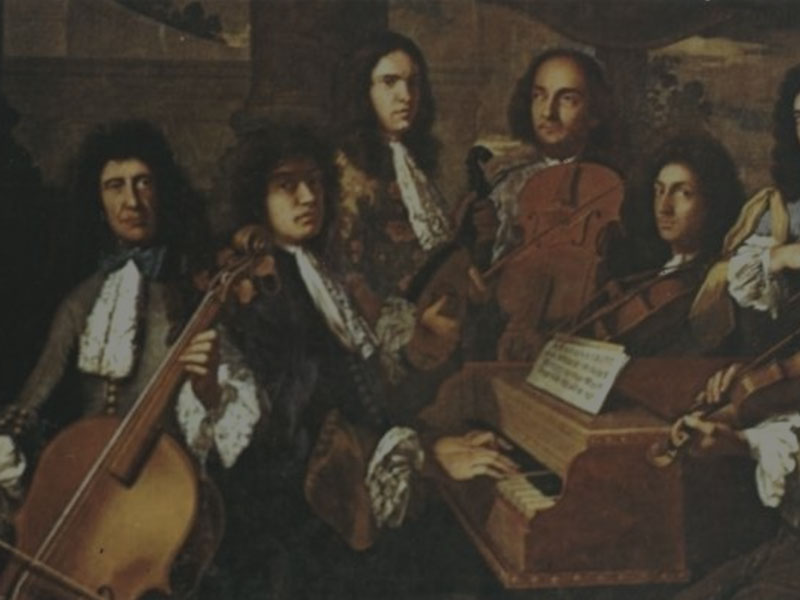
This third evolutionary phase, which characterised the age of Monteverdi, Stradella and Purcell, was precisely the one in which the overall manufacturing complexity of gut strings reached heights that were never subsequently surpassed.
The last evolutionary phase
The last evolutionary phase of musical strings is now at the door: someone (according to the most recent documents, in England a little after the middle of the seventeenth century) had the idea of loading an ordinary gut string by covering it with a thin metal wire: the acoustic result, in the bass, was absolutely extraordinary.
The spread of these new, more efficient basses was not, however, as rapid as one might imagine: the viol player Sainte Colombe, for example, only introduced them in France around 1675. In Italy, a country that had always produced renowned musical strings, they would paradoxically be discussed even later: the earliest known pictorial depictions of a cello and of a violin showing the fourth, lowest string wound with silver date respectively to 1681 and 1685.
The influence of this new discovery on instrument-making and on music was, needless to say, enormous — so much so that one can certainly speak of a genuine “dividing wall” between before and after: once again, it was the string that dictated the law.
Only now, in fact, could one have instruments with basses that were genuinely agile and sonorous, which would later pave the way for new musical forms such as the string quartet, and for musicians of the calibre of a Vivaldi or a Bach. The cello would thus develop, the legitimate offspring of this new invention, with a body length considerably smaller than the cumbersome Bass Violin, which remained in practical use only a little beyond the end of the seventeenth century.
Indeed, with the appearance of wound strings it was no longer necessary to build “oversized” instruments in order to safeguard the acoustic response of their basses: the age-old rule was thus definitively broken, and rapidly forgotten by new generations of musicians and luthiers down to our own day. Bowed musical instruments immediately gained in playing agility across all their strings, finally freeing the larger ones from the centuries-old function of playing elementary bass lines, in favour of a more concertante role — of equal dignity, in short, with the other instruments.
Thus ended forever the distinction (and, in certain respects, the discrimination) between musical instruments “of ornament and of foundation”, typical of the Renaissance and the Baroque.
As wound strings became established (and as a consequence of strong commercial demand), the ancient and secret techniques for constructing traditional plain-gut basses were rapidly forgotten by new generations of stringmakers: a thin metal wire around a core of stiffer gut was enough to obtain an extraordinarily sonorous bass string. The seventeenth century, the golden age of gut, was over forever.
Historically informed performance?
The implications arising from the study of the types of strings used in the past have proved to be of vital importance, but also of dramatic impact, for musicians and luthiers concerned with the faithful reconstruction of instruments and musical repertoires from a historical period stretching roughly from the late Middle Ages to the age of Frederick the Great — although, as far as strings are concerned, this chronological boundary can be pushed as far as the end of the nineteenth century.
It has only recently become apparent, in fact, that the criteria used to reconstruct historical instruments — viols, for example — by ignoring, in most cases, the importance of referring, at the design stage, to the constructional proportions suggested by the physical and acoustic characteristics of the strings later to be fitted (as was rigorously observed throughout the sixteenth century and much of the seventeenth) produce instruments that may be excellent from an aesthetic point of view, but are often very poor in the bass when strung entirely in plain gut according to the practice of the historical period in question. Hence the usual justification: that the sonorities of those times were exactly those we manage to reproduce today, on account of the imperfect strings then available.
It is not at all surprising that a good many musicians performing these repertoires readily accept the use, on their sixteenth- or seventeenth-century copies of lutes or viols (or even on instruments intended for medieval repertoires, such as vielles or rebecs), of wound bass strings which, historically speaking, only began to come into widespread use at the start of the eighteenth century. Such strings are, moreover, characterised by a particularly bright and sustained acoustic response, profoundly different, that is, from that typical of plain gut: a genuine philological paradox!
The truth is that it is not possible to step rigorously into the shoes of the luthiers of the time —deliberately foregoing the perfection of modern strings— without also inheriting their very same problems, which can be solved only —and I believe this to be fairly logical— by adopting their design criteria, certainly not ours.
It consequently seems correct —if the premises being proclaimed are those of strict adherence to criteria of authenticity— to string copies of musical instruments respecting, as far as possible, the type of string characteristic of the evolutionary stage under consideration. This, within certain limits, is today perfectly possible.
In Italy, for instance, it has recently been possible to make plain-gut bass strings of increased weight —just as was fashionable in the seventeenth century— allowing, for the first time, all-gut stringing of genuine acoustic effectiveness, used in the recordings of late-Renaissance and Baroque repertoire partly proposed here.
In this way it has been possible, without great difficulty, to make the strings used in the Middle Ages (the recipe books of the time are, fortunately for us, fairly precise) and even the wound bass strings used in the time of Bach, Mozart and Beethoven. One wonders, however, once again, what sense this research work makes if the sizing criteria for copies of historical instruments are not also reconsidered accordingly (quite apart from the cultural value that is in any case acknowledged for this kind of investigation). On this point, some tests we carried out with viols strung entirely in gut have fully confirmed just what magnificent acoustic results can be obtained from these instruments by adhering strictly, in their constructional proportions, to the criteria dictated by the strings. Following this path, we thus managed to solve a genuine conundrum: making a viola bastarda (an instrument in vogue towards the late sixteenth century and a little beyond) play with virtuoso agility across its whole range, not through the use of modern wound bass strings, but with stringing entirely of natural gut.
In the end, a three-way working relationship is indispensable: Stringmaker, Luthier and Musician.
As for the general quality of the gut strings available today (unlike in the past, few people today are able to tell a very good string from a lesser one by sight and touch alone), the choice of gauges and working tensions according to criteria of supposed philological correctness has, unfortunately, in most of the cases observed, turned out to be too far from the “real thing”, as clearly emerges from comparison with the abundant documentation of the period now available — in a sort of game of playing at “Renaissance”, “Baroque” and “Classical period” that is often of a purely virtual nature rather than pertaining to reality, as the cellist and composer Claudio Ronco — among the first in Italy to study gut stringing for bowed instruments between the eighteenth and nineteenth centuries — rightly pointed out.
One example among all should suffice: the practice — unfortunately fairly widespread among musicians (essentially inherited from the north-European school, but also upheld by certain important makers of musical strings) — of holding that, in order to perform Baroque repertoire according to criteria of authenticity, one should seek out strings ensuring rather low tensions, so as to obtain a delicate, slightly nasal sonority, to be set, in short, against that of the Romantic period. A fairly extensive discography seems to have somehow persuaded a good many lovers of Baroque music that this was the “typical” sonority of the time (if it even makes sense to speak of a typical sonority).
But the truth that emerges abundantly from the very numerous written accounts — including of a technological character (stringmaking techniques) — dating for example to the eighteenth century (to cite just one historical period) is decidedly a different one.
Principally, that concerning the violin — the type of strings and stringing used then, and what the eighteenth-century virtuosos such as Locatelli and Tartini were able to draw from this wonderful instrument. But much more could be added about the cello, the viola, viols, the double bass, and finally lutes.
What ultimately emerges from the original sources traces, without mincing words, a path quite different from the commonplaces — often never verified at first hand: any violinist, violist or cellist of the Age of Enlightenment and beyond (so, without necessarily invoking Romberg, Tartini or Leopold Mozart) certainly had strings different from ours —for example, much less stiff— sought gauges much thicker than ours (hence higher working tensions; so much for a nasal, delicate sound!), and finally arranged these gauges so that the same tactile sensation of stiffness was found across all the strings of his instrument.
Now, not one of these three cardinal criteria of the sixteenth through nineteenth centuries is followed —or even simply known— by most performers of Renaissance and Baroque music, bowed-string players foremost among them!
By contrast, the string setups now traditionally employed on “Baroque” bowed instruments would appear to have been perfectly unknown to musicians of the seventeenth, eighteenth and nineteenth centuries: a virtual Baroque, then?
On the other hand, the time has also come to seriously question the use of steel top strings in modern stringing of bowed instruments (especially where readapted historical instruments are concerned), given that it has recently been demonstrated, at the Institute of Plant Physiology in Lausanne, that the ultrasound produced by steel strings —but not by gut— exerts a strongly destructive action on the cellular structure of wood. Ultrasound, let it be recalled, is used in medicine to pulverise gallstones and kidney stones: one wonders with some apprehension how many instruments of our historical heritage may perhaps have met this same fate.
Taking up “in toto” the stringing criteria of the past is not, however, in any way possible without radically intervening on certain parts of the instrument, such as the neck angle, the string height above the fingerboard, the bass bar, the bridge and finally the soundpost. The bow, too, is an absolutely fundamental question (the research being carried out by the violinist Mario Ferraris and the Cremonese luthier Eduardo Gorr is keeping pace with this); not to mention the rosin to be used on the hair: recent experiments we have carried out with eighteenth-century bow-rosin recipes —now fallen into oblivion— have held more than one pleasant surprise.
At this point even someone with no musical training will have fully grasped what profound changes would be brought about in the aesthetics and dynamics of the resulting sound.
The real challenge of trying to best recover the authenticity of these sounds will in any case be played out “beyond the wall”, that is, with the repertoires and instruments typical of the sixteenth and seventeenth centuries. In those days liberties were taken that are inconceivable to us today —such as freely moving a bowed instrument’s bridge lower than the position now considered canonical and inviolable, the centre of the “f”-holes— whenever this was thought necessary. To complicate matters a little further, it should be remembered that wound basses did not yet exist, making everything far more difficult for us, children of gut’s “fourth age”.
But that is another story.
About the author
Mimmo Peruffo, a scholar from Vicenza, has devoted himself to the study and reconstruction of the gut strings used in the Renaissance, Baroque and Classical periods. One practical fruit of this work has been the creation of Aquila Corde Armoniche, based in Vicenza, an Italian firm producing musical gut strings reconstructed rigorously according to historical criteria.
Worth noting too is the production of synthetic-material strings for the classical guitar and the lute.
His contributions on this subject have appeared in the Oxford “F.O.M.R.H.I. Quarterly”, the “Bollettino della Società Italiana del Liuto”, “The Lute Society of America Bulletin”, “Quattrocentoquindici” and “Il Fronimo”. He curated the section on gut strings for the new catalogue of musical instruments of the Germanisches Nationalmuseum in Nuremberg, and for the volume of the recent Bergamo exhibition “Evaristo Baschenis e la natura morta in Europa”. He also carried out, for the first time, careful surveys of the surviving fragments of gut strings dating from the first half of the eighteenth century held at the Museo Stradivariano in Cremona.
Mimmo Peruffo
© Aquila Corde Armoniche srl. All rights reserved. To request permission to reproduce this work, write to aquila@aquilacorde.com or see the terms of use for content.
Suggested discography
The discography suggested here offers examples of musical performances given on instruments that faithfully reflect recent discoveries in the field of strings. Particularly fine are the lute recordings by Jakob Lindberg and Paul Beier, and, among all of them, that by Claudio Ronco, Julie Mondor, Andrea Coen and Lone Loell (Handel, Barrière and Lanzetti), distinguished by the fact that the cellos used in the recording (original eighteenth-century instruments) are strung exactly according to the stringing suggested by Romberg (the great cellist of Beethoven’s time) in his cello methods.
- “Suso in Italia bella”, Musique dans les cours et cloîtres de l’Italie du Nord. La Reverdie; Arcana/Westdeutscher Rundfunk (WDR) Köln co-production; CD A 38, M7/875, 1995, made in France.
- “Amando e Desiando”, Spanish and Italian music from the 16th century. Akantus, 1993, Alice Musik Produktion, Stockholm. Lena Susanne Norin, voice; Peter Söderberg, lute and vihuela; Leif Henriksson, viola da gamba.
- “La Serenissima II”, Lute music in Venice 1550–1600. Jakob Lindberg, 1993; CD-599, Stereo, BIS Digital.
- “The Complete Solo Lute Music”, John Dowland. Jakob Lindberg, 1995. BIS 722/724, Stereo, made in Austria.
- “Style brisé”, Gaultier & the French Lute School. Toyohiko Satoh. Channel Classics CCS 8795, 1995.
- “J. S. Bach”, Lute Music. Jakob Lindberg, 1994 (2 CDs), BIS CD-587/588.
- “Adam Falckenhagen, Sylvius Leopold Weiss”: works for lute. Paul Beier, 1994. Stradivarius, Digital Studio Dulcimer, STR 33448.
- “Gade–Heise”, trios for piano and strings. Brenno Ambrosini, Luigi Mangiocavallo, Claudio Ronco. Symphonia Digital SY95137, 1995.
- “Rolla–Paganini”, concertante duets for violin and cello. Luigi Mangiocavallo, Claudio Ronco. Symphonia Digital SY96136, 1995.
- “Handel, Barrière, Lanzetti”, for voice and cello, cantatas and sonatas. Lone Loell, voice; Claudio Ronco, Julie Mondor, cellos; Andrea Coen, organ and harpsichord. P 1996 Claudio Ronco, C.R.G.C. 01/A-B.