Summary
Four-part essay by Mimmo Peruffo, published in Il Fronimo nos. 117–120 (January, April, July and October 2002), reconstructing the history of guitar strings from the Renaissance to the advent of nylon in 1947. The author identifies four "ages" of gut strings, describes Italian manufacture between the mid-18th and the late 19th century, maps the production centres (Rome, Naples, Padua, Salle, Markneukirchen, Saxony) and reconstructs the historical selection criteria, based on an equal tactile sensation of stiffness rather than on equal weight in kilograms. The documentary core lies in the gauges: the Stradivari templates for the Chitarra Tiorbata, the table of 18th–19th-century violin diameters, the Paganini relics at Palazzo Rosso, the strings found in an 1845 Panormo case, Pujol's gauges and the Pirastro/Hauser/Frignani samples of the early 20th century. Part four reconstructs the invention of nylon strings (Segovia, Albert Augustine and Du Pont, 1947) and measures their acoustic consequences, closing with a critique of the strongly scaled "strange profile" of today's commercial sets, alien to historical practice.
Key takeaways
- The four ages of gut: empirical selection (Middle Ages), stringmakers' professionalisation (15th–16th c.), bass loading with heavy metals (16th–17th c.), wound strings (from 1659).
- From the Renaissance to the mid-19th century the word "tension" in the treatises means a tactile sensation of stiffness, not a value in kilograms: this misunderstanding has vitiated the modern reconstruction of historical stringing.
- Historical centres: Rome (17th c., about twenty workshops in 1735), Naples (19th c., with the Abruzzese stringmakers of Salle), Padua (Romanin workshop, 1613–1911), Markneukirchen and Saxony around 1900.
- The three treble strings of the 19th-century guitar match the gauges of the contemporary violin: E 0.66–0.73 mm, B 0.85–0.91 mm, G 1.10–1.25 mm, for an average tension of about 7.8 kg per string.
- The Paganini relics at Palazzo Rosso (early decades of the 19th c.): E 0.70–0.72 mm (medium twist), A 0.87–0.89 mm and D 1.15–1.16 mm (high twist), consistent with Ruffini of Naples's commercial gauges and with Riccati's measurements.
- Five-course guitar (18th c.): first course from a single gut (c. 0.42 mm), second from two guts (c. 0.57 mm), third equal to a "thick" violin first string, three guts (c. 0.73 mm); fourth and fifth courses wound on gut or silk.
- The open-wound (demi-filée) basses described by Le Cocq in 1729 are not "transition strings" but a technological answer to the limits of period wire drawing.
- The invention of nylon strings (1947): Andrés Segovia, Albert Augustine and Du Pont, after gut was requisitioned in wartime for surgical suture.
- Historical stringing was close to equal tension; modern sets instead show a strongly scaled profile (first string up to 10.5 kg, third string 5.9–6.5 kg), a consequence of nylon's low density in the trebles and of the heavy metal winding in the basses.
Guitar strings from the 18th century to the advent of nylon
Types, manufacturing techniques and selection criteria
by Mimmo Peruffo — published in Il Fronimo, nos. 117–120, January–October 2002 (Ed. Il Dialogo, Milan)
"Las cualidades sonoras del mejor instrumento desmerecen si está provisto de cuerdas mediocres." — Emilio Pujol, Escuela razonada de la guitarra, Buenos Aires 1934.
Introduction
In matters of strings and the criteria for choosing a guitar's stringing over the course of the 18th, 19th and part of the 20th century, the study of recently recovered historical material has proved rather surprising, perhaps because very little in this field has been investigated so far. There is also a still deeply rooted opinion that everything belonging to the instrument's past can somehow be reduced to a series of intermediate steps in that long evolutionary process leading to the so-called final "goal": the arrival of the "Torres" guitar (and its variants), the use of right-hand nails, and the abandonment of the primordial gut strings in favour of synthetic materials.
There is also a widespread idea — borrowed perhaps from bowed instruments readapted for playing baroque music — that the 19th-century guitar, and that of part of the following century, was strung much more lightly than today's standards. Since we are dealing specifically with gut strings, it is even more deeply rooted an opinion that their overall acoustic performance must somehow have been inferior to that of nylon or PVDF (polyvinylidene fluoride) strings, the so-called "carbon" strings, even though very few of those who hold this view have ever tried a single gut string on their own guitar.
What has in fact begun to emerge from the examination of the recovered documentation — suitably supplemented by a degree of practical experimentation — points forcibly towards substantially different realities.
This contribution therefore seems necessary, not only because the ranks of those rediscovering the pleasure of playing certain repertoires on period instruments or copies of them keep growing, but because, more simply, it is a duty in itself for the recovery of the history (not only the musical history) of our instrument and, not least, for being able to listen with still greater awareness to guitar recordings made before the 1950s, an era in which gut and silk reigned undisturbed.
Thus, if the philological reconstruction of early musical repertoires and the recovery of the instruments related to them cannot possibly do without a thorough, comparative investigation of the various elements available, then the string, as the very essence generating the sound, certainly represents its cardinal starting point; it is in fact — as numerous studies have by now demonstrated — no longer "the stone rejected by the builder" (a mere accessory, in other words) but "the cornerstone of the temple". An instrument without strings — be it a Stradivari or a Torres — has no musical life of its own, other than that produced by simply striking it.
In our treatment we have deliberately avoided metal strings, which, in the guitar world, began to gain ground from the second half of the 19th century as a consequence of the appearance of "piano steel" (around 1840), a material of extremely high tensile strength compared with the iron previously used (together with brass and bronze) in keyboard and plucked instruments (the mandolin, for instance) but not on the six-string guitar. In the guitar world — especially the "art" guitar — there were, in fact, very few exceptions to gut; these were essentially confined to the popular chitarra battente or to individual choices such as that of Agustín Barrios, who in 1944 himself described his own guitar, in no uncertain terms, as "a wire fence" — a choice perhaps dictated, besides purely aesthetic reasons, by the absence in South America of any independent production of gut strings and by the hot, humid climate of Paraguay, ill-suited to their durability. Segovia vehemently opposed this choice.
Part one — The four ages of gut strings
Gut is a millennia-old material: gut strings have been found, for example, in ancient Egyptian plucked instruments dating from the Third Dynasty. Over the centuries a process of refinement took place in the techniques needed to produce a good string, but only towards the second half of the 17th century did this long evolutionary arc lead to the revolutionary discovery and spread of wound bass strings, made of a gut core completely covered by a thin metal wire, generally silver but also copper and brass.
Research has allowed the hypothesis to be formed that the manufacturing technology of gut strings developed not so much through slow progression but, rather, through abrupt changes brought about by some technological novelty that then reverberated with surprising speed on contemporary musical instruments, causing the appearance/disappearance of certain classes that had remained in a relatively quiescent state during "transitional" periods. This claim can be effectively verified by examining, for example, the effects caused in certain instruments by the appearance of wound bass strings, directly responsible for the rapid abandonment of the cumbersome violone basses in use until the end of the 17th century — or a little beyond — in favour of the emerging cello. Their appearance also allowed the sixth string to be added to a guitar of limited vibrating length compared with those of the recent past, and this without adverse consequences for acoustic performance. The recurring notion that the strings of the ancients were somehow "primordial", far removed from the supposed perfection of our own, must be dispelled in the most absolute terms.
Research, as has been said, has made it possible to put forward the hypothesis of four characteristic "ages" in the technology of gut-string manufacture. Four can be distinguished:
- Empirical selection (Middle Ages): the "first age" of musical strings is lost in the mists of time and has been identified with that long process of empirical selection of the natural raw materials possessing a certain degree of tensile strength and a certain spontaneous predisposition to produce sound once twisted together, foremost among them silk and gut. The latter, perhaps because it was more readily available, prevailed in the Christian West and in the civilisations of the Mediterranean basin. There followed the identification and progressive refinement of the most suitable manufacturing system, that indicated, in essence, by the numerous "do-it-yourself" recipe books of the Middle Ages: a procedure surprisingly similar to today's. Here, for instance, is an anonymous recipe from the Secretum Philosophorum, 15th century: "Ad faciendum cordas lire… recipe intestina ovium et lava ea munde et pone ea in aqua vel in lexivia per dimidium vel plus usque caro se separet leviter a materia corde que est similis quasi nervo. Post depone carnem de materia cum penna vel cum digito mundo. Post pone materiam in lescivia forti vel rubio vino per 2 dies. Post extrahe et sicca cum panno lineo et iunge 3 vel 4 simul secundum quantitatem quam volueris habere et atturna ea usque sufficiat. Et extende ea super parietem et permitte sicare…". The finished product, given that manufacture was not yet professionalised, must in all probability have been characterised by fairly wide quality variability.
- Stringmakers' professionalisation (second half of the 15th – mid-16th c.): the second evolutionary stage can safely be placed between the second half of the 15th century and the middle of the following century. It seems to coincide with the emergence of the figure of the stringmaker, who perfected and rationalised the manufacturing techniques already in use, bringing the quality of musical strings to the highest mechanical and acoustic levels. Telling in this sense is the near-total disappearance, from the recipe books of the time, of procedures for making one's own strings at home, recipes that had been fairly widespread in the Middle Ages. Throughout the 16th century, the most renowned centres for the production of musical strings were also important centres for the dyeing and spinning of silk and cotton: Barcelona, Munich, Nuremberg and Lyon may serve as examples. We therefore cannot rule out the possibility that the stringmakers of these cities acquired the more complex spinning techniques used for silks, an acquisition that allowed a first significant reduction in the stiffness of the thicker strings used in the low registers of instruments. These basses had, of necessity, to be even more elastic and efficient than usual, if a first change in morphology could be afforded: the lute, for example, was already able, towards the second half of the 15th century, to expand decidedly into the bass by an interval of a fourth, sometimes a fifth, with the addition of a sixth, doubled string (the so-called "course"); the same happened with the bowed viols.
- Bass loading (second half of the 16th c.): the third evolutionary stage can be placed around the second half of the 16th century, when a further, important leap in quality took place among musical instruments: a seventh, lower course was added to the lute (and subsequently several others on the fingerboard), tuned from the outset as much as a fourth, sometimes a fifth, below the sixth. In bowed instruments a certain contraction of vibrating lengths has been credited — at equal pitch, that is — compared with those previously in use. Recent studies tend to show that the reason for these sudden changes should be traced to the application of a revolutionary idea: increasing the weight of the gut used to make bass strings by means of suitable loading treatments with heavy metals. In 17th-century musical iconography it is not uncommon to observe that the strings of these registers — known from the lute treatises of the time to have always and only been of gut — appear with colourings ranging from deep red to brown, entirely different, therefore, from the yellow typical of natural gut: these colourings appear precisely where modern wound basses are used today. The bridge holes for the basses of the (presumed) original bridges of numerous historical lutes preserved in museums are moreover too narrow for what would be required if strings of plain gut were used, unless those strings had been specially loaded. Mathematics indeed demonstrates that only a specific weight double that of natural gut would allow strings able to pass through these narrow holes to reach appropriate working tensions. Such treatment would therefore have allowed the production of strings considerably thinner and more sonorous than those previously in use, while simultaneously guaranteeing correct working tension. This third evolutionary phase, characteristic of the age of Monteverdi and Stradella, was precisely the one in which the overall manufacturing complexity of gut strings probably reached heights that were never subsequently surpassed. The catline mentioned by Dowland, a bass string in vogue in the 17th century, most likely belongs to this type; according to Abbott and Segerman it would have been twisted using the construction techniques of marine hawsers, in order to make it considerably more elastic and hence more sonorous.
- Wound strings: the fourth and last "age" of musical strings — the one that concerns us and that continues even today — was characterised by the revolutionary appearance of wound bass strings, made of a gut core — but also silk — tightly wound, with close or spaced turns, by a thin metal wire: an alternative and far more efficient system was thus found for loading gut, instead of charging it by means of "chemical" treatments. The earliest written testimony at our disposal dates from 1659: "[…] Goretsky hath an invention of Lute strings covered whith silver wyer, or strings which make a most admirable musick", a communication attributed to the chemist Robert Boyle and preserved in Samuel Hartlib's Ephemerides. This was followed, chronologically, by John Playford's 1664 treatise for the bass viol, which represents, so to speak, the "official" announcement made to the musical world of the time. The spread of these new and more efficient basses was, however, not as rapid as one might think: telling is the fact that the viol player Sainte Colombe introduced them in France only around 1675. In Italy, a country that had always produced renowned musical strings, they are recorded from 1677; the earliest known European pictorial depictions of instruments (violin and cello) showing wound bass strings date, in any case, from around 1681/85 (the fourth, low string of these instruments is white: wound in silver or silvered copper, in all likelihood). As for plucked instruments such as the lute, however, no iconographic or written evidence of note testifying to their use has yet been found. The influence of this new invention on instrument-making and musical practice was, needless to say, revolutionary, so much so that one can speak outright of a genuine "dividing wall" between before and after: while in the more treble instruments such as the violin vibrating lengths remained, in any case, "man-sized", they had always been quite disproportionate in the larger instruments, relative to the reach easily achievable by the fingers of the left hand, at least until the appearance of covered strings. It is easy to see that as soon as the ancients had access to far more exuberant basses, the first thing that probably occurred to them was precisely to systematically reduce the vibrating lengths of some of them (the bass viol, for instance) or even to introduce new ones (the cello), gaining in playing agility: this paved the way entirely for new musical forms and finally allowed, towards the end of the 18th century, the addition to the guitar of the sixth, low string, together with a marked, corresponding reduction in the instrument's vibrating length and the abandonment of courses (and of the gut frets tied on) in favour of single strings.
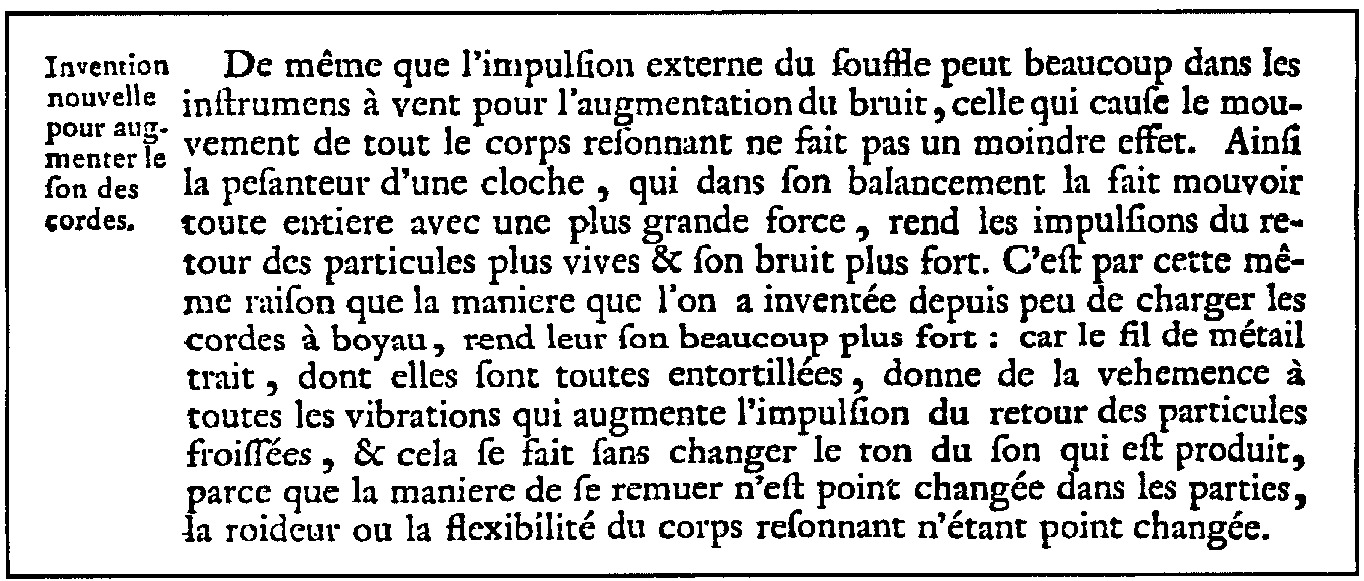
Stringmaking technique from the mid-18th to the late 19th century
At first sight the manufacturing process of strings in the 18th and 19th centuries appears surprisingly similar to today's, but in reality there are some substantial differences that lead to the conclusion that the strings of that time — and at least until the end of the 19th century — were more elastic and hence, quite probably, better than ours from the point of view of durability and acoustic performance.
The process of the time, described by De Lalande (1786) and Griselini (1769), normally called for the use of whole lamb gut (which, once emptied and degreased, appears, incidentally, as a flat, semi-transparent membrane only 3–4 mm wide) at least fifty feet long. After being carefully emptied and rinsed for several days in running water, it underwent a series of treatments designed to remove the useless parts so as to leave free and perfectly degreased only the muscular membrane, which was what interested the stringmaker. This result was obtained by leaving the guts immersed for several days in alkaline baths of progressively increasing concentration; afterwards, with simple, gentle scraping performed with the back of a knife or with a fragment of marsh reed, the non-muscular membranes and the fat that always accompanies gut were easily removed.
The alkaline baths consisted of vegetable ash dissolved in water (potash). The progressive increase in bath concentration can perhaps be explained by the fact that at the start of the degreasing treatment dilute solutions of alkaline product are enough, being already capable of removing the more easily soluble fatty substances. The highest concentration of potash is reserved for the end only, when a far more energetic action becomes necessary against everything still difficult to remove. At this stage a modest amount of rock alum could also be added, whose astringent, tanning effect slightly hardened the gut. The alkaline baths, in other words, brought about a process of fermentation and saponification of the organic matter such as to facilitate the mechanical detachment of the useless parts.
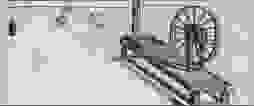
The degreased guts were then carefully selected and gathered into parallel bundles in variable quantities — depending on the required string diameter, up to as many as fifty for the double bass — knotted at the ends and subsequently twisted by means of a special winch (the opposite end of the proto-string was fixed to a peg in turn fastened to one side of the drying frame). Once the string had been properly twisted, the free end was in turn fixed to the other peg on the opposite jamb of the frame, thereby putting the damp string under tension.
Once the frame was well hung with strings it was carried to a small dedicated room, where the strings were bleached by sulphuring: they were subjected for days to the bleaching action of the sulphur dioxide given off by burning, in a basin, flowers of sulphur. At the end of this operation the strings were further twisted, after which they were left to dry finally in the open air, an operation that took only a few hours. Since fresh gut is like a sponge soaked in water, its drying involves a considerable reduction in diameter: in practice a fresh, perfectly white string of about 5 mm diameter, once dried, shrinks to a yellowish one of only about 1 mm.
The last stage consisted of smoothing, by rubbing, the rough surface of the strings, using a plant with abrasive properties (soaked in the alkaline degreasing liquid, or "temper"): horsetail, scouring rush; only in the course of the 19th century did the use of powdered pumice come to be increasingly preferred. Once perfectly smoothed, the strings were oiled with olive oil, cut at the ends of the frame and packed in coils; each oiled-paper packet could hold from fifteen to thirty strings or more. It is interesting to note, in 17th-century musical iconography, how the length of string left hanging past the instrument was gathered into a little bundle, as if it were soft twine: this strongly suggests that the strings of the time were extremely soft. From the 18th century onward, strings were instead packed in a circular profile, which seems to confirm the changes that had occurred in the stringmaking trade, perhaps following the appearance of wound strings.
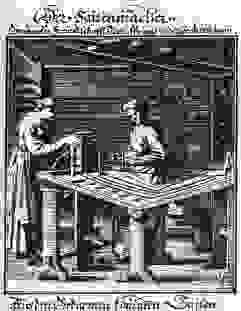
It might at first sight seem that the modernisation of this centuries-old, unchanged string-making technology was an entirely positive development, but things are not so simple. Some apparently trivial steps of the old manufacturing system have never been properly investigated; the practical difference can be seen by comparing the few surviving string samples — even from the beginning of the century — with those available today: the former extremely twisted, soft and elastic, the latter generally stiff and little twisted. Our strings, moreover, unless varnished, generally have, once fitted to the instrument, a distinctly short lifespan.
The question of durability is easily explained by the fact that a string made from whole guts, treated only with light smoothing using an abrasive plant or pumice, shows a much smaller number of broken surface fibres than a string made from strips of gut whose final diameter has been imposed by mechanical grinding, which can remove a fair amount of material from the surface of the raw string, making it more prone to premature fraying.
The second important aspect — which heavily affects overall acoustic performance — concerns the fact that today's gut strings seem in some way inclined to give up the pursuit of maximum elasticity in favour of tensile strength alone, owing to the low degree of twist imparted to them: it is easily forgotten that the task of a musical string is to sound as well as possible, certainly not to compete with a towing rope. In other words, strings must be able to convert the mechanical impulse transmitted by the finger into a vibrational motion that, as far as possible, is free from the internal friction within the string that would reduce the efficiency with which the mechanical energy transmitted to the material is converted.
That today's strings are generally under-twisted compared with those of the past can be deduced, besides from information found in old documents, also from the examination of surviving fragments; it need hardly be said how basic a factor twist is in determining the degree of elasticity of a gut string: a heavily twisted string is always less stiff and more sonorous. According to Abbott and Segerman the strings of the bass registers were made both in low and in high twist, and more precisely, until the end of the Middle Ages strings would have been lightly twisted, only to be twisted more heavily from the full 16th century onward, once stringmakers realised that heavier twisting produced better acoustic results; our own view instead holds the hypothesis that strings were, from the very outset, produced with a high degree of twist — except perhaps for the most heavily stressed strings of all, lute first strings — and that this was by no means a secret, given how trivial it was to achieve, consisting simply in giving more or fewer turns to the winch wheel during the twisting stage.
The conclusion leads one to believe that the musical strings of the past were probably superior — from the acoustic and durability standpoint — to ours, which can at least boast of being of precise dimensions and therefore seldom "false": a true and constant problem of strings before the advent of mechanical grinding, introduced only after the mid-20th century.
Production centres
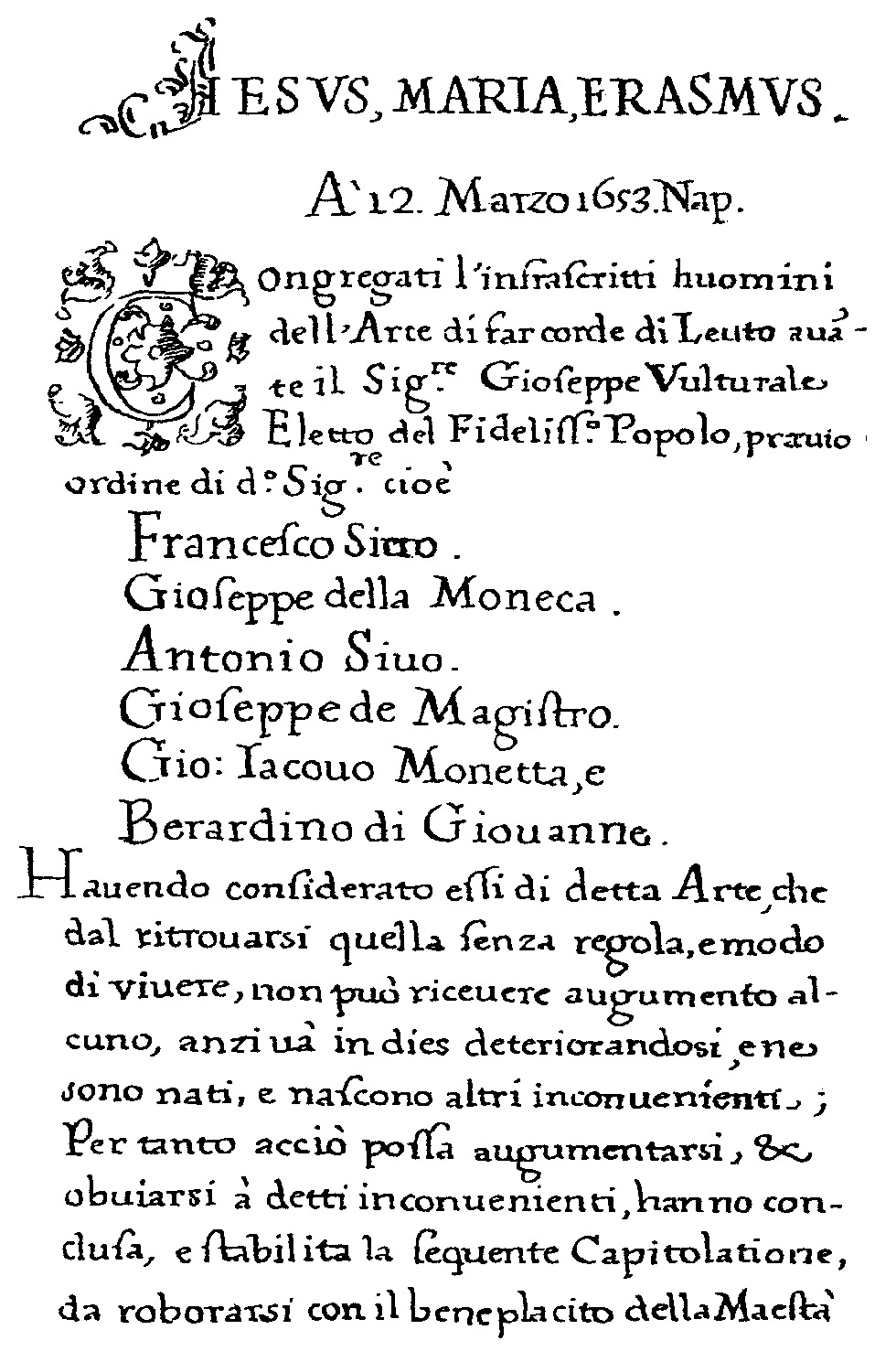
Through the 17th century the most prestigious centre of Italian and European musical-string production was certainly Rome, which in 1735 boasted some twenty stringmaking workshops — governed by detailed statutes — able to supply the whole of contemporary Europe with musical strings of excellent quality. Roman first strings remained renowned well beyond the end of the 18th century, the century in which the city's powerful stringmakers' guild was dissolved. The primacy for quality then passed, throughout the 19th century and beyond, to the able stringmakers of Naples, followed closely by those of the city of Padua (in 1786 the names that stand out are the stringmaker Antonio Bagatella and the workshop "Antonio fratelli Priuli detto Romanin", founded in 1613 by an Antonio Romanin perhaps originally from Rome), where the production of musical strings ceased for good in 1911 — run, as research carried out at the Chamber of Commerce of Padua shows, from 1849 by the Calegari family until the business was sold to the firm "Eredi Nicola Bella" of Drezza Giuseppe in Verona, who did not continue the production of musical strings.
De Lalande wrote that "la fabrication des cordes de violon est une chose qui est presque réservée à l'Italie, Naples & Rome en fournissent toute l'Europe & il y a toiours beaucoup de mystère dans ces branches exclusives de commerce…" [the manufacture of violin strings is almost an Italian monopoly, since Rome and Naples supply the whole of Europe, and there is always a great deal of mystery in these exclusive branches of trade]. Here now are Galeazzi's directions: "Let us come at last to strings: strings should be supplied by the best factories of Italy; namely those of Padua; of Naples; of Rome; of Budrio near Bologna; and of L'Aquila in the Abruzzo. There are also other factories in Città di Castello; Perugia; Rieti; Teramo; and other places; but the first take the prize; especially those of Padua; and of Naples.". The violinist Spohr reports as follows: "There are Italian strings and German strings, of which the former should be preferred; although even among Italian strings there are bad ones. Ordinarily the best are the Neapolitan strings, then come those of Rome and finally those of Padua and Milan; but the latter are worth little.".
Naples was always a genuine puzzle for the French, skilled as they were at making any kind of string except first strings for this instrument. These were therefore imported in large quantities from Italy and, it seems, at prohibitive prices. Towards the end of the 18th century the French even instituted an award for whoever could match the quality of the Neapolitan product. The gold medal was in the end awarded to the Parisian stringmaker of… Neapolitan origin, Savaresse, who solved the case brilliantly: the "secret" lay in the fact that in Naples, and in numerous other parts of Italy, gut from rather young animals was used — unlike in France; but this had in truth already been written by De Lalande in his Voyage some decades earlier.
The primacy of quality for strings manufactured in Italy is found unchanged even at the end of the 19th century, so much so that George Hart wrote: "Musical strings are manufactured in Italy, Germany, France and England. The Italians rank first, as in the past times, in this manufacture, their proficiency being evident in the three chief requisites for string, viz. high finish, great durability, and purity of sound. There are manufactories at Rome, Naples, Padua and Verona […]. The German strings now rank next to the Italian, Saxony being the seat of manufacture […]. The French take the third place […]. The English manufacture all qualities, but chiefly the cheaper kinds…". Forino (1905) in turn reports as follows: "…the workshops of Berti and of Colla in Rome, and of Ruffini in Naples, were once famous. Today the products of Righetti in Treviso, of Raffaele di Bartolomeo in Naples, of Nicola Morante at Tavernale di Barra (Naples), of Nicola Di Russo and of Raffaele Pistola Profeta (Ruffini's successor) at Salle (Pescara), of Luigi D'Orazi likewise at Salle and of Conti at Mugellano (Rieti) are much appreciated […]. After Italy and Germany comes France in third place, which produces excellent strings especially for the harp: the strings of Lyon enjoy a fine reputation.". Towards the end of the 19th century and in the early 20th, Markneukirchen and Saxony nonetheless took the lead, for purely industrial reasons.
Emilio Pujol, the only guitarist among our sources to have expressly mentioned the production of guitar strings, wrote in his method: "Las mejores cuerdas nos parecen ser hoy las de la marca Pirastro; y de éstas las que llevan una etiqueta dorada. Su sonido es claro sin ser chillón; su afinación es generalmente justa, y su resistencia y duración no han sido hasta ahora superadas. Las marcas "Pirazzi", "Padova", "Elite" y "El Maestro" son también cuerdas de tripa de excelente resultado. Las de seda hilada suelen ser, de afinacion justa. Son buenas las que fabrica en Valencia José M. Dutrá, las de H. Hauser de Munich, y otras que por ignorar su procedencia, no puedo precisar." [The best strings today seem to us to be those of the Pirastro brand; and among these, those with the gold label. Their sound is clear without being shrill; their intonation is generally accurate, and their strength and durability remain unsurpassed to this day. The brands "Pirazzi", "Padova", "Élite" and "El Maestro" are also gut strings of excellent quality. Spun-silk strings usually have accurate intonation. Good ones are those made in Valencia by José M. Dutrá, those of H. Hauser in Munich, and others whose origin, being unknown to me, I cannot specify]. As can easily be imagined, the manufacture of wound strings was a prerogative not so much of stringmakers as of luthiers, if not of the musicians themselves.
String evaluation criteria
But what were the guiding criteria that distinguished a good string from a bad one? The first thing to stress is that period professional musicians — guitarists included — show a remarkable skill in telling by touch and sight material of good quality and vibration (the area of origin was already in itself considered a reliable indicator). This knowledge had always been handed down from master to pupil, according to a kind of oral, but also written, tradition — Aguado, in his Nuevo método, wrote that "the guitarist must be a master of strings" — that began to break down perhaps from the dawn of the 20th century, when it became progressively customary to rely blindly on the large stringmaking firms then developing in Germany and France (but certainly not in Italy: the Italian stringmaker as a craft figure was by now in decline; after the Great War most of them began to close shop or chose to emigrate abroad, America first and foremost, bringing about the rapid end of the glorious, centuries-old Italian tradition), which effectively imposed their own choices in terms of manufacturing strategies and standard commercial gauges — as the English magazine The Strad already complained in 1900: "At the present time the matter of string thickness seems to rest entirely with the makers, the player has practically to take what is given to him".
The age-old custom of the oral tradition might explain why so little is found on the subject of string selection in period guitar methods, and what little can be learned about it is found chiefly in violin methods — the instrument around which everything revolved — or in manuals concerning bowed-instrument making in general. Here, then, is what our sources report.
Michel Corrette: "Les plus unies sous le doigt et transparentes sont les meilleurs" [those most even under the finger and transparent are the best]. Francesco Galeazzi: "a good string must be diaphanous; gold-coloured, that is, tending to yellow, and not white as some would have it; smooth and polished, but this independently of having been pumiced; without knots or joins; supremely elastic and strong; and not flabby and yielding". Antoine-Germain Labarraque: "La corde la meilleure et qui doit faire le plus long usage, est celle qui change le moins d'aspect quand on la monte" [the best string, and the one that will give the longest service, is that whose appearance changes least when it is fitted]. Louis Spohr: "…a good string is known by its white colour, its clarity and smoothness […]. Old, spoiled strings, or those of poor make, are recognised at once by their dull, yellow colour; they are neither transparent nor elastic like good strings".
Maugin and Maigne, quoting the stringmaker Philippe Savaresse: "Les chantarelles, dit M. P. Savaresse, doivent être transparentes, parfaitement unies et assenz régulières de grosseur. Elles ne doivent pas être trop blanches, car cela prouverait qu'elles ont été faites avec des agneaux trop jeunes, et lorsqu'on serre un paquet de chantarelles sous la main, elles doivent paraitre élastiques et revenir promptement comme le ferait un ressort d'acier. […]. Les grosses cordes, deuxième et troisième, doivent, au contraire, être transparentes et très blanches. Il faut, en outre, qu'elles soient très molles quand on en comprime un paquet, mais elles ne doivent pas changer de couleur et elles doivent revenir promptement à leur état cylindrique; si elles présentaient trop de raideur, cela indiquerait qu'elles ont été faites avec des boyaux trop résistants, et, dans ce cas, elles auraient une mauvaise qualité de son" [First strings, says Mr P. Savaresse, must be transparent, perfectly even and very regular in gauge. They must not be too white, as this would prove they were made from too-young lambs, and when a packet of first strings is squeezed in the hand they must appear elastic and spring back promptly like a steel spring. Thick strings, second and third, must, on the contrary, be transparent and very white. They must also be very soft when a packet of them is squeezed, but they must not change colour and must promptly return to their cylindrical state; if they showed too much stiffness, this would indicate that they were made with gut that was too resistant, and in that case they would have poor tone]. George Hart: "Choose those that are most transparent; the seconds and thirds, as they are made with several threads, are seldom very clear […] and hence, absence of transparency in their case denotes inferior material".
The last document we present was published in 1905 and is probably the last text still to set out the criteria for choosing a musical string according to 19th-century tradition. Luigi Forino: "German strings have the merit of durability and, like all products of that nation, also that of a good price. They are extremely smooth, hard to the touch, almost like steel [!]: and the sound suffers from that hardness […]. A good string should be neither too smooth nor too white, for the action of pumice does not benefit good tone: it must be very elastic and perfectly cylindrical […]. To test elasticity it is enough to press a still-twisted string between the fingers and try the experiment, for example, between a German string and an Italian one."

Working tension and the tactile sensation of stiffness
The most important and universal feature that characterised the choice of stringing for any instrument, plucked or bowed, from the Renaissance until at least the middle of the 19th century, was that all the strings of the instrument, when pressed at the same point, had to display an equal tactile sensation of stiffness — that is, the same amount of lateral displacement obtained between two or more strings, even ones differing in diameter, vibrating length, degree of twist or pitch, by means of the same quantity of weight (generally similar to the pressure induced by the finger or the bow) acting at the same point. This criterion was reiterated, over the centuries, ad nauseam by the most authoritative treatise-writers, who also wrote that strings should feel neither too "hard" nor too "soft". It will be understood that while the criterion of "equal sensation of stiffness" among all the strings is a criterion of a universal nature (equal means equal), the concept of just how "hard or soft" they should be — in practice, the choice of the right gauges — is instead of an extremely subjective nature, bound up with individual sensitivity, the type of instrument, etc.
Thomas Mace (1676): "Another general Observation must be This which indeed is the Chiefest: viz. that what siz'd Lute soever, you are to String, you must so suit your Strings, as (in Tuning you intend to set in at) the Strings may all stand, at a Proportionable, and ever Stiffness, otherwise, their will arise Two Great Incoveniences: the one to the Performer, the other to the Auditor. And here Note, that when we say, a Lute is not equally String, it is, when some Strings are stiff, and some slack". Robert Dowland (1610): "[…] these double bases like wise must neither be stretched too hard, nor too weake, but that they may according to your feeling in striking with your Thombe and fingers equally counterpoyse the Trebles…". The Burwell Lute Tutor: "[…] when you stroke all the strings with your thumb must feel an equal stiffness […]".
These extremely functional rules, however, are today almost completely ignored (even by the few who try to understand what lies behind a commercial set of strings), replaced instead by the concept of working tension expressed in kg or, worse still, by the terms "light", "medium", "thick" etc. that appear on packets, leaving no room for any conscious reasoning or for the musician's wish to experiment. It is generally assumed that an equal tactile sensation of stiffness among the strings (which in a plucked or bowed musical instrument is a universal rule) corresponds entirely to equal tension, but this is not true. Let us try to clarify this fundamental point, which has had a negative bearing on the reconstruction of the stringing of every Renaissance and Baroque plucked and bowed instrument, as well as on modern stringing for the five-course baroque guitar or the six-single-string guitar of the Romantic period and beyond. While working tension is a numerical value perfectly well defined by its own figure, the tactile sensation of stiffness — being precisely a sensation — is subject to several variables.
Here are some examples: between two identical strings subjected to the same working tension — but at different vibrating lengths — the longer one will feel more yielding to the touch; likewise, between two gut strings of equal gauge, working tension and vibrating length — but of which one is heavily twisted and the other lightly — the former will feel more yielding under finger pressure because it possesses a greater longitudinal elastic give (this is why it is always problematic to replace a given diameter of string of one commercial brand with one of different origin: the degree of twist, the type of material and its processing could be different enough to make equality of gauge useless for obtaining the same sensation of stiffness under the fingers). Finally, between two strings identical in degree of twist, vibrating length and working tension — but not diameter — the thinner one will feel more yielding to the touch. It is easy to see what problems of tactile unevenness arise in a chitarrone (which has the characteristic of carrying its strings at two different vibrating lengths) if everything is set up — as is commonly done today — at equal tension rather than following the criteria of the ancients.
To sum up, when period documents — and by "period" is meant at least until the mid-19th century — referred to the word "tension" with regard to an actual string setup (that is, not in cases of pure theoretical speculation about the relationships among various physical parameters such as frequency, vibrating length, diameter etc., as for instance in Mersenne's treatise and others), they were essentially referring to the tactile sensation of stiffness, not to tension in kilograms as everyone understands it today. Galeazzi provided us with a decidedly relevant example: "…the tension [in the violin, ed.] must be the same for all four strings, for if one were tighter than another this would produce under the fingers, and under the bow, a notable unevenness, which would greatly harm the evenness of the voice". It is transparently clear that "tension" here coincides with tactile sensation of stiffness. In Bartoli's treatise the coincidence between "tension" and tactile sensation is equally evident: "The closer a string is to the beginning of its tension, the tauter it is there […]. Let us now consider any string of a lute: it has two starting points of tension, equal in power, namely the pegs at one end and the bridge at the other: hence, by the foregoing, it is tauter the closer one gets to them, and consequently is less taut in the middle".
Part two — 18th-century string types
Breaking index and vibrating length
Let us examine in this second part what the criteria were for choosing the stringing of our instrument during the 18th century, referring to the few documents we have found. The guitar of the time had four double courses (the so-called "courses", though we prefer to call them "orders") plus a usually, but not always, single first string, and frets made of gut-string offcuts. Tuning (in E for the majority of cases, but sometimes also in D) allowed, as is known, several variants for the two bass courses, which could be tuned in octaves or in unison. The range of vibrating lengths of this instrument was markedly greater — 69÷74 cm — than the 62÷63 cm typical of guitars of Sor's day.
Why precisely these measurements and not others? To understand this subject properly one must first say a word about the behaviour of strings in those days, when the only material available was essentially gut. In other words it is a little as if today we had available — even in the various thicknesses required — only nylon threads and found ourselves in the difficult position of having to guarantee acceptable acoustic performance in every register of the guitar (or the lute). When a string of any material is progressively tensioned between two fixed points (the vibrating length), a pitch is reached that causes the string to break because its breaking load has been reached, which for gut hovers on average around 34 kg/mm², a value that can be considered valid — for a number of demonstrated reasons — also for strings made in the 18th–19th centuries. In other words, the strings of that time had more or less the same tensile strength as ours. The value of this limiting frequency, called the "breaking frequency", is completely independent of diameter, and this can easily be verified both mathematically (by applying the general string formula) and experimentally.
This "boundary" frequency is inversely proportional to the vibrating length of the string itself; thus if the vibrating length is halved, the frequency doubles (and vice versa). In other words, the product of vibrating length — in metres — and breaking frequency — in Hz — is a constant defined as the breaking index. The experimental breaking index of a modern gut string lies between 220 and 290 Hz · m, averaging around 260 Hz · m, corresponding precisely to a breaking load of 34 kg/mm². This means that at a vibrating length of one metre, a string will break, at least in theory, at 260 Hz. If the breaking index is divided by the required pitch of the first string (which is the luthier's starting figure), one obtains the vibrating length at which — for the given pitch — the string will snap outright. Taking, for example, the pitch of the first string of a baroque guitar for a hypothetical 17th-century pitch standard of 415 Hz — that is, E = 311 Hz — the theoretical vibrating length at which the first string will break turns out to be 83 cm: one need only divide the breaking index by the frequency of the E.
The choice of working vibrating length will necessarily have to allow for a prudent shortening of this limiting length. We have already seen how 16th–17th-century musicians who played plucked (or bowed) instruments took care that the strings of an instrument should feel neither excessively taut nor excessively slack to the touch, a sensation to be found identical, moreover, among all the strings of the setup: exactly as we would do ourselves if pre-assembled sets no longer existed, but only loose strings of various diameters. The search for a correct, subjective degree of tension therefore implies the choice of the most appropriate gauges.
There is then a second factor to take into account, always the bane of musicians and luthiers in the times preceding the advent of wound bass strings: as a gut string increases in cross-section — under conditions of equal tension and vibrating length — it does indeed reach ever lower pitches (diameter and frequency being inversely proportional), but its overall acoustic performance, in terms of dynamics, richness of harmonics and sustain, keeps decreasing, until — beyond certain gauges — it reaches thoroughly unsatisfactory levels. Strings, in practice, owing to the increase in stiffness caused by large diameters, become ever more damped and dull-sounding, and this we can easily grasp even today if we compare, on an ordinary guitar, the acoustic performance of the G string against that of the first-string E. A D and an A in pure nylon, instead of wound, would have a diameter of about 1.4 mm and 1.9 mm respectively: it is not hard to imagine what would happen to their sound. As if that were not enough, gauges of this bulk — when pressed against the fingerboard — rise more steeply in pitch than thinner strings; modest variations in finger pressure on the frets then produce a considerable variation in the pitch emitted. All this because thick strings made of a single material (pure nylon, for instance) are by their very nature extremely stiff.
Wishing, therefore, to safeguard as best as possible the performance of the stopped bass registers, and having no material available other than gut (metal strings existed, of course, but besides having a timbre entirely different from gut, they imposed limits heavy enough to affect the design characteristics of the instrument), the only path open to luthiers of the time was to seek the maximum vibrating length. Only by following this path (since vibrating length and diameter are inversely proportional) could one hope to reduce string diameter to a minimum and obtain the best sonority from it. Let us recall that vibrating length was, however, bound by the limits imposed by the tensile strength of the first string, as described above.
This clarifies, in reverse, a rule that applied to the lute, the guitar and other instruments of the 16th–17th centuries, and that is decidedly little understood today: that of tuning the first string as high as possible. Only by observing this condition could one achieve — at equal tension — the greatest possible reduction in string diameters, freeing the sound to its fullest in all its dynamic and timbral components. It is easy to see that vibrating lengths, calculated by luthiers on the basis of the mechanical and acoustic properties of the strings available to them, could only keep the pitch of the first string — even though then tuned empirically by the player — within a fairly narrow window of frequencies, on pain of either the immediate breaking of the first string (if pitched too high) or deficient acoustic performance (if the instrument was pitched too low for that given vibrating length).
A vibrating length of 59 cm, typical of certain historical lutes such as the seven-course instrument by Vendelio Venere (Venice, 1596), was calculated precisely to achieve a potential G tuning at the late-16th-century Venetian pitch standard, which was about a semitone higher than our modern pitch standard (440 Hz), and suggests that the luthiers of the time had a clear grasp of the concept of breaking index. The same reasoning can be extended to the German 11- and 13-course lutes of the 18th century tuned in D minor: knowing for certain, in this case, that the first note was an F "Kammerton" — in practice a good semitone below our modern one — given the range of vibrating lengths typical of these instruments (68÷72 cm), it emerges that the first string worked automatically close to the breaking frequency. On the basis of these considerations — extendable also to the viol family, at least until the second half of the 17th century — researchers have long since calculated that the working vibrating length required a prudent shortening of about 2–3 semitones with respect to the "breaking" length, equal to a working index of 230÷240 Hz · m. This value is also obtained for the lute in Plate XVI, no. 3, of Michael Praetorius (Syntagma Musicum, "Sciagraphia", Elias Holwein, Wolfenbüttel 1615–20), where the product of the vibrating length — which can be determined, since the author specifies the unit of measurement — and the hypothesised pitch of the first string equals 235 Hz · m.
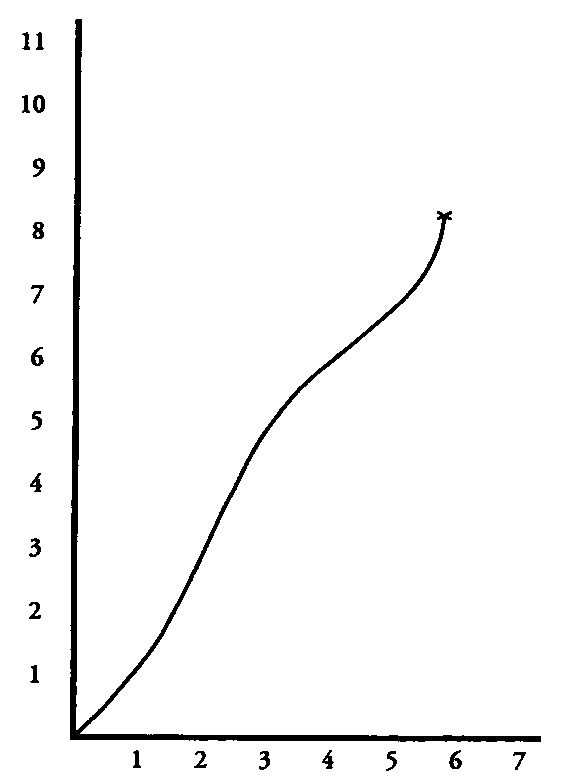
This theory finally finds strong experimental support if one observes the behaviour of a whole-gut first string (as they were made at the time) as the pitch is progressively raised: at about two to three semitones from breaking, it begins to lose noticeably its capacity to stretch further, as if it were a steel wire. In practice, as tension increases, the string's pitch, at a certain point, rises far more rapidly than expected, even for small advances of the peg, until it soon reaches breaking point [fig. 7]. This was undoubtedly an excellent signal for the lutenists/guitarists of the time, but also for those — such as luthiers — who had to skilfully dimension a guitar, a lute or a viol. The string, in other words, automatically signalled to the player when the limit had been reached: it thus suggested to the luthier the correct criterion for properly proportioning an instrument of which he knew only the pitch of the first string (from which, by proportion, followed that of the other strings) required by the client, according to the pitch standard of the place where the instrument was then to be used.
It is well known, in fact, that not all the Es, Gs etc. of the various regions of Europe were identical, but varied from state to state by as much as 2–3 semitones, and this had to be duly taken into account by the luthier concerned. This explains why a hypothetical archlute in G built by the Venetian Matteo Sellas in 1640 has a stopped vibrating length of only 58 cm, while a similar instrument built by Bassiano Haim in Rome in 1668 has as much as 64.5 cm of stopped vibrating length. The difference between the two vibrating lengths is about two semitones, and this coincides exactly with what is believed to have been the difference in pitch between the Venetian and Roman pitch standards of the 17th century. Whether the instrument was then destined to take on a figure-of-eight shape like the guitar and the vihuela de mano, or a "pear" shape like the lute, or whether it was played plucked or bowed, made no difference to this underlying principle.
This is why building exact copies of original instruments from the 16th/early 17th century — particularly Renaissance viols and lutes — poses everyone a frankly unresolvable doubt: assuming all the parts are in original condition, for which pitch standard were they dimensioned? It is not uncommon, indeed, to find today exact copies of a G lute (that is, "Mezano", nowadays called "Tenor") with vibrating lengths of 65 cm, or, worse, archlutes with 68 cm of stopped length, meant to be tuned in G but at our modern pitch standard, that is, at 440 Hz. The simple product of today's G pitch (392 Hz) and the vibrating length would immediately make it clear to anyone that the working index, instead of remaining at 230–240 Hz · m, would leap beyond what gut can offer, and that in such a case it would be pointless to fit a thinner first string in the hope that it will not break. In practice, a modern G lute strung in gut should never exceed a vibrating length of 61–62 cm.
On the basis of these considerations, the breaking vibrating length indicated earlier for the guitar — equal to 82 cm — corresponds, therefore, to a working length of 69–73 cm which, as it happens, is a range of values typical of surviving five-course instruments of the 17th and first half of the 18th century. Tuning the first string to E (A = 415 Hz), it thus finds itself two to three semitones from the hypothetical breaking point. The original function of the octave strings paired with the bass courses during the 16th century most probably served to restore, by another route — through this ingenious device — the upper harmonics that were heavily penalised in the thicker strings (as also stressed by Sebastian Virdung in Musica getusch, Basel 1511), and it strangely remained in use even after the invention of covered strings.
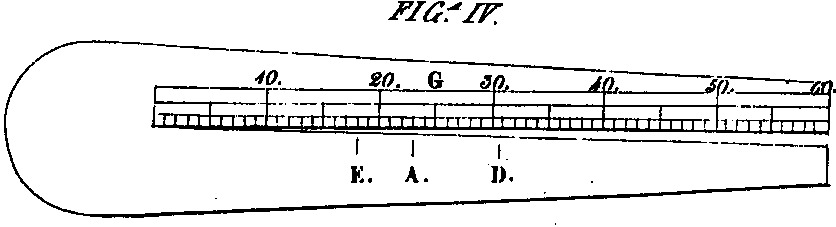
The gauges of Stradivari's Chitarra Tiorbata
The Museo Stradivariano of Cremona holds numerous drawings and paper or card templates concerning plucked and bowed instruments. One of these (drawing no. 375) is of particular interest since it bears the description of the strings needed for the five stopped courses of the "chitarra tiorbata", which is in practice a five-course guitar with five single drone strings off the fingerboard:
- 1st and 2nd string (first course): "two guitar first strings".
- 3rd and 4th string (second course): "two guitar sotanelle".
- 5th and 6th string (third course): "two thick violin first strings".
- 7th string (fourth course): "a violin second string".
- 8th string (fourth course): "a guitar sotanella".
- 9th string (fifth course): "a violin second string but of the thicker sort".
- 10th string (fifth course): "a violin first string".
Sacconi believes that these indications, dating from the first half of the 18th century, are the work of one of Stradivari's sons, who, although he died in 1737, was obliged from 1725 onward to delegate much of the work to his assistants. Let us attempt an estimate of the diameters involved. As will also prove to be the case for the guitar of the following century, we should note the reference — the first in chronological order — to the gauges of the contemporary violin. Through Count Riccati (who, besides being a great physicist, was a decent amateur violinist and a friend of Tartini) we know for certain that the terms cantino and canto refer respectively to the E and A of this instrument. Again according to Riccati's data — who around 1740–50 carried out some interesting measurements on the strings of his own violin — we know that the measurements of the cantino and the canto were respectively around 0.70 and 0.90 mm. Let us recall that these estimates are also indirectly confirmed by data supplied by the French traveller and astronomer De Lalande — c. 1760 — on the number of guts used to make mandolin, violin and double-bass strings by the celebrated Abruzzese stringmaker working in Naples, Domenico Antonio Angelucci, and, importantly, that these proportions remained strictly constant until the end of the following century, in both Italy and France.
As for the wording "thick" cantini/canti, let us take as a guide the thickest gauge value ("thick") of E and A strings made from the same number of strands of gut, as indicated by George Hart. Given the great standardisation in the manufacturing process of violin strings, it then becomes possible to venture the hypothesis that a "thick" three-strand first string might measure around 0.73 mm (roughly the maximum diameter obtainable from three strands of 8–9-month-old lamb gut, as we ourselves, as stringmakers, have verified experimentally), 0.90 mm for the "normal" second string and 0.95 mm for the "somewhat thick" one. Since the third course of this guitar used a violin first string (always made with three guts, otherwise called "strands"), the second course, by simple mathematical proportion, must have consisted of two strands (like the first string of the mandolin and of the pardessus de viole, according to De Lalande) and the first of a single gut, exactly like lute first strings. Under theoretical calculation, indeed, the ratio between diameters equals the square root of the ratio between the number of strands used.
The first string could only have the same gauge as those of the by-then almost obsolete lute, since the guitar of the time did nothing but follow the same guiding principles, namely the pursuit of the maximum vibrating length so as to work with the first string close to breaking point. Since three "strands" produce a diameter of around 0.70 mm, simple mathematical proportion allows the diameters of the first, second and fifth courses to be derived. Here, then, is the hypothesised set of diameters: 1st course ~ 0.42 mm (one gut); 2nd course ~ 0.57 mm (two guts); 3rd course ~ 0.73 mm ("thick" violin first string: three guts); 4th course ~ 0.90 mm (violin second string) paired with ~ 0.57 mm (two guts); 5th course ~ 0.95 mm (violin second string, somewhat thick) paired with ~ 0.70 mm (violin first string: three guts).
As can be seen, the fourth and fifth courses consist of a fundamental bass paired with its octave, a system more typical of the early-17th-century Italian school (see Benedetto Sanseverino, etc.) than of Stradivari's French contemporaries such as Corbetta and De Visée. The latter, in fact, preferred the two strings of the fifth course tuned in unison at the upper octave, while the fourth consisted of the fundamental bass paired with a thinner string set an octave higher. As for the vibrating length of the guitar in question, template no. 374, for another Stradivari guitar for which several measurements are given, can help us: comparing the data, a vibrating length of 68.3 ± 5 mm can be deduced. For the purpose of estimating working tension, the pitch standard remains to be assessed, which we conventionally fix at 415 Hz. The fact that the first three strings of this instrument take one, two and three guts respectively — exactly as happens on the lute — suggests the interesting hypothesis that the intervals of a fourth between the strings of the lute, guitar and other plucked instruments were dictated not so much by musical, philosophical or simple fingering considerations as, more prosaically, by the fact that only such intervals, among all possible ones, allowed gut strings made of one, two and three guts (and so on) to yield an equal tactile sensation of stiffness. As the number of paired guts increases, the difference in diameter between adjacent strings (for instance between a string made of ten guts and one made of eleven) naturally tends to decrease; conversely, the difference in gauge found among strings made of few guts is fairly significant. Assuming the vibrating length of 68.3 cm and a pitch standard of 415 Hz, the following tensions result:
| Course | Diameter | Tension per string | Tension of the course |
|---|---|---|---|
| 1st (first string) | c. 0.42 mm | c. 3.3 kg | 6.6 kg if doubled |
| 2nd | c. 0.57 mm | c. 3.3 kg | 6.6 kg |
| 3rd | c. 0.73 mm | c. 3.5 kg | 7.0 kg |
| 4th, bass | c. 0.90 mm | c. 3.0 kg | — |
| 4th, octave | c. 0.57 mm | c. 4.6 kg | — |
| 5th, bass | c. 0.95 mm | c. 1.87 kg | — |
| 5th, octave | c. 0.70 mm | c. 4.0 kg | — |
The tension value for the bass of the fifth course is decidedly below average, while the remaining values seem to keep roughly the same tension, except for the two octave strings: a profile, that is, substantially close to equal tension. Stradivari's indications allow us to observe how the string of the second course was also used to make the octave string paired with the bass of the fourth. A gauge slightly thinner than the third course, in turn, made the octave string paired with the fifth. The most plausible explanation for the reduced working tension of the bass string lies in the fact that this gauge in all likelihood indicates the size of the core to be used for the subsequent metal winding. There are similar examples, in this respect, concerning the fourth string (the only wound one) of the violin, taken from period string gauges, such as the one reproduced below. From Italy, unfortunately, we have no further information.
The French, Spanish and Mexican sources
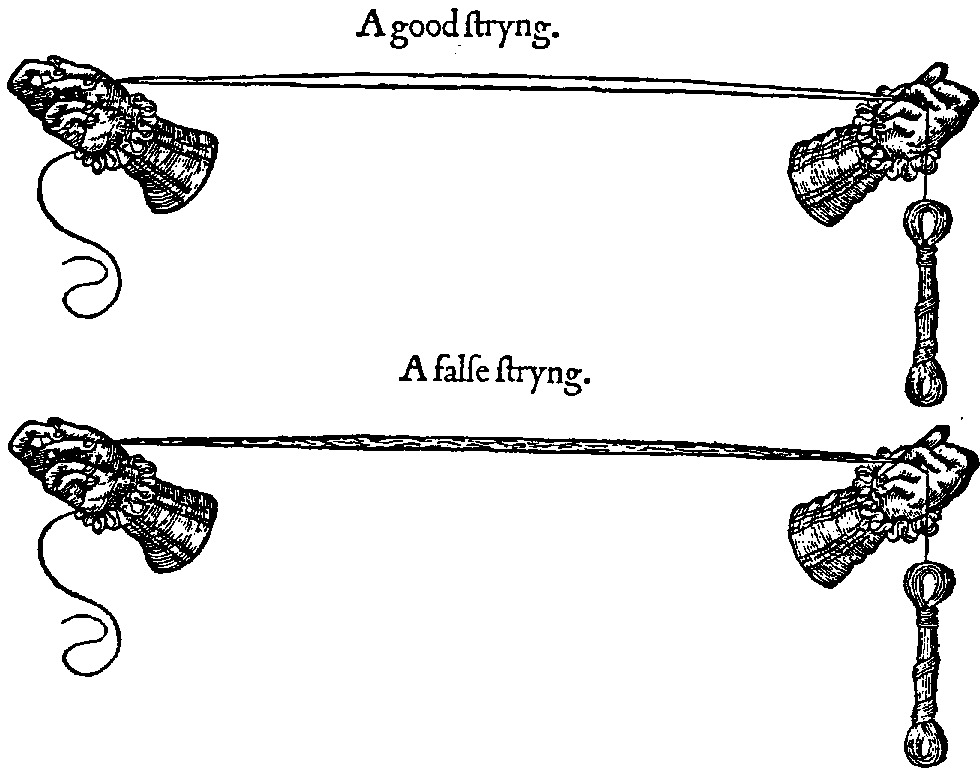
Le Cocq, in 1729, provides useful guidance on choosing strings for the guitar of his time. Having pointed out that all the strings are of gut and explained the method for telling a good string from a false one [fig. 10], and having given directions on frets, Le Cocq specifies that for the second and third courses and for the octave of the fourth, strings of similar thickness are used; in practice, if we have understood correctly, a single string gauge "covered" as many as three courses: "Tout les autres rangs, ou cordes [besides the chantarelle, which was single] peuvent étre d'une même grosseur…". As for the octave of the fifth, low, course, or drone, its gauge had to be imperceptibly thicker than that of the third-course strings. The basses of the 4th and 5th courses were wound and called for a thick core equal to their respective paired octaves, loaded with a thin brass, or better silver, wire.
It should be noted that the winding is not close-wound, like the strings generally available in French shops, "entirely wound or too thick" ("…que celles qu'on trouve aux boutiques sont entierement chargées ou trop grosses…"), but of the "demi" type, that is, with turns spaced by the diameter of the wire or slightly more, and "home-made". A good iconographic example in which the fourth and fifth strings of a five-course guitar can be seen in white (wound, presumably, in silver or silvered copper) is a canvas by Jean Baptiste Oudry (1686–1755), Allegorie der Künste, 1713 (Schwerin, Staatliches Museum). Despite this information, there are no comparisons with the gauges of other instruments, and it is therefore not possible to offer any hypothesis of string diameters for this source.
Michel Corrette (Les Dons d'Apollon, 1763), however, confirms the Stradivari proportions: "La guitarre se mont en cinq rangs de cordes, le 1er n'en a qu'un qui se nomme chantarelle, et les quatre autres rangs en ont chacum deux… Il faut observer que les deux cordes du 3me rang et la petite corde a l'octave du 5me rang soient égales en grosseur pas si forte que la chantarelle de violon. Les deux cordes du second rang égales et plus fines que les précédentes. La chantarelle et la plus petit du 4me rang égales en grosseur et plus fines que celle du 2me rang. La 1re du 4me rang demi-filèe, plus fortes que celle du 3me rang. La 1re du 5me rang, filée en plein plus forte que la 4me. On peut faire filer des cordes de soye à la manière des Chinois qui ne'en usent pas d'autres à leur instruments à cordes, ce qui rend le son plus agréable et plus sonor…". The reference points are thus the third order and the octave of the fifth, which have a gauge equal to the contemporary violin first string, that is, around 0.70 mm (three strands of 8–9-month-old lamb gut). Here, then, are the hypothesised diameters: 1st course ~ 0.42 mm (one gut); 2nd course ~ 0.57 mm (two guts); 3rd course ~ 0.70 mm (medium violin first string: three guts); 4th course octave ~ 0.42 mm (equal to the first string: one gut); 5th course octave ~ 0.70 mm (violin first string: three guts); while for the basses of the fourth and fifth courses no diameter hypothesis is possible. Taking a vibrating length typical of a French guitar, such as an instrument by Alexandre Voboam of 1676 (Paris, Conservatoire, E 1532), equal to 69.4 cm, the following tension values are derived for a French pitch standard around 390 Hz: 1st course ~ 3.0 kg per string (6.0 kg total if doubled); 2nd course ~ 3.1 kg per string (6.2 kg total); 3rd course ~ 3.0 kg per string (6.0 kg total); 4th course octave ~ 2.4 kg; 5th course octave ~ 3.8 kg. There is a certain discrepancy between the tensions of the octave strings paired with the basses of the 4th and 5th courses, while the upper courses show values comparable with the Italian example. This is the first practical 18th-century indication of the use of silk as a core for wound strings.
P. J. Baillon (1781) writes: "La guitarre doint être montée au ton ordinaire d'un orchestre. Il faut avoir soin que les cordes soient bien choisies et bien égales. La meilleur méthode est de la monter à cordes doubles; la chantarelle seule doint être simple: les secondes doivent être plus grosses que la chantarelle et montées à l'unisson: les troisiemes doivent être plus grosses que les secondes et montées de même à l'unisson: la quatrieme doint être en soie filèe en entier accompagnée d'une corde à boyau un peu plus grosse que la chantarelle et montée à l'octave de la corde filée: la cinquieme doint être aussi en soie filée en entier et plus grosse que la quatrieme; elle doit être accompagnée d'une corde a boyau un peu plus grosse que les secondes et montée à l'octave de la corde filée. Il faut observer que les cordes qui accompagnent la quatriesme et la cinquieme doivent être posées après les cordes filées, c'est a dire, il faut qu'elles soient les premierès du coté du pouce." [The guitar must be strung at the ordinary orchestral pitch. Care must be taken that the strings are well chosen and well matched. The best method is to string it in double courses; only the first string should be single. The seconds should be thicker than the first string and tuned in unison; the thirds thicker than the seconds and likewise in unison. The fourth should be entirely wound silk accompanied by a gut string a little thicker than the first string and tuned an octave above the wound string. The fifth should also be entirely wound silk and thicker than the fourth, accompanied by a gut string a little thicker than the seconds and tuned an octave above the wound string. It should be noted that the strings accompanying the fourth and fifth must be placed after the wound strings, that is, they must be the first ones on the thumb side]. For the first three courses there are no particular indications except the specification that the first string is single; interesting, however, is what is indicated for the octaves of the fourth and fifth courses, which had to be a little thicker than, respectively, the first string and the second course, rather than the second and third as in Stradivari. As for the basses, one should again note what now appears as the sole indication, namely that the bass strings be wound on silk — even though, in truth, silk-wound basses had already been described by Playford in 1664, when the recent invention of wound strings was officially announced to the musical world of the time, although not a single historical source documents their use before the second half of the 18th century.
It may perhaps seem strange that news concerning the guitar could come from one of the Spanish colonies in America, also because, in parallel with other instruments, very little of significance has so far been found across the ocean. The treatise of Antonio Vargas y Guzmán (1776) deserves particular attention because it indicates the strings to be used on the six-course guitar, an instrument in vogue in Spain in the late 18th century up to the first decades of the 19th. Vargas specifies that the guitar has six courses: the first three in unison, while the wound basses (called entorchados) normally go at the octave. It is further specified that if the guitar is used for accompaniment — especially when a "large" orchestral ensemble is involved — then the basses too go in unison. In the treatise in question, the strings of the third course have a gauge equal to the violin second string (hence ~ 0.90 mm) and the second course equal to that instrument's first string, that is, ~ 0.70 mm on average. Considering a hypothetical vibrating length of 66 cm, like that of the Sanguiño guitar of Seville (1759), which indeed has six or seven courses, and assuming for the sake of pure speculation a pitch standard of 415 Hz, we can estimate the working tension for the second and third courses: B ~ 0.70 mm: ~ 4.8 kg; G ~ 0.90 mm: ~ 5.0 kg. What is certainly most significant is that between these two courses (though very probably also among the following strings) a condition close to equal working tension emerges, in line with the cases examined earlier. It follows that presumably the first string too should take on ~5.0 kg of tension, giving a diameter close to 0.53 mm: roughly what is obtained with two "strands" of gut, used as the first string of the mandolin or of the pardessus de viole.
With these documents we close what is known concerning the guitar of the Age of Enlightenment; as shown by the few data recovered, a profile of equal tension among the strings seems to emerge. Of the 17th century, on the other hand, we possess to this day nothing of significance except a few workshop inventories recording expenditure on strings of various kinds, guitar strings among them; given the close design kinship with the guitar, it is nonetheless believed that the gauges used on the 17th-century guitar were none other than those commonly used on the lute.
As for the place of origin of guitar strings, it should be stressed that, as with the violin, the French preference went to the Italian product — considered unsurpassed, especially for first strings — over other manufactures. Here, for instance, is Michel Corrette: "Les bonnes cordes à boyaux sont ordinairement de Rome, de Florence, de Naples, et de Lyon" [good gut strings usually come from Rome, from Florence, from Naples and from Lyon]. The preference for strings of Roman, and even more Neapolitan, origin also emerges clearly from the letters of the viol player Forqueray — who recommended to Prince Wilhelm of Prussia, between 1767 and 1768, "…que les deux dernières petites cordes soient romaines, les cinqe dernières de Naples…" — and remains unchanged, for other bowed instruments too, at least until the end of the 19th century.
As silk-wound basses spread on the guitar (offering, as they did, unquestionably better acoustic performance than gut-wound ones), the rule of seeking maximum vibrating length, still observed in the first half of the 18th century, no longer had any technical reason to exist. This made it possible for late-18th-century luthiers to shorten the vibrating length of our instrument substantially (by about a tone), to the benefit of playing agility, an aspect that had by then become particularly necessary given changing musical demands. Agility further favoured by a concurrent, gradual elimination of courses in favour of single strings, by the abolition of gut frets, replaced by fixed ivory or metal ones, and, finally, by the decisive addition of the sixth, bass string tuned to E, an addition that brought about the end of the perpetually inverted chord voicings typical of the five-course instrument. It should be stressed that a single-strung plucked instrument possesses, by its very nature, greater dynamic versatility and playing agility than one with courses.
Among the reasons that may have inspired the addition of the sixth bass string, the six-course mandora, an instrument greatly in vogue in Austria, Germany, Bohemia and Moravia at the time this important transformation occurred, cannot probably be overlooked. This instrument shows characteristics strongly akin — in the number and arrangement of its strings, as well as in the type of performance it allowed — to what would later become the six-string guitar, disregarding the fact that it appeared morphologically quite similar to the six- to eight-course lute of the Renaissance period. The mandora's tuning was generally in D, but with the same intervals as the guitar. Given that the vibrating length of many surviving museum examples hovers around 70–72 cm, simple proportion yields a vibrating length of 62–64 cm if theoretically proportioned for a tuning in E. Instruments of this kind were sought after north of the Alps for their agility and for the presence of sound in realising the bass part, in fierce competition with the theorbo and the lute — competition all the more formidable for the five-course guitar, which by then no longer enjoyed the 17th-century distinction of being strummed, which had somewhat set it apart from other plucked instruments. Here is what Simon Molitor has to say on the matter in 1807: "The guitar has now achieved a second improvement through the addition of the sixth string, precisely the bass E, which very quickly became common among us. In this way the guitar became entirely similar to the mandora".
The reasons why the guitar shortened by roughly two frets are not clearly stated: given, however, the close symbiotic bond it always had with the violin, one is led to think that only with this precise shortening could the first three strings of that instrument be adopted exactly as they were, while at the same time guaranteeing a tension value deemed correct. Significantly, the guitar took on a vibrating length exactly double that of the violin, likewise presenting its first string in E: the guitar of Sor and Giuliani's day had been born.
Wound basses and demi-filée winding
Open-wound strings — with turns spaced by the diameter of the wire or slightly more — are described precisely by François Le Cocq in 1729: "…qu'elles ne soient chargées qu'à demi: c'est à dire qu'il reste un espace vide à le corde, de la grosseur du dit filet ou même un peu plus" [so that they are only charged by half: that is, so that a gap the width of the said wire, or even a little more, remains on the string]. They are not "transition strings" on the way to close winding, but a technological answer to the limits of period wire drawing, which could not produce sufficiently thin metal wire. Le Cocq notes that this yields a less dry and hard sound than the ordinary close-wound strings available on the French market, which in his judgement were also too thick. Here too it should be noted that fundamental basses appear at the fourth and fifth courses, in partial contrast with the criteria adopted by De Visée and Corbetta.
A final piece of French information, drawn from the Encyclopédie Méthodique (Paris, 1785), reports the following: "Les bourdons filés ont deux inconvéniens, l'un d'user & de couper les touches; l'autre plus grand, est de dominer trop sur les autres cordes, & d'en faire perdre le son final par la durée du leur, principalement dans les batteries. Il est des accords oú ils peuvent bien faire, c'est lorsqu'ils produisent le son fondamental; mais comme cela n'arrive pas le plus souvent, il vaut mieux s'en tenir aux bourdons simples, à moins qu'on ne veuille que pincer. Visé, célèbre maitre de guitarre sous Louis XIV, n'en mettoit point au cinquième rang; mais il y perdoit l'octave du la, & par conséquent une demi-octave" [Wound drones have two drawbacks: one is that they wear and cut the frets; the other, greater one, is that they dominate too much over the other strings, causing their final sound to be lost through the duration of their own, chiefly in strummed passages. There are chords in which they can work well, when they produce the fundamental note; but as this does not happen most of the time, it is better to stick to plain drones, unless one intends only to pluck. Visée, the celebrated guitar master under Louis XIV, put none at all on the fifth course, thereby losing the octave of the A and, consequently, half an octave]. The wear of gut frets caused by covered basses was perhaps the triggering factor that led to the switch to ivory or metal frets; this, however, shifted the problem of wear onto the wound strings themselves, and it presents itself in just the same way today. The same open-winding type survives in the early-19th-century French violin and in the seven-string bass viol.
Part three — 19th-century strings
The link with the violin
Beginning to analyse the question of diameters and working tensions of the 19th-century guitar, one naturally wonders why, unlike the violin and other plucked and bowed instruments, so few 19th-century methods give string measurements for the guitar, with the possible exception, well into the 20th century, of Pujol's. And this despite the great popularity the instrument enjoyed in that era. It should be noted, incidentally, that even mandolin methods of the time give precise suggestions for choosing strings, and this as early as the second half of the 18th century. Sor, for example, after a lengthy discussion of the correct technique for plucking the strings, simply reports that the luthier Manuel Martinez, having found the correct dimensions of the guitar for a given client, would merely ask whether he wished to use a light or a heavy stringing and whether he preferred a silvery or a velvety sound.
An explanation, discovered only recently, is that the diameters used on our instrument coincided entirely with those of the contemporary violin (we are speaking, naturally, of the first three strings), of which we are fortunate enough today to possess abundant information. 19th-century guitarists, in all likelihood, considered this total symbiosis with the king of instruments an entirely established fact, a body of shared knowledge, in other words: superfluous, therefore, to discuss in Methods. A wholly analogous case has been found with the viola, which used the violin's second, third and fourth strings respectively as its first, second and third. The only string outside this group was thus the fourth, which was wound like the third. Because of this shared custom, no method or manual, throughout the 19th century, troubled to indicate string diameters for the viola, since everyone already knew how to proceed.
With the transition from courses to single strings, working tension rose until it reached values comparable to the sum of the tensions given by the two strings making up each course of the old five-course guitar. On the other hand the tactile sensation of stiffness necessarily implied that supplied by the two strings of the course together. Thus, for example, roughly 3.3 kg of tension for each string of the second course of Stradivari's guitar are equivalent to a single string of about 6.6 kg (and this likewise carries through to the tactile sensation of stiffness).
To obtain a satisfactory answer regarding the first three gut strings of our instrument, one must turn one's attention (even more than before) to the violin. And this, while taking into account the period musical treatises — as other researchers have already done — but suggesting a rather different angle of approach, one that pays particular attention to the technical information handed down to us by stringmakers. Indeed, whatever may have been written in treatises and violin methods, it was ultimately the stringmakers who established (or perhaps it is better to say imposed) the commercial diameters of the strings of their time, a figure inextricably bound to the number of guts of which a string is made. The information we possess for the 19th-century violin is summarised in the table below.
| Source | E | A | D |
|---|---|---|---|
| De Lalande / Angelucci, c. 1760 | 0.70 | — | 1.07 |
| Riccati, 1767 | 0.70 | 0.90 | 1.10 |
| surviving string fragment, c. 1770 | 0.71–0.72 | — | — |
| Fouchetti, c. 1770 | 0.70 | — | — |
| Sibire, 1806 | 0.70–0.73 | 0.98–1.03 | 1.38–1.45 |
| Foderà, 1834 | 0.66–0.70 | 0.92–1.03 | 1.15–1.19 |
| Spohr, 1834 | 0.72 | 0.92 | 1.24 |
| Delezenne, 1853 | 0.61–0.70 | 0.82–0.96 | 1.02–1.39 |
| Laboulaye / Savaresse, 1865 | 0.70 | 0.89 | 1.14 |
| Maugin and Maigne, 1869 | 0.63 | 0.89 | 1.09 |
| Hart, 1874 | 0.65 / 0.72 / 0.73 | 0.84 / 0.89 / 0.90 | 1.14 / 1.23 / 1.25 |
| Huggins / Ruffini, 1883 | 0.67 | 0.90 | 1.17 |
| Bishopp, 1884 | 0.61 / 0.68 / 0.69 | 0.80 / 0.85 | 1.08 / 1.16 / 1.19 |
| Heron-Allen, 1890 | 0.69 | 0.93 | 1.22 |
| surviving E-string samples | 0.66–0.68 | — | — |
| modern baroque set, 1998 | 0.58 | 0.79 | 1.04 |
The table shows that the first string, even in the full 19th century, was generally made from three whole lamb guts — sometimes four, if thinner to begin with — for a final diameter averaging between 0.65 and 0.73 mm: exactly as in the 18th century. This same trend, that is, the use of three or four whole guts to make the violin E, continued uninterrupted throughout the 19th century. Here is what Maugin reports, drawing on information supplied by the great French stringmaker of Neapolitan origin Henry Savaresse: "Les chantarelles se composent de 4, 5, ou 6 fils, selon la grosseur du boyau, et chaque fil est formé d'une moitié de boyau divisé dans sa longueur. Les mi de violon ont de 3 à 4 fils pleins, mais très fins. Les la en ont le meme nombre, mais plus forts. Quant aux re, ils en ont de 6 à 7 pleins" [First strings are made of 4, 5 or 6 strands depending on the thickness of the gut, and each strand is formed from half a gut split lengthwise. Violin Es have 3 to 4 full strands, but very thin. As have the same number of strands, but thicker. As for Ds, they have 6 to 7 full strands]. Philippe Savaresse in turn wrote in 1874: "On a longtemps attribué la supériorité des cordes de Naples aux secrets de fabrique, plus tard on l'a attribuée à la petite espèce de moutons qui permettait de faire les chantarelles à trois fils […] La chantarelle ayant trois fils, si les autres cordes sont faites avec les mêmes intestins, la seconde aura 5 ou 6 fils et la troisieme 8 et 9. […]" [For a long time the superiority of Neapolitan strings was attributed to manufacturing secrets; later it was attributed to the small breed of sheep that allowed three-strand first strings to be made. If the first string has three strands and the other strings are made from the same guts, the second will have 5 or 6 strands and the third 8 or 9]. It is clear that where the gut has been cut down the middle, a doubled number of strands must be used. The information on string manufacture reported by Maugin was taken up verbatim by other late-19th-century methods, and also by Angeloni's Hoepli manual. The second and third strings were made of 5 and 9 guts respectively.
It should not be forgotten that the gauge of strings made from the same number of guts cannot be identical for all of them. Some oscillation around an average diameter is normal, given that the individual guts — being a natural product — are never perfectly equal to one another. Unlike today, where gut strings are produced according to a wide variety of commercial sizes whose increments follow a constant progression imposed by precision mechanical grinding (e.g. 0.60 mm, 0.62 mm, 0.64 mm and so on), the final gauge of 19th-century strings, and of part of the following century, was determined exclusively by the number of guts joined to make a string, and not by the final smoothing treatment at the end of the process, which served only to smooth the raw string a little. As some period documents report, commercial strings were marked, besides by the trademark indicating their area of manufacture, also by a progressive numbering indicating the number of gut "strands" of which they were made — so that, as an old 1759 trade dictionary states, "…ensorte que celles du N° 1, ne sont faites que d'un seul filet; celles du N° 2, de deux filets, celles du N° 3, de trois fillets; & ainsi des autres cordes…". Stringmakers always took care to standardise as far as possible the quality of the guts used (seeking material from lambs of the same age, breed and area of origin, and finally carefully selecting the guts before pairing them). Nonetheless, some degree of uncertainty — or, rather, oscillation — in the final gauge was unavoidable and could in no way be remedied by hand smoothing (which is not a mechanised grinding operation): there was indeed a tangible risk of making the string false, given the difficulty of manually maintaining perfectly even hand pressure while smoothing with abrasive pumice. In such workshops there was certainly no micrometer available for a final quality check on the finished product.
Strings made from the same number of guts therefore had a range of diameters that can be well represented by a bell curve, or Gaussian (in other words, most strings clustered around a certain diameter, tailing off a little towards the thinner ones and a little towards the thicker ones). The stringmaker's skill therefore also lay in ensuring that, within a given packet marked for instance with the number "three", there was little variation in average diameter, as well as a degree of reproducibility across production batches made at different times. This aspect was highly valued by musicians of the time, and it is not hard to understand why: imagine the inconvenience we too would feel if we found strings of a different gauge every time within the usual packet of our favourite brand. An idea of the extent of the difference in gauge obtainable from strings made from the same number of guts can be deduced, as already mentioned, from the extremes of diameter for the violin's three tension grades suggested by George Hart: for the first string, 0.65–0.73 mm. This figure also gives an indication of the range of diameter for the guitar's first string of the time, as well as of the width of the "window" of working tension available to guitarists. As already mentioned, it is intuitive to understand that as the number of guts to be paired increases — in order to obtain greater thicknesses — the extent of the variation in the resulting gauge decreases rapidly, owing to the "averaging" effect produced by the many paired guts, and likewise the gap in gauge between two adjacent strings differing by one gut. The final gauge, before the mechanical grinding introduced only after the mid-20th century, was thus determined exclusively by the number of guts joined together: strings were sold not in envelopes but in bundles marked by the number of "strands".
A careful eye will certainly not have missed the fact that the working tensions derived from the gauges shown in the table do not, in the violin, lead at all to an equal-tension profile — that is, equal kilograms — but rather to a scaled profile. One naturally wonders what secret lies behind this particular pattern of working tension: the answer lies in the fact that scaled tension is the only way of concretely achieving the concept of an equal tactile sensation of stiffness under the fingers, pursued ad nauseam by treatises from the 17th century onward. Scaled working tension is in fact perceived by touch as a sensation of equal tension among the strings, because, decreasing progressively, it compensates for the increase in tactile stiffness that would otherwise be found in progressively thicker strings. In a setup at equal kilograms, indeed, the thicker strings, under equal finger pressure, tend to flex less than the thin ones, owing to their reduced capacity to stretch. This produces the empirical impression that they are tauter than the trebles. By progressively scaling the tension, this effect can be compensated for, thereby making the sensation produced by the different gauges in use on the instrument more homogeneous. The strings, in other words, will seem equally taut.
It should be pointed out that the scaled tension profile is very pronounced in the violin, which is tuned in fifths. In the guitar, however, which is tuned in fourths and a third, the scaling effect of working tension given by the same group of strings is far less pronounced, if not altogether absent. Consequently, if in the violin the pronounced scaling produces the subjective impression of a homogeneous tactile sensation of stiffness, in the guitar — which is not tuned in fifths — a certain, unavoidable increase in tactile stiffness is instead found as one moves towards the third string. The application of the scaled tension profile is found strongly, above all, in today's guitar sets, between strings of a homogeneous nature (in other words, either among the basses or among the trebles), as we shall examine in more detail in the fourth and final part of this study.
Vibrating length and pitch standard
Before dealing with the subject of diameters in use, it is necessary to clarify the evolution of vibrating length and of pitch-standard frequency; parameters indispensable — together with string diameter — for deducing anything meaningful about working tensions. After the addition of the sixth string and the abandonment of courses in favour of single strings, and until the appearance of Torres's "enlarged" guitars in the second half of the 19th century, the vibrating length of the six-single-string instrument settled around 63 cm ± 1 cm, as is also shown by Aguado in his Method (27 pulgadas, that is, about 62 cm) and as is evident in numerous surviving period instruments, both of Italian and of foreign manufacture. As already mentioned, note the proportional relationship between the guitar's vibrating length and the violin's (about 32 cm): the violin, being tuned an octave higher, has a vibrating length equal to roughly half that of the guitar. Thus, were it not for the different interval between the strings, the guitar would have — in its three trebles — the same working tensions as the violin.
The second factor to take into account concerns the variety of pitch standards in use during the 19th century, in other words the standard frequency of A. Gervasoni, for instance, stated that "Not in every City is the tone commonly called the Pitch Standard found the same, but rather in some it is recognised as higher or lower than in others. The Pitch Standard of Rome is in fact much lower than that of Milan, Pavia, Parma, Piacenza and all the other Cities of Lombardy: and the Pitch Standard of Paris, moreover, not only rises above the Roman Pitch Standard, but far more above the Lombard one. A middling Pitch Standard, and the most generally embraced, is therefore that of Lombardy: and it is to this, indeed, that the Pitch Standards of the various Provinces come more or less close.". Despite the fact that on 16 February 1859 the French government, the first in Europe to do so, decided by imperial decree to bring order to the jungle of pitch standards by fixing A at 435 Hz, in reality it always fluctuated considerably, not only from state to state but also in the same place at different points in time. The supposed 19th-century pitch standard (equal to 435 Hz), so widely accepted today, turns out to be more a chimera than the reality of the facts, and this is certainly true until the second half of the 19th century. In a letter of February 1884 Giuseppe Verdi himself urged the Italian government to follow the French example: "Sir, ever since the normal diapason was adopted in France, I advised that the example be followed here too; and I formally asked the orchestras of various Italian cities, among them that of La Scala, to lower the pitch standard in line with the French normal.". With the Vienna Congress of 1885 the pitch standard was officially fixed at 870 simple vibrations, that is, 435 Hz doubled, an indication also taken up by the Italian government in 1887, but in reality fluctuations in pitch continued undisturbed. Only with the meeting called by the ISO in 1939 was a standard pitch of 440 Hz first proposed. For the purpose of estimating the working tensions of the guitar of this period, a nominal value of 435 Hz for A will nonetheless be taken as valid, from which the following frequencies result: E 325.9 Hz; B 244.0 Hz; G 193.8 Hz; D 145.2 Hz; A 108.7 Hz; E 81.5 Hz.
Gauges and tensions of the 19th-century guitar
As mentioned earlier, the gauges of the guitar's three treble strings in the 19th century were the same as those of the contemporary violin, which brings us back to the indications of Stradivari and Corrette, the first to relate the violin to the guitar. Here, for example, is what Castellacci's Method states, in its "Note pour la grosseur des cordes": "Cordes de boyaux: 3e corde du N° 9; 2e corde du N° 7; 1ere corde du N° 4, à quatre fils." Castellacci gives the number of guts to be used to make the strings, an indication remarkably identical, in its proportions, to the number of guts (or "strands") to be paired to obtain, respectively, the violin's three upper strings of the time. If, indeed, an average diameter of 0.68 mm obtainable from four guts is taken for the first string, then 7 strands proportionally give 0.90 mm, while 9 strands equal 1.02 mm: precisely the typical ratios of violin strings which, following the tuning in fifths typical of bowed instruments, lead to a scaled tension profile curiously coinciding — in degree of scaling — with that of today's guitar sets.
The Method of the Pole Romuald Truskolaski, published in Warsaw around 1830–50, is even more explicit in stressing the link between the violin and the guitar: "…the following [the first three strings, ed.] are as thick as those of the violin, and on the guitar they are called G, B, E." In light of this, the guitar's first three strings must therefore have had the range of diameters generally in use for the violin, namely: 1st E 0.66–0.73 mm (average 0.69 mm); 2nd B 0.85–0.91 mm (average 0.88 mm); 3rd G 1.10–1.25 mm (average 1.17 mm). For a first, useful comparison with today's strings, let us recall that the typical diameters of nylon strings found in various commercial sets are, by comparison: 1st E 0.71–0.73 mm (average 0.72 mm, equal to 0.65 mm if it were gut); 2nd B 0.83–0.85 mm (average 0.84 mm, equal to 0.77 mm if it were gut); 3rd G 1.01–1.07 mm (average 1.04 mm, equal to 0.94 mm if it were gut), with average tensions (vibrating length 65 cm; A = 440 Hz) of 8.0 kg, 6.4 kg and 6.0 kg respectively. Taking the conventional value of 435 Hz and a vibrating length of 62 cm, the violin diameter table yields the following "window" of working tension:
| String | Frequency | Diameter | Mean value | Tension | Mean |
|---|---|---|---|---|---|
| 1st E | 325.9 Hz | 0.66–0.73 mm | 0.69 mm | 7.4–9.0 kg | 8.2 kg |
| 2nd B | 244.0 Hz | 0.85–0.91 mm | 0.88 mm | 6.9–7.9 kg | 7.4 kg |
| 3rd G | 193.8 Hz | 1.10–1.25 mm | 1.17 mm | 7.4–9.3 kg | 8.2 kg |
The average tension is 7.8 kg per string, for a total on the six strings of about 46.8 kg (assuming the average tension value also holds for the three basses): in line with Aguado, who gives an overall load of 80 or 90 pounds, that is, 39–44 kg (equal respectively to 83% and 94% of the figure calculated here). Due allowance should be made for the purely indicative — if still significant — nature of these numerical values, especially considering that, while we do at least know the vibrating length of Aguado's guitar, we have no idea at all of the pitch standard he was referring to: this can greatly affect the swing in working tension, which for a frequency variation of ± a semitone amounts to ± 0.97 kg. As can be seen, these are working tensions well beyond any expectation and rather similar — if not higher — to our present-day ones, tension profile aside. The mean gauges reproduce almost exactly the commercial gauges of Andrea Ruffini (1880), probably the greatest Italian stringmaker of the late 19th century: an Abruzzese from Salle, he had a substantial production of musical strings in Naples and, in part, also in his home town. His market was rather thriving: he sold strings across the whole of Europe, but especially in Victorian London, second home, as is well known, to numerous guitarists.
The method of Maugin & Maigne, whose section on strings was added in 1869, reports as follows: "Pour les cordes de guitare, on emploie des fils plus fins que pour celles de violon." [For guitar strings, thinner strands are used than for those of the violin]. Since the directions given for constructing violin strings — E: 3–4 strands of whole gut, A: the same number but thicker, or 5 strands of the same gut, D: seven/nine strands — one naturally wonders why, for Maugin and Maigne, the guitar's first string should take the same number of guts as the violin's, but of a somewhat thinner quality. The most plausible explanation might lie in the fact that, if three strands settle around 0.70 mm, two strands of the same gut would give only about 0.58 mm: a gauge perhaps a little too light by the standards of the time. Hence, only three strands of a slightly thinner gut than usual could guarantee an intermediate diameter useful for the guitar, namely, in their example, 0.64 mm (the average between 0.58 and 0.70 mm, that is, between two and three strands of gut respectively). For sheer exercise we can attempt an estimate of the working tensions of a guitar with a vibrating length of 62 cm at the French pitch standard of 435 Hz (as fixed in France in 1859), for gauges that proportionally follow the scaled tension profile typical of the violin, starting from a first string of 0.64 mm: E 0.64 mm: 7.0 kg; B 0.85 mm: 6.9 kg; G 1.09 mm: 7.1 kg. It can perhaps never be stressed enough to today's guitarist, accustomed as he is to the precision and manufacturing reproducibility of synthetic strings, that the figures reported here should not be taken literally, but understood as indicative values, be they diameters or tensions. In this case working tension reaches an average of 7.0 kg for a total value on the six strings (assuming the wound basses follow the same criteria as the three trebles in gut) of 42 kg, once again recalling Aguado.
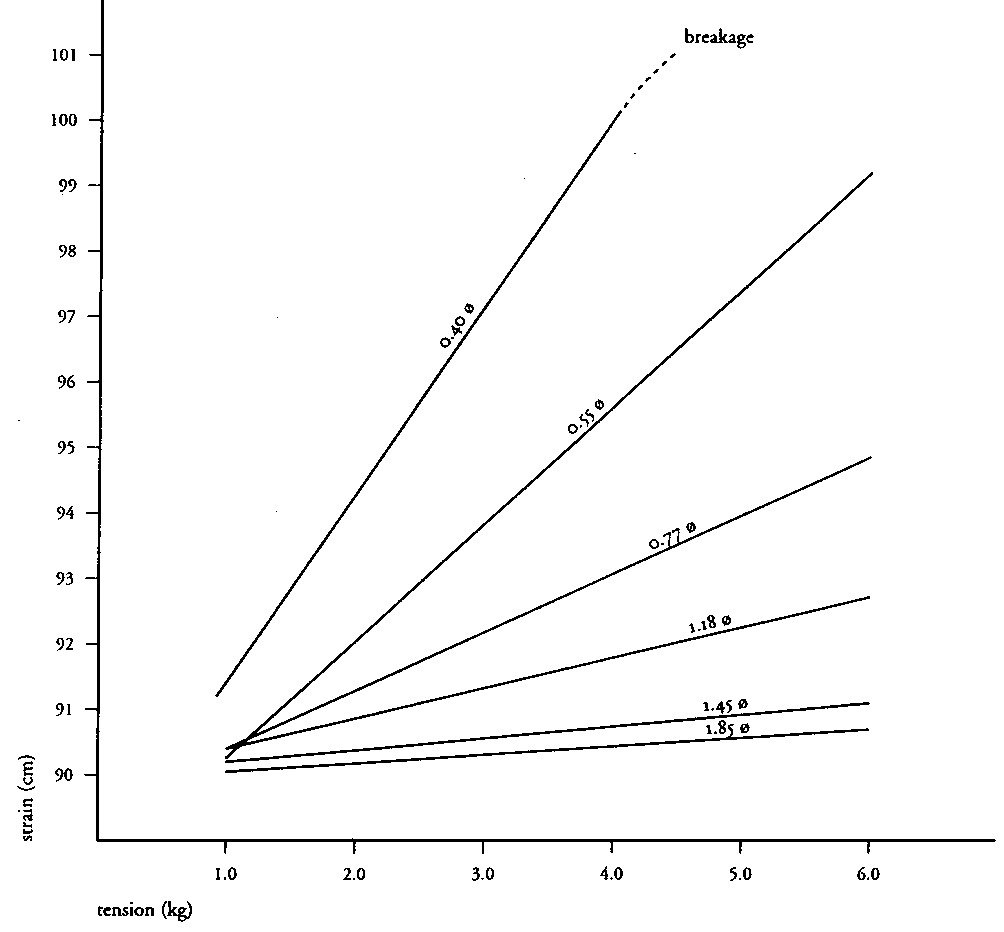
The Paganini relics at Palazzo Rosso
Measuring 19th-century string fragments
This subject immediately appears rather interesting because the discovery of original string samples not only allows their diameter to be established (measurements that can therefore confirm or disprove the interpretation of period documentation) but also allows a visual and analytical assessment of the strings themselves; in particular the amount of twist imparted to the gut, the degree of surface finish etc. The real problem lies in securely dating the samples: a genuine obstacle. Dating by means of radioisotopes (a method that is in itself destructive) is not practicable, given the short span of time elapsed. In any case, on the basis of the various samples collected for both violin and guitar — some found still in their original packets — we can state that they substantially confirm the accuracy of what has so far been worked out from old documents and from experimental trials.
The Paganini relics at Palazzo Rosso
Among the string samples found, those belonging to Paganini (1782–1840) are by far — and in every respect — the most recent and interesting relic among those forming his bequest, preserved in the Palazzo Rosso Archive in Genoa. These relics consist of a violin bridge, two bows (one of them broken in several places), a packet of rosin made by Vuillaume, and a roll of gut strings in fair condition, held together by two red silk ribbons. It is presumed that this bequest may have been handed over together with the violin to the Comune di Genova by Achille Paganini, Nicolò's son, in July 1851.
Our attention is focused on this last relic, which represents perhaps the first, if not the only, case in the world of samples of old gut strings whose dating is certain, dating, in other words, to the early decades of the 19th century. The material we examined in April 2001 was kept in an envelope stamped "Cartoleria Rubartelli Genova", sealed with red wax bearing the imprinted symbol of the Comune di Genova and a handwritten note in black ink: "Strings and bridge found on Paganini's violin at the moment of its delivery to the municipality". Inside was a second envelope, made from a folded sheet, bearing a second handwritten note: "Old strings from Nicolò Paganini's Violin". The string gauges were then measured by us with a micrometer, and the measurements fully confirmed the typical diameters of the period:
| String | Diameter | Notes |
|---|---|---|
| E | 0.70–0.72 mm | medium twist |
| A | 0.87–0.89 mm | high twist |
| A* | 0.80–0.83 mm | high twist (single segment) |
| D | 1.15–1.16 mm | high twist |
As can be seen, the fourth string is missing, which at the time was the only wound one. This should come as no surprise, since, as was customary for the period, it was made separately by the luthiers themselves (if not by the musicians themselves), using a rather thin second string subsequently wound with silver wire or some less noble metal. As shown by the late Edward Neill, Paganini himself, in some of his letters, gives interesting details about the strings he used on his violin: "I need a favour: take all possible care and diligence. I lack first strings. I want them very thin […]. Although so thin, they must be of 4 strands so as to endure. Make sure the string is smooth, even, and well drawn […] I beg you to keep an eye on the makers and to act promptly and well." (letter written at Breslau, 31 July 1829, addressed to "signore profre Onorio de Vito, Napoli"). In a letter sent shortly before from Naples to his friend and confidant Germi, dated 29 May 1829, we read: "Your Paganini wishes to know […] how many bundles of first strings and how many of seconds, and of how many strands, are wanted from Naples, because August is now approaching, the right season for making strings".
It may seem strange, but the importance of this find lies not so much in the fact that the strings belonged to the great violinist as, rather, in the fact that they can be securely dated and… are for the violin (that is… for the guitar!). It is not implausible, indeed, to think that these same gauges were used (can we say for certain?) also for our instrument, given that Paganini was more than a passable player of it. The strings from the find, coloured straw-yellow, fragile, slightly rough and intact, that is, never used, can presumably be summarised as two Ds, three As, two Es for violin. The E strings are made in medium twist, while the A and D strings are decidedly high twist: under these conditions a gut string is fairly elastic; it is no surprise at all that they must have displayed their acoustic properties at their best.
The strings of the 1845 Panormo
Here now are the measurements of some samples of gut string found in the case of a guitar built by Louis Panormo in 1845 (vibrating length = 63.3 cm), from a private collection. As for the E string, it was found not to be at all consistent, in its visual appearance and manufacture, with the second and third strings: it is probably a later addition. A secure dating of these strings is not possible, although the owner assures that the guitar in question remained unused inside its original case for a long time — perhaps a hundred years. It may perhaps serve as a useful clue that the ends of the wound strings (with a knot at one end and, at the other, a gap in the winding) would not allow a vibrating length greater than 64 cm to be covered: "post-Torres" stringing can therefore be ruled out. What remains is the fact that the gauges in question — the first string aside — are in line with 19th-century information; the analogy between the gauges of the B and G strings and those of the Paganini find (the A and the D) is evident. Below are given the diameter, wire diameter, "equivalent gut" and calculated working tension:
| String | Outer ø | Wire ø | Equivalent gut ø | Tension | Notes |
|---|---|---|---|---|---|
| E | 0.59 mm | — | — | 6.1 kg | gut, medium twist |
| B | 0.83 mm | — | — | 6.8 kg | gut, high twist |
| G | 1.14 mm | — | — | 8.0 kg | gut, high twist |
| A | 1.08 mm | 0.18 mm | 2.04 mm | 8.1 kg | wound on green silk |
| low E | 1.26 mm | 0.26 mm | 2.50 mm | 6.7 kg | wound on yellow silk |
On the basis of our own experimentation, the original wire diameters must have been between 0.20–0.22 mm for the A and 0.30–0.33 mm for the E (the starting diameter of the wire, which is silvered copper, turns out to be at least 10% greater, owing to the elongation the wire undergoes during the string's winding process). Taking the diameter values expressed as "equivalent gut", it is possible to derive the overall value of the working tension of the Panormo guitar's strings for a pitch standard of 435 Hz. The result is a total of about 45 kg (for a better alignment of the first string's tension — in practice at least 8 kg of tension — a diameter of at least 0.68 mm should be expected) and, above all, a profile essentially at equal tension, which once again confirms the figures cited earlier and, once again, Aguado's.
It is interesting to note that from this period onward guitar strings probably began to be packaged in dedicated envelopes rather than in bundles of coiled strings, and an early hint of a certain independence from violin packaging can perhaps be found in a catalogue by Luigi Forni dated 1867: "Italian Guitar Strings by the dozen… 30 to the bundle from Rome, Naples, of 2, 3, 4 strands, drawn to 2, 3, 4… National strings of the best factories… double-bass strings, copper-wound and plain, each…". It should be stressed that until at least the end of the 19th century strings were not sold one to an envelope, but in bundles of strings made up of the same number of strands.
19th-century wound basses
To make wound strings a dedicated hand-driven machine was used (like the one pictured in the first part of this study), in use at least until the end of the 19th century and later replaced by automatic winding machinery or by machines still hand-operated but with synchronised traction coming from both hooks supporting the multifilament under tension. With the system in use in the 18th and 19th centuries — rotating from one side only — the right amount of silk floss was fixed to a fixed hook at one end; the other end was fixed to another hook connected to a weight, which kept the material under tension while at the same time allowing freedom of rotation by means of a lubricated swivel joint. At this point the worker could wind the turns of metal wire while rotating the silk core by means of the crank wheel.
Interesting is the technique for depositing silver on the copper wire — a few microns thick — by simple chemical displacement: the electroplating process had not yet been invented, since it only began to take hold towards the middle of the following century. Since covered strings consist of the pairing of heterogeneous materials such as metal and silk, it has become customary to characterise them in terms of "equivalent gut": this refers, in practice, to the diameter of a theoretical gut string possessing the same weight as the wound string per unit length; under these conditions its gauge can therefore be determined by means of specific mathematical formulae. At the same pitch and vibrating length, the tension will therefore be the same. But be careful: even at equal equivalent gut, countless ratios between the amount of metal and that of silk can be obtained. Obviously, as one increases the other must decrease, in order to keep the total weight of the string — in other words, its "equivalent gut" — constant. The greater the prevalence of silk over metal, the more the tone will tend to be dull and poorly brilliant. The exact opposite where there is more metal.
By what criteria was the correct ratio between metal and silk in the basses decided, so as to guarantee a balanced timbral and dynamic performance? In the guitar, unlike bowed instruments, this choice left little room for manoeuvre: once the working tension had been decided (in other words, the equivalent diameter of the wound string), the proportions between metal and silk were chosen to obtain the greatest possible dynamic output from the string; to this end the thickest wire possible was chosen and the amount of silk was reduced to a minimum compatible with the breaking load: in other words, the aim was to achieve the greatest possible prevalence of metal over the "core". Only under these conditions could the bass strings deliver maximum dynamic output. Despite this precaution, silk-wound strings — even when found intact in their packaging — sound to our ears rather percussive and poor in upper partials.
As for the metal used for the winding, the almost exclusive choice of silvered copper should be stressed: ordinary copper with a thin silver coating deposited on its surface to best protect the copper from rapid oxidation, made worse besides by the sweat and moisture of the player's fingers. The "myth" that a thin silver coating improves the sound of bare copper must therefore be dispelled. The choice of copper as the base material is justified by the fact that it was the metal that combined — then as now — the highest specific weight with the lowest possible cost. This translated into a wire of reduced cross-section. Some, at the time, could certainly make advantageous use of pure silver (thus using a wire of smaller diameter, as Paganini did, for example, for the fourth string of his violin: "I do not know whether before, but after a week or two's stay there I shall return to Milan for your Violins and shall have fourths wound in silver wire made for you"), but in that case costs rose considerably. These considerations also hold for today's bass guitar strings.
Here now are the suggestions of Jean Baptiste Phillis (1804): "Je ne saurois trop reccomander aux Amatours de bien monter leurs instruments; car la négligence de le faire a toujours existé et déprécié la Guitarre. Il ne faut pas que les Cordes filées soient trop chargées de Soye; cela les assourdit et empêche la vibration." [I can never recommend enough to Amateurs that they string their instruments well; for negligence in this regard has always existed and has always been detrimental to the guitar. Wound strings must not be too heavily laden with silk; this deadens them and prevents vibration]. As for the gauge of metal wire (or "gauge") to be used: "On doit faire filer le Re du trait N° 15, le La du trait N° 13 et le Mi du trait N° 12. Les sons alors en seront parfait." Let us now see Romuald Truskolaski: "Too much silk makes the string too thick, and it then has a flat, short tone". And further: "…the first, E, string must be wound with No. 10, the second, A, with No. 13, the third, D, with No. 18."
Now for Castellacci, who provides — a unique case of its kind — the number of silk strands to be used as the core of the covered strings: 10 strands of silk and wire no. 10 for the sixth, 8 strands and wire no. 12 for the fifth, 6 strands and wire no. 16 for the fourth. While modern basses keep the thickness of the multifilament constant across all strings, in Castellacci's case it instead increases as one descends towards the lower strings. This results in an increasingly muffled acoustic output. It can further be observed that the variation in diameter among the various metal strands making up the winding for the D, the A and the E is less pronounced than in today's bass-string criteria. Finally, it should be noted that it is not yet known what a "brin" (that is, a strand) of silk would correspond to by today's technical standards; that is, in Dtex (decitex) or in "Deniers", both units of measurement for yarns. As for converting the "gauge" numbers of the metal wires in these examples into millimetres, research so far has unfortunately not led to any positive result, also because the gauge numbering here is strangely reversed with respect to usual practice, that is, an increase in wire diameter corresponds to a decrease in the number. It is thus not known whether these authors were referring to pure silver wire or to silvered copper, although the examination of old string fragments and the documentation found tend to favour the latter material.
Conclusions on the 19th century
The historical documentation found demonstrates clearly that the 19th-century guitar generally followed principles profoundly different from what is now widely assumed: it did not, in other words, have lower working tensions than today's guitar. Period documentation shows, if anything, that the opposite was true. It should also be noted how the tension profile of the strings differs markedly from that of our traditional sets: markedly scaled in ours, almost, if not exactly, at equal tension in theirs.
As if that were not enough, the basses of the time, besides being proportionally more tensioned than ours, used materials (silk) and followed criteria for balancing core and metal wire that would nowadays be considered thoroughly wrong. The resulting sonority was consequently rather percussive, by no means as sustained or as rich in upper partials as we now recognise in basses. Small movements of the peg were moreover enough to cause large frequency swings in the basses, since silk floss is less inclined to yield longitudinally than nylon multifilament. Gut itself, moreover — as we shall see better in the fourth and final part — has, in itself, acoustic properties profoundly different from nylon and, in certain respects, much closer to carbon.
To speak, therefore, of historically informed (or, as one says, philological) performance merely because a Panormo or a Fabbricatore strung with synthetic material (following today's criteria, certainly not those of the time) is used seems, frankly, in light of what has been examined so far, a rather bold claim. But the truth that emerges from the documents, with its undoubtedly destabilising weight for us, need not frighten us: if anything it points us towards the desire to experiment, to explore new paths. In a word: the authentic sonority of the 19th-century guitar is, for the most part, still entirely to be discovered.
With this concluding note the chapter concerning guitar strings in the 19th century thus comes to a close. The following century will mark, with brutal speed, the end of the millennia-long dominance of silk and gut, as a consequence of the extraordinary discovery of Dr Carothers, a research chemist at the American Du Pont company, and of the decisive, pioneering contribution of men of the calibre of Albert Augustine and Andrés Segovia: the age of nylon had arrived.
Part four — The 20th century and the advent of nylon
The decline of Italian stringmaking
The foundations that characterised the 20th-century guitar were laid as early as the second half of the 19th century, and consisted essentially in the arrival of the guitar of Antonio de Torres. Even so, no one at the time could remotely foresee the epoch-making change that synthetic chemistry would bring about, towards the middle of the following century, in the world of the guitar. What matters here is that with Torres the guitar's vibrating length rose and settled around 65 cm, and has substantially remained so to this day, barring a few exceptions such as instruments built by the Ramirez family (about 67 cm of vibrating length). The reasons that led the great luthier to this precise increase remain unknown, given that stringmaking technology and pitch-standard frequencies did not change appreciably from the norm. As regards the question of pitch standard in the late 19th/early 20th century in particular, it can be held that it substantially stabilised around 435 Hz, the fruit of the first effective international agreements of the late century.
As for string production, an unstoppable phenomenon must unfortunately be noted: the abrupt collapse of the glorious, centuries-old Italian production, for centuries the backbone of music-making in Europe — suffice it to say that even today the centres in Italy producing gut strings for musical use are only three, located at Salle, Vicenza and Naples. While in Italy string production — spread across a good part of the central-northern region — was always characterised as an entirely artisanal, individualistic affair, in France stringmakers instead enjoyed the attention of the State administration, which regarded them with pride. In Germany the production of gut strings had in fact taken on an industrial character. Although the quality of the German product often left something to be desired (the strings were indeed inexpensive, but rather stiff), the Germans, already in the early decades of the 20th century, were able to dominate a large part of the European market, despite the rapid and growing spread, among bowed instruments — which were the principal users of musical strings — of metal strings.
The causes of the rapid Italian decline, besides the "scattered" nature of national production, are probably to be sought in the general severe economic hardships weighing on the population of the time. These difficulties stemmed in part from the still-recent Unification of Italy at first, and later from the events of the 1915–18 war. Many Italians, in order to make ends meet, chose the path of emigration, and among them also several stringmakers; some of these managed, against enormous odds, to lay the foundations of what would later become the flourishing North American production (D'Addario, La Bella-Mari etc.: all surnames of Abruzzese origin). In Europe Markneukirchen, Saxony, Hauser in Munich and Pirastro took the lead; Lorenzo Frignani of Modena remained one of the few Italians.
It is not yet known when the guitar began to grow independent of comparison with violin strings. We may suppose that this happened to coincide with the increase in its vibrating length: such a "detachment" became necessary in order to keep tension values more or less unchanged with respect to established custom, since a longer string length calls for the use of thinner gauges. It should indeed be noted that the shift from a vibrating length of about 62 cm (typical of guitars of the first half of the 19th century) to 65 cm — almost a semitone of extra length — would, were the strings unchanged, entail an increase in working tension of nearly one kg in total.
Pujol's gauges and early-20th-century samples
For meaningful data referring exclusively to the guitar, however, one has to wait for Pujol. On the basis of the precise indications given in his Method, it can be seen that there was indeed a slight fall in the average diameter of the treble strings compared with the previous century and, importantly, the first appearance of a degree of scaling in working tension, an aspect virtually unknown to 19th-century guitar stringing. The first precise indications referring exclusively to the guitar are thus due to Emilio Pujol, whose Escuela razonada was published in 1934 but whose writing almost certainly dates from the late 1920s; the string measurements reported can very probably also cover that earlier period. The measurements are, in fact, given not in tenths but in twentieths of a millimetre, following the "PM" grading still used for Pirastro gauges:
| String | Pujol's figure | Diameter | Tension |
|---|---|---|---|
| 1st E | 12.5–13.5 | 0.63–0.68 mm | 7.4–8.6 kg |
| 2nd B | 16–17.5 | 0.80–0.88 mm | 6.0–8.1 kg |
| 3rd G | 20–21.5 | 1.00–1.08 mm | 6.6–7.7 kg |
| 4th D | 15–16 | 0.75–0.80 mm (outer) | — |
| 5th A | 18.5–19.5 | 0.93–0.98 mm (outer) | — |
| 6th E | 23–24 | 1.15–1.20 mm (outer) | — |
At the pitch standard of 435 Hz and the vibrating length of 65 cm (Pujol owned a Torres guitar), the following ranges result for the working tension of the trebles: E 7.4–8.6 kg; B 6.0–8.1 kg; G 6.6–7.7 kg (for the basses the tension cannot be calculated, since the measurements given by Pujol refer only to the outer diameter). Although these are gauges specific to the guitar, the alignment of the three trebles with the gauges in use on the contemporary violin remains striking, and this held true for at least another decade: compare, for instance, the violin diameters suggested by Carl Flesch in 1924: E 0.63 mm, A 0.82 mm, D 1.09 mm.
As for the second string, Pujol curiously suggests that it should be exactly halfway in thickness between the third and the first, twice as thick as the latter, justifying this with the fact that "la necesidad de una cierta claridad que secunde en esta cuerda el carácter expressivo de la prima, hace que se prefiera ligeramente delgada, siempre que no cerdée" [the need for a certain clarity that should support, on this string, the expressive character of the first, means that it is preferred slightly thin, provided it does not lose its intonation]. The meaning of this remark is not clear to us: the table instead shows that the diameter of the second string is exactly the average of the diameters of the first and third. The Manual still reports the old test for telling a false string from a good one: this means that at the time strings were still smoothed by hand. Interesting is the description of the Pirastro micrometer for measuring string diameters, an instrument that was then beginning to supplant the old 19th-century plate-type string gauge. The direct consequence of the introduction of scaled tension was that the tactile sensation of stiffness began to appear more homogeneous among the strings.
Here now are some examples of gut violin strings we have found: they date from the early decades of the 20th century and can offer a useful comparison with those of the guitar: an E of 0.66 mm in an oiled-paper packet marked "Bimba"; an E of 0.68 mm in a packet marked "London", high twist; a D of 1.14 mm in an unclassifiable packet, high twist, origin unknown; a D of 1.17 mm in a packet marked "Lustral", Valtelot-Hekking, Paris, high twist.
Here, then, are the measurements of gut guitar strings probably dating from the 1940s/50s, found intact in their sealed packets, marked (a) for strings kindly made available to us by the luthier Lorenzo Frignani of Modena, and (b) for samples found in the case of an 1867 Torres guitar held at the Palacio de la Guitarra in Ibaraki (Japan): E 0.64 mm, packet marked "Perfect", France, medium twist (a); E 0.65–0.67 mm, string coiled and never used, high twist (b); A 0.84–0.86 mm, string coiled and never used, high twist (b); G 1.02–1.04 mm and 1.0–1.03 mm, strings coiled and never used, high twist (b); G 1.02 mm, packet marked "Perfect", France, low twist (a); G 1.05 mm, packet marked "Celesta", France, low twist (a). These measurements show total agreement with what Pujol wrote, as well as confirming the scaling of working tension and the continued, if unspoken, link with violin gauges: the violin is simply no longer mentioned as a term of comparison.
The poor elasticity found in some of these samples should be stressed: hard and stiff to the touch, they are made with a low degree of twist, a feature that sets them well apart from the high quality of strings produced in Italy and France in the 19th century. Recall that a poorly twisted string, owing to its considerable stiffness, certainly does not allow the best acoustic performance; the manufacture of particularly "hard" strings might be explained by an attempt to increase durability and pitch stability, albeit at the expense of tone — a trait shared by most of the patents on gut-string manufacture of this period, chiefly the work of German researchers. It should be noted that the working tension of the first string did not actually change from the 19th century, if one considers that the roughly one-fret increase in vibrating length brought about by the Spaniards corresponds to a compensating reduction in the string diameter used, amounting precisely to about a semitone.
Let us now examine some samples of silk-wound strings probably dating from the 1930s/40s, to be compared with modern ones, in particular as regards the diameter of the metal wires used, the outer diameter and the equivalent gut (the strings marked (a) and (b) come respectively from the luthier Frignani and from the Torres held at the Palacio de la Guitarra, while the one marked (c) was made available to us by Kenneth Sparr of Stockholm): D 0.72 mm (wire 0.11 mm, equivalent gut 1.33 mm, tension 6.5 kg), oiled-paper envelope "Flamenco" (a); A 0.91 mm (wire 0.18 mm, equivalent gut 1.80 mm, tension 6.7 kg), oiled-paper envelope "Flamenco" (a); A 1.02 mm (wire 0.18 mm, equivalent gut 1.80 mm, tension 6.7 kg), loose string coiled (b); E 1.23 mm (wire 0.28 mm, equivalent gut 2.53 mm, tension 7.5 kg), oiled-paper envelope "Manucord" (a); E 1.20 mm (wire 0.23 mm, equivalent gut 2.32 mm, tension 6.3 kg), oiled-paper envelope "Boyaucord" (a); E 1.17 mm (wire 0.24 mm, equivalent gut 2.34 mm, tension 6.4 kg), without its own packaging (c); E 1.26 mm and 1.19 mm (wire 0.28 mm, equivalent gut 2.34 mm, tension 6.4 kg), loose strings coiled (b). Tensions are calculated for an instrument with a vibrating length of 65 cm and a pitch standard of 435 Hz; all wires are silvered copper.
The advent of nylon (1947)
With the appearance of the polyamides (nylon) — on the eve of the Second World War — the scenario changed radically. It is probably not widely known what an absolutely decisive role Andrés Segovia played in driving the application of new synthetic materials to replace gut, at a time in history (there was a war on) when all the available gut had to be used to make surgical suture for military use. In Italy, for instance, it seems the Allies literally "requisitioned" the last Italian centres producing gut strings — Salle and Musellaro, in Abruzzo — assigning them to the massive, exclusive and "top secret" production of suture thread. This new production line remains alive to this day, having almost entirely supplanted the production of musical strings.
In this scenario, where finding gut strings for musical use was an impossible undertaking, the polyamides suddenly, as has been said, entered the scene. The gold medal for technical experimentation applied to the guitar goes unreservedly to the New York luthier Albert Augustine, one of the luthiers known to Segovia, who, under the Maestro's irresistible pressure, succeeded in the task of perfecting for musical purposes this synthetic material, available in the form of a thread recently discovered (1938) by Dr Wallace Carothers, chief researcher at the laboratories of the American Du Pont Company. This new class of materials, which revealed extraordinary mechanical properties, was christened by the company itself with the generic "surname" of nylon. Perlon (polyamide 6) was the progenitor of the nylon family and was immediately used for fishing line, for women's stockings, but above all to make parachutes for military use.
Andrés Segovia's decisive role is little known. Segovia, as early as the beginning of 1947, was among the first to be able to try nylon, thanks to some samples of thread (not yet fit to be called strings proper) supplied to him by General Lindenman, a pivotal figure whom he happened to meet at a reception at the Spanish embassy in Washington at Christmas 1946. During the reception, Segovia happened to complain to him about the endemic shortage on the market of gut strings, and first strings in particular, on account of the war (let us recall that it was precisely Germany that held, in the 1930s, the lead in European production). The general on that occasion promised to send him some samples of the new material, which he himself would request confidentially from Du Pont. A month later a few nylon filaments that could pass for a guitar first string arrived at the hotel where Segovia was staying: he tested them at once on his instrument, grasping their great potential instantly. From this precise moment the age of gut ended forever.
Despite the scepticism of Du Pont's own experts, Albert Augustine (apparently in collaboration also with the firm of Mari/La Bella, well-known New York stringmakers of Italian origin, manufacturers of gut strings) succeeded, constantly spurred on by Segovia, in the final development of both trebles and basses with the new nylon-floss core: a sort of "artificial silk", in other words. This allowed the first commercial production of synthetic guitar strings under the "Augustine" brand. Du Pont immediately developed — already in the early 1950s — products better suited to music (that is, endowed with a high elastic modulus and low moisture absorption), such as polyamide 6-12 (better known as Tynex and still used today for the guitar's trebles), whose bulk use, in truth, was centred, then as now, on the production of synthetic bristles for… toothbrushes.
One naturally wonders whether the transition from gut to nylon brought about major changes in the choice of gauges and in working tensions: the answer is yes, but with due qualifications.

Acoustic consequences
The first consideration concerns the acoustic and mechanical properties of nylon in the trebles: without going too deeply into technical details, already amply covered elsewhere, it should be said that this material has the merit of low atmospheric moisture absorption (for Tynex, about 3% at saturation against about 20% for gut), a low cost, a perfectly glossy surface — not possible with gut — and, finally, considerable resistance to abrasion: these are undoubted mechanical and reliability advantages, but ones that in themselves have no bearing whatsoever on tone quality. By contrast, the specific weight of the polyamides is noticeably lower than that of the natural material (1.07 g/cm³ against 1.30 g/cm³ for gut), a major handicap from the point of view of sound, because it translates into a less brilliant response, with a slower, noisier attack transient than gut, which in certain respects tends instead to resemble carbon far more than nylon. In other words, the advent of nylon caused, for the first time, a remarkable departure from the acoustic tradition induced, since the dawn of time, by gut strings.
In the basses, by contrast, a genuine revolution took place: multifilament nylon has a tensile strength so much greater than silk's (besides possessing a lower degree of atmospheric moisture absorption) that it allowed, for the first time, a sharp reduction in the diameter of the "core" in favour of the metal wire. The consequence of this change was a considerable increase in the acoustic power of the bass registers, virtually unknown to guitarists until then. To give a concrete example, in the E string one moved from a silvered-copper wire of only 0.30 mm, typical of silk-cored strings, to today's 0.35 mm, entirely to the benefit of the sound. Put another way (since tone quality — at equal equivalent gut — depends on how thin the core used is), if in the early 20th century the diameter of the silk core of the low E was around 0.70 mm, with nylon it is reduced to only about 0.52 mm: in both cases a bass string is nonetheless designed to work at the limit, in practice one or two semitones below the core's breaking point. One can readily tell when the exitus is approaching, since the string no longer rises in pitch despite the tuning peg being turned, while small crackling sounds begin to be heard, caused by fibres breaking in rapid succession inside the string itself.
It should be noted that the new basses show greater longitudinal give than those with silk; this translates into more turns of the tuning machine being needed before reaching the required pitch, which is an advantage for the precision of that same tuning. For the trebles, then, gut's vocality was traded for nylon's low cost, reliability, and climatic and pitch stability. The acoustic output of the trebles, however, became more muffled and less brilliant (an aspect only partly remedied by carbon, a Japanese-patented material introduced in Europe in the 1970s, whose specific weight goes well beyond that of gut itself: 1.78 g/cm³ against 1.30 g/cm³ for gut), thereby producing a sonority that is certainly prompt and incisive, but judged by many "emotionally cold". A genuine reversal, then: percussive basses, poor in harmonics, with brilliant trebles until 1948; brilliant, sustaining basses but more muffled trebles in the decades that followed. It is also the reason why the recordings of Tarrega, Pujol and Segovia from the 1920s and 1930s "sound different".
It should be noted how the appearance of synthetic materials has inevitably brought about a certain technological flattening: while gut strings were made by hand by numerous European manufacturing centres, each following its own idea of a string, polyamide threads are made by a handful of international producers. Most of the companies that "make" guitar strings ultimately limit themselves to simple packaging, after buying in "bars" weighing a few kilograms, made up of a few thousand nylon threads of the same size, thread that can in truth be used for various purposes, musical use being only one of them. It should be noted that the range of commercial gauges available to the buyer has long since been standardised — read: dictated — by the very company that extrudes the thread. The exact same situation can be observed for the multifilament of the basses, which is sold in standardised sizes according to criteria borrowed from the textile industry (since it is used chiefly as a reinforcing component in car tyres and for textile uses in general); it is, in short, simply a matter of covering it with silvered-copper wire or other alloys — including brass or, more rarely, alloys containing a higher proportion of silver — and cutting the resulting string to commercial length.
It is obvious, therefore, that strings produced by the various brands are inevitably rather similar — not to say identical — to one another. Nor could it be otherwise, given that nylon multifilament is practically the same for everyone, and that the ratio between metal and multifilament has long since reached the optimisation beyond which a string under tension risks breaking prematurely. The same problem is found for the nylon of the trebles, since these too follow predetermined industrial production channels.
The tension profile of modern guitars
What has been said can readily be verified in the table below, which compares guitar-string sets of some of the best-known brands (the packets on which our measurements were taken were purchased in 2000 from a musical-accessories shop in Vicenza). Today's commercial sets show a strongly scaled tension profile, with two independent trends covering respectively the three nylon or PVDF trebles and the three wound basses. Measurements taken on some of the best-known brands, for an instrument of 65 cm vibrating length at A = 440 Hz, give the following picture:
| Set | E | B | G | D | A | low E |
|---|---|---|---|---|---|---|
| Hannabach 815 Low tension | 8.3 | 6.4 | 5.9 | 8.2 | 7.5 | 6.9 |
| Hannabach 8271 HT "flamenco" | 9.1 | 6.4 | 6.4 | 8.6 | 8.3 | 7.3 |
| Augustine Light tension | 8.3 | 6.4 | 6.4 | 8.2 | 7.5 | 6.9 |
| Savarez-Alliance 540 RH (PVDF) | 10.5 | 7.0 | 6.5 | 8.3 | 6.8 | 7.0 |
| D'Addario Compositum High tension | 7.8 | 6.0 | 6.0 | 7.7 | 8.3 | 7.7 |
What undoubtedly strikes one most about these current sets is the even more strongly scaled trend of working tensions compared with those reported by Pujol, to the point of making them resemble those of the 19th-century violin. Tensions that are moreover divided — within the same set — into two independent trends concerning either the three more treble nylon/PVDF strings or the three wound basses. The purpose of so bizarre a tension profile, remarkably similar across the various brands, is aimed at recovering as far as possible the equality of tactile sensation of stiffness across all strings: the scaling indeed compensates for the increase in stiffness that would otherwise be found in progressively thicker strings.
Absolutely curious (if not disquieting) is the fact that the working-tension range between the extreme versions of one and the same model ("Light" and "Heavy") fails to exceed a semitone. One can further observe the case of some strings of the "Light" version that turn out to be tighter than the "Medium" version and, dulcis in fundo, that what is printed on the outside of some packets (string diameters, working tension etc.) does not correspond at all to the actual string gauges found by accurate laboratory measurement: one often finds, in other words, tensions and diameters rather different from what is stated on the packets. Still on the subject of tension, by way of example, if one takes the equivalent-gut diameter of the E string in the Hannabach "Low tension" series, it turns out to be 2.41 mm. Were it raised by a semitone (thereby constituting what might almost be considered a Medium Tension) it would reach an "equivalent gut" of 2.55 mm. But in the High tension series — which is the highest tension — it reaches only a value of 2.48 mm: only a quarter-tone more than the Low tension. Can this be called a Heavy tension? Similarly, with the two Augustine sets considered, it is found that the nylon trebles of the Light tension are in fact thicker than those of the Heavy; for the three basses, on the other hand, things run smoothly, except that here too the gap between the two extreme tension grades of the basses barely reaches 1/4 of a tone. For the more meticulous among us we should specify that the diameter and weight measurements of commercial strings were taken by us with a calibrated precision micrometer, while the weights of wound strings — whose "equivalent gut" diameter is derived by simple calculation — were obtained by means of a microanalysis balance accurate to the fifth decimal place and under conditions of constant humidity.
For the sake of completeness it should be pointed out that treble strings, by their very nature, always show a certain degree of ovalisation and inconsistency of gauge along their length: this is a consequence of the fact that one starts from a molten material, which is then extruded to size and cooled. For gut strings this was a decidedly unknown issue. For the basses, likewise, there is always a certain fluctuation in the gauge of string produced, depending on whether the worker manages, through his own skill, to maintain a constant pull on the metal wire while winding it onto the nylon floss held under tension and rotation. Experimental trials have shown that this fluctuation (when deliberately pushed to the extreme) can produce as much as 1/4 of a tone of tension difference between two supposedly identical strings (that is, made from the same amount of floss and the same metal wire), where the wire, during the winding stage, was in one case kept under lighter tension and in the other under greater tension. This state of affairs, which does in fact exist, certainly opens up serious questions for those who enjoy devising ingenious, and often complicated, schemes for laying out a guitar's frets in order to achieve so-called perfect intonation. Gut strings, which did not suffer from ovalisation, were instead rather soft, so much so that they suffered heavily under the action of right-hand nails and metal frets. This aspect is utterly negligible with nylon and carbon strings, which are far harder than gut.
Final recap
At this point it seems to emerge with sufficient clarity that the stringing and the types of strings used on the guitar in the past always followed criteria substantially different from those commonly in use today for stringing the baroque, romantic and early-20th-century guitar. This may partly explain the thinness of the sound produced today on these instruments.
As regards the guitar of the "Age of Enlightenment" in particular, it is evident that we find ourselves literally on another planet, and this not only from the strictly organological and musical point of view, but also as regards tuning, the types of strings and the diameters involved. Beyond the constructional affinity with instruments of more recent build and single strings, it thus seems we are dealing with an altogether different instrument from that of the following century. As for the latter, in turn, it actually used string diameters far larger than has so far been supposed, with a distribution essentially at equal tension among the various strings and, moreover, with silk basses. The strings themselves, it has been said, were probably quite different from today's gut strings, whose current production yields strings that are almost always too stiff (and stiffness has a negative effect on tone quality). Italian and French production of the time, by contrast, aimed at obtaining gut strings that were far more elastic and hence of better acoustic performance. It should also be remembered that, unlike today, musicians of the time could easily tell a good string from a bad one by touch and sight, whereas today this culture appears almost entirely lost. One could moreover choose stringing more or less strong according to personal taste and the type of instrument, simply by looking, within the usual packet (marked with a number indicating the quantity of strands making up all the strings in the bundle), by means of the appropriate string gauge, for strings deemed suitable. With the evolution of the guitar that took place in the late 19th century (Torres), the criteria for choosing a stringing underwent a change in the type of diameters to be used (thinner) compared with the 19th century.
But the most substantial difference compared with the previous century is found in the tension profile across the strings: now become scaled, it allows the recovery of a homogeneous tactile sensation of stiffness, which had been the guiding criterion in the centuries preceding the 19th. It should nonetheless be observed that a reduction in gauge of about a semitone's worth of tension is accompanied also by an increase in vibrating length, likewise equal to about a semitone: it follows, therefore — through a compensating effect — that the average value of total tension did not undergo significant increases or decreases, since diameter and vibrating length are inversely proportional to working tension.
As for the basses, while in the 18th century they were predominantly made of covered gut, with the advent of the six-single-string guitar they were always made using silk, taking care — at equal equivalent gut — to achieve the greatest possible prevalence of metal over silk. It is believed that silk basses — which offer certainly better acoustic performance than those with a gut core — may have played a certain part in the "launch" of the smaller, six-string guitar, even though they cannot stand any comparison at all with nylon floss.
With the advent of nylon a genuine Copernican revolution took place that no one could, or could have, foreseen, accompanied however by a certain flattening of production owing to the standardised supply methods for nylon monofilament and multifilament. These materials, unlike gut, are now produced on a large scale — and to rigidly fixed sizes — by the multinational patent holders, generally Japanese (for carbon) or American (for nylon). Commercial guitar sets inevitably show strong similarities to one another and only partly match those in use in the first half of the 20th century, especially in the tension profile of the first three strings. The situation is different, however, for basses with a synthetic multifilament core: thanks to their better mechanical qualities, their acoustic performance, compared with silk, is considerably better; most of the "percussive" effect typical of silk-cored strings disappears, and one obtains, at the same time, greater power of emission, richness of upper partials — not always desired, in truth — and sustain.
But research has not forgotten gut: current trends are strongly geared towards developing materials that reproduce the acoustic performance typical of this element without the characteristic drawbacks already overcome, in their time, by nylon, such as high cost, instability under changing climate, and poor durability. Hence the appearance on the scene of new products such as the already-mentioned PVDF for the first treble strings, new types of nylon (more transparent and of better sonority, such as Cristal, made of polyamide 12), followed shortly afterwards by Nylgut, a synthetic material recently applied to music, of translucent white colour, which, having the same density as gut, in some ways represents its most faithful synthetic version, since it has an acoustic performance extremely similar — if not identical — to it. On the other hand it has the drawback of being rather soft compared with nylon and carbon (as, indeed, is gut itself). Nylgut, made in the form of a multifilament — owing to its high tensile strength — has recently allowed a further reduction in the amount of core material in the basses in favour of a greater amount of metal, thereby opening the way to an unprecedented generation of wound strings characterised by surprising overall performance, with outer diameters — especially if made in pure silver — noticeably smaller. In other words, a low E can have a diameter only slightly greater than that of a traditional nylon A. The diameter of the E core at an equal degree of tension has thus progressively gone from the 0.67–0.74 mm typical of silk floss, to the 0.44–0.50 mm of nylon, down to today's 0.30–0.35 mm made possible by Nylgut floss.
Conclusions
The history of stringmakers, unlike that of their luthier and musician colleagues, was substantially marked by almost total anonymity. Many of them, moreover, could neither read nor write, and their humble workshops were pushed out of the towns without much ceremony because of the frankly nauseating smell the production process gave off. It is difficult to know anything of their private lives, and even harder to glean anything more of their trade secrets. It is harder still for us to acknowledge that the noble art of music was based, for millennia, essentially on such a repellent material: animal gut.
Credit must nonetheless go to stringmakers for making plucked and bowed sound possible, and above all controllable and reproducible. Enough to allow the greatness of a Bach, a Torres, a Segovia, but also the simple amateur, to express their own poetry.
The propulsive drive given by Andrés Segovia to the development of synthetic materials was literally irresistible. Judgement Day had decidedly come for gut: from the Maestro's writings, in those frantic years dense with experimentation, there shows through, beyond any doubt, a genuine bitterness on the part of a great performer, which he truly was, who could no longer bear strings that frayed during concerts and, as if that were not enough, were expensive, of variable quality and at the mercy of the vagaries of the weather: "Those of my generation who devoted themselves, whether professionally or as amateurs, to the guitar will remember, as I do, how much we suffered when all we had were gut and silk strings, despite the well-meaning efforts of the directors of Pirastro, or of Hermann Hauser, for instance, who brought their products to the highest degree of perfection attainable in those days." And further: "I was increasingly irritated by the shrill sound of the first string, at times rather offensive to a sensitive ear, by the lack of sweetness of the second, and by the truly rough, dark timbre of the third. The sound of the fourth, fifth and sixth strings, moreover, died away at once." With Segovia, in short, the millennia-old symbiotic bond between plucked musical instruments and natural materials such as gut and silk was closed forever. But, as often happens to people strongly driven by an important cause, he forgot to record for posterity the good qualities contained in what he was fighting against; specifically, the quality that in any case makes gut an absolutely unique material, almost endowed with a soul: its irresistible tendency towards "vocality". That is, towards the imitation of the human voice.
I wish here to set aside the strictly scientific aspects covered so far, in order to lead the reader into a realm where the emotional and artistic dimension takes over, to the point of inspiring possible future directions for research. In years of conversation between myself and my friend Stefano Grondona, some interesting anecdotal aspects have emerged whose substance offers verification of what has been discussed so far. One of the most significant episodes concerns a recording by Andrés Segovia. Beyond the unquestionable value of the artist's own work, this recording carries a deep significance in Grondona's personal history in that, as he has often stressed, it was the impression made by those performances that led him to decide to become a guitarist. In other words, the sound of that record was for a long time almost a "guiding spirit".
In this sense that sound had within it a magical, transcendent quality, partly owing to certain characteristics that might seem almost at odds with today's canons of beautiful tone. He pointed out to me that he had always sought the particular expressiveness of those basses, so singing and yet so veiled, to the point of choosing instruments with the characteristic of being "dull".
Segovia's instrument, taken as a whole, possessed an absolute expressive proportion across every register. The result of that recording was, for Grondona, simply compelling; but at the time these recordings were being made, neither guitars nor strings (nor, probably, any hands other than Segovia's own) seemed able to produce even a faint imitation of those sounds. Only after years spent in constant artistic research, crowned more recently by an intense synergy between player and stringmaker, has it become possible to arrive at a plausible explanation for the mystery of that sound, while also giving a new historical picture of that record: recorded in 1944 (this the revealing discovery) but published on an LP only in 1949, the record contained recordings made by Segovia with the legendary 1937 Hauser, still strung entirely with gut strings and silk-wound basses, the furthest outpost of a world on the verge of extinction. The recordings Segovia would go on to make immediately after the war (London, 1949; the Castelnuovo-Tedesco Concerto, Ponce's Sonatina Meridional etc.) are in fact, to this day, the very first in which a guitar (again the same 1937 Hauser) is found strung with nylon strings.
This record, then, emblematically represents Segovia's last recording made while still unaware of the revolutionary step that, shortly afterwards, through his own strong determination, would be taken. And it could not have been a finer farewell concert! With this record, an era closes in a certain sense, an era that was in fact still shaped by the cultural canons and aesthetics of the 19th century.
Rediscovering the culture of gut and the historical criteria of choice and manufacture is the precondition for listening critically to pre-1950 recordings and for giving back to period guitars, so often copied today, their authentic sonic universe.
M.P.
References
- Stefano Grondona, Luca Waldner, La chitarra di liuteria, L'Officina del Libro, Sondrio 2001.
- Werner Bachmann, The Origins of bowing, Oxford University Press, London 1969, p. 79.
- Stephen Bonta, "From Violone to Violoncello: a question of strings?", Journal of the American Musical Instrument Society III, 1977, pp. 64–99.
- Christopher Page, Voices and Instruments of the Middle Ages, J.M. Dent & Sons, London, pp. 234–5.
- Djilda Abbott, Ephraim Segerman, "Strings in the 16th and 17th centuries", The Galpin Society Journal XXVII, 1974, pp. 48–73.
- Mimmo Peruffo, "The mystery of gut bass strings in the sixteenth and seventeenth centuries: the role of loaded-weighted gut", Recercare V, 1993, pp. 115–51.
- Samuel Hartlib, Ephemerides, ms. 1659.
- John Playford, An introduction to the skill of music, William Godbid for John Playford, London 1664.
- Claude Perrault, Œuvres de physique, Amsterdam 1727 (1st ed. 1680), pp. 224–225.
- Patrizio Barbieri, "Cembalaro, organaro, chitarraro e fabbricatore di corde armoniche nella Polyanthea technica di Pinaroli (1718–32)", Recercare I, 1989, p. 198.
- Antonio Domenico Gabbiani, Ritratto di musicisti alla corte medicea, 1684–1687, Florence, Palazzo Pitti, inv. 1890.
- François De Lalande, Voyage en Italie… fait dans les années 1765 & 1766, 2nd ed., vol. IX, Desaint, Paris 1786, pp. 514–519.
- Francesco Griselini, Dizionario delle arti e mestieri, vol. V, Venice 1769.
- Francesco Galeazzi, Elementi teorico-pratici di musica, Pilucchi Cracas, Rome 1791, pp. 71–76.
- Antoine-Germain Labarraque, L'art du boyaudier, Imprimerie de Madame Huzard, Paris 1822, pp. 31–32.
- Louis Spohr, Violinschule, Tobias Haslinger, Vienna 1832, pp. 13–14.
- George Hart, The violin and its music, Dulau and Schott, London 1881, pp. 46–47.
- Luigi Forino, Il violoncello, il violoncellista ed i violoncellisti, Hoepli, Turin 1905, pp. 55–56.
- Patrizia Frisoli, "The Museo Stradivariano in Cremona", The Galpin Society Journal XXIV, July 1971, p. 40.
- Michel Corrette, Les Dons d'Apollon, Paris 1763, p. 22, ch. XVI.
- François Le Cocq, Recueil des pieces de guitarre, Brussels 1730, ms., ch. "Des chordes".
- Pierre-Jean Baillon, Nouvelle Méthode de Guitarre, Paris 1781, p. 3.
- Sébastien de Brossard, Fragments d'une méthode de violon, ms. c. 1712.
- Jean-Benjamin De Laborde, Essai sur la musique ancienne et moderne, Paris 1780.
- Antonio Vargas y Guzmán, Explicación para tocar la guitarra, Veracruz 1776 (cf. Robert Stevenson, "A neglected Mexican Guitar Manual of 1776", Inter-American Music Review I/1, 1979, pp. 205–10).
- Edward Neill, Nicolò Paganini: Registro di lettere, 1829, Graphos, Genoa 1991, p. 80.
- Edward Neill, Paganini: epistolario, Comune di Genova, Genoa 1982, p. 49.
- Mimmo Peruffo, "Italian violin strings in the eighteenth and nineteenth centuries: typologies, manufacturing techniques and principles of stringing", Recercare IX, 1997, pp. 155–203.
- Patrizio Barbieri, "Giordano Riccati on the diameters of strings and pipes", The Galpin Society Journal XXXVIII, 1985, pp. 20–34.
- Jean-Carl Maugin, Walter Maigne, Nouveau manuel complet du luthier, 2nd ed., Roret, Paris 1869, pp. 183–184.
- Philippe Savaresse, "Cordes pour tous les instruments de musique", in Charles P.L. Laboulaye, Dictionnaire des arts et manufactures, 3rd ed., vol. I, Lacroix, Paris 1865.
- Carl Flesch, The art of violin playing, Fischer, New York 1924–30.
- Daniello Bartoli, Del suono, de' tremori armonici e dell'udito, Nicolò Angelo Tinassi, Rome 1679.
- Thomas Mace, Musick's Monument, Ratcliffe & Thompson for the author and John Carr, London 1676, ch. VI, pp. 65–66.
- John Dowland, "Other necessary observations belonging to the lute", in Robert Dowland, Varietie of Lute Lessons, Thomas Adams, London 1610.
- Jean-Baptiste Phillis, Nouvelle Méthode Pour la Lyre ou Guitare A Six Cordes, op. 6, Paris c. 1804, p. 6.
- Luigi Castellacci, Grande Méthode de Guitare, Paris 1824, p. 92.
- Dionisio Aguado, Nuevo Método para Guitarra, Madrid 1843, chs. VI and VII.
- Carlo Gervasoni, La Scuola di Musica, Piacenza 1800, part one, p. 126.
- Domenico Angeloni, Il Liutaio, Hoepli, Milan 1923, pp. 279–298.
- Emilio Pujol, Escuela razonada de la guitarra, Libro Primero, Ricordi Americana, Buenos Aires 1934, p. 33.
- Andrés Segovia, "Guitar strings before and after Albert Augustine", Society of the Classical Guitar, New York, 15 October 1954.
- Franz Jahnel, Die Gitarre und ihr Bau, Verlag Das Musikinstrument, Frankfurt am Main 1977.
- Richard Stover, "Agustin Barrios Mangoré. His Life and Music. Part III: Cacique Nitsuga Mangoré", Guitar Review, no. 100, Winter 1995, pp. 20–21.
- Jean Rousseau, Traité de la Viole, Christophe Ballard, Paris 1687.
- Simone Sacconi, I segreti di Stradivari, Libreria del Convegno, Cremona 1972.
- Martyn Hodgson, "The stringing of a baroque guitar", FoMRHI Quarterly, no. 41, October 1985, pp. 61–67.
- Athanasius Kircher, Musurgia Universalis sive Ars Magna Consoni et Dissoni in X. Libros Digesta, Rome 1650.
- Pietro Prosser, "Calichon e Mandora, ovvero: das non plus ultra satis est", Il Fronimo, no. 109 (part I), April 2000, pp. 44–52, and no. 110 (part II), July 2000, p. 33.
- Simon Molitor, Versuch einer vollständigen methodischen Anleitung zum Guitarre-Spielen, Vienna 1807.
- Arthur Broadley, "String gauges", The Strad, April 1900, p. 371.
- Stephen Bonta, "Further thoughts on the history of strings", The Catgut Acoustical Society Newsletter, no. XXVI, 1 November 1976, p. 22.
- Arthur Mendel, "Pitch in western music since 1500: a re-examination", Acta Musicologica, L, 1978, pp. 1–93.
- Ernst Gottlieb Baron, Historisch-theoretische und practische Untersuchung des Instruments der Lauten, Johann Friedrich Rüdiger, Nuremberg 1727.
- Ephraim Segerman, "On German, Italian and French pitch standards in the 17th and 18th centuries", FoMRHI Quarterly, no. 30, January 1983, comm. 442.
- R. Thomas William, J.J.K. Rhodes, "The string scales of Italian keyboard instruments", The Galpin Society Journal, XX, 1967, p. 48.
- Patrizio Barbieri, Acustica, accordatura e temperamento nell'illuminismo veneto, Istituto di Paleografia Musicale, Torre d'Orfeo, Rome 1987.
- Edward Heron-Allen, Violin-making as it was and is, Ward, Lock & Co., London 1884.
- William Huggins, "On the function of the sound-post and the proportional thickness of the strings of the Violin", Royal Society Proceedings, XXXV, London 1883, pp. 241–248.
- Lorenzo Frignani, Chitarre e Mandolini: piccola collezione di strumenti italiani dell'800 e del '900, Poligrafico Mucchi, Modena 1998.
- Pietro Righini, La lunga storia del diapason, Bèrben, Ancona 1990, pp. 23–24.
- Alexander Ellis, The History of musical pitch, London 1880.
- Edward Neill, Nicolò Paganini, il cavaliere filarmonico, De Ferrari Editore, Genoa 1990, p. 313.
- Jaques Savary des Bruslons, Dictionnaire universel de commerce, d'histoire naturelle, et des arts et métiers, vol. II, Cl. & Ant. Philibert, Copenhagen 1759, entry "Corde", p. 248.
- Horace Doursther, Dictionnaire universel des poids et mesures anciens et modernes, Antwerp 1840 (facsimile, Amsterdam 1965).
- J. H. Alexandre, Universal Dictionary of Weights and Measures Ancient and Modern, New York 1867, p. 90.
- William Nicholson, A dictionary of Chemistry, vol. II, London 1795, pp. 820–824.
- Yves Gérard, "Notes sur la fabrication de la viole de gambe et la manière d'en jouer, d'après une correspondance inédite de J.B. Forqueray au prince Frédéric-Guillaume de Prusse", Recherches sur la musique française classique, II, 1961–62, letter 7.
- Encyclopédie Méthodique, Paris 1785, chapter "L'art du faiseur d'instruments de musique".