
Summary
The author dismantles the widespread belief that classical guitar strings are calculated to share the same tension. Comparing the tension profiles of five commercial brands he shows that the “tactile feel” of balance actually comes from a scaled profile carefully designed by the stringmaker to compensate for the differential stretching of each string under load. Because every string stretches by a different amount and loses diameter accordingly, the stringmaker enlarges the diameters of the least stable strings from the outset: the profile looks scaled at rest and converges towards balance once the set is up to pitch. The scaling is then amplified further to counter the pitch rise of the larger strings in the upper positions of the fingerboard.
Key takeaways
- The feeling of balance under the fingers does not correspond to equal values in kilograms: it is an equal feeling, not an equal tension.
- Strings stretch differently (the first string much more than the third): a truly equal-tension calculation would become unbalanced once tuned to pitch.
- The stringmaker compensates by oversizing the most unstable strings, producing a scaled at-rest profile that converges toward balance under tension.
- The Working Index (the product of string frequency and vibrating length) and the heterogeneous materials involved — synthetic monofilament trebles, synthetic core plus metal winding for the basses — make the problem far more complex than a constant-tension calculation.
- On modern guitars the scaling is amplified further to limit pitch rise on the upper frets, a problem handled differently on historical gut strings.
Contrary to what one might think, classical guitar string sets do not follow an equal-tension profile across the six strings. The graph below shows, for example, the working tension of several sets from different manufacturers:
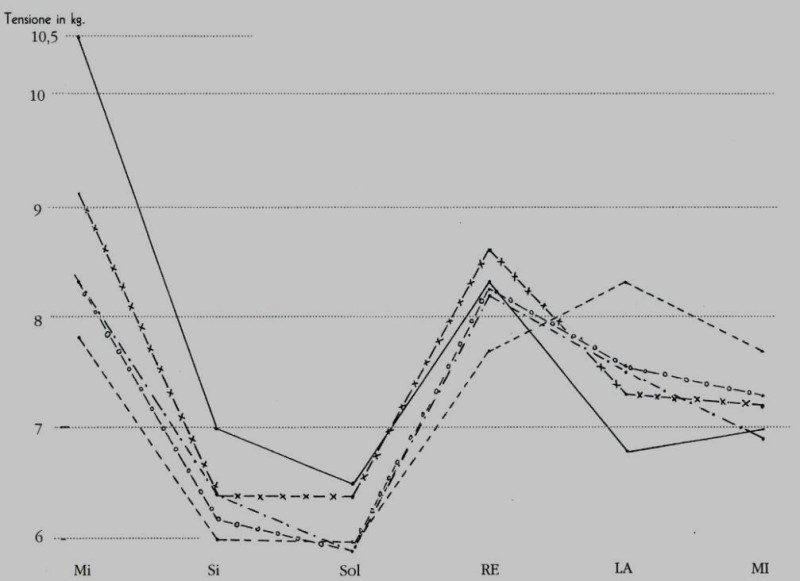
Tension profile of the six strings across five different brands.
Why is the tension profile not equal?
The most common way to assess the tension of guitar strings is to press them with the right-hand fingers near the bridge: a set is judged well-made when every string offers the same resistance to the pressing finger. One would therefore conclude that they have all been calculated at the same working tension.
But this kind of evaluation is in fact a “tactile feeling” of tension, not the tension in kilograms or pounds proper, measurable with the right instruments. By a law of physics, two strings that produce the same lateral displacement under the same weight applied at the same point (in practice the pressing finger) also share the same tension in kilograms. This equality, however, does not coincide with the equality used in the calculation that determines the string diameters.
Stretching under load and the loss of diameter
The reason is simple: under tension strings stretch (this is most evident in the many turns of the tuning machine required to reach pitch), and stretching reduces the diameter. As the diameter shrinks the working tension drops proportionally below the value originally set in the calculation. The amount of stretching is not the same for every string: it is largest for the first string, less for the second and much less for the third — everyone knows that tuning the first string requires many more turns than the third. As a result, a set calculated for equal tension would become completely unbalanced once brought up to pitch.
This is unavoidable: a guitar mounts strings of physically heterogeneous nature (the first three are synthetic monofilament; the basses combine a synthetic core with a metal winding), of different diameters and occupying specific positions on the instrument that technicians describe through the “Working Index” (the product of frequency and vibrating length). Achieving a uniform tactile tension across the strings is therefore much more complex in practice than in the theoretical calculation, where the tension parameter is held constant.
Scaled tension as a compensation process
Scaled tension is thus a compensation process carefully studied by the stringmaker to neutralise, string by string, the loss of diameter caused by stretching under load: once stably tuned each string will reduce in its own percentage until reaching a working tension equal to the others. The condition is then met in which, when pressed with a finger, they show the same deflection. In practical terms, if the first string drops experimentally by 2%, then its diameter must be enlarged by 2% in the original calculation, and so on for every other string.
Synthetic strings, gut and intonation on the upper frets
In real-world practice the slope of the tension profile must be made even steeper: this exaggeration of the scaling is intended to better counter the pitch rise of the larger strings (second and especially third) on the upper and uppermost frets. With historical gut strings such additional scaling was unnecessary, because the larger strings were automatically made with higher twist (and are therefore more elastic), whereas synthetic monofilaments all share the same specific stretch coefficient. The remedy, with synthetic strings, has nevertheless not proved fully sufficient: a series of compensating adjustments to the bridge saddle is still often required, the most common being its inclination.
For an in-depth discussion go here
Mimmo Peruffo, 2010